
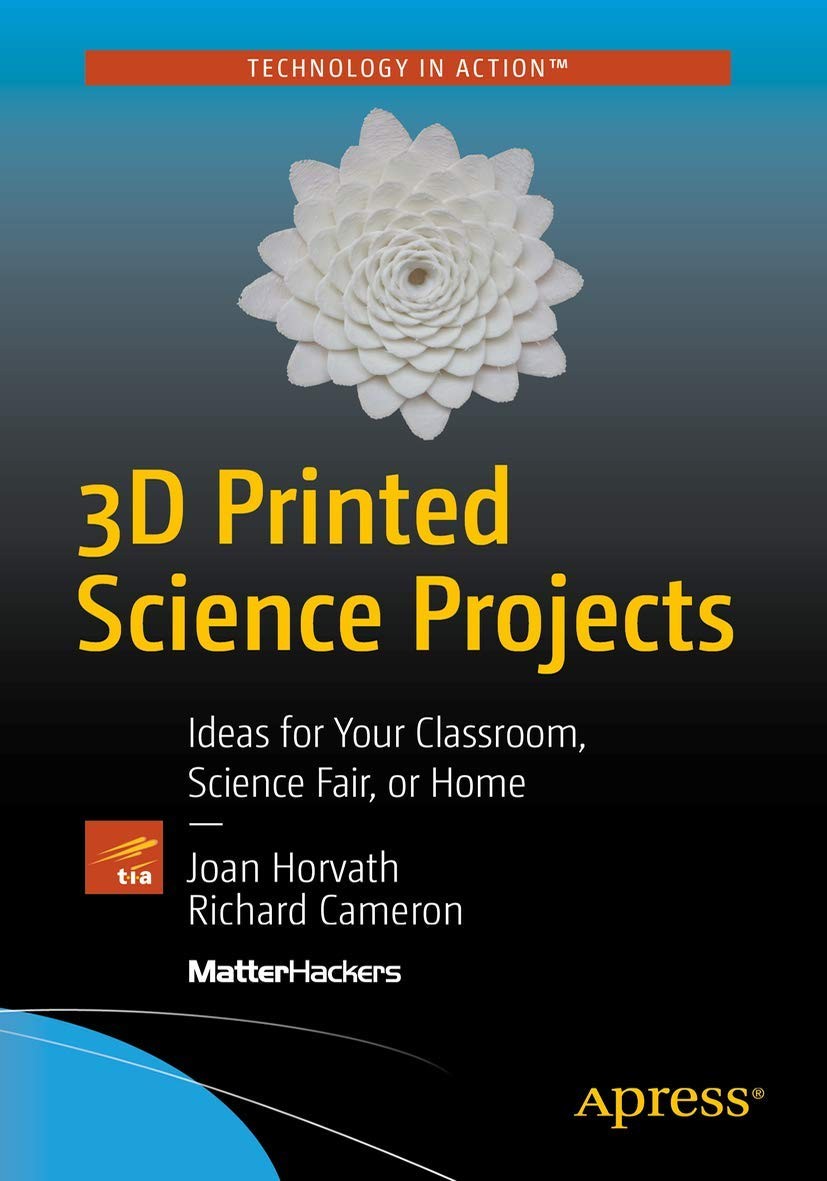
3D Printed Science Projects: Ideas for Your Classroom, Science Fair or Home by Joan Horvath – A Practical Guide to STEM
Inclusive of all applicable taxes. FREE shipping on all orders.
Available Offers
- 🚚Free Delivery — Free shipping on all orders
- 💵Cash on Delivery — Pay when your order arrives
- ↩️15-Day Easy Returns — Hassle-free return policy
- 🔒Cash on Delivery — Pay safely when your order arrives
Check Delivery
Product Description
Introduction
Imagine holding a working model of a DNA helix, a miniature wind turbine, or a geometric proof in the palm of your hand. 3D Printed Science Projects: Ideas for Your Classroom, Science Fair or Home by Joan Horvath is a hands-on guide that bridges the gap between abstract scientific concepts and tangible, printable models. Designed for Indian educators, parents, and curious students, this book transforms a 3D printer into a powerful teaching tool that makes science come alive. Whether you are preparing for a school science fair, looking for engaging classroom demonstrations, or simply want to explore STEM at home, this book provides a treasure trove of ready-to-adapt projects that go far beyond simple scaling or decoration.
Book Overview
Published by Apress, this hardcover volume is a practical resource for anyone who wants to integrate 3D printing into science education. Joan Horvath, a renowned technologist and educator, has carefully designed each project to embed scientific principles directly into the geometry of the model. Unlike generic 3D files, these models are built to teach — from the forces acting on a bridge to the growth patterns in botany. The book covers eight core topics, each with step-by-step instructions, clear explanations of the underlying science, and suggestions for customisation. It is ideal for students from kindergarten to graduate school, making it a versatile addition to any Indian school library, STEM lab, or home workshop.
Key Highlights
- Science-Integrated Models: Every project is designed to illustrate a fundamental concept in physics, mathematics, chemistry, biology, or engineering, not just to look cool.
- Customisable for All Levels: Beginners can print the base models, while advanced students can modify parameters to explore deeper questions and create unique science fair entries.
- Ready for Indian Classrooms: Projects align with common curriculum topics like geometry, simple machines, and plant biology, making them easy to adopt for CBSE, ICSE, or state board syllabi.
- Complete Project Guidance: Each chapter includes printing tips, material suggestions, troubleshooting advice, and ideas for extending the project into a full-fledged investigation.
- Science Fair Focus: Dedicated sections help students frame hypotheses, collect data, and present their findings — perfect for regional and national science fairs in India.
Inside the Book
The book is organised into eight thematic chapters, each centred on a specific scientific domain. You will find detailed instructions for printing and assembling models such as a working pendulum, a set of polyhedra for geometry lessons, a model of a plant leaf to study surface area and transpiration, and a chemical molecular structure kit. Every project is accompanied by clear photographs, diagrams, and print settings. The author also explains how to use free or low-cost software to tweak designs, so you can adapt the models to your own experiments. A comprehensive resources section lists websites, videos, and further reading for deeper exploration.
Key Topics
- Physics: Pendulums, levers, gears, and bridges to demonstrate forces, motion, and structural engineering.
- Mathematics: 3D geometric shapes, fractals, and tessellations for hands-on learning of angles, volume, and symmetry.
- Botany: Models of plant cells, leaves, and root systems to explore biology and ecology.
- Chemistry: Molecular models and crystal structures for understanding atomic bonding.
- Engineering: Simple machines like pulleys and inclined planes, plus design challenges for budding engineers.
- Earth Science: Topographic maps and geological formations to study landforms and erosion.
Reader Benefits
By using this book, you will gain the confidence to integrate 3D printing into your teaching or learning routine. Teachers can create reusable classroom aids that make complex topics visual and interactive. Students will develop problem-solving skills, creativity, and a deeper understanding of science through trial and error. Parents can enjoy quality learning time with their children, turning a home printer into a centre for discovery. The book also saves you hours of searching for reliable, educational 3D models online — everything you need is curated and explained in one place.
Learning Outcomes
- Understand Core Science Concepts: Grasp abstract ideas like gravity, photosynthesis, and molecular geometry by seeing and touching them.
- Develop 3D Design Skills: Learn to modify existing models using beginner-friendly software, building digital literacy.
- Master the Scientific Method: Practice forming hypotheses, conducting experiments, and analysing results through project-based learning.
- Enhance Presentation Abilities: Create impressive physical models for science fairs, class projects, or open-house displays.
- Foster Independent Thinking: Encourage curiosity and self-directed exploration by customising projects to answer your own questions.
Who Should Read
This book is written for a broad audience. School teachers in India looking for innovative ways to teach science and mathematics will find ready-made lesson companions. Students from Class 6 to undergraduate level can use it for projects, assignments, or personal enrichment. Parents who homeschool or want to supplement school learning with hands-on activities will love the structured approach. STEM club coordinators and science fair mentors will discover a goldmine of ideas. Even hobbyists new to 3D printing will appreciate the clear guidance and focus on education.
About the Author
Joan Horvath is a co-founder of Nonscriptum LLC, a consulting firm that helps educators and businesses adopt 3D printing and maker technologies. She holds a degree in aeronautics and astronautics from MIT and has worked at NASA's Jet Propulsion Laboratory and at various technology companies. Joan is a prolific author and speaker, passionate about making science and engineering accessible through hands-on projects. Her practical, no-nonsense writing style ensures that even complex ideas are easy to understand and implement.
About the Publisher
Apress is a leading publisher of technology and professional development books, with a strong focus on practical guides for programmers, engineers, and educators. Known for its high-quality content and expert authors, Apress brings you titles that are both authoritative and accessible. This book continues that tradition by offering a resource that is as useful in a Mumbai classroom as it is in a Bengaluru makerspace.
Conclusion
3D Printed Science Projects is more than just a collection of printable files — it is a complete educational toolkit that empowers Indian students and educators to explore science in three dimensions. By turning abstract concepts into physical objects, it sparks curiosity, deepens understanding, and prepares learners for a future where digital fabrication and STEM literacy go hand in hand. Whether you are a teacher planning your next lesson, a student aiming for the science fair trophy, or a parent wanting to inspire a love for learning, this book is your gateway to a world of hands-on discovery. Add it to your library today and start building, learning, and innovating.
Quick Summary
3D Printed Science Projects by Joan Horvath is an essential resource for educators, parents, and students who want to bring STEM concepts to life through 3D printing. The book presents eight customizable projects that cover mathematics, physics, botany, chemistry, and engineering, making abstract ideas tangible and engaging. Each project is designed to be a starting point for exploration, encouraging students to modify and experiment. The book includes science fair suggestions, extra credit ideas, and extensive references for further learning. It is suitable for learners from kindergarten to graduate school, with projects that can be scaled in complexity. For Indian readers, this book offers a practical way to integrate hands-on technology into the classroom or home, supporting the growing emphasis on STEM education. By purchasing from Bookshops.in, you get a trusted, high-quality physical copy delivered to your doorstep, along with the assurance of a premium Indian bookstore experience.
Book Highlights
Book Specifications
| ISBN-13 | 9781484213247 |
| ISBN-10 | 1484213246 |
| Publisher | Apress |
| Language | English |
| Dimensions | 15.49 x 1.3 x 23.5 cm |
| Weight | 431 g |
| Category | Graphics & Visualization › Computer Aided Design (CAD) |
| Genre | Education & Technology |
| Reading Age | 12+ |
| Original Language | English |
Frequently Asked Questions
What is this book about?
Who is the author?
Is prior 3D printing experience needed?
What age group is this book for?
Can I use these projects for a science fair?
What subjects are covered?
Are the models ready to print?
Is this book suitable for Indian schools?
Does the book include resources for further learning?
Can I use this book without a 3D printer?
How many projects are in the book?
Is the book hardcover?
What is the ISBN?
Where can I buy this book in India?
Does the book include digital files?
Readers Also Search For
Customers Also Bought
Computer Science
Spring 2.5 Aspect Oriented Programming (English, Massimiliano Dess� | Massimiliano Dessi)

Computer Science
Asterisk 1.4 - the Professional's Guide (English, Colman Carpenter | David Duffett | Nik Middleton)

Computer Science
Advances In Natural Language Processing: 4th International Conference, Estal 2004, Alicante, Spain, October 20-22, 2004. Proceedings: 3230 (Lecture Notes in Computer Science)
Computer Science
Multimedia, Communication and Computing Application: Proceedings of the 2014 International Conference on Multimedia, Communication and Computing ... 2014), Xiamen, China, October 16-17, 2014
Computer Science
Cases on Database Technologies and Applications (Cases on Information Technology Series)
Computer Science
ASP.Net 3.5 Social Networking (English, Andrew Siemer)
Related Products
View AllComputer Science
Spring 2.5 Aspect Oriented Programming (English, Massimiliano Dess� | Massimiliano Dessi)
Computer Science
Asterisk 1.4 - the Professional's Guide (English, Colman Carpenter | David Duffett | Nik Middleton)
Computer Science
Advances In Natural Language Processing: 4th International Conference, Estal 2004, Alicante, Spain, October 20-22, 2004. Proceedings: 3230 (Lecture Notes in Computer Science)
Computer Science
Multimedia, Communication and Computing Application: Proceedings of the 2014 International Conference on Multimedia, Communication and Computing ... 2014), Xiamen, China, October 16-17, 2014
Computer Science
Cases on Database Technologies and Applications (Cases on Information Technology Series)
Computer Science