
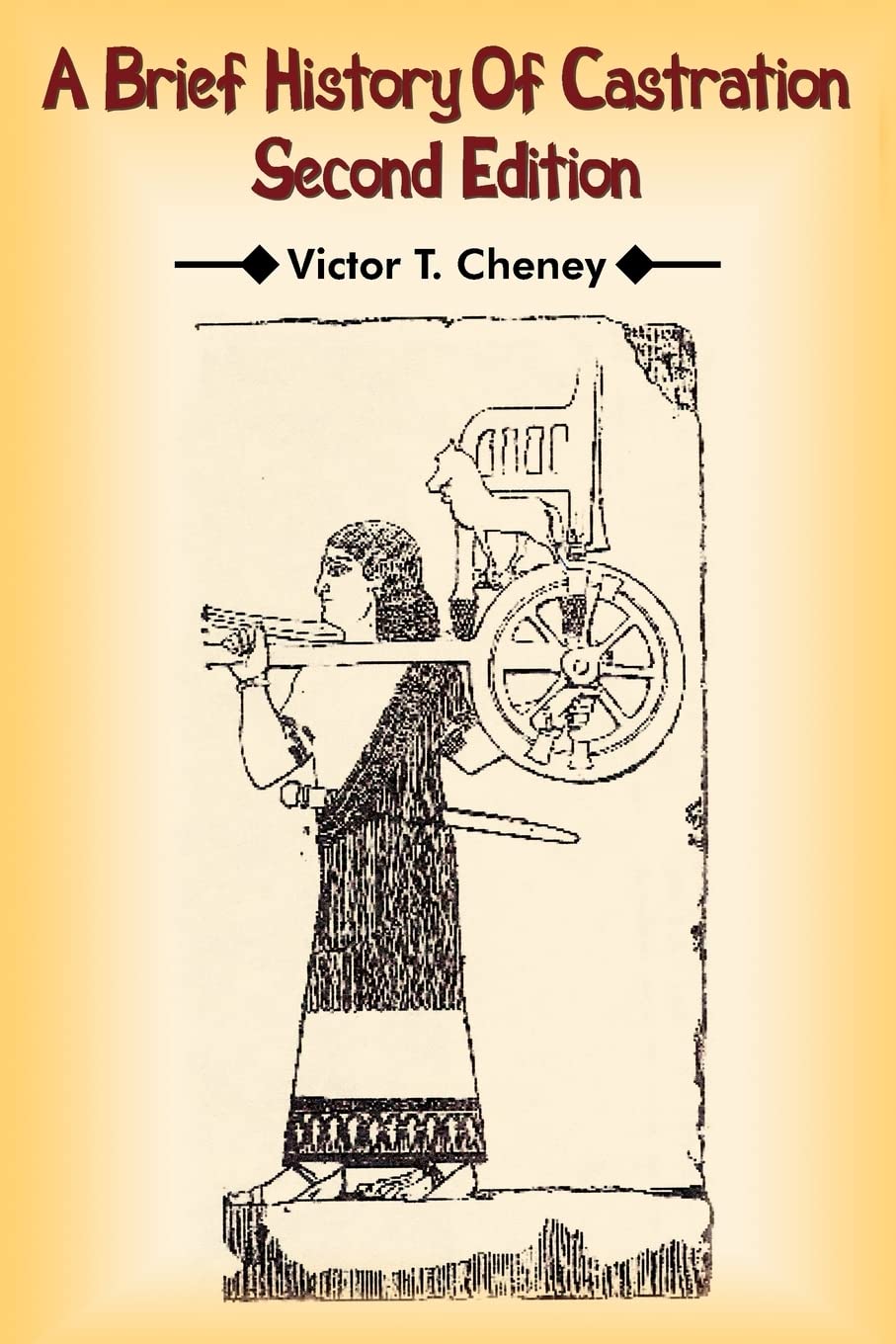
A Brief History Of Castration: A Detailed Historical Account by Victor T. Cheney
Inclusive of all applicable taxes. FREE shipping on all orders.
Available Offers
- 🚚Free Delivery — Free shipping on all orders
- 💵Cash on Delivery — Pay when your order arrives
- ↩️15-Day Easy Returns — Hassle-free return policy
- 🔒Cash on Delivery — Pay safely when your order arrives
Check Delivery
Product Description
Introduction
In the vast landscape of human history, few subjects are as provocative, misunderstood, and historically significant as the practice of castration. Victor T. Cheney’s A Brief History Of Castration: Second Edition offers a meticulously researched and unflinching look at a practice that has shaped societies, religions, economies, and even the arts across centuries. This hardcover edition, published by Authorhouse, is an essential addition for any serious student of history, anthropology, or sociology. Cheney peels back layers of taboo to reveal how castration influenced everything from imperial governance in China to the golden age of opera in Italy. Written with scholarly rigor and accessible prose, this book challenges readers to confront uncomfortable truths about power, gender, and human cruelty.
Book Overview
A Brief History Of Castration: Second Edition is not merely a chronological account; it is a deep dive into the cultural, medical, and social implications of a procedure that has been both feared and revered. Cheney traces the practice from ancient civilizations—where it was used to create loyal servants, eunuch guards, and even religious figures—through the Middle Ages, into the Renaissance, and up to modern times. The second edition expands on the original with updated research, a comprehensive index, and a glossary of terms that demystifies the subject for the curious reader. The book reveals startling facts: that castrated males often lived longer than their unaltered counterparts, that the practice was integral to the functioning of harems and imperial courts, and that it was once a common ‘solution’ for certain medical and social problems. Cheney’s work is a testament to the idea that understanding the darkest corners of history illuminates the present.
Key Highlights
- Comprehensive Index and Glossary: A five-page index and two-page glossary make navigation and comprehension easy for researchers and casual readers alike.
- Global Perspective: Covers castration practices in ancient Rome, China, the Arab world, India, and Europe, showing how different cultures used the procedure for distinct purposes.
- Medical and Social Insights: Explores the surprising health benefits (such as increased lifespan) alongside the immense risks and ethical questions.
- Cultural Impact: Examines the role of castrati in Italian opera, the creation of eunuch bureaucrats in China, and the use of castrated slaves in the Ottoman Empire.
- Updated Research: The second edition includes new findings and footnotes that aid serious historical inquiry.
Inside the Book
Readers will find a well-structured narrative that moves from the prehistoric origins of castration to its modern-day manifestations. Cheney dedicates chapters to the physiological effects of the procedure—both intended and unintended—and how different societies justified it. The book includes detailed accounts of the lives of famous eunuchs, the surgical techniques used (often with terrifyingly primitive tools), and the psychological impact on individuals. The glossary helps readers understand terms like ‘emasculation,’ ‘orchidectomy,’ and ‘spay,’ while the index allows for quick reference to specific cultures or time periods. Each chapter is supported by numerous footnotes that cite primary and secondary sources, making this a credible resource for academic work.
Key Topics
- Ancient practices in Mesopotamia, Egypt, and India
- The role of eunuchs in Chinese imperial courts and treasuries
- Castration in the Islamic world: harem guards and slave trade
- European castrati: from choirboys to opera stars
- Medical castration for health, punishment, and religious reasons
- The psychological and social status of eunuchs across cultures
- Modern parallels: chemical castration and sex reassignment surgery
Reader Benefits
This book offers Indian readers a rare opportunity to understand a global historical phenomenon that has often been ignored in mainstream education. It encourages critical thinking about how societies control bodies—especially male bodies—for political, economic, and aesthetic ends. Students of history will gain a nuanced perspective on how power structures like the Mughal, Ottoman, and Chinese empires functioned. The book also serves as a cautionary tale about the extremes of human ingenuity and cruelty. For writers, researchers, and curious minds, it provides a wealth of primary material and thought-provoking analysis that can inspire further study or creative work.
Learning Outcomes
- Understand the historical evolution of castration from ancient to modern times
- Analyze the cultural and political motivations behind the practice in different civilizations
- Recognize the medical and social consequences of castration for individuals and societies
- Critically evaluate the ethical dimensions of body modification and control
- Connect historical practices to contemporary debates on gender, identity, and medical ethics
Who Should Read
This book is ideal for undergraduate and postgraduate students of history, anthropology, sociology, and gender studies. It is also highly recommended for medical history enthusiasts, writers researching historical fiction, and general readers with a taste for the unusual and the profound. Indian readers interested in the parallels between Indian history (such as the hijra community or Mughal eunuchs) and global practices will find this book particularly enlightening. It is not for the faint-hearted but for those who seek a deeper, unvarnished understanding of human civilization.
About the Author
Victor T. Cheney is a historian and author known for his fearless exploration of taboo subjects. With a background in medical history and cultural anthropology, Cheney has spent decades researching the intersections of body, power, and society. His work is characterized by meticulous research, clear writing, and a commitment to presenting facts without sensationalism. A Brief History Of Castration: Second Edition is his most renowned work, praised by scholars for its thoroughness and accessibility. Cheney’s ability to handle sensitive topics with academic integrity makes him a trusted voice in the field.
About the Publisher
Authorhouse is a respected independent publishing house that specializes in bringing scholarly and niche works to a global audience. Known for supporting authors who tackle unconventional subjects, Authorhouse ensures that books like this one are produced with high editorial standards and durable hardcover binding—perfect for libraries and long-term reference. Their commitment to preserving marginal histories aligns with their mission to broaden the horizons of readers everywhere.
Conclusion
A Brief History Of Castration: Second Edition is more than a history book; it is a mirror held up to humanity’s complex relationship with the body, power, and control. Victor T. Cheney has crafted a work that is both scholarly and gripping, shedding light on a practice that has quietly shaped the world. For Indian readers, it offers a chance to connect global histories with local understandings—such as the legacy of eunuchs in South Asian courts. This hardcover edition from Authorhouse is a durable, well-indexed resource that belongs on the shelf of every serious history enthusiast. Order your copy today from Bookshops.in and step into a world of startling revelations.
Quick Summary
A Brief History Of Castration by Victor T. Cheney is a comprehensive historical study that uncovers the surprising and often overlooked practice of castration across world cultures. From the castrati of Italian opera to the eunuch treasurers of Chinese emperors and the harem guards in Arab lands, this book reveals how castration served political, religious, musical, and social purposes. The second edition includes a five-page index, a two-page glossary, and extensive footnotes, making it valuable for both casual readers and serious researchers. Readers will learn about the medical dangers of the operation in ancient times, the cultural rationales behind it, and its lasting impact on history. This book is ideal for history enthusiasts, students, and anyone curious about unusual historical practices. By purchasing from Bookshops.in, you get a high-quality hardcover copy delivered across India, supporting a trusted local bookstore that offers competitive prices and reliable service.
Book Highlights
Book Specifications
| ISBN-13 | 9781420897203 |
| ISBN-10 | 1420897209 |
| Publisher | AuthorHouse |
| Language | English |
| Dimensions | 15.24 x 1.63 x 22.86 cm |
| Weight | 227 g |
| Country | India |
| Category | Special Topics › History |
| Genre | Nonfiction |
| Reading Age | Adult |
| Original Language | English |
Frequently Asked Questions
What is A Brief History Of Castration about?
Who is the author of this book?
Does the book cover castration in India?
What is the reading level of this book?
Is this book available in hardcover?
Does the book discuss the medical aspects of castration?
What cultures are covered in the book?
Can I use this book for a college history paper?
Is there any mention of castration in modern times?
What is the price of this book?
What is the ISBN of this book?
Readers Also Search For
Related Products
View All
History
The Information Revolution: Transforming the World Through Technology (World History)

History
Human Nature and the French Revolution: From the Enlightenment to the Napoleonic Code: 3 (Polygons: Cultural Diversities and Intersections, 3)
History
The Unmaking of Home in Contemporary Art (Cultural Spaces)

History
Handbook to Life in Medieval and Early Modern Japan | by William E. Deal | Oxford University Press | by William E. Deal | Oxford University Press | by William E. Deal | Oxford University Press | by William E. Deal | Oxford University Press | by William E. Deal | Oxford University Press | by William E. Deal | Oxford University Press | by William E. Deal | Oxford University Press | by William E. Deal | Oxford University Press | by William E. Deal | Oxford University Press | by William E. Deal | Ox

History
The Narrators of Barbarian History (A.D. 550-800) | by Walter Goffart | University of Notre Dame Press | by Walter Goffart | University of Notre Dame Press | by Walter Goffart | University of Notre Dame Press | by Walter Goffart | University of Notre Dame Press | by Walter Goffart | University of Notre Dame Press | by Walter Goffart | University of Notre Dame Press | by Walter Goffart | University of Notre Dame Press | by Walter Goffart | University of Notre Dame Press | by Walter Goffart | Univ

History