
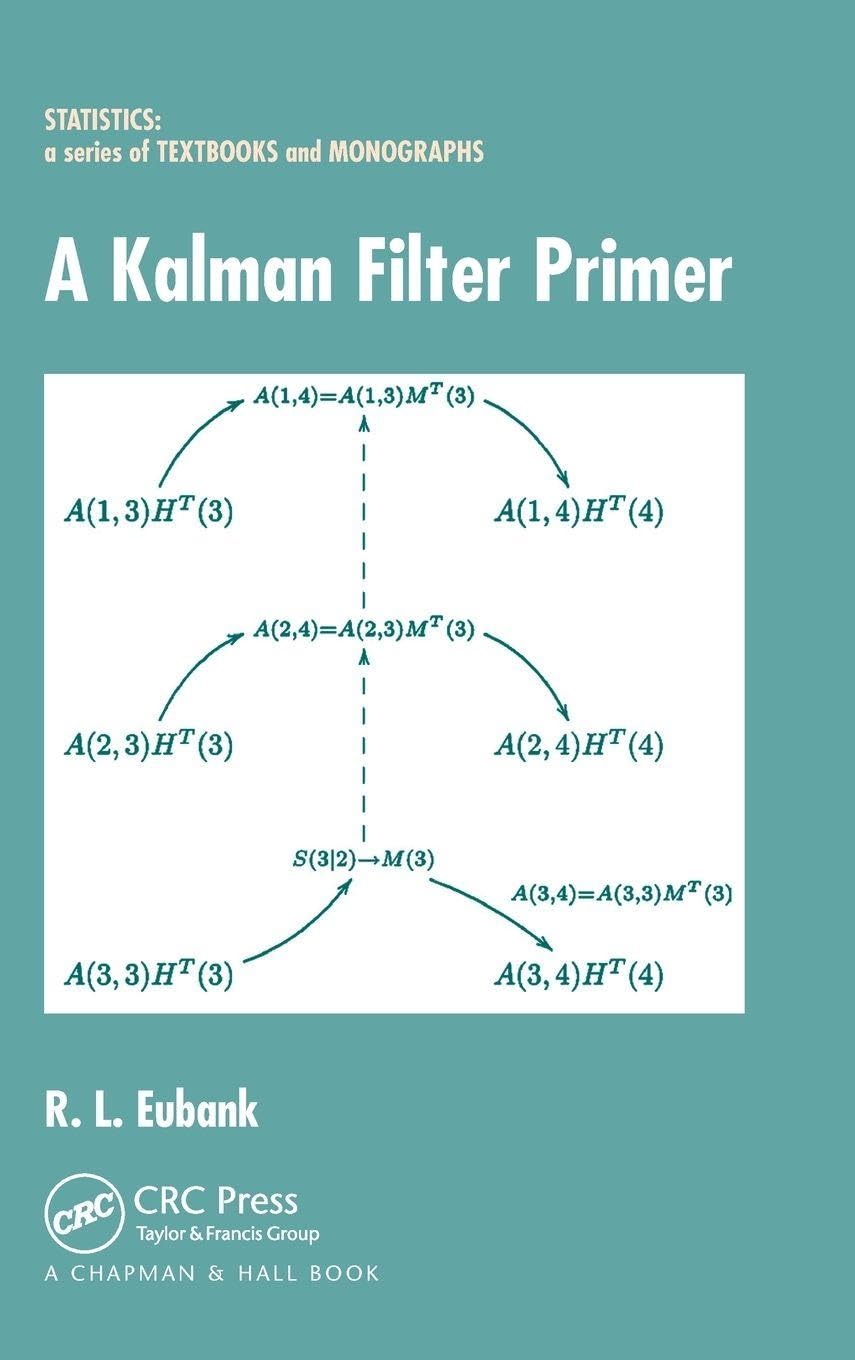
A Kalman Filter Primer: Discrete-Time State Estimation Using Least-Squares and Matrix Methods by Randall L. Eubank
Inclusive of all applicable taxes. FREE shipping on all orders.
Available Offers
- 🚚Free Delivery — Free shipping on all orders
- 💵Cash on Delivery — Pay when your order arrives
- ↩️15-Day Easy Returns — Hassle-free return policy
- 🔒Cash on Delivery — Pay safely when your order arrives
Check Delivery
Product Description
Introduction
A Kalman Filter Primer by Randall L. Eubank is an essential resource for students, researchers, and professionals who want to master the discrete-time Kalman filter from the ground up. Published by Chapman and Hall/CRC, this hardcover edition offers a mathematically rigorous yet accessible pathway into one of the most widely used estimation algorithms in control systems, signal processing, and beyond. Unlike many texts that rely heavily on Bayesian reasoning, this book takes a refreshingly direct approach using least-squares theory and classical matrix methods, making it ideal for Indian readers seeking a solid theoretical foundation.
Book Overview
This book systematically builds the Kalman filter recursions from first principles, using the Cholesky decomposition as a unifying tool. Eubank carefully guides readers through the motivation behind each step, including the critical choice of the initializing state vector. The text is deliberately concise and focused, stripping away unnecessary complexity to reveal the core ideas. Pseudo-code algorithms are provided for the various recursion forms, bridging the gap between theory and practical implementation. Whether you are a postgraduate student in engineering or a working professional in aerospace or finance, this primer equips you with the clarity needed to apply the Kalman filter confidently.
Key Highlights
- Mathematically rigorous approach – Develops the Kalman filter using least-squares and matrix methods, not Bayesian statistics.
- Cholesky decomposition as a central tool – Simplifies derivations and helps demystify the filter’s inner workings.
- Pseudo-code for key algorithms – Makes theory directly translatable to code in languages like MATLAB or Python.
- Clear motivation for initialization – Explains why the state vector is chosen as it is, a point often glossed over in other texts.
- No-frills, focused content – Avoids distracting tangents, keeping the reader firmly on the learning path.
- Hardcover edition – Durable and suitable for long-term reference in libraries or personal collections.
Inside the Book
The book is structured to take the reader from the basics of linear estimation to the full discrete-time Kalman filter recursions. Early chapters establish the necessary mathematical background, including orthogonal projections and the role of the Cholesky decomposition. Subsequent chapters derive the prediction and update steps, discuss filter stability, and explore extensions like the information filter. Each chapter includes worked examples and exercises that reinforce understanding. The pseudo-code algorithms are presented in a language-agnostic format, making them easy to adapt to any programming environment.
Key Topics
- Least-squares estimation – The foundation on which the Kalman filter is built.
- Orthogonal projections and the Gram–Schmidt process – Geometric intuition behind estimation.
- Cholesky decomposition – How it simplifies the derivation of filter recursions.
- Discrete-time Kalman filter recursions – Prediction, update, and covariance propagation.
- Initialization of the state vector – Practical and theoretical considerations.
- Information filter formulation – An alternative for high-dimensional systems.
- Stability and convergence – Conditions for reliable filter performance.
Reader Benefits
- Deep conceptual clarity – Understand not just the ‘how’ but the ‘why’ behind every equation.
- Practical coding readiness – Pseudo-code algorithms accelerate your ability to implement filters.
- Strong foundation for advanced topics – Prepares you for nonlinear extensions like the extended or unscented Kalman filter.
- Self-contained learning – Requires only basic linear algebra and probability; no prior knowledge of filtering assumed.
- Indian academic context – Suitable for courses in electrical engineering, computer science, statistics, and applied mathematics at Indian universities.
Learning Outcomes
By the end of this book, you will be able to: derive the discrete-time Kalman filter recursions from first principles; implement the filter using pseudo-code in your language of choice; explain the role of the Cholesky decomposition in simplifying the estimation process; correctly initialize the state vector for a given system; analyze the stability and convergence properties of the filter; and adapt the basic algorithm to variants like the information filter. These outcomes directly support coursework and research in control theory, robotics, navigation, and econometrics.
Who Should Read
This book is designed for graduate and advanced undergraduate students in engineering, physics, statistics, and applied mathematics. It is equally valuable for researchers and industry professionals working in areas such as autonomous systems, aerospace engineering, financial modeling, and sensor fusion. Instructors looking for a clear, theory-first textbook for a course on estimation will find it ideal. The mathematical level is accessible to anyone comfortable with linear algebra and basic probability, making it suitable for self-study as well.
About the Author
Randall L. Eubank is a distinguished academic known for his contributions to statistical computing, nonparametric regression, and time series analysis. He has authored several influential textbooks that combine theoretical rigor with practical insights. His writing style is clear and methodical, making complex topics approachable for learners at all levels. Professor Eubank’s expertise in matrix methods and linear models shines through in this primer, ensuring that readers gain a deep and lasting understanding of the Kalman filter.
About the Publisher
Chapman and Hall/CRC is a premier publisher of scientific and technical books, renowned for its high-quality titles in mathematics, statistics, engineering, and computer science. With a legacy spanning decades, the publisher is trusted by academics and professionals worldwide. This hardcover edition reflects their commitment to producing durable, authoritative resources that stand the test of time. For Indian readers, Chapman and Hall/CRC books are widely available through Bookshops.in and are often prescribed in top Indian university curricula.
Conclusion
A Kalman Filter Primer is more than just a textbook—it is a carefully crafted guide that demystifies one of the most important algorithms in modern engineering and science. With its unique least-squares perspective, emphasis on the Cholesky decomposition, and practical pseudo-code, this book provides the clarity and depth that serious learners need. Whether you are preparing for exams, embarking on research, or solving real-world estimation problems, this primer will be an invaluable companion. Order your hardcover copy from Bookshops.in today and start building your expertise in this foundational topic.
Quick Summary
A Kalman Filter Primer by Randall L. Eubank is a rigorous, no-frills introduction to the discrete-time Kalman filter. Unlike many texts that adopt a Bayesian viewpoint, this book builds the filter from first principles using least-squares and classical matrix methods, including Cholesky decomposition. It is designed for graduate students, researchers, and practicing engineers in control systems, signal processing, and related fields who need a deep understanding of how the Kalman filter works internally. Readers will learn to derive filter recursions step by step, grasp the role of covariance matrices and innovations, and gain the mathematical foundation to implement or extend the filter in practical applications. This book stands out for its clarity and mathematical precision, making it an essential resource for anyone serious about state estimation. Purchase your copy from Bookshops.in, India’s trusted online bookstore, to get a genuine hardcover edition delivered to your doorstep.
Book Highlights
Book Specifications
| ISBN-13 | 9780824723651 |
| ISBN-10 | 0824723651 |
| Publisher | Chapman and Hall/CRC |
| Language | English |
| Dimensions | 10.8 x 1.27 x 16.51 cm |
| Weight | 204 g |
| Country | India |
| Category | Electrical & Electronic Engineering › Signal Processing |
| Genre | Nonfiction |
| Original Language | English |
Frequently Asked Questions
What is a Kalman filter?
Who is the author of A Kalman Filter Primer?
What is the approach of this book?
Is this book suitable for beginners?
Does the book cover continuous-time Kalman filters?
What mathematical prerequisites are needed?
How is this book different from other Kalman filter books?
Can this book help with practical implementation?
Is there any software or code included?
Who should read this book?
Does the book cover nonlinear Kalman filters like EKF?
What is the price of this book at Bookshops.in?
Is this book available in paperback?
Readers Also Search For
Customers Also Bought

McFarland & Company
Playing with the Guys | by Marc A. Ouellette | Matthew Wilhelm Kapell | McFarland & Company | by Marc A. Ouellette | Matthew Wilhelm Kapell | McFarland & Company | by Marc A. Ouellette | Matthew Wilhelm Kapell | McFarland & Company | by Marc A. Ouellette | Matthew Wilhelm Kapell | McFarland & Company | by Marc A. Ouellette | Matthew Wilhelm Kapell | McFarland & Company | by Marc A. Ouellette | Matthew Wilhelm Kapell | McFarland & Company | by Marc A. Ouellette | Matthew W

Rowman & Littlefield Publishers
Joss Whedon's Dollhouse: Confounding Purpose, Confusing Identity (Science Fiction Television)

State University of New York Press
Mexico Unmanned: The Cultural Politics of Masculinity in Mexican Cinema (SUNY series in Latin American Cinema)

McFarland & Company
Valley Forge to Monmouth | by Jim Stempel | McFarland & Company | by Jim Stempel | McFarland & Company | by Jim Stempel | McFarland & Company | by Jim Stempel | McFarland & Company | by Jim Stempel | McFarland & Company | by Jim Stempel | McFarland & Company | by Jim Stempel | McFarland & Company | by Jim Stempel | McFarland & Company | by Jim Stempel | McFarland & Company | by Jim Stempel | McFarland & Company | by Jim Stempel | McFarland & Company |

University of Toronto Press
Structures of Feeling in Seventeenth-Century Cultural Expression (UCLA Center Clark Library)

McFarland & Company
Welcome to Arkham Asylum | by Sharon Packer | Daniel R. Fredrick | McFarland & Company | by Sharon Packer | Daniel R. Fredrick | McFarland & Company | by Sharon Packer | Daniel R. Fredrick | McFarland & Company | by Sharon Packer | Daniel R. Fredrick | McFarland & Company | by Sharon Packer | Daniel R. Fredrick | McFarland & Company | by Sharon Packer | Daniel R. Fredrick | McFarland & Company | by Sharon Packer | Daniel R. Fredrick | McFarland & Company | by Sharon P
Related Products
View All
Chapman and Hall/CRC
Information Discovery on Electronic Health Records | by Vagelis Hristidis | Chapman and Hall/CRC | by Vagelis Hristidis | Chapman and Hall/CRC | by Vagelis Hristidis | Chapman and Hall/CRC | by Vagelis Hristidis | Chapman and Hall/CRC | by Vagelis Hristidis | Chapman and Hall/CRC | by Vagelis Hristidis | Chapman and Hall/CRC | by Vagelis Hristidis | Chapman and Hall/CRC | by Vagelis Hristidis | Chapman and Hall/CRC | by Vagelis Hristidis | Chapman and Hall/CRC | by Vagelis Hristidis | Chapman an

Chapman and Hall/CRC
Discrete and Continuous Fourier Transforms | by Eleanor Chu | Chapman and Hall/CRC | by Eleanor Chu | Chapman and Hall/CRC | by Eleanor Chu | Chapman and Hall/CRC | by Eleanor Chu | Chapman and Hall/CRC | by Eleanor Chu | Chapman and Hall/CRC | by Eleanor Chu | Chapman and Hall/CRC | by Eleanor Chu | Chapman and Hall/CRC | by Eleanor Chu | Chapman and Hall/CRC | by Eleanor Chu | Chapman and Hall/CRC | by Eleanor Chu | Chapman and Hall/CRC | by Eleanor Chu | Chapman and Hall/CRC | by Eleanor Chu

Chapman and Hall/CRC
Differential Forms on Singular Varieties | by Vincenzo Ancona | Bernard Gaveau | Chapman and Hall/CRC | by Vincenzo Ancona | Bernard Gaveau | Chapman and Hall/CRC | by Vincenzo Ancona | Bernard Gaveau | Chapman and Hall/CRC | by Vincenzo Ancona | Bernard Gaveau | Chapman and Hall/CRC | by Vincenzo Ancona | Bernard Gaveau | Chapman and Hall/CRC | by Vincenzo Ancona | Bernard Gaveau | Chapman and Hall/CRC | by Vincenzo Ancona | Bernard Gaveau | Chapman and Hall/CRC | by Vincenzo Ancona | Bernard G

Chapman and Hall/CRC
Factoring Groups into Subsets | by Sandor Szabo | Arthur D. Sands | Chapman and Hall/CRC | by Sandor Szabo | Arthur D. Sands | Chapman and Hall/CRC | by Sandor Szabo | Arthur D. Sands | Chapman and Hall/CRC | by Sandor Szabo | Arthur D. Sands | Chapman and Hall/CRC | by Sandor Szabo | Arthur D. Sands | Chapman and Hall/CRC | by Sandor Szabo | Arthur D. Sands | Chapman and Hall/CRC | by Sandor Szabo | Arthur D. Sands | Chapman and Hall/CRC | by Sandor Szabo | Arthur D. Sands | Chapman and Hall/CR
Chapman and Hall/CRC
Impulsive Differential Equations (English, Drumi Bainov | Pavel Simeonov)
Chapman and Hall/CRC