
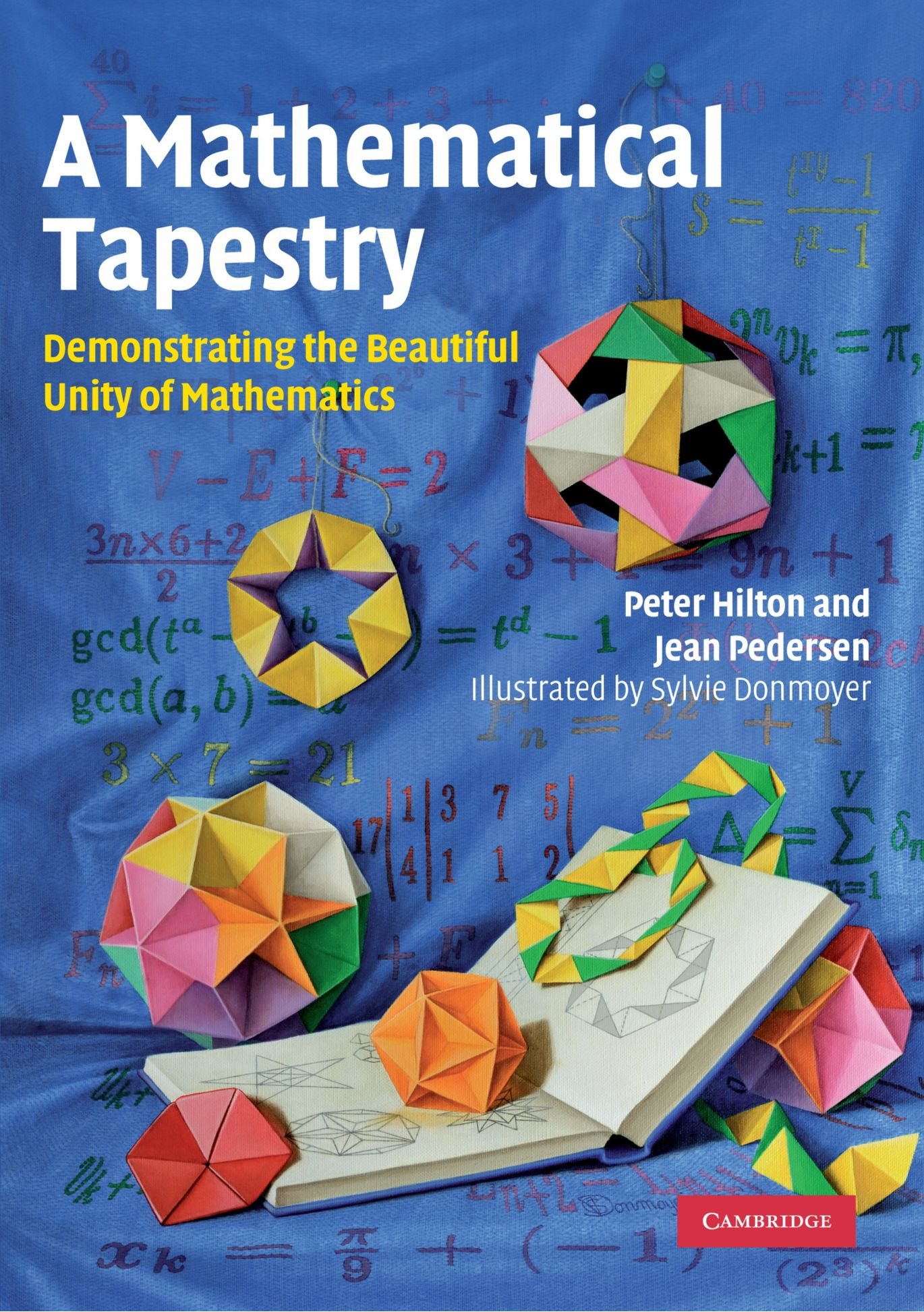
A Mathematical Tapestry: Demonstrating the Beautiful Unity of Mathematics by Peter Hilton – A Journey Through Number The
Inclusive of all applicable taxes. FREE shipping on all orders.
Available Offers
- 🚚Free Delivery — Free shipping on all orders
- 💵Cash on Delivery — Pay when your order arrives
- ↩️15-Day Easy Returns — Hassle-free return policy
- 🔒Cash on Delivery — Pay safely when your order arrives
Check Delivery
Product Description
Introduction
Mathematics is often seen as a collection of isolated branches—algebra, geometry, number theory, and combinatorics—each with its own language and rules. But what if a single, simple idea could weave them all into a seamless tapestry? This is exactly what Peter Hilton’s remarkable book, A Mathematical Tapestry: Demonstrating the Beautiful Unity of Mathematics, accomplishes. Published by Cambridge University Press, this 2010 hardcover volume invites readers on an eye-opening journey where paper folding becomes a gateway to profound mathematical truths. Whether you are a student in India preparing for competitive exams or a lifelong learner fascinated by patterns, this book will transform the way you see mathematics.
Book Overview
At its heart, A Mathematical Tapestry explores a deceptively simple geometric procedure: systematic paper folding. By folding a strip of paper in a specific way, you can construct a regular polygon with any number of sides. This elegant algorithm, far from being a mere craft, unlocks deep connections across number theory, polyhedral geometry, combinatorial geometry, and group theory. The book demonstrates how the same folding technique leads to proofs in number theory, answers questions about partitions of space, and even derives the volume of a regular tetrahedron using only basic arithmetic and elementary plane geometry. Each chapter builds on the last, revealing the hidden unity that binds diverse mathematical fields.
Key Highlights
- Unique hands-on approach: Uses paper folding as a primary tool to explore abstract concepts, making mathematics tangible and accessible.
- Interdisciplinary connections: Bridges number theory, geometry, combinatorics, and group theory through a single unifying idea.
- Clear, step-by-step instructions: Detailed illustrations guide you through constructing models, enabling self-discovery.
- Elegant proofs: Derives complex results, such as the volume of a regular tetrahedron, in just a few simple steps.
- Accessible to a wide audience: Requires only basic arithmetic and elementary plane geometry, making it suitable for students and enthusiasts alike.
Inside the Book
The book is structured to take you from a simple folding algorithm to profound mathematical insights. It begins with the basic technique of constructing polygons, then moves into applications in number theory—showing how the folding pattern relates to modular arithmetic and prime numbers. Next, it explores polyhedra, using folded models to understand Platonic solids and their properties. Combinatorial geometry comes alive as the folding method reveals partitions of space and tiling patterns. Finally, group theory is introduced, demonstrating how the symmetries of folded figures correspond to algebraic groups. Throughout, the author provides clear illustrations and exercises to reinforce understanding.
Key Topics
- Systematic paper-folding construction of regular polygons
- Number theory: connections to modular arithmetic and divisibility
- Polyhedral geometry: Platonic solids, Archimedean solids, and their properties
- Combinatorial geometry: space partitions, tilings, and tessellations
- Group theory: symmetry groups and their algebraic structures
- Volume derivation of regular tetrahedron using basic geometry
- Proofs and algorithms arising from geometric folding
Reader Benefits
- Deepens mathematical intuition: By physically folding paper, abstract concepts become concrete and memorable.
- Enhances problem-solving skills: The book trains you to see connections between seemingly unrelated topics.
- Boosts confidence in mathematics: Simple steps lead to sophisticated results, demystifying advanced ideas.
- Provides a recreational yet rigorous experience: Perfect for self-study or supplementary reading alongside formal courses.
- Encourages creative exploration: The hands-on nature sparks curiosity and personal discovery.
Learning Outcomes
By the end of this book, readers will be able to construct any regular polygon using a simple folding technique, understand how the same method yields number-theoretic proofs, analyse polyhedral structures through folded models, explore combinatorial partitions of space, and grasp fundamental group-theoretic concepts through geometric symmetries. More importantly, readers will develop a holistic view of mathematics as an interconnected discipline, where a single idea can illuminate multiple branches.
Who Should Read
- Undergraduate and postgraduate students in mathematics, physics, or engineering looking for a fresh perspective on core topics.
- High school students with a keen interest in mathematics who want to go beyond the textbook.
- Mathematics educators seeking innovative ways to teach geometry, number theory, or group theory.
- Recreational mathematicians and puzzle enthusiasts who enjoy hands-on exploration.
- Anyone curious about the beauty of mathematics and how simple ideas can lead to profound unity.
About the Author
Peter Hilton was a distinguished mathematician and educator, known for his work in algebraic topology, homological algebra, and mathematics education. He held professorships at several leading universities and authored numerous influential texts. His passion for making mathematics accessible and beautiful shines through in this book, which combines his deep expertise with a love for hands-on learning. Hilton’s writing is clear, engaging, and always focused on revealing the elegance of mathematical structures.
About the Publisher
Cambridge University Press is one of the world’s oldest and most respected academic publishers, with a rich history dating back to 1534. Known for producing authoritative works in science, mathematics, and the humanities, Cambridge University Press ensures that every title meets the highest standards of scholarship and clarity. This hardcover edition reflects their commitment to quality, with durable binding and clear typesetting that will last for years of use.
Conclusion
A Mathematical Tapestry: Demonstrating the Beautiful Unity of Mathematics is more than just a book—it is an invitation to experience mathematics as a living, connected web of ideas. Through the simple act of folding paper, Peter Hilton reveals the hidden threads that bind number theory, geometry, combinatorics, and group theory. For Indian readers and students who often encounter mathematics as a series of disconnected topics, this book offers a refreshing and illuminating perspective. Whether you are preparing for exams, teaching a class, or simply exploring for joy, this volume will enrich your understanding and inspire a lifelong appreciation for the unity of mathematics. Order your hardcover copy today from Bookshops.in and begin your own journey into the tapestry.
Quick Summary
A Mathematical Tapestry: Demonstrating the Beautiful Unity of Mathematics by Peter Hilton is a captivating exploration of how a single geometric idea—systematic paper folding—can illuminate connections across number theory, polyhedra, combinatorial geometry, and group theory. Written in an accessible style, the book requires only basic arithmetic and elementary plane geometry, making it ideal for students, teachers, and math enthusiasts. Readers will learn to construct regular polygons with any number of sides, discover elegant proofs, derive the volume of a regular tetrahedron in just three steps, and solve combinatorial puzzles involving space partitions. The book reveals the profound interconnectedness of mathematics, encouraging a holistic view of the subject. Published by Cambridge University Press, this hardcover edition is a valuable addition to any library. Buy from Bookshops.in for fast delivery across India and a trusted shopping experience.
Book Highlights
Book Specifications
| ISBN-13 | 9780521128216 |
| ISBN-10 | 0521128218 |
| Publisher | Cambridge University Press |
| Language | English |
| Dimensions | 17.4 x 1.75 x 24.69 cm |
| Weight | 620 g |
| Country | India |
| Category | Mathematics › Geometry |
| Genre | Non-fiction |
| Reading Age | 16 years and up |
| Original Language | English |
Frequently Asked Questions
What is the main idea of A Mathematical Tapestry?
Who is the author Peter Hilton?
Do I need advanced math to understand this book?
What is the paper-folding method described?
Can I use this book for self-study?
How does the book connect different math topics?
Is this book suitable for high school students?
What will I learn about polyhedra?
Does the book include exercises?
Why is the book called A Mathematical Tapestry?
Is this a textbook or a popular math book?
What is the role of group theory in the book?
Can I buy this book from Bookshops.in?
What makes this book unique?
Readers Also Search For
Customers Also Bought
Mathematics
Stereotype Spaces and Algebras: 73 (De Gruyter Expositions in Mathematics, 73)
Mathematics
Semigroups in Algebra, Geometry and Analysis: 20 (De Gruyter Expositions in Mathematics, 20)
Mathematics
Geometry from the Pacific Rim: Proceedings of the Pacific Rim Geometry Conference held at National University of Singapore, Republic of Singapore, ... 1994 (De Gruyter Proceedings in Mathematics)
Mathematics
First International Tainan-Moscow Algebra Workshop: Proceedings of the International Conference held at National Cheng Kung University Tainan, Taiwan, ... 1994 (De Gruyter Proceedings in Mathematics)
Mathematics
Group Theory, Algebra, and Number Theory: Colloquium in Memory of Hans Zassenhaus held in Saarbrücken, Germany, June 4-5, 1993
Mathematics
Mathematical Theory of Optimal Processes (Classics of Soviet Mathematics)
Related Products
View AllMathematics
Mathematical Theory of Optimal Processes (Classics of Soviet Mathematics)
Mathematics
Stereotype Spaces and Algebras: 73 (De Gruyter Expositions in Mathematics, 73)
Mathematics
Semigroups in Algebra, Geometry and Analysis: 20 (De Gruyter Expositions in Mathematics, 20)
Mathematics
Geometry from the Pacific Rim: Proceedings of the Pacific Rim Geometry Conference held at National University of Singapore, Republic of Singapore, ... 1994 (De Gruyter Proceedings in Mathematics)
Mathematics
First International Tainan-Moscow Algebra Workshop: Proceedings of the International Conference held at National Cheng Kung University Tainan, Taiwan, ... 1994 (De Gruyter Proceedings in Mathematics)
Mathematics