
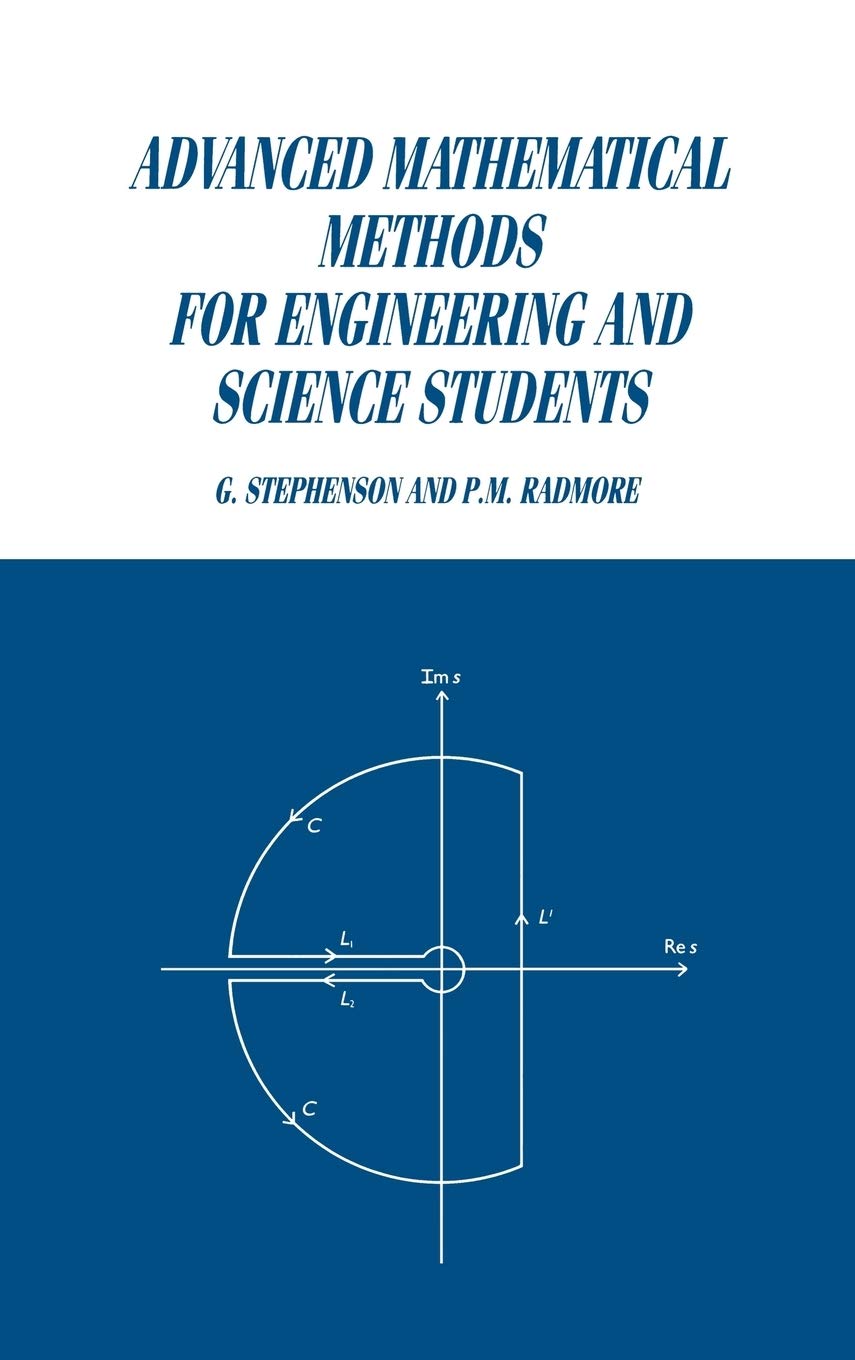
Advanced Mathematical Methods for Engineering and Science Students by G. Stephenson – A Concise Foundation in Applied Ma
Inclusive of all applicable taxes. FREE shipping on all orders.
Available Offers
- 🚚Free Delivery — Free shipping on all orders
- 💵Cash on Delivery — Pay when your order arrives
- ↩️15-Day Easy Returns — Hassle-free return policy
- 🔒Cash on Delivery — Pay safely when your order arrives
Check Delivery
Product Description
Introduction
For students of engineering and the physical sciences, mastering advanced mathematical methods is not merely an academic exercise—it is a fundamental requirement for understanding the deeper principles that govern our world. Advanced Mathematical Methods for Engineering and Science Students by G. Stephenson, published by Cambridge University Press, stands as a trusted companion for those who wish to bridge the gap between basic calculus and the sophisticated analytical tools used in higher studies and research. This hardbound edition is a durable resource designed to accompany you through years of rigorous learning.
Book Overview
This compact yet comprehensive volume offers a clear and direct introduction to several pivotal topics in applied mathematics. Unlike many texts that either oversimplify or become mired in abstract theory, Stephenson strikes a careful balance. The book is virtually self-contained, assuming only that the reader has completed a solid first course in ancillary mathematics. Each chapter is built around worked examples that illustrate the analytical structure and real-world applications of the material. The result is a concise, focused, and immensely practical guide that has helped generations of students succeed.
Key Highlights
- Self-contained approach: Builds from foundational concepts without assuming prior advanced knowledge.
- Concise yet thorough: Covers a wide range of essential topics in a remarkably compact format.
- Rich with worked examples: Each concept is demonstrated through carefully solved problems.
- Practice problems with answers: End-of-chapter exercises allow you to test your understanding, with solutions provided at the back.
- Durable hardcover binding: Built to withstand frequent use in classrooms, labs, and study desks.
Inside the Book
The text is structured to guide you step by step through increasingly complex ideas. Every chapter opens with a clear statement of objectives and proceeds with methodical explanations. The worked examples are not mere illustrations; they are designed to teach you how to think analytically and approach problems systematically. The exercises at the end of each chapter range from routine applications to more challenging problems, ensuring a thorough grasp of the material. The answer key at the back provides immediate feedback, making self-study effective and rewarding.
Key Topics
- Fourier series and transforms
- Laplace transforms and their applications
- Partial differential equations
- Vector calculus and tensor analysis
- Complex variable theory
- Numerical methods for differential equations
- Special functions (Gamma, Beta, Bessel, Legendre)
Reader Benefits
By working through this book, you will develop a robust analytical toolkit that is directly applicable to problems in physics, chemistry, theoretical biology, and all branches of engineering. The emphasis on analytical structure means you will not just memorize formulas but understand their origins and limitations. This deeper comprehension makes it easier to adapt methods to new situations—a skill highly valued in both academic research and professional practice. The concise format also makes this an excellent revision text for postgraduate students preparing for qualifying exams.
Learning Outcomes
- Gain proficiency in solving ordinary and partial differential equations using advanced techniques.
- Apply Fourier and Laplace transforms to model and analyze physical systems.
- Understand the role of special functions in mathematical physics and engineering.
- Develop the ability to handle vector fields and tensors in multiple dimensions.
- Build confidence in tackling complex analysis problems relevant to fluid dynamics, electromagnetism, and quantum mechanics.
Who Should Read
This book is ideal for undergraduate students in physics, chemistry, theoretical biology, and all engineering disciplines—civil, mechanical, electrical, chemical, and aerospace. It is equally valuable for postgraduate students who need a quick yet thorough revision of advanced methods. Teachers and lecturers will find it a useful source for designing problem sets and lecture examples. If you are a self-learner with a solid background in basic calculus and linear algebra, this book will serve as an excellent gateway to higher-level applied mathematics.
About the Author
G. Stephenson was a highly respected mathematician and educator, known for his ability to present complex topics with exceptional clarity. His textbooks have been used in universities across the world for decades, helping countless students build a strong foundation in mathematical methods. Stephenson’s writing reflects a deep understanding of the challenges faced by science and engineering students, and a commitment to making advanced mathematics accessible without sacrificing rigor.
About the Publisher
Cambridge University Press is one of the oldest and most prestigious academic publishers in the world. With a history spanning nearly five centuries, Cambridge University Press is renowned for its rigorous editorial standards and its commitment to advancing knowledge. This book carries the hallmark of quality that readers have come to expect from Cambridge—accurate, well-structured, and peer-reviewed content that you can trust for your studies and research.
Conclusion
Advanced Mathematical Methods for Engineering and Science Students is more than just a textbook; it is a lifelong reference that will support you from your undergraduate days through your professional career. Its concise format, wealth of examples, and practical focus make it an indispensable addition to any student’s library. Whether you are preparing for exams, working on research projects, or simply seeking to deepen your understanding of applied mathematics, this book delivers the clarity and depth you need. Order your copy from Bookshops.in today and equip yourself with the mathematical tools that define modern science and engineering.
Quick Summary
Advanced Mathematical Methods for Engineering and Science Students by G. Stephenson is a concise yet comprehensive textbook published by Cambridge University Press. Designed for undergraduate students in physics, chemistry, theoretical biology, and all engineering disciplines, this book covers essential mathematical topics such as differential equations, linear algebra, Fourier series, Laplace transforms, complex analysis, and vector calculus. The author adopts a simple and direct approach, focusing on the analytical structure and real-world applications of each method. The text is virtually self-contained, requiring only a basic course in ancillary mathematics. Each chapter includes numerous worked examples that illustrate key concepts, followed by a set of problems with answers provided at the end of the book. This structure makes it ideal for both classroom use and independent study. Unlike many longer texts, this book delivers material in a compact form without sacrificing depth. Indian students will find it particularly useful for building a strong mathematical foundation for competitive exams and advanced coursework. By purchasing from Bookshops.in, customers receive a genuine hardcover edition with fast delivery across India, backed by reliable customer service and competitive pricing.
Book Highlights
Book Specifications
| ISBN-13 | 9780521368605 |
| ISBN-10 | 052136860X |
| Publisher | Cambridge University Press |
| Language | English |
| Dimensions | 15.24 x 1.7 x 22.86 cm |
| Weight | 392 g |
| Country | India |
| Category | Science & Mathematics › Mathematics |
| Genre | Non-fiction |
| Original Language | English |
Frequently Asked Questions
Is this book suitable for beginners in advanced mathematics?
Does the book include answers to all problems?
Which topics are covered in this book?
Can this book be used for self-study?
Is this book relevant for Indian engineering curricula?
Who is the author G. Stephenson?
Is this book available in other languages?
What is the price of this book on Bookshops.in?
Can I use this book for GATE preparation?
Does the book cover numerical methods?
What is the ISBN of this book?
Is this book suitable for postgraduate students?
How is this book different from other mathematical methods textbooks?
Readers Also Search For
Customers Also Bought
Mathematics
Stereotype Spaces and Algebras: 73 (De Gruyter Expositions in Mathematics, 73)
Mathematics
Semigroups in Algebra, Geometry and Analysis: 20 (De Gruyter Expositions in Mathematics, 20)
Mathematics
Geometry from the Pacific Rim: Proceedings of the Pacific Rim Geometry Conference held at National University of Singapore, Republic of Singapore, ... 1994 (De Gruyter Proceedings in Mathematics)
Mathematics
First International Tainan-Moscow Algebra Workshop: Proceedings of the International Conference held at National Cheng Kung University Tainan, Taiwan, ... 1994 (De Gruyter Proceedings in Mathematics)
Mathematics
Differential Geometry - Proceedings of the VIII International Colloquium (English, Jesus A. Alvarez Lopez | Eduardo Garcia-Rio)
Mathematics
Mathematical Theory of Optimal Processes (Classics of Soviet Mathematics)
Related Products
View AllMathematics
Stereotype Spaces and Algebras: 73 (De Gruyter Expositions in Mathematics, 73)
Mathematics
Semigroups in Algebra, Geometry and Analysis: 20 (De Gruyter Expositions in Mathematics, 20)
Mathematics
Geometry from the Pacific Rim: Proceedings of the Pacific Rim Geometry Conference held at National University of Singapore, Republic of Singapore, ... 1994 (De Gruyter Proceedings in Mathematics)
Mathematics
First International Tainan-Moscow Algebra Workshop: Proceedings of the International Conference held at National Cheng Kung University Tainan, Taiwan, ... 1994 (De Gruyter Proceedings in Mathematics)
Mathematics
Differential Geometry - Proceedings of the VIII International Colloquium (English, Jesus A. Alvarez Lopez | Eduardo Garcia-Rio)
Mathematics