
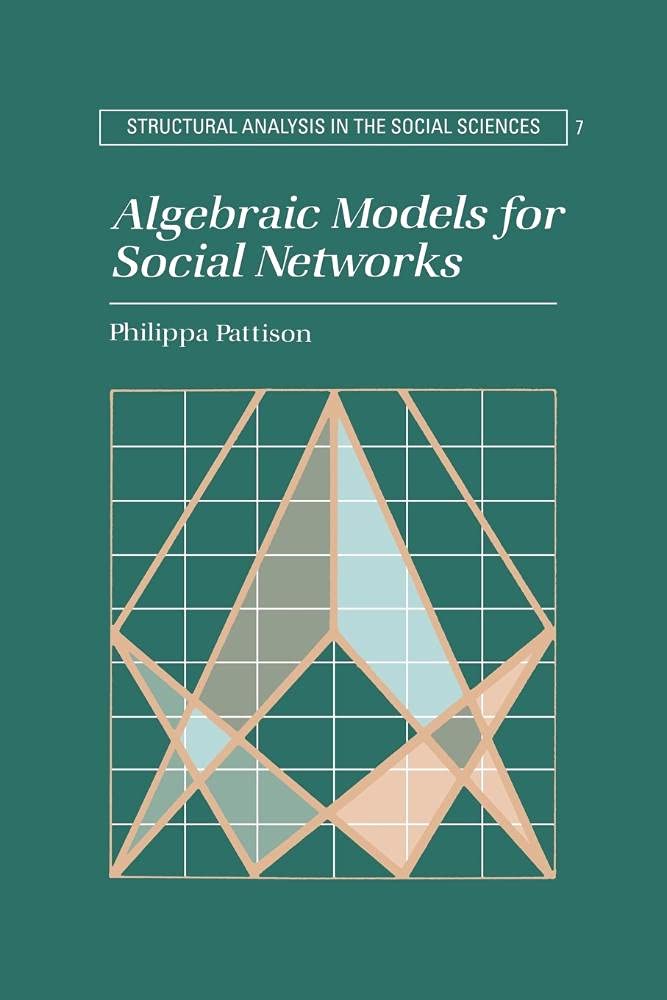
Algebraic Models for Social Networks by Philippa Pattison – A Comprehensive Guide for Social Network Analysis
Inclusive of all applicable taxes. FREE shipping on all orders.
Available Offers
- 🚚Free Delivery — Free shipping on all orders
- 💵Cash on Delivery — Pay when your order arrives
- ↩️15-Day Easy Returns — Hassle-free return policy
- 🔒Cash on Delivery — Pay safely when your order arrives
Check Delivery
Product Description
Introduction
In an era where data drives decisions, understanding the intricate web of human connections has never been more critical. Algebraic Models for Social Networks by Philippa Pattison is a seminal work that bridges the gap between abstract mathematics and the tangible realities of social relationships. This hardcover edition, published by Cambridge University Press, offers a rigorous yet accessible framework for analyzing the structure of social ties. Whether you are a researcher, a graduate student, or a data enthusiast, this book equips you with the algebraic tools to decode patterns of interaction within groups, making it an indispensable resource for the Indian academic and professional landscape.
Book Overview
This book addresses a pressing need in the social and behavioural sciences: the development of analytical methods that keep pace with the explosive growth of network data. Philippa Pattison presents a coherent algebraic approach to model both complete networks—where every relationship within a bounded group is mapped—and local networks, which focus on the ties surrounding a single individual. Through clear exposition and numerous real-world applications, the author demonstrates how algebraic models can answer fundamental questions about social cohesion, influence, and information flow. The text is designed to be both a theoretical foundation and a practical guide, making it suitable for readers from diverse disciplinary backgrounds, including sociology, anthropology, psychology, and computer science.
Key Highlights
- Comprehensive Algebraic Framework: Introduces a unified mathematical language for network analysis, leveraging concepts from abstract algebra such as semigroups and relational structures.
- Dual Focus on Networks: Covers both complete networks (e.g., all friendships in a classroom) and local networks (e.g., an individual’s immediate contacts), offering versatile tools for different research contexts.
- Applied to Real Data: Features numerous case studies drawn from actual social settings, illustrating how algebraic models reveal hidden patterns in friendship, kinship, and organizational ties.
- Bridges Theory and Practice: Provides step-by-step explanations of model construction, ensuring that readers can implement these methods in their own research without getting lost in mathematical jargon.
- Authoritative Publisher: Published by Cambridge University Press, a hallmark of academic excellence and rigorous peer review.
Inside the Book
The book is structured to guide the reader from foundational concepts to advanced applications. Early chapters establish the rationale for an algebraic perspective, explaining why traditional statistical methods often fall short in capturing the complexity of relational data. Subsequent chapters delve into the construction of algebraic models for complete networks, exploring topics like regular equivalence and role structures. The latter part of the book shifts to local networks, introducing novel models for ego-centered data. Each chapter is punctuated with exercises and examples, encouraging hands-on learning. The appendices provide supplementary mathematical background, ensuring that even readers with modest formal training can follow the core arguments.
Key Topics
- Algebraic Foundations: Semigroups, binary relations, and their application to social ties.
- Complete Network Models: Analyzing entire group structures through algebraic representations.
- Local Network Models: Techniques for modeling networks from the perspective of a single actor.
- Role and Position Analysis: Identifying structurally equivalent positions within a network.
- Comparative Network Studies: Using algebra to compare networks across different groups or time points.
- Computational Aspects: Practical considerations for implementing algebraic models with real data.
Reader Benefits
- Deepen Analytical Skills: Gain a powerful set of tools that go beyond descriptive statistics, allowing for predictive and structural insights.
- Enhance Research Quality: Apply rigorous algebraic methods to produce more robust and replicable findings in social network analysis.
- Interdisciplinary Applicability: The methods are relevant to sociology, anthropology, epidemiology, organizational behaviour, and even marketing analytics.
- Build a Strong Foundation: Ideal for self-study or as a supplementary text for advanced courses in network science.
- Indian Context Relevance: With India’s growing emphasis on data-driven policy and community studies, this book provides the theoretical backbone for analyzing everything from rural kinship networks to urban professional clusters.
Learning Outcomes
By the end of this book, readers will be able to: construct algebraic representations of social networks; distinguish between complete and local network models; apply semigroup theory to identify role structures; interpret algebraic outputs to draw meaningful sociological conclusions; and critically evaluate the limitations of different modeling approaches. These skills are directly transferable to research projects, dissertations, and professional work in data analytics.
Who Should Read
- Graduate Students in sociology, social psychology, and anthropology seeking advanced methodological training.
- Researchers and Academics in network science, statistics, and applied mathematics.
- Data Scientists interested in the theoretical underpinnings of network analysis beyond machine learning.
- Professionals in organizational development, public health, and community planning who work with relational data.
- Curious Learners with a background in mathematics or social sciences who want to explore the intersection of these fields.
About the Author
Philippa Pattison is a distinguished scholar in the field of social network analysis, known for her pioneering work on algebraic models for relational data. She has held academic positions at the University of Melbourne and other leading institutions, and her research has profoundly influenced how social scientists understand the structure of interpersonal ties. Pattison’s writing is characterized by clarity and depth, making complex mathematical ideas accessible to a broad audience. Her contributions have earned her international recognition, including fellowships in prestigious academic societies.
About the Publisher
Cambridge University Press is one of the world’s oldest and most respected academic publishers, with a history spanning over four centuries. Known for its rigorous editorial standards and commitment to scholarly excellence, CUP publishes works that shape research and education globally. This hardcover edition ensures durability and a premium reading experience, making it a valuable addition to any personal or institutional library in India.
Conclusion
Algebraic Models for Social Networks is more than a textbook—it is a gateway to a deeper understanding of human connectedness. For Indian students and researchers navigating the complexities of social data, this book offers a rare combination of mathematical rigor and practical relevance. Whether you are mapping caste networks in a village or analyzing collaboration patterns in a corporate firm, the tools in this volume will transform how you see relationships. Order your copy today from Bookshops.in and step into the fascinating world of algebraic social science.
Quick Summary
Algebraic Models for Social Networks by Philippa Pattison is a seminal work that bridges the gap between the rapid collection of social network data and the need for sophisticated analytical methods. The book introduces algebraic models for analyzing both complete networks—where ties between all members of a group are known—and local networks, which focus on the connections of a single individual. Written for researchers and graduate students in sociology, psychology, statistics, and related fields, it provides a clear mathematical foundation along with practical applications. Readers will learn how to apply algebraic techniques to uncover structural patterns in social relationships, making it an essential resource for anyone engaged in quantitative social network research. Published by Cambridge University Press, this hardcover edition is a durable reference for academic libraries and personal collections. By choosing Bookshops.in, Indian customers get authentic copies with reliable delivery and competitive pricing.
Book Highlights
Book Specifications
| ISBN-13 | 9780521031417 |
| ISBN-10 | 0521031419 |
| Publisher | Cambridge University Press |
| Language | English |
| Dimensions | 15.24 x 2.13 x 22.86 cm |
| Weight | 515 g |
| Country | India |
| Category | Science & Mathematics › Mathematics |
| Genre | Non-fiction |
| Original Language | English |
Frequently Asked Questions
What is Algebraic Models for Social Networks about?
Who is the author of this book?
Is this book suitable for beginners in network analysis?
What types of networks are covered?
Does the book include real-world examples?
What is the ISBN for this book?
Which publisher released this book?
Is this book available in hardcover?
What language is the book written in?
What is the price of this book?
Can this book help with my PhD research?
Does the book cover statistical software?
Where can I buy this book in India?
Readers Also Search For
Customers Also Bought
Mathematics
Stereotype Spaces and Algebras: 73 (De Gruyter Expositions in Mathematics, 73)

Mathematics
Semigroups in Algebra, Geometry and Analysis: 20 (De Gruyter Expositions in Mathematics, 20)

Mathematics
Geometry from the Pacific Rim: Proceedings of the Pacific Rim Geometry Conference held at National University of Singapore, Republic of Singapore, ... 1994 (De Gruyter Proceedings in Mathematics)

Mathematics
First International Tainan-Moscow Algebra Workshop: Proceedings of the International Conference held at National Cheng Kung University Tainan, Taiwan, ... 1994 (De Gruyter Proceedings in Mathematics)

Mathematics
Differential Geometry - Proceedings of the VIII International Colloquium (English, Jesus A. Alvarez Lopez | Eduardo Garcia-Rio)

Mathematics
Mathematical Theory of Optimal Processes (Classics of Soviet Mathematics)
Related Products
View AllMathematics
Mathematical Theory of Optimal Processes (Classics of Soviet Mathematics)
Mathematics
Stereotype Spaces and Algebras: 73 (De Gruyter Expositions in Mathematics, 73)
Mathematics
Semigroups in Algebra, Geometry and Analysis: 20 (De Gruyter Expositions in Mathematics, 20)
Mathematics
Geometry from the Pacific Rim: Proceedings of the Pacific Rim Geometry Conference held at National University of Singapore, Republic of Singapore, ... 1994 (De Gruyter Proceedings in Mathematics)
Mathematics
First International Tainan-Moscow Algebra Workshop: Proceedings of the International Conference held at National Cheng Kung University Tainan, Taiwan, ... 1994 (De Gruyter Proceedings in Mathematics)
Mathematics