
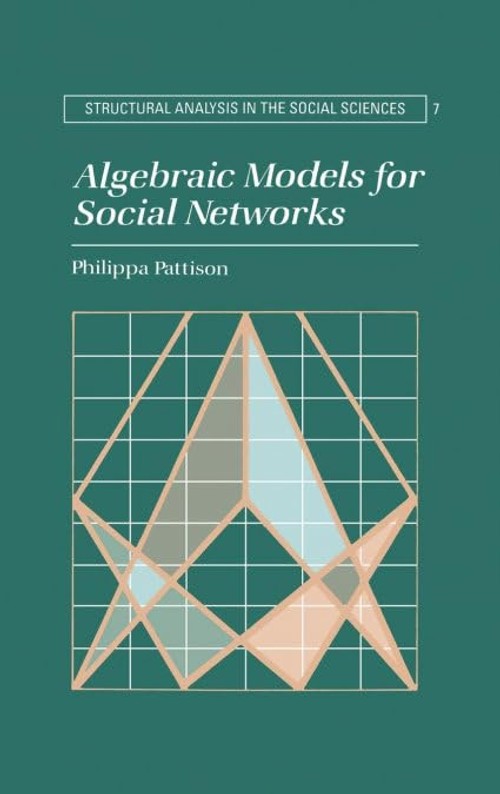
Algebraic Models for Social Networks: A Mathematical Framework for Network Analysis by Philippa Pattison
Inclusive of all applicable taxes. FREE shipping on all orders.
Available Offers
- 🚚Free Delivery — Free shipping on all orders
- 💵Cash on Delivery — Pay when your order arrives
- ↩️15-Day Easy Returns — Hassle-free return policy
- 🔒Cash on Delivery — Pay safely when your order arrives
Check Delivery
Product Description
Introduction
In the rapidly evolving landscape of social and behavioural sciences, the study of social networks has emerged as a critical lens for understanding human interaction. For Indian scholars, researchers, and students delving into this field, Algebraic Models for Social Networks by Philippa Pattison offers a rigorous yet accessible foundation. Published by Cambridge University Press, this hardcover volume is an indispensable resource for those seeking to move beyond descriptive network analysis into the realm of formal algebraic modelling. Whether you are a postgraduate student in sociology, a data scientist exploring network theory, or a psychologist studying interpersonal relationships, this book equips you with the mathematical tools to uncover hidden structures within social ties.
Book Overview
This authoritative work addresses a pressing gap in social network research: the need for analytical models that can keep pace with the growing volume of network data. Pattison systematically introduces algebraic models designed for both complete networks—where ties between all members of a group are mapped—and local networks, which focus on the connections surrounding a single individual. Through clear exposition and numerous real-world applications, the book demonstrates how algebraic approaches can resolve key issues such as network equivalence, role structures, and the dynamics of social influence. It is a bridge between raw network data and meaningful sociological interpretation.
Key Highlights
- Dual Focus: Covers both complete and local network models, offering a comprehensive toolkit for different research contexts.
- Practical Applications: Features numerous examples from sociology, anthropology, and psychology, showing how algebraic models solve real research problems.
- Foundational Yet Advanced: Builds from basic algebraic concepts to sophisticated modelling techniques, making it suitable for newcomers and experienced analysts alike.
- Rigorous Methodology: Provides step-by-step guidance on constructing and interpreting algebraic representations of social structures.
Inside the Book
The book is structured to guide readers from fundamental principles to advanced applications. Early chapters establish the rationale for algebraic modelling, introducing key concepts like semigroups, partial orders, and homomorphisms. Subsequent chapters delve into specific models for complete networks, including the analysis of role structures and blockmodels. The latter half of the book shifts focus to local networks, exploring how personal communities can be algebraically characterised. Each chapter concludes with exercises and discussion questions that encourage hands-on learning. The text is enriched with diagrams, matrices, and algebraic notations that clarify complex ideas.
Key Topics
- Algebraic representation of social relations
- Semigroups and their application to network data
- Blockmodeling and role equivalence
- Local network models and personal communities
- Duality between actors and relations
- Methods for comparing network structures
- Algebraic approaches to network dynamics
Reader Benefits
- Enhanced Analytical Skills: Learn to move beyond descriptive statistics and apply formal algebraic reasoning to social data.
- Research Versatility: Gain models that work for small-scale ethnographic studies as well as large-scale network surveys.
- Deepened Understanding: Uncover the latent patterns and structural equivalences that drive social behaviour.
- Academic Edge: Equip yourself with techniques that are increasingly demanded in top-tier sociology and psychology journals.
Learning Outcomes
By the end of this book, readers will be able to: construct algebraic models for complete and local social networks; interpret semigroup structures and their sociological meanings; apply blockmodeling to identify role systems; analyse personal networks using algebraic frameworks; and critically evaluate network data using formal mathematical methods. These outcomes prepare students for advanced research in network science and related fields.
Who Should Read
- Postgraduate and doctoral students in sociology, social psychology, and anthropology
- Researchers in network science and computational social science
- Data analysts working with relational data in academic or corporate settings
- Faculty members teaching advanced social network analysis courses
- Professionals in market research and organisational behaviour seeking formal modelling tools
About the Author
Philippa Pattison is a distinguished scholar in the field of social network analysis. With a career spanning decades, she has contributed seminal works on algebraic models for social structures and has held academic positions at the University of Melbourne. Her research focuses on the mathematical foundations of social networks, and she is widely recognised for advancing the integration of algebra into sociological methodology. This book reflects her deep expertise and commitment to making complex models accessible to a broad audience.
About the Publisher
Cambridge University Press is one of the world's oldest and most respected academic publishers, with a legacy of producing high-quality scholarly works across disciplines. Known for rigorous peer review and editorial excellence, Cambridge titles are trusted by universities and research institutions globally. This hardcover edition reflects the publisher's commitment to durable, authoritative academic resources that support serious study and research.
Conclusion
Algebraic Models for Social Networks is more than a textbook—it is a gateway to sophisticated network analysis. For Indian students and researchers navigating the complexities of social ties, this book provides the theoretical depth and practical tools needed to excel. By bridging algebra and sociology, Philippa Pattison has created a work that will remain relevant as network science continues to grow. Add this essential volume to your library and transform the way you understand social structures.
Quick Summary
Algebraic Models for Social Networks by Philippa Pattison is a seminal academic work that introduces algebraic frameworks for analyzing social network data. The book addresses the growing need for analytical tools in social and behavioral sciences by presenting models for both complete networks—those encompassing all ties among group members—and local networks centered on individual actors. Pattison explains the algebraic rationale behind these models, making complex mathematical concepts accessible to researchers and students. With numerous applications drawn from sociology, psychology, and related fields, this book equips readers to uncover structural patterns in social relationships. Ideal for graduate students, academics, and data scientists, it bridges theory and practice. Bookshops.in offers this hardcover edition at ₹4031, ensuring Indian readers get a durable, high-quality reference for their library.
Book Highlights
Book Specifications
| ISBN-13 | 9780521365680 |
| ISBN-10 | 0521365686 |
| Publisher | Cambridge University Press |
| Language | English |
| Dimensions | 15.88 x 1.91 x 24.13 cm |
| Weight | 647 g |
| Category | Science & Mathematics › Mathematics |
| Genre | Non-fiction |
| Original Language | English |
Frequently Asked Questions
What is Algebraic Models for Social Networks about?
Who is the author of this book?
What are complete networks?
What are local networks?
Is this book suitable for beginners?
Does the book include real-world applications?
What is the ISBN?
Can this book help with data science?
Is the book available in hardcover?
What language is the book in?
Does the book cover graph theory?
Who should buy this book?
Why buy from Bookshops.in?
Readers Also Search For
Related Products
View All
Science & Mathematics
Elements of Pelagos Biology: With Focus on the Mediterranean Sea

Science & Mathematics
Mathematical Theory of Optimal Processes (Classics of Soviet Mathematics)
Science & Mathematics
Cambridge IGCSE and O Level Additional Mathematics by Val Hanrahan – Textbook for 0606/4037

Science & Mathematics
Squid - Superconducting Quantum Interference Devices and Their Applications: Proceedings of the International Conference on Superconducting Quantum Devices, Berlin-west, October 4-8, 1976

Science & Mathematics
Concise Encyclopedia of Biochemistry
Science & Mathematics