
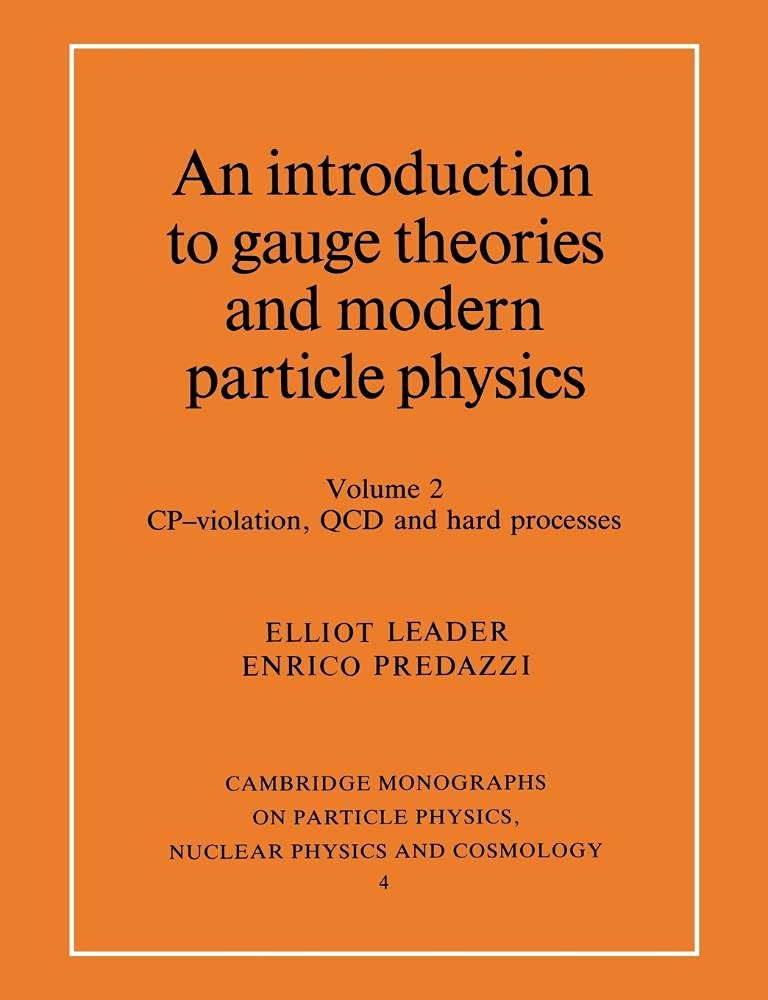
An Introduction to Gauge Theories and Modern Particle Physics by Elliot Leader: A Comprehensive Guide for Advanced Stude
Inclusive of all applicable taxes. FREE shipping on all orders.
Available Offers
- 🚚Free Delivery — Free shipping on all orders
- 💵Cash on Delivery — Pay when your order arrives
- ↩️15-Day Easy Returns — Hassle-free return policy
- 🔒Cash on Delivery — Pay safely when your order arrives
Check Delivery
Product Description
Introduction
For students and researchers venturing into the intricate world of particle physics, finding a resource that balances theoretical depth with intuitive clarity is essential. An Introduction to Gauge Theories and Modern Particle Physics by Elliot Leader stands as a monumental two-volume work that systematically bridges the gap between foundational concepts and advanced research. Published by Cambridge University Press, this hardcover edition is a definitive guide for anyone serious about understanding the forces and particles that constitute our universe.
Book Overview
This comprehensive set is designed to take the reader from the core principles of electroweak interactions through to the sophisticated framework of quantum chromodynamics (QCD). Volume 1 lays the groundwork by exploring electroweak unification, the discovery of new particles, and the parton model—a cornerstone for understanding hadronic structure. Volume 2 delves deeper into CP-violation and provides an exhaustive treatment of QCD, including its applications to hard scattering processes and a concise overview of soft hadronic physics. The author’s approach is remarkably pedagogical, introducing complex gauge theories in a gradual, step-by-step manner without sacrificing rigor.
Key Highlights
- Two-Volume Integration: Covers both electroweak theory and QCD in a single, cohesive narrative.
- Intuitive Explanations: Physical principles are presented clearly before diving into mathematical formalism.
- Research-Ready Content: Prepares the reader for contemporary studies in particle physics and high-energy experiments.
- Comprehensive Coverage: Includes critical topics like CP-violation, parton distributions, and gauge invariance.
Inside the Book
The first volume begins with the fundamental concepts of gauge theories and spontaneously broken symmetries, gradually introducing the Weinberg-Salam model. It then moves to experimental discoveries, such as the J/ψ and tau lepton, and explains the parton model’s success in deep inelastic scattering. Volume 2 opens with a detailed analysis of CP-violation in the kaon system before transitioning to QCD. The text meticulously covers asymptotic freedom, the running coupling constant, and applications to jet physics, heavy quark production, and Drell-Yan processes. A chapter on soft hadronic physics, including Regge theory and the topological expansion, rounds out the treatment.
Key Topics
- Electroweak unification and the Higgs mechanism
- Properties of the Standard Model particles
- The parton model and scaling violations
- CP-violation in neutral kaon decays
- Quantum chromodynamics and its non-abelian gauge structure
- Perturbative QCD and hard scattering processes
- Soft hadronic interactions and Regge phenomenology
Reader Benefits
This book is crafted to transform a motivated student into a confident researcher. The gradual introduction of advanced mathematics ensures that readers are never overwhelmed. Each chapter builds logically on the previous, with numerous examples and clear derivations. The two-volume format allows for a thorough exploration of both theoretical frameworks and experimental evidence, making it an invaluable reference for coursework, self-study, or laboratory work. Indian students pursuing MSc or PhD programs in physics will find the text particularly well-suited for bridging undergraduate knowledge with cutting-edge research.
Learning Outcomes
- Develop a deep understanding of gauge symmetry and its role in modern physics.
- Gain proficiency in calculating cross-sections and decay rates for electroweak and QCD processes.
- Interpret experimental results from collider experiments using parton model and QCD tools.
- Analyze CP-violation mechanisms and their implications for matter-antimatter asymmetry.
- Apply perturbative QCD techniques to predict observables in high-energy collisions.
Who Should Read
This text is ideally suited for graduate students in physics who have completed introductory courses in quantum mechanics and special relativity. It is also highly recommended for postdoctoral researchers, academicians, and industry professionals in high-energy physics who need a comprehensive reference. Advanced undergraduate students with a strong foundation in mathematical methods will also benefit from its clear exposition. Indian institutes like IISc, IITs, and central universities will find this an excellent textbook for advanced particle physics courses.
About the Author
Elliot Leader is a distinguished physicist and professor emeritus at Imperial College London, with decades of experience in theoretical particle physics. He is renowned for his seminal contributions to the study of spin phenomena, parton distributions, and gauge theories. His pedagogical style reflects a deep commitment to making complex ideas accessible, and he has authored several influential textbooks that have shaped generations of physicists. His expertise ensures that every concept in this book is presented with both authority and clarity.
About the Publisher
Cambridge University Press is one of the world’s oldest and most prestigious academic publishers, with a history spanning over four centuries. Known for its rigorous editorial standards and commitment to scholarly excellence, Cambridge University Press publishes works that define and advance their fields. This book is a testament to their tradition of producing high-quality, enduring resources for the global scientific community. Indian readers can trust the accuracy and production quality that comes with the Cambridge imprint.
Conclusion
An Introduction to Gauge Theories and Modern Particle Physics is more than a textbook—it is a gateway to the frontiers of human knowledge. Whether you are preparing for a research career or seeking a deeper understanding of the fundamental forces, Elliot Leader’s masterful exposition will guide you every step of the way. This hardcover edition from Cambridge University Press is a lasting investment in your scientific education. Add it to your library today and embark on a journey through the heart of modern particle physics.
Quick Summary
An Introduction to Gauge Theories and Modern Particle Physics by Elliot Leader is a definitive two-volume textbook that offers a comprehensive and unified treatment of modern theoretical and experimental particle physics. Written for beginning research students, the book emphasizes underlying physical principles in a simple and intuitive way. Volume 1 covers electroweak interactions, the discovery of new particles, partons, and the simple parton model. Volume 2 delves into CP violation and quantum chromodynamics, with applications to hard processes and a brief coverage of soft hadronic physics. Readers will gain a deep understanding of gauge symmetries, the Standard Model, and the tools used in contemporary particle physics research. This book is ideal for Indian MSc and PhD students, as well as researchers seeking a solid foundation. By purchasing from Bookshops.in, customers receive a genuine Cambridge University Press hardcover edition at a competitive price, with reliable delivery across India.
Book Highlights
Book Specifications
| ISBN-13 | 9780521499514 |
| ISBN-10 | 0521499518 |
| Publisher | Cambridge University Press |
| Language | English |
| Dimensions | 18.9 x 2.67 x 24.61 cm |
| Weight | 816 g |
| Country | India |
| Category | Science & Mathematics › Physics |
| Genre | Academic Textbook |
| Reading Age | 18+ |
| Original Language | English |
Frequently Asked Questions
What is the main focus of this book?
Who is the author of this book?
Is this book suitable for beginners in particle physics?
How many volumes does this set include?
What topics are covered in Volume 1?
What topics are covered in Volume 2?
What is the ISBN for this book?
What is the price of this book in India?
Does this book include exercises or problems?
Is this book used in Indian university courses?
What is the language of this book?
What is the difference between this book and other particle physics textbooks?
Can I use this book for self-study?
Readers Also Search For
Customers Also Bought
Mathematics
Stereotype Spaces and Algebras: 73 (De Gruyter Expositions in Mathematics, 73)

Mathematics
Semigroups in Algebra, Geometry and Analysis: 20 (De Gruyter Expositions in Mathematics, 20)
Mathematics
Geometry from the Pacific Rim: Proceedings of the Pacific Rim Geometry Conference held at National University of Singapore, Republic of Singapore, ... 1994 (De Gruyter Proceedings in Mathematics)
Mathematics
First International Tainan-Moscow Algebra Workshop: Proceedings of the International Conference held at National Cheng Kung University Tainan, Taiwan, ... 1994 (De Gruyter Proceedings in Mathematics)

Mathematics
Differential Geometry - Proceedings of the VIII International Colloquium (English, Jesus A. Alvarez Lopez | Eduardo Garcia-Rio)
Mathematics
Mathematical Theory of Optimal Processes (Classics of Soviet Mathematics)
Related Products
View All
Physics
The Quantum and Cosmic Codes of the Universe
Physics
Physics for You by Keith Johnson – GCSE Physics Textbook
Physics
Experimental Techniques in Nuclear Physics
Physics
Essential Physics I

Physics
Modern Foundations of Quantum Optics
Physics