
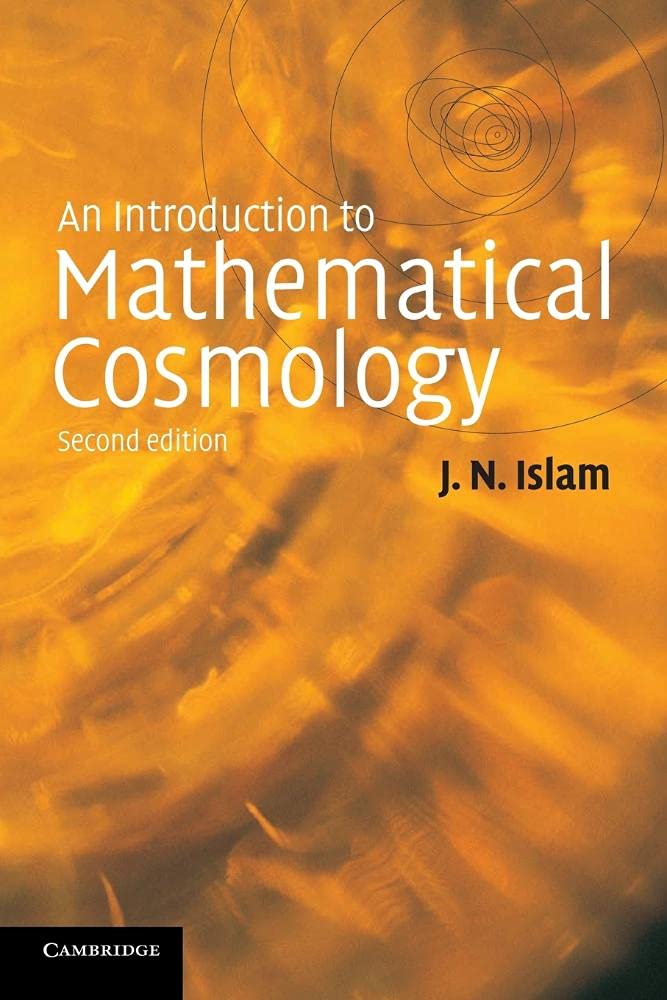
An Introduction to Mathematical Cosmology by Jamal N. Islam – A Rigorous Exploration of the Universe's Origin, Structure
Inclusive of all applicable taxes. FREE shipping on all orders.
Available Offers
- 🚚Free Delivery — Free shipping on all orders
- 💵Cash on Delivery — Pay when your order arrives
- ↩️15-Day Easy Returns — Hassle-free return policy
- 🔒Cash on Delivery — Pay safely when your order arrives
Check Delivery
Product Description
Introduction
For students and enthusiasts of cosmology who wish to move beyond descriptive accounts and engage with the rigorous mathematical framework of the universe, An Introduction to Mathematical Cosmology by Jamal N. Islam offers a clear and concise gateway. Published by the prestigious Cambridge University Press, this hardbound volume is an essential resource for advanced undergraduates and beginning graduate students in India and around the world. It bridges the gap between observational astronomy and the deep mathematical structures that govern cosmic evolution.
Book Overview
This book presents a systematic exploration of the mathematical underpinnings of modern cosmology. Starting from a brief overview of observational cosmology and a compact introduction to general relativity, the author guides readers through the Friedmann models, the Hubble constant, and the deceleration parameter. The text then ventures into singularities, the early universe, inflation, quantum cosmology, and even the distant future of the cosmos. This edition features a rigorous derivation of the Robertson–Walker metric and discusses the limits of parameter space through theoretical and observational constraints, making it a thoroughly updated and self-contained text.
Key Highlights
- Rigorous yet accessible: Balances mathematical depth with clear physical explanations, ideal for Indian students transitioning from undergraduate to postgraduate studies.
- Updated content: Includes new discussions on parameter space constraints and a novel inflationary solution for a sixth degree potential.
- Comprehensive scope: Covers everything from the geometry of spacetime to the quantum origins of the universe.
- Authoritative source: Published by Cambridge University Press, a hallmark of academic excellence.
Inside the Book
The book is structured to build understanding step by step. Early chapters lay the groundwork with special relativity, tensor calculus, and the Einstein field equations. Later chapters delve into the Robertson–Walker metric, the dynamics of the scale factor, and the physics of the early universe. Readers will encounter detailed derivations of the Friedmann equations, the concept of particle horizons, and the inflationary paradigm. The final chapters explore quantum cosmology and the ultimate fate of the universe, offering a glimpse into the frontiers of cosmological research.
Key Topics
- Observational cosmology and the expanding universe
- Essentials of general relativity and tensor analysis
- The Robertson–Walker metric and its derivation
- Friedmann models, Hubble constant, and deceleration parameter
- Singularities and the cosmic censorship hypothesis
- Inflationary cosmology and scalar field dynamics
- Quantum cosmology and the wave function of the universe
- The far future: heat death, big rip, and cyclic models
Reader Benefits
This book empowers readers to independently derive key cosmological equations and understand the physical assumptions behind them. It sharpens mathematical skills while providing deep insight into the nature of space, time, and matter. The self-contained derivations reduce reliance on external references, making it an ideal companion for self-study or classroom use. Indian students preparing for competitive exams like JEST, TIFR, or GATE in physics will find the clear exposition particularly valuable.
Learning Outcomes
- Gain proficiency in the mathematical formalism of general relativity as applied to cosmology.
- Derive and interpret the Friedmann equations and the Robertson–Walker metric.
- Understand the observational basis for the big bang and inflationary models.
- Analyze the role of dark energy and the accelerating universe using mathematical tools.
- Appreciate the conceptual foundations of quantum cosmology and the early universe.
Who Should Read
This book is perfect for advanced undergraduate and postgraduate students in physics, astronomy, and mathematics. It will also appeal to researchers in cosmology, astrophysics, and mathematical physics who need a compact yet thorough reference. Indian students pursuing a master's degree in physics or a PhD in cosmology will find it indispensable for building a strong analytical foundation. Teachers and lecturers can use it as a textbook for a one-semester course on mathematical cosmology.
About the Author
Jamal N. Islam was a renowned cosmologist and mathematician who made significant contributions to the study of black holes, gravitational collapse, and the mathematical structure of the universe. He served as a professor at the University of Chittagong and later at the City University, London. His works, including this celebrated textbook, are known for their clarity, precision, and deep physical insight, inspiring generations of students in cosmology and general relativity.
About the Publisher
Cambridge University Press is one of the oldest and most respected academic publishers in the world. With a legacy dating back to 1534, it is committed to advancing knowledge through high-quality scholarly books and textbooks. This hardcover edition reflects the press's dedication to rigorous academic standards and durable production, making it a valuable addition to any library or personal collection in India.
Conclusion
An Introduction to Mathematical Cosmology is more than a textbook—it is a carefully crafted journey into the heart of theoretical cosmology. For Indian students and researchers who seek a mathematically grounded yet intuitively clear understanding of the universe, this book is an investment that will pay dividends for years to come. Whether you are preparing for advanced studies or pursuing independent research, this volume will serve as a trusted guide through the cosmos of equations and ideas.
Quick Summary
An Introduction to Mathematical Cosmology by Jamal N. Islam is a rigorous yet accessible textbook that delves into the mathematical foundations of modern cosmology. Designed for advanced undergraduates and beginning graduate students, the book covers essential topics such as Friedmann models, the Hubble constant, deceleration parameter, singularities, the early universe, inflation, quantum cosmology, and the distant future of the cosmos. This edition features a thorough derivation of the Robertson-Walker metric and discusses theoretical and observational constraints on cosmological parameters, including a new inflationary solution for a sixth degree potential. Readers will gain a deep understanding of the mathematical tools used to describe the origin, structure, and evolution of the universe. Published by Cambridge University Press, this hardcover volume is an invaluable resource for Indian students pursuing physics, mathematics, or astrophysics. By choosing Bookshops.in, you support a trusted Indian bookstore that offers genuine, high-quality academic books with reliable delivery across the country.
Book Highlights
Book Specifications
| ISBN-13 | 9780521499736 |
| ISBN-10 | 0521499739 |
| Publisher | Cambridge University Press |
| Language | English |
| Dimensions | 15.21 x 1.68 x 22.91 cm |
| Weight | 390 g |
| Country | India |
| Category | Science & Mathematics › Mathematics |
| Genre | Science & Mathematics |
| Original Language | English |
Frequently Asked Questions
What is the main focus of this book?
Who is the author of this book?
Is this book suitable for beginners in cosmology?
Does this book cover general relativity?
What is the Robertson-Walker metric?
Does the book discuss the early universe?
What is the sixth degree potential mentioned?
Is this book used as a textbook?
Does the book include observational cosmology?
What are the Hubble constant and deceleration parameter?
Can I use this book for self-study?
What is quantum cosmology?
Is the book available in hardcover?
Where can I buy this book in India?
Readers Also Search For
Customers Also Bought
Mathematics
Stereotype Spaces and Algebras: 73 (De Gruyter Expositions in Mathematics, 73)
Mathematics
Semigroups in Algebra, Geometry and Analysis: 20 (De Gruyter Expositions in Mathematics, 20)
Mathematics
Geometry from the Pacific Rim: Proceedings of the Pacific Rim Geometry Conference held at National University of Singapore, Republic of Singapore, ... 1994 (De Gruyter Proceedings in Mathematics)
Mathematics
First International Tainan-Moscow Algebra Workshop: Proceedings of the International Conference held at National Cheng Kung University Tainan, Taiwan, ... 1994 (De Gruyter Proceedings in Mathematics)
Mathematics
Differential Geometry - Proceedings of the VIII International Colloquium (English, Jesus A. Alvarez Lopez | Eduardo Garcia-Rio)
Mathematics
Mathematical Theory of Optimal Processes (Classics of Soviet Mathematics)
Related Products
View AllMathematics
Stereotype Spaces and Algebras: 73 (De Gruyter Expositions in Mathematics, 73)
Mathematics
Semigroups in Algebra, Geometry and Analysis: 20 (De Gruyter Expositions in Mathematics, 20)
Mathematics
Geometry from the Pacific Rim: Proceedings of the Pacific Rim Geometry Conference held at National University of Singapore, Republic of Singapore, ... 1994 (De Gruyter Proceedings in Mathematics)
Mathematics
First International Tainan-Moscow Algebra Workshop: Proceedings of the International Conference held at National Cheng Kung University Tainan, Taiwan, ... 1994 (De Gruyter Proceedings in Mathematics)
Mathematics
Differential Geometry - Proceedings of the VIII International Colloquium (English, Jesus A. Alvarez Lopez | Eduardo Garcia-Rio)
Mathematics