
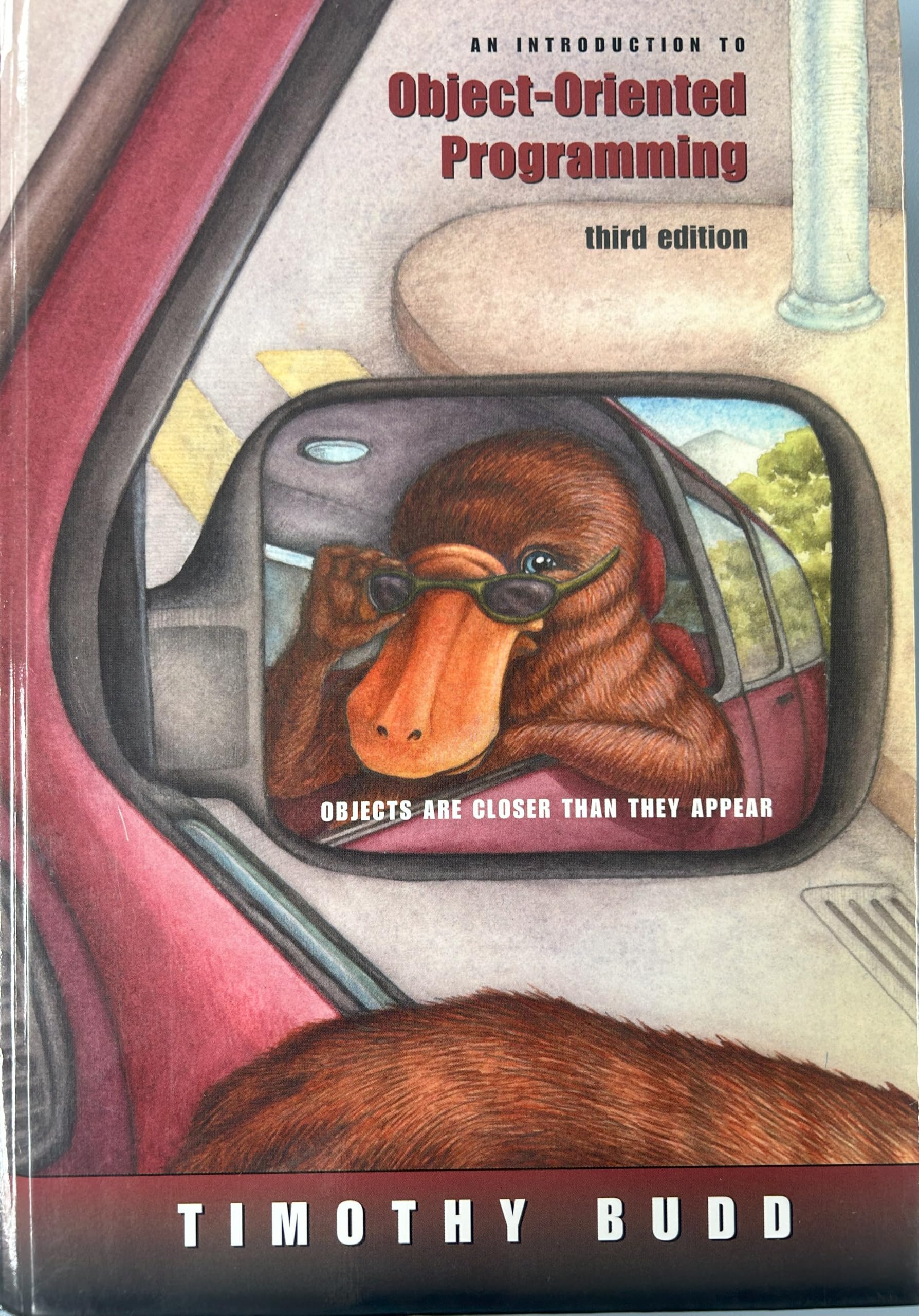
An Introduction to Object-Oriented Programming by Timothy Budd – A Comprehensive Guide to OOP Principles with Examples i
Inclusive of all applicable taxes. FREE shipping on all orders.
Available Offers
- 🚚Free Delivery — Free shipping on all orders
- 💵Cash on Delivery — Pay when your order arrives
- ↩️15-Day Easy Returns — Hassle-free return policy
- 🔒Cash on Delivery — Pay safely when your order arrives
Check Delivery
Product Description
Introduction
Object-oriented programming (OOP) has transformed the way software is designed, built, and maintained. For Indian students, developers, and computer science enthusiasts, mastering OOP is essential for building robust, scalable applications. An Introduction to Object-Oriented Programming by Timothy Budd is a timeless, language-independent guide that unpacks the core principles of OOP—objects, methods, inheritance, and polymorphism—using real-world examples from multiple programming languages. Published by Pearson, this hardcover edition is an indispensable resource for anyone seeking a deep, conceptual understanding of OOP beyond syntax.
Book Overview
Timothy Budd’s classic text offers a comprehensive, language-agnostic exploration of object-oriented concepts. Unlike books tied to a single language, this volume draws examples from C++, C#, Java, CLOS, Delphi, Eiffel, Objective-C, Smalltalk, and Python. The third edition includes expanded coverage of Eiffel, CLOS, and Python, along with extensive comparisons between C++, C#, and Java. Case studies illustrate polymorphism in the STL (C++) and the AWT (Java), while UML diagrams are integrated throughout to clarify design. Advanced sections on design patterns, reflection, and introspection make this book suitable for both beginners and experienced programmers.
Key Highlights
- Language-Independent Approach: Learn OOP principles that apply across C++, Java, Python, C#, and more.
- Updated Content: Third edition with new examples from Eiffel, CLOS, and Python, plus detailed comparisons between C++, C#, and Java.
- Practical Case Studies: Explore polymorphism in the Standard Template Library (STL) and the Abstract Window Toolkit (AWT).
- UML Integration: Unified Modeling Language diagrams and notation used throughout for clear visualization.
- Advanced Topics: Covers design patterns, reflection, introspection, and network programming.
- Indian Context: Ideal for B.Tech, MCA, and self-learners following university curricula that emphasize multiple languages.
Inside the Book
The book is structured to build understanding step by step. Early chapters introduce fundamental concepts: objects, classes, messages, and methods. Subsequent chapters delve into inheritance, multiple inheritance, polymorphism, and dynamic binding. Each concept is illustrated with code snippets from several languages, helping readers see the same idea expressed differently. Later chapters explore advanced topics such as design patterns (Singleton, Factory, Observer), reflection and introspection, and network programming with objects. UML diagrams accompany every major design discussion, making abstract ideas concrete. The final chapters include case studies that tie everything together, showing how OOP principles are applied in real-world libraries like the STL and AWT.
Key Topics
- Objects, classes, and encapsulation
- Methods, messages, and polymorphism
- Inheritance and multiple inheritance
- Dynamic binding and virtual functions
- Design patterns (creational, structural, behavioral)
- Reflection and introspection
- Network programming with objects
- UML class and sequence diagrams
- Comparison of C++, Java, C#, Python, Smalltalk, and Eiffel
- Case studies: STL in C++ and AWT in Java
Reader Benefits
- Conceptual Clarity: Gain a rock-solid understanding of OOP that is not tied to any one language.
- Multi-Language Proficiency: See how the same principle is implemented in C++, Java, Python, and more—ideal for competitive exams and interviews.
- Career Readiness: Design patterns and advanced topics prepare you for professional software development.
- Exam-Friendly: Covers topics commonly asked in GATE, university exams, and technical interviews in India.
- Self-Paced Learning: Clear explanations and numerous examples make it suitable for independent study.
Learning Outcomes
- Define and differentiate objects, classes, and methods across multiple languages.
- Implement inheritance hierarchies and understand multiple inheritance challenges.
- Apply polymorphism to write flexible, reusable code.
- Design software using common design patterns (Singleton, Factory, Observer).
- Read and create UML diagrams to model object-oriented systems.
- Compare and contrast OOP features in C++, Java, C#, Python, and Smalltalk.
- Use reflection and introspection for dynamic programming.
- Build network applications using object-oriented principles.
Who Should Read
This book is perfect for undergraduate and postgraduate students in computer science (B.Tech, B.Sc, MCA, M.Sc) who want a solid foundation in OOP. It is also valuable for working professionals transitioning from procedural to object-oriented languages, as well as self-taught programmers looking to deepen their understanding. Teachers and trainers will find it an excellent reference for designing OOP courses. Anyone preparing for technical interviews or competitive exams like GATE will benefit from its language-agnostic approach.
About the Author
Timothy Budd is a renowned educator and author in the field of computer science. A professor at Oregon State University, he has written several influential textbooks on programming languages, data structures, and object-oriented design. His clear, example-driven teaching style has helped generations of students master complex concepts. Budd’s deep expertise in multiple programming paradigms makes him uniquely qualified to present OOP in a language-independent manner.
About the Publisher
Pearson is a global leader in educational publishing, known for high-quality academic and professional textbooks. With a strong presence in India, Pearson provides resources that align with university curricula and industry standards. This hardcover edition is produced to the highest editorial and production standards, ensuring durability and readability for years of use.
Conclusion
An Introduction to Object-Oriented Programming by Timothy Budd is more than just a textbook—it is a gateway to thinking in objects. By focusing on timeless principles rather than fleeting syntax, it equips readers with skills that transcend any single language. Whether you are a student in an Indian university, a professional upgrading your skills, or a teacher shaping the next generation of developers, this book offers lasting value. Add this essential hardcover to your library and build a foundation that will serve you throughout your programming career.
Quick Summary
An Introduction to Object-Oriented Programming by Timothy Budd is a language-independent textbook that demystifies OOP concepts such as objects, methods, inheritance (including multiple inheritance), and polymorphism. Designed for computer science students and professional developers, it draws examples from a wide array of languages including C++, Java, Python, C#, Smalltalk, Eiffel, CLOS, Delphi, and Objective-C. This third edition features expanded comparisons between C++, C#, and Java, along with case studies like polymorphism in the STL. Readers will gain a deep, transferable understanding of OOP principles that apply across programming ecosystems. The book is ideal for Indian undergraduate and postgraduate courses, self-study, or interview preparation. By purchasing from Bookshops.in, you receive a genuine Pearson hardcover edition with reliable delivery and customer support, ensuring a valuable addition to your academic library.
Book Highlights
Book Specifications
| ISBN-13 | 9780201760316 |
| ISBN-10 | 0201760312 |
| Publisher | Pearson College Div |
| Language | English |
| Dimensions | 4.32 x 16.51 x 23.5 cm |
| Weight | 590 g |
| Category | Software Design, Testing & Engineering › Object-Oriented Design |
| Genre | Non-fiction |
| Original Language | English |
Frequently Asked Questions
Is this book suitable for beginners?
Which programming languages are covered?
Does the book cover multiple inheritance?
Can I use this book for a university course?
Is the book language-independent?
Does it include Python examples?
Is this book available in English?
Who is the author?
What is the ISBN?
Does the book cover design patterns?
Is there a focus on C++ STL?
Can I compare C++ and Java OOP features?
Why buy from Bookshops.in?
Readers Also Search For
Customers Also Bought

Programming
Algorithmische Sprache Und Programmentwicklung | by H. Partsch | F. L. Bauer | P. Pepper | Springer | by H. Partsch | F. L. Bauer | P. Pepper | Springer | by H. Partsch | F. L. Bauer | P. Pepper | Springer | by H. Partsch | F. L. Bauer | P. Pepper | Springer | by H. Partsch | F. L. Bauer | P. Pepper | Springer | by H. Partsch | F. L. Bauer | P. Pepper | Springer | by H. Partsch | F. L. Bauer | P. Pepper | Springer | by H. Partsch | F. L. Bauer | P. Pepper | Springer | by H. Partsch | F. L. Bauer
Programming
Distributed Algorithms | by Jean-Claude Bermond | Michel Raynal | Springer | by Jean-Claude Bermond | Michel Raynal | Springer | by Jean-Claude Bermond | Michel Raynal | Springer | by Jean-Claude Bermond | Michel Raynal | Springer | by Jean-Claude Bermond | Michel Raynal | Springer | by Jean-Claude Bermond | Michel Raynal | Springer | by Jean-Claude Bermond | Michel Raynal | Springer | by Jean-Claude Bermond | Michel Raynal | Springer | by Jean-Claude Bermond | Michel Raynal | Springer | by Jean
Programming
Meta-Level Control for Deductive Database Systems | by Helmut Schmidt | Springer | by Helmut Schmidt | Springer | by Helmut Schmidt | Springer | by Helmut Schmidt | Springer | by Helmut Schmidt | Springer | by Helmut Schmidt | Springer | by Helmut Schmidt | Springer | by Helmut Schmidt | Springer | by Helmut Schmidt | Springer | by Helmut Schmidt | Springer | by Helmut Schmidt | Springer | by Helmut Schmidt | Springer | by Helmut Schmidt | Springer | by Helmut Schmidt | Springer | by Helmut Schm
Programming
Java Web Services | by David A. Chappell | Tyler Jewell | O'Reilly Media | by David A. Chappell | Tyler Jewell | O'Reilly Media | by David A. Chappell | Tyler Jewell | O'Reilly Media | by David A. Chappell | Tyler Jewell | O'Reilly Media | by David A. Chappell | Tyler Jewell | O'Reilly Media | by David A. Chappell | Tyler Jewell | O'Reilly Media | by David A. Chappell | Tyler Jewell | O'Reilly Media | by David A. Chappell | Tyler Jewell | O'Reilly Media | by David A. Chappell | Tyler Jewell | O'
Programming
Database in Depth | by Chris J. Date | O'Reilly Media | by Chris J. Date | O'Reilly Media | by Chris J. Date | O'Reilly Media | by Chris J. Date | O'Reilly Media | by Chris J. Date | O'Reilly Media | by Chris J. Date | O'Reilly Media | by Chris J. Date | O'Reilly Media | by Chris J. Date | O'Reilly Media | by Chris J. Date | O'Reilly Media | by Chris J. Date | O'Reilly Media | by Chris J. Date | O'Reilly Media | by Chris J. Date | O'Reilly Media | by Chris J. Date | O'Reilly Media | by Chris J.
Programming
Integration of AI and OR Techniques in Constraint Programming for Combinatorial Optimization Problem | by Nicolas Beldiceanu | Narendra Jussien | Eric Pinson | Springer | by Nicolas Beldiceanu | Narendra Jussien | Eric Pinson | Springer | by Nicolas Beldiceanu | Narendra Jussien | Eric Pinson | Springer | by Nicolas Beldiceanu | Narendra Jussien | Eric Pinson | Springer | by Nicolas Beldiceanu | Narendra Jussien | Eric Pinson | Springer | by Nicolas Beldiceanu | Narendra Jussien | Eric Pinson |
Related Products
View All
Computers & Internet
Modern Full-Stack React Projects by Daniel Bugl
Computers & Internet
Mootools 1.2 Beginner's Guide (English, Jacob Gube)
Computers & Internet
Contemporary Methods for Speech Parameterization (Springerbriefs in Electrical and Computer Engineering / Springerbriefs in Speech Technology)

Computers & Internet
Information Technology and Lawyers | by Arno R. Lodder | Anja Oskamp | Springer | by Arno R. Lodder | Anja Oskamp | Springer | by Arno R. Lodder | Anja Oskamp | Springer | by Arno R. Lodder | Anja Oskamp | Springer | by Arno R. Lodder | Anja Oskamp | Springer | by Arno R. Lodder | Anja Oskamp | Springer | by Arno R. Lodder | Anja Oskamp | Springer | by Arno R. Lodder | Anja Oskamp | Springer | by Arno R. Lodder | Anja Oskamp | Springer | by Arno R. Lodder | Anja Oskamp | Springer | by Arno R. Lo

Computers & Internet
Digital Analysis of Remotely Sensed Imagery | by Jay Gao | McGraw-Hill Companies | by Jay Gao | McGraw-Hill Companies | by Jay Gao | McGraw-Hill Companies | by Jay Gao | McGraw-Hill Companies | by Jay Gao | McGraw-Hill Companies | by Jay Gao | McGraw-Hill Companies | by Jay Gao | McGraw-Hill Companies | by Jay Gao | McGraw-Hill Companies | by Jay Gao | McGraw-Hill Companies | by Jay Gao | McGraw-Hill Companies | by Jay Gao | McGraw-Hill Companies | by Jay Gao | McGraw-Hill Companies | by Jay Gao
Computers & Internet