
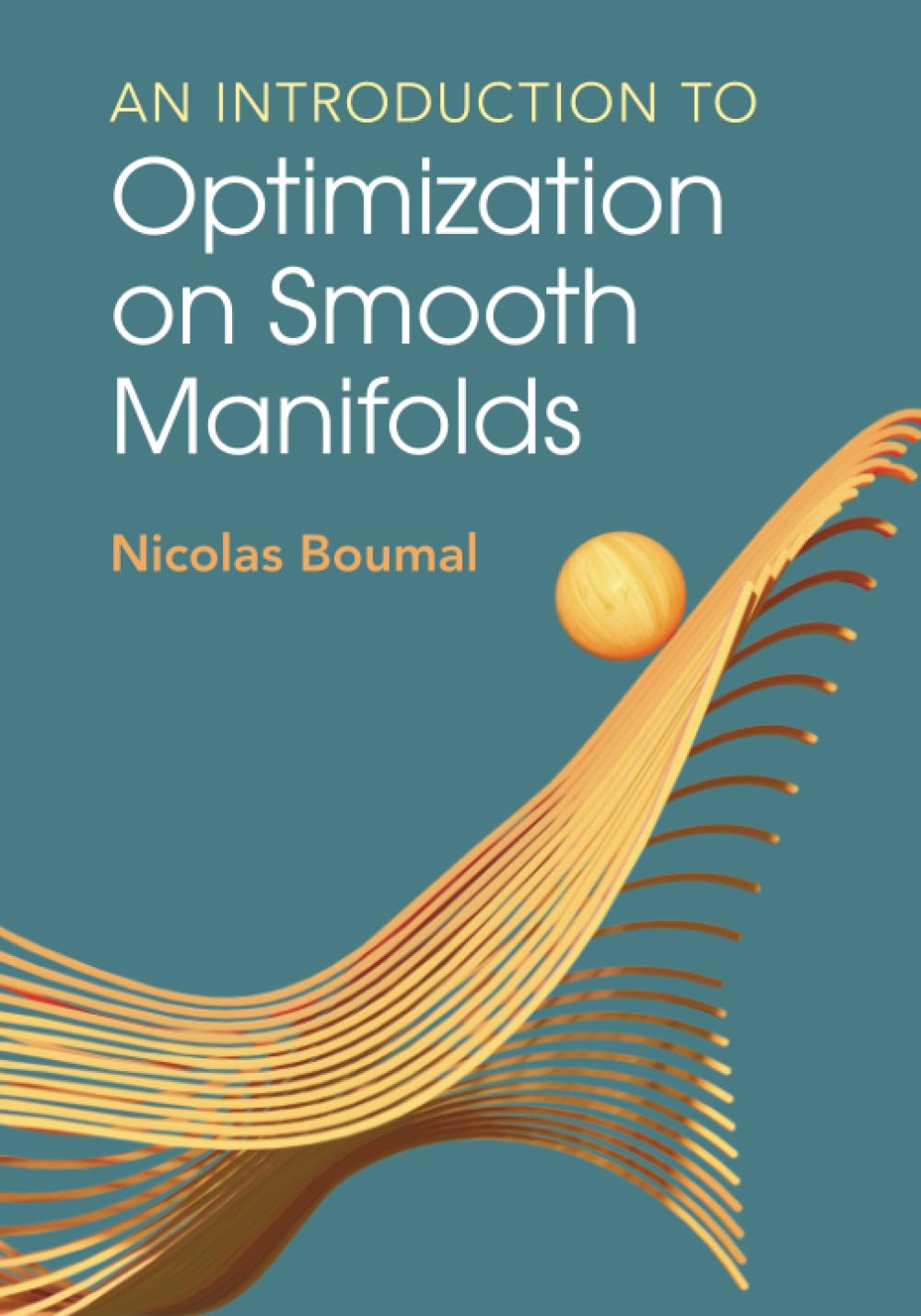
An Introduction to Optimization on Smooth Manifolds
Inclusive of all applicable taxes. FREE shipping on all orders.
Available Offers
- 🚚Free Delivery — Free shipping on all orders
- 💵Cash on Delivery — Pay when your order arrives
- ↩️15-Day Easy Returns — Hassle-free return policy
- 🔒Cash on Delivery — Pay safely when your order arrives
Check Delivery
Product Description
Introduction
Optimization is the backbone of modern science and engineering, from training machine learning models to solving complex problems in robotics and computer vision. But what happens when the variables in your optimization problem are not simple vectors, but points on a curved space—a smooth manifold? This is where the elegant and powerful framework of optimization on manifolds comes into play. An Introduction to Optimization on Smooth Manifolds by Nicolas Boumal, published by Cambridge University Press, is the definitive guide for Indian students and researchers who want to master this cutting-edge subject. Written with clarity and a focus on intuition, this hardcover volume bridges the gap between abstract differential geometry and practical algorithmic design, making it an indispensable resource for anyone serious about advanced optimization.
Book Overview
This book provides a thorough, self-contained introduction to the theory and practice of optimization on Riemannian manifolds. Unlike traditional texts that lead with heavy geometry, Boumal adopts a charts-last approach, which is more natural for optimizers. Starting from first principles, the text carefully builds the necessary differential and Riemannian geometry, motivating each concept by its role in constructing efficient, time-tested algorithms. The book covers everything from gradient descent and Newton's method on manifolds to cutting-edge topics like worst-case complexity analysis and geodesic convexity. It is packed with practical tricks of the trade for numerical implementation, making it equally suitable for classroom use and independent research.
Key Highlights
- Charts-last pedagogy: Geometry is introduced only when needed, keeping the focus on optimization.
- Self-contained: Assumes only basic linear algebra, calculus, and optimization—no prior geometry required.
- Bridges theory and practice: Includes concrete algorithms, convergence proofs, and implementation tips.
- Up-to-date research: Covers recent advances like worst-case complexity and geodesic convexity.
- Rigorous yet accessible: All definitions and theorems are motivated by algorithmic needs.
Inside the Book
The book is structured to gradually introduce the reader to manifolds, tangent spaces, Riemannian metrics, and geodesics, always tying these concepts back to optimization algorithms. Key chapters cover retractions, vector transport, and the Riemannian gradient descent, conjugate gradient, and Newton methods. The author also delves into constraint optimization on manifolds and provides a comprehensive treatment of worst-case complexity bounds. Each chapter ends with exercises that reinforce understanding and encourage hands-on coding. The final chapters explore advanced topics such as geodesic convexity and its implications for global convergence, giving readers a taste of current research frontiers.
Key Topics
- Smooth manifolds and tangent spaces
- Riemannian metrics and geodesics
- Retractions and vector transport
- Riemannian gradient descent and its convergence
- Newton's method on manifolds
- Conjugate gradient and quasi-Newton methods
- Constraint optimization on manifolds
- Worst-case complexity analysis
- Geodesic convexity and global optimization
Reader Benefits
By working through this book, readers will gain a solid mathematical foundation that allows them to confidently apply optimization on manifolds to real-world problems. They will learn how to design algorithms that respect the geometry of the problem, leading to faster and more accurate solutions. The practical tips scattered throughout the book—such as how to choose a retraction or implement a line search on a manifold—are invaluable for researchers and practitioners. Moreover, the clear connection between theory and implementation ensures that readers can immediately translate concepts into working code.
Learning Outcomes
- Understand the fundamental concepts of differential and Riemannian geometry as they apply to optimization.
- Derive and implement Riemannian gradient descent, Newton, and conjugate gradient methods.
- Analyze the convergence and complexity of optimization algorithms on manifolds.
- Apply geodesic convexity to guarantee global convergence for certain problems.
- Confidently read and contribute to research literature in optimization, machine learning, and related fields.
Who Should Read
This book is ideal for graduate students and researchers in applied mathematics, computer science, electrical engineering, and related disciplines. It is particularly valuable for those working in machine learning, computer vision, signal processing, dynamical systems, and scientific computing. Indian students preparing for competitive research or industry roles in AI and data science will find this text a powerful addition to their library. The material is also suitable for advanced undergraduates with a strong background in linear algebra and calculus.
About the Author
Nicolas Boumal is a leading researcher in optimization on manifolds and an Associate Professor in the School of Mathematics at the Institute for Advanced Study (IAS) at Princeton University. He is known for his clear exposition and for developing practical algorithms that are widely used in machine learning and signal processing. His research has earned him numerous accolades, and his teaching philosophy—making advanced topics accessible—shines through in every chapter of this book.
About the Publisher
Cambridge University Press is one of the world's oldest and most prestigious academic publishers. With a history spanning over 400 years, Cambridge University Press is committed to advancing knowledge, education, learning, and research. Their mathematics and computer science catalog is renowned for high-quality, authoritative texts that shape the curriculum worldwide. This hardcover edition upholds that tradition of excellence, offering durable binding and clear typesetting for years of reference.
Conclusion
Whether you are a student embarking on a research career or a seasoned practitioner looking to expand your optimization toolkit, An Introduction to Optimization on Smooth Manifolds is the definitive resource. Its unique pedagogical approach, rigorous yet intuitive coverage, and practical focus make it a standout title. Order your hardcover copy from Bookshops.in today and take a confident step into the elegant world of geometric optimization.
Quick Summary
An Introduction to Optimization on Smooth Manifolds by Nicolas Boumal is a groundbreaking textbook that bridges the gap between differential geometry and modern optimization. Aimed at graduate students and researchers in applied mathematics, computer science, and engineering, the book provides a clear, first-principles introduction to Riemannian geometry using a unique 'charts-last' approach that prioritizes intuition for optimizers. Readers will learn to design and implement algorithms such as gradient descent, conjugate gradient, and trust-region methods on manifolds like the Stiefel and Grassmann manifolds, with applications spanning machine learning, computer vision, signal processing, and scientific computing. The book is packed with worked examples, exercises, and practical guidance, making it ideal for self-study or as a course text. Published by Cambridge University Press in a durable hardcover edition, this book is a must-have for anyone serious about geometric optimization. Buy it from Bookshops.in for reliable delivery across India and the assurance of a premium reading experience.
Book Highlights
Book Specifications
| ISBN-13 | 9781009166157 |
| ISBN-10 | 1009166158 |
| Publisher | Cambridge University Press |
| Language | English |
| Dimensions | 17.78 x 2.06 x 25.4 cm |
| Weight | 670 g |
| Country | India |
| Category | Mathematics › Geometry |
| Genre | Mathematics |
| Reading Age | Graduate level |
| Original Language | English |
Frequently Asked Questions
What is this book about?
Who is the author?
Is this book suitable for beginners in geometry?
What are the prerequisites?
Does the book include exercises?
What applications are covered?
Is this a textbook or a research monograph?
What is the 'charts-last' approach?
Does the book cover second-order methods?
What is the ISBN?
Is this book available in India?
What is the binding of this edition?
Can I use this book for a course?
Readers Also Search For
Customers Also Bought
Mathematics
Stereotype Spaces and Algebras: 73 (De Gruyter Expositions in Mathematics, 73)
Mathematics
Semigroups in Algebra, Geometry and Analysis: 20 (De Gruyter Expositions in Mathematics, 20)
Mathematics
Geometry from the Pacific Rim: Proceedings of the Pacific Rim Geometry Conference held at National University of Singapore, Republic of Singapore, ... 1994 (De Gruyter Proceedings in Mathematics)
Mathematics
First International Tainan-Moscow Algebra Workshop: Proceedings of the International Conference held at National Cheng Kung University Tainan, Taiwan, ... 1994 (De Gruyter Proceedings in Mathematics)
Mathematics
Differential Geometry - Proceedings of the VIII International Colloquium (English, Jesus A. Alvarez Lopez | Eduardo Garcia-Rio)
Mathematics
Mathematical Theory of Optimal Processes (Classics of Soviet Mathematics)
Related Products
View AllMathematics
Mathematical Theory of Optimal Processes (Classics of Soviet Mathematics)
Mathematics
Stereotype Spaces and Algebras: 73 (De Gruyter Expositions in Mathematics, 73)
Mathematics
Semigroups in Algebra, Geometry and Analysis: 20 (De Gruyter Expositions in Mathematics, 20)
Mathematics
Geometry from the Pacific Rim: Proceedings of the Pacific Rim Geometry Conference held at National University of Singapore, Republic of Singapore, ... 1994 (De Gruyter Proceedings in Mathematics)
Mathematics
First International Tainan-Moscow Algebra Workshop: Proceedings of the International Conference held at National Cheng Kung University Tainan, Taiwan, ... 1994 (De Gruyter Proceedings in Mathematics)
Mathematics