
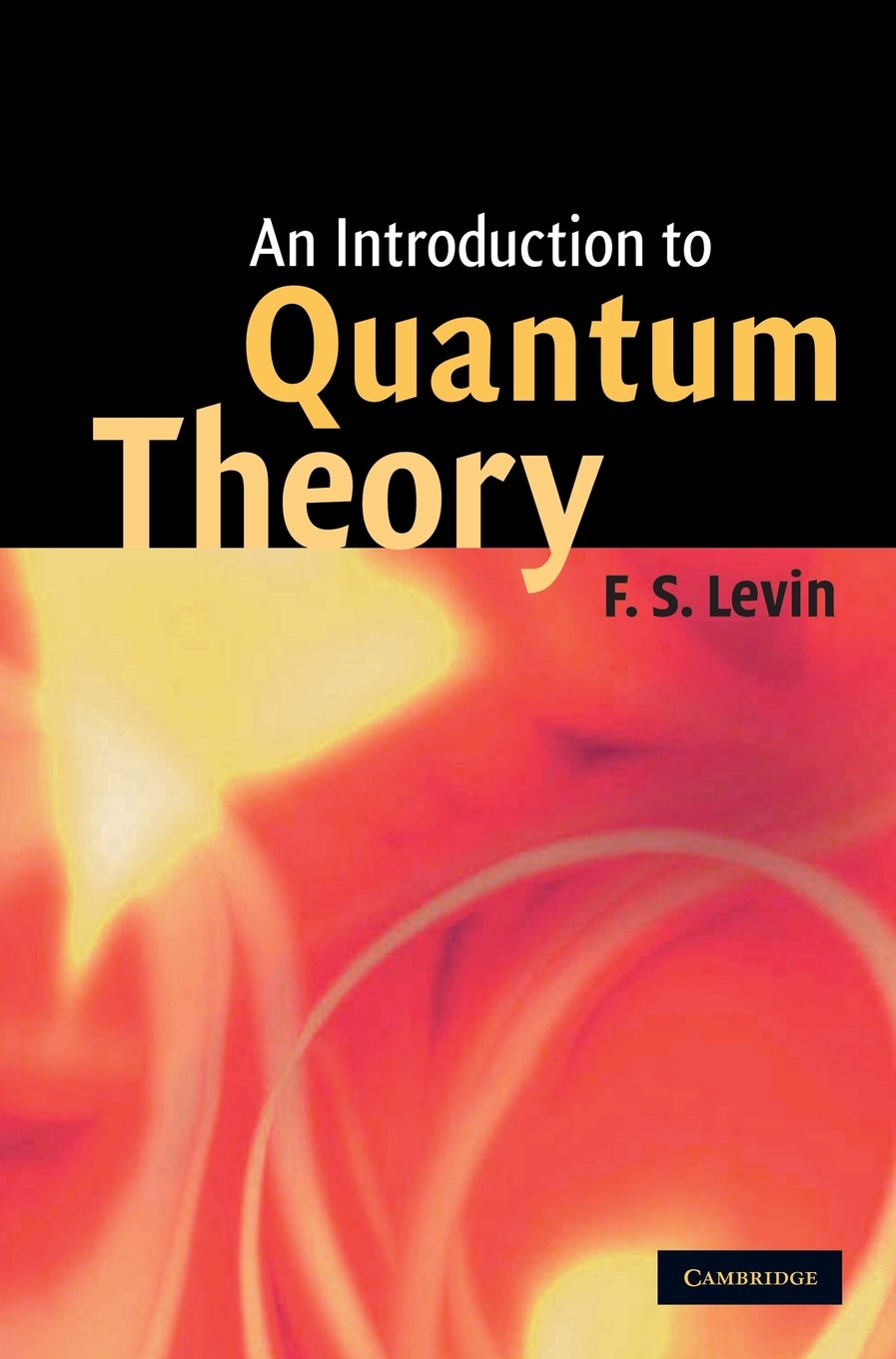
AN INTRODUCTION TO QUANTUM THEORY by F. S. Levin – A Comprehensive Physics Textbook on Quantum Mechanics for Advanced St
Inclusive of all applicable taxes. FREE shipping on all orders.
Available Offers
- 🚚Free Delivery — Free shipping on all orders
- 💵Cash on Delivery — Pay when your order arrives
- ↩️15-Day Easy Returns — Hassle-free return policy
- 🔒Cash on Delivery — Pay safely when your order arrives
Check Delivery
Product Description
Introduction
Quantum theory stands as one of the most profound and intellectually stimulating pillars of modern science. For students and enthusiasts in India who wish to grasp the foundational principles of this fascinating subject, An Introduction to Quantum Theory by F. S. Levin offers a rigorous yet accessible gateway. Published by the esteemed Cambridge University Press, this hardcover edition is an essential addition to the library of any serious learner of physics and mathematics.
Book Overview
This comprehensive volume provides a systematic and self-contained introduction to the core concepts of quantum mechanics. Written with clarity and precision, it bridges the gap between elementary physics and advanced quantum theory. The book is designed to build a strong conceptual and mathematical foundation, making it ideal for undergraduate and postgraduate students across Indian universities who are pursuing courses in physics, chemistry, or engineering. It emphasizes physical interpretation alongside mathematical formalism, ensuring readers not only solve problems but truly understand the quantum world.
Key Highlights
- Rigorous yet accessible: Presents complex ideas in a step-by-step manner without sacrificing depth.
- Comprehensive coverage: From wave-particle duality to advanced topics like perturbation theory.
- Mathematical clarity: All necessary mathematics, including linear algebra and differential equations, is explained within the context.
- Problem sets: Numerous exercises at the end of each chapter to reinforce learning and test understanding.
- Physical intuition: Focuses on the conceptual meaning behind equations and postulates.
Inside the Book
The book is meticulously structured to guide the reader through the evolution of quantum ideas. It begins with the historical experiments that challenged classical physics, then moves into the mathematical framework of state vectors and operators. Each chapter builds upon the previous, with clear derivations and illustrative examples. The text includes detailed discussions on the uncertainty principle, quantum dynamics, angular momentum, and spin, culminating in an introduction to approximation methods and scattering theory. Diagrams and tables aid visualization, making abstract concepts tangible.
Key Topics
- Wave-particle duality and the Schrödinger equation
- Hilbert spaces, observables, and measurement theory
- One-dimensional potentials and tunneling
- Angular momentum and the hydrogen atom
- Spin and identical particles
- Time-independent and time-dependent perturbation theory
- Scattering theory and quantum statistics
Reader Benefits
Reading this book equips students with the analytical tools and conceptual clarity needed to excel in quantum mechanics. It demystifies daunting topics, builds problem-solving confidence, and prepares learners for advanced research or competitive examinations such as GATE, JEST, and TIFR. The physical hardcover format ensures durability for repeated study, and the clear layout reduces eye strain during long reading sessions.
Learning Outcomes
By the end of this book, readers will be able to:
- Explain the fundamental postulates of quantum mechanics and their experimental basis.
- Solve the Schrödinger equation for simple potentials and interpret the solutions.
- Apply operator methods to compute observables and uncertainties.
- Analyze quantum systems involving spin and angular momentum.
- Use perturbation theory to approximate solutions for complex systems.
- Understand the principles underlying quantum technologies and modern physics.
Who Should Read
This book is ideal for undergraduate students in physics, chemistry, and materials science, as well as first-year postgraduate students seeking a solid refresher. It is also suitable for self-learners with a background in calculus and basic classical mechanics. Teachers and lecturers will find it a valuable resource for designing courses and explaining difficult concepts.
About the Author
F. S. Levin is a distinguished physicist and educator with decades of experience in teaching quantum mechanics at the university level. His deep understanding of the subject and commitment to clear pedagogy shine through in this carefully crafted textbook. He has contributed significantly to research in theoretical physics and has a passion for making advanced topics accessible to students.
About the Publisher
Cambridge University Press is a world-renowned academic publisher with a legacy of excellence spanning over four centuries. Known for producing authoritative and high-quality textbooks, Cambridge ensures that every title meets rigorous academic standards. This hardcover edition is printed on premium paper, ensuring longevity and a pleasant reading experience for Indian students.
Conclusion
An Introduction to Quantum Theory by F. S. Levin is more than just a textbook—it is a trusted companion on the journey to mastering one of science's most captivating fields. Whether you are a student preparing for exams, a researcher brushing up on fundamentals, or a curious mind eager to explore the quantum realm, this book offers the depth, clarity, and reliability you need. Order your copy from Bookshops.in today and take a definitive step toward understanding the universe at its most fundamental level.
Quick Summary
AN INTRODUCTION TO QUANTUM THEORY by F. S. Levin is a comprehensive textbook that offers a rigorous yet accessible introduction to quantum mechanics. Published by Cambridge University Press, this hardcover edition is designed for advanced undergraduate and graduate students in physics and engineering. The book covers essential topics such as wave-particle duality, the Schrödinger equation, quantum operators, Hilbert space, and quantum measurement theory. It provides clear mathematical derivations and practical examples to help students build a strong conceptual foundation. This textbook is particularly valuable for Indian students pursuing degrees in physics, applied physics, or quantum technologies. Readers will gain a deep understanding of quantum principles and develop problem-solving skills necessary for further study or research. By purchasing from Bookshops.in, customers receive a genuine, brand-new hardcover copy with reliable delivery across India.
Book Highlights
Book Specifications
| ISBN-13 | 9780521591614 |
| ISBN-10 | 0521591619 |
| Publisher | Cambridge University Press |
| Language | English |
| Dimensions | 18.42 x 3.81 x 26.67 cm |
| Weight | 1 kg 450 g |
| Country | India |
| Category | Science & Mathematics › Physics |
| Genre | Science & Mathematics |
| Original Language | English |
Frequently Asked Questions
What is AN INTRODUCTION TO QUANTUM THEORY about?
Who is the author of this book?
Is this book suitable for Indian students?
What level of mathematics is required?
Does the book include practice problems?
What topics are covered?
Is this book only for physics majors?
How is this book different from other quantum textbooks?
Can I use this book for self-study?
Does the book cover quantum computing?
Is there a digital version available?
Where can I buy this book in India?
Readers Also Search For
Customers Also Bought
Mathematics
Stereotype Spaces and Algebras: 73 (De Gruyter Expositions in Mathematics, 73)
Mathematics
Semigroups in Algebra, Geometry and Analysis: 20 (De Gruyter Expositions in Mathematics, 20)
Mathematics
Geometry from the Pacific Rim: Proceedings of the Pacific Rim Geometry Conference held at National University of Singapore, Republic of Singapore, ... 1994 (De Gruyter Proceedings in Mathematics)
Mathematics
First International Tainan-Moscow Algebra Workshop: Proceedings of the International Conference held at National Cheng Kung University Tainan, Taiwan, ... 1994 (De Gruyter Proceedings in Mathematics)

Mathematics
Group Theory, Algebra, and Number Theory: Colloquium in Memory of Hans Zassenhaus held in Saarbrücken, Germany, June 4-5, 1993
Mathematics
Mathematical Theory of Optimal Processes (Classics of Soviet Mathematics)
Related Products
View All
Physics
The Quantum and Cosmic Codes of the Universe
Physics
Experimental Techniques in Nuclear Physics
Physics
Essential Physics I

Physics
Modern Foundations of Quantum Optics
Physics
Lectures On Elementary Particles and Quantum Field Theory by Stanley Deser – Physics
Physics