
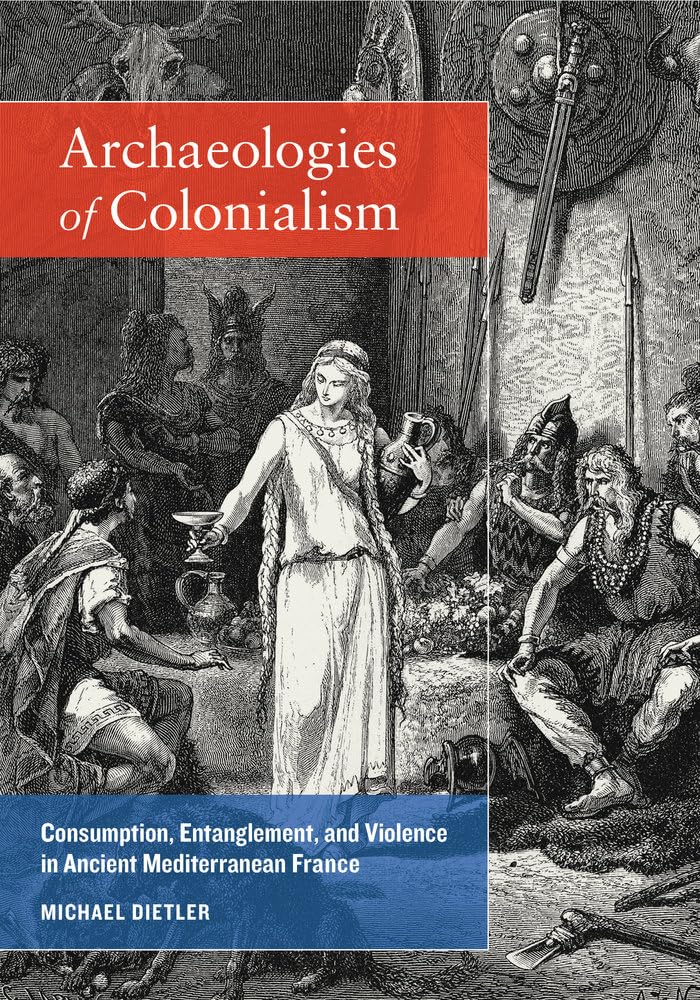
Archaeologies of Colonialism: Consumption, Entanglement, and Violence in Ancient Mediterranean France by Michael Dietler
Inclusive of all applicable taxes. FREE shipping on all orders.
Available Offers
- 🚚Free Delivery — Free shipping on all orders
- 💵Cash on Delivery — Pay when your order arrives
- ↩️15-Day Easy Returns — Hassle-free return policy
- 🔒Cash on Delivery — Pay safely when your order arrives
Check Delivery
Product Description
Introduction
In Archaeologies of Colonialism: Consumption, Entanglement, and Violence in Ancient Mediterranean France, Michael Dietler presents a groundbreaking archaeological study of cultural encounters between indigenous peoples and Etruscan, Greek, and Roman colonists during the first millennium BC. This hardcover volume from University of California Press offers Indian readers a deep dive into how material culture, consumption patterns, and violence shaped colonial dynamics in ancient Europe. Ideal for history students, archaeologists, and scholars, this book challenges conventional narratives by focusing on the transformative relationships forged through selective consumption.
Book Overview
Spanning six centuries of colonial encounters in Mediterranean France, this book integrates archaeological data with ancient texts to reconstruct the complex interactions between native societies and Mediterranean colonizers. Michael Dietler moves beyond simplistic models of domination and resistance, instead revealing how everyday practices—such as feasting, trade, and the adoption of foreign goods—created entangled social landscapes. The book also critically examines how these ancient encounters influenced modern European identity and colonial ideologies, making it a vital resource for understanding the long shadow of colonialism.
Key Highlights
- Comprehensive analysis of Etruscan, Greek, and Roman colonial impacts on indigenous communities in France
- Focus on consumption as a driver of cultural change and entanglement
- Critical examination of violence, both physical and structural, in colonial contexts
- Integration of archaeological evidence with textual sources for a multi-faceted perspective
- Reflection on how ancient colonialism shaped modern European thought and identity
Inside the Book
The volume is organized into thematic chapters that explore urban landscapes, economic practices, ritual feasting, and the role of material culture in identity formation. Dietler uses case studies from sites such as Lattara and Massalia to illustrate how imported wine, pottery, and metalwork were selectively adopted and re-signified by local populations. The book also delves into the violent disruptions caused by colonization, including warfare and enslavement, while highlighting the agency of indigenous peoples in shaping hybrid cultures.
Key Topics
- Colonial encounters in the ancient Mediterranean
- Consumption and material culture as tools of entanglement
- Violence, resistance, and accommodation in colonial settings
- Archaeological methods for studying past colonialisms
- Legacy of ancient colonialism in modern European identity
Reader Benefits
This book equips readers with a nuanced understanding of how consumption and material exchanges can drive deep cultural transformations. It offers a critical framework for analyzing colonial situations, applicable not only to ancient history but also to modern contexts. Students will gain exposure to cutting-edge archaeological theory, while researchers will appreciate the detailed case studies and methodological rigor. The book also encourages readers to question Eurocentric narratives and consider the perspectives of colonized peoples.
Learning Outcomes
- Understand the role of consumption in creating colonial entanglements
- Analyze how material culture reflects and shapes power dynamics
- Critically evaluate archaeological evidence for violence and resistance
- Connect ancient colonial processes to modern identity formation
- Apply theoretical concepts like entanglement and hybridity to archaeological data
Who Should Read
This book is essential for postgraduate students and scholars in archaeology, ancient history, anthropology, and colonial studies. It is also highly relevant for Indian readers interested in comparative colonialism, as the theoretical insights can be applied to South Asian contexts. Undergraduate students with a background in archaeology or classics will find it accessible, while general readers passionate about ancient civilizations will appreciate its engaging narrative.
About the Author
Michael Dietler is a professor of anthropology at the University of Chicago, specializing in the archaeology of colonialism, consumption, and identity in the ancient Mediterranean. He has conducted extensive fieldwork in France and Italy, and his research has been widely published in leading journals. Dietler’s work is known for blending archaeological data with social theory to explore how material practices shape human relationships.
About the Publisher
University of California Press is a prestigious academic publisher based in the United States, known for its high-quality books in the humanities and social sciences. With a commitment to scholarly excellence, UC Press publishes works that advance knowledge and foster critical thinking. This hardcover edition reflects the press’s dedication to producing durable, beautifully designed volumes that are a valuable addition to any library.
Conclusion
Archaeologies of Colonialism is a masterful synthesis of archaeology, history, and theory that redefines how we understand ancient colonial encounters. By foregrounding consumption and entanglement, Michael Dietler offers a fresh perspective that resonates with contemporary debates on identity, power, and cultural exchange. Whether you are a student, researcher, or curious reader, this book will enrich your understanding of the past and its enduring impact on the present.
Quick Summary
Michael Dietler's 'Archaeologies of Colonialism: Consumption, Entanglement, and Violence in Ancient Mediterranean France' is a landmark study that redefines how we understand ancient colonial encounters. Focusing on the region of Mediterranean France during the first millennium BC, Dietler analyzes the complex interactions between indigenous societies and Etruscan, Greek, and Roman colonists. Rather than viewing colonialism as a one-sided imposition, he demonstrates through archaeological evidence and ancient texts how selective consumption of goods, practices, and ideas created deep entanglements that transformed all parties involved. The book explores urban landscapes, economic systems, and forms of violence—both physical and symbolic—to reveal the nuanced dynamics of power and identity. Dietler also critically examines how these ancient encounters have been used to construct modern European identity and colonial ideology, offering a powerful critique of archaeological practice. This book is ideal for archaeology and history students, postcolonial scholars, and any reader interested in the roots of colonialism. By purchasing from Bookshops.in, you get an authentic hardcover edition delivered across India, with reliable service and competitive pricing.
Book Highlights
Book Specifications
| ISBN-13 | 9780520265516 |
| ISBN-10 | 0520265513 |
| Publisher | Univ of California Pr |
| Language | English |
| Dimensions | 17.78 x 3.81 x 25.4 cm |
| Weight | 1 kg 180 g |
| Country | USA |
| Category | Social Sciences › Archaeology |
| Genre | Non-fiction |
| Reading Age | Adult |
| Original Language | English |
Frequently Asked Questions
What is 'Archaeologies of Colonialism' about?
Who is the author Michael Dietler?
Is this book suitable for Indian readers?
What makes this book different from other archaeology books?
Does the book include illustrations?
What period does the book cover?
Is this book used in university courses?
What is the main argument of the book?
Does the book discuss violence?
Can I buy this book from Bookshops.in?
Is this book part of a series?
Does the book cover Roman colonization?
How does this book relate to modern colonialism?
Readers Also Search For
Related Products
View All
History
The Information Revolution: Transforming the World Through Technology (World History)
History
Human Nature and the French Revolution: From the Enlightenment to the Napoleonic Code: 3 (Polygons: Cultural Diversities and Intersections, 3)
History
The Unmaking of Home in Contemporary Art (Cultural Spaces)

History
Handbook to Life in Medieval and Early Modern Japan | by William E. Deal | Oxford University Press | by William E. Deal | Oxford University Press | by William E. Deal | Oxford University Press | by William E. Deal | Oxford University Press | by William E. Deal | Oxford University Press | by William E. Deal | Oxford University Press | by William E. Deal | Oxford University Press | by William E. Deal | Oxford University Press | by William E. Deal | Oxford University Press | by William E. Deal | Ox

History
The Narrators of Barbarian History (A.D. 550-800) | by Walter Goffart | University of Notre Dame Press | by Walter Goffart | University of Notre Dame Press | by Walter Goffart | University of Notre Dame Press | by Walter Goffart | University of Notre Dame Press | by Walter Goffart | University of Notre Dame Press | by Walter Goffart | University of Notre Dame Press | by Walter Goffart | University of Notre Dame Press | by Walter Goffart | University of Notre Dame Press | by Walter Goffart | Univ
History