
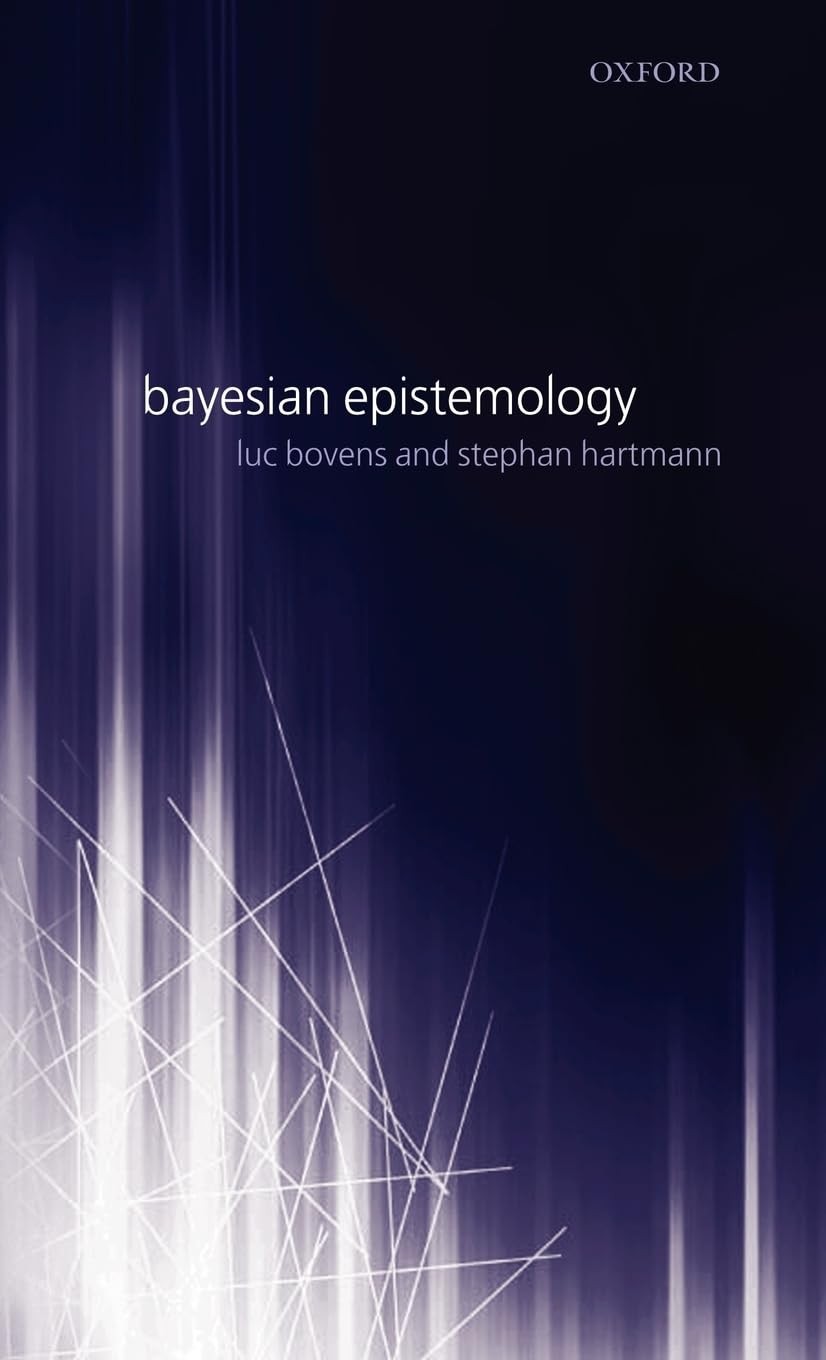
Bayesian Epistemology: Probabilistic Methods for Justifying Beliefs and Evaluating Theories by Luc Bovens
Inclusive of all applicable taxes. FREE shipping on all orders.
Available Offers
- 🚚Free Delivery — Free shipping on all orders
- 💵Cash on Delivery — Pay when your order arrives
- ↩️15-Day Easy Returns — Hassle-free return policy
- 🔒Cash on Delivery — Pay safely when your order arrives
Check Delivery
Product Description
Introduction
In the vast landscape of philosophical inquiry, the quest for certainty and justified belief has always been central. Bayesian Epistemology by Luc Bovens offers a rigorous and illuminating journey into how probability theory reshapes our understanding of knowledge, evidence, and rational belief. For Indian students, scholars, and professionals navigating the intersections of philosophy, science, and logic, this hardcover volume from OUP Oxford provides a sophisticated toolkit for tackling some of the most pressing questions in modern epistemology. It is an essential addition to any serious academic library, bridging abstract theory with practical applications in fields as diverse as jurisprudence, cognitive psychology, and voting theory.
Book Overview
This book systematically explores how Bayesian probabilistic models can address fundamental problems in epistemology and philosophy of science. Bovens and co-author Stephan Hartmann demonstrate that probability theory is not merely a mathematical curiosity but a powerful lens for understanding how we justify beliefs, evaluate competing theories, and process testimonial evidence. The work moves beyond traditional philosophical debates by offering formal, yet accessible, frameworks for coherence, reliability, and confirmation. It challenges readers to think quantitatively about qualitative problems, making it a transformative read for anyone interested in the logic of discovery and justification.
Key Highlights
- Rigorous yet accessible: Presents complex Bayesian concepts without overwhelming mathematical jargon, making them usable for philosophers and social scientists.
- Interdisciplinary relevance: Connects epistemology to real-world domains like cognitive psychology, legal reasoning, and political science.
- Original contributions: Introduces novel probabilistic measures for coherence and reliability that have influenced contemporary research.
- Practical applications: Demonstrates how Bayesian methods can resolve paradoxes in confirmation theory and testimony.
- Authoritative scholarship: Authored by a leading philosopher of science with deep expertise in formal epistemology.
Inside the Book
The book is structured to guide the reader from foundational probabilistic concepts to advanced applications. Early chapters lay the groundwork by explaining Bayesian conditionalization, likelihood ratios, and the principle of total evidence. Subsequent chapters delve into the epistemology of testimony, examining how we should update our beliefs in light of multiple witnesses. The authors meticulously analyze the problem of coherence—how to measure the mutual support among a set of beliefs—and propose a novel Bayesian account. Later sections explore confirmation theory, the ravens paradox, and the role of simplicity in scientific inference. Each chapter includes worked examples and thought experiments that clarify abstract principles, making the text suitable for both self-study and classroom use.
Key Topics
- Bayesian probability and conditionalization
- Coherence and measures of mutual support
- Reliability of testimonial sources
- Confirmation theory and the paradoxes of confirmation
- Simplicity and model selection
- Voting paradoxes and collective decision-making
- Legal evidence and probabilistic reasoning
Reader Benefits
This book empowers readers to approach epistemological problems with mathematical precision. You will learn to distinguish between genuine probabilistic support and spurious correlations, evaluate the strength of evidence in scientific and everyday contexts, and critically assess arguments about testimony and consensus. The Bayesian framework provides a unified language for discussing uncertainty, which is invaluable for researchers in philosophy, economics, law, and artificial intelligence. For Indian students preparing for competitive examinations in philosophy or logic, the formal clarity of this text offers a distinct advantage.
Learning Outcomes
By engaging with this book, readers will be able to: construct and interpret Bayesian models for belief revision; evaluate the coherence of a set of propositions using probabilistic tools; analyze the reliability of multiple testimonies; apply confirmation theory to scientific hypotheses; and critically assess formal approaches to social epistemology. These skills are directly transferable to advanced research in philosophy of science, cognitive science, and formal epistemology.
Who Should Read
Bayesian Epistemology is ideal for graduate students and researchers in philosophy, particularly those specializing in epistemology, philosophy of science, or logic. It is also highly relevant for academics in cognitive psychology, political science, and law who employ probabilistic reasoning. Advanced undergraduates with a background in formal logic or probability will find the book challenging but rewarding. Indian readers in interdisciplinary programs—such as cognitive science, data ethics, or legal theory—will discover a robust foundation for understanding uncertainty and evidence.
About the Author
Luc Bovens is a distinguished philosopher and professor at the University of North Carolina at Chapel Hill. His research spans formal epistemology, philosophy of science, and political philosophy. He has published extensively on Bayesian reasoning, social epistemology, and the ethics of belief. Bovens is known for his ability to bridge technical formal methods with substantive philosophical questions, making his work influential across multiple disciplines.
About the Publisher
Oxford University Press (OUP) is the world's largest university press, with a legacy of scholarly excellence spanning over five centuries. OUP Oxford publishes authoritative works in philosophy, science, and the humanities, ensuring that each volume meets the highest editorial and production standards. This hardcover edition reflects OUP's commitment to durable, beautifully bound books that endure for generations of readers.
Conclusion
Bayesian Epistemology is a landmark work that equips readers with the formal tools to navigate the complexities of belief, evidence, and rational decision-making. Whether you are a philosopher seeking a rigorous framework for justification or a social scientist exploring probabilistic models, this book offers enduring insights. For Indian readers committed to intellectual depth and analytical rigor, this hardcover edition from Bookshops.in is a worthy investment in your academic journey.
Quick Summary
Bayesian Epistemology by Luc Bovens (with Stephan Hartmann) is a seminal work that systematically applies Bayesian probability theory to core issues in epistemology. The book demonstrates how probabilistic models can clarify problems of information, coherence, reliability, confirmation, and testimony, offering rigorous methods for justifying beliefs and evaluating scientific theories. It is written for advanced students and researchers in philosophy, philosophy of science, cognitive psychology, and related fields. Readers will learn to use Bayesian updating, assess coherence, and analyze testimony through formal lenses. The interdisciplinary scope—including applications in voting theory and jurisprudence—makes it a unique resource. By purchasing from Bookshops.in, Indian readers gain access to a premium hardcover edition with reliable delivery and customer support, ensuring a valuable addition to any academic library.
Book Highlights
Book Specifications
| ISBN-13 | 9780199269754 |
| ISBN-10 | 0199269750 |
| Publisher | Oxford Univ Pr on Demand |
| Language | English |
| Dimensions | 22.25 x 1.42 x 14.43 cm |
| Weight | 318 g |
| Category | Economics › Economic Theory |
| Genre | Non-fiction |
| Original Language | English |
Frequently Asked Questions
What is Bayesian Epistemology about?
Who is the author of Bayesian Epistemology?
Is this book suitable for beginners?
What topics does the book cover?
Does the book require knowledge of probability?
How is this book different from other epistemology texts?
What is the ISBN?
Is this a hardcover or paperback?
Can I use this book for a PhD course?
Does the book include exercises?
What is the price in India?
Where can I buy this book in India?
What is the rating of this book?
Readers Also Search For
Related Products
View All
Society & Social Sciences
Cognitive Phenomenology | by Tim Bayne | Michelle Montague | OUP UK | by Tim Bayne | Michelle Montague | OUP UK | by Tim Bayne | Michelle Montague | OUP UK | by Tim Bayne | Michelle Montague | OUP UK | by Tim Bayne | Michelle Montague | OUP UK | by Tim Bayne | Michelle Montague | OUP UK | by Tim Bayne | Michelle Montague | OUP UK | by Tim Bayne | Michelle Montague | OUP UK | by Tim Bayne | Michelle Montague | OUP UK | by Tim Bayne | Michelle Montague | OUP UK | by Tim Bayne | Michelle Montague |

Society & Social Sciences
Oxford Studies in Epistemology, Volume 3 | by Tamar Szabo Gendler | John Hawthorne | OUP UK | by Tamar Szabo Gendler | John Hawthorne | OUP UK | by Tamar Szabo Gendler | John Hawthorne | OUP UK | by Tamar Szabo Gendler | John Hawthorne | OUP UK | by Tamar Szabo Gendler | John Hawthorne | OUP UK | by Tamar Szabo Gendler | John Hawthorne | OUP UK | by Tamar Szabo Gendler | John Hawthorne | OUP UK | by Tamar Szabo Gendler | John Hawthorne | OUP UK | by Tamar Szabo Gendler | John Hawthorne | OUP UK
Society & Social Sciences
Alasdair MacIntyre on Practical Philosophy | by Kelvin Knight | Peter Wicks | University of Notre Dame Press | by Kelvin Knight | Peter Wicks | University of Notre Dame Press | by Kelvin Knight | Peter Wicks | University of Notre Dame Press | by Kelvin Knight | Peter Wicks | University of Notre Dame Press | by Kelvin Knight | Peter Wicks | University of Notre Dame Press | by Kelvin Knight | Peter Wicks | University of Notre Dame Press | by Kelvin Knight | Peter Wicks | University of Notre Dame P
Society & Social Sciences
Philosophical Historicism and the Betrayal of First Philosophy | by Carl Page | Penn State University Press | by Carl Page | Penn State University Press | by Carl Page | Penn State University Press | by Carl Page | Penn State University Press | by Carl Page | Penn State University Press | by Carl Page | Penn State University Press | by Carl Page | Penn State University Press | by Carl Page | Penn State University Press | by Carl Page | Penn State University Press | by Carl Page | Penn State Univ

Society & Social Sciences
American and European Philosophy | by David Farrell Krell | Penn State University Press | by David Farrell Krell | Penn State University Press | by David Farrell Krell | Penn State University Press | by David Farrell Krell | Penn State University Press | by David Farrell Krell | Penn State University Press | by David Farrell Krell | Penn State University Press | by David Farrell Krell | Penn State University Press | by David Farrell Krell | Penn State University Press | by David Farrell Krell |
Society & Social Sciences