
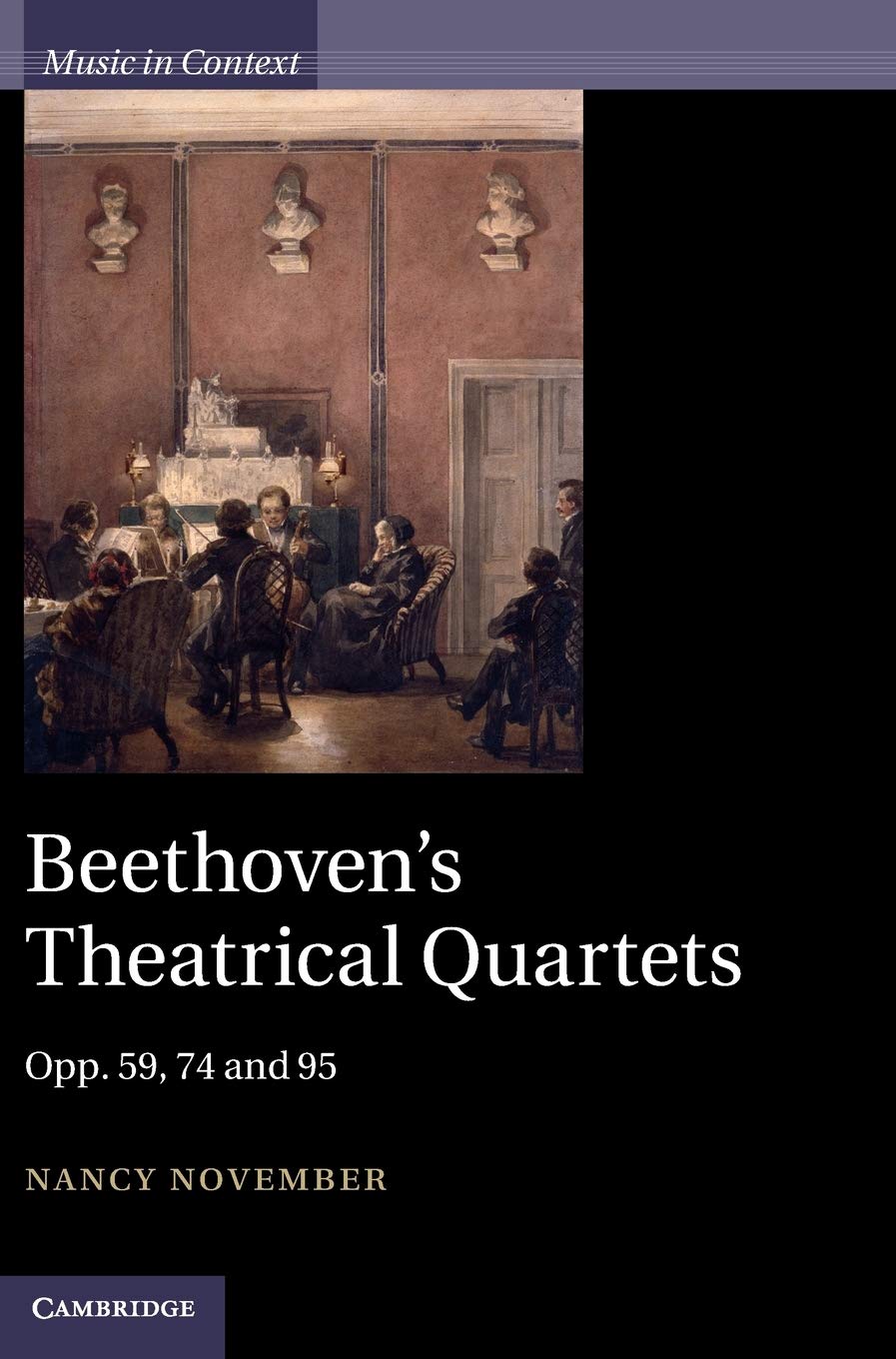
Beethoven's Theatrical Quartets: Opp. 59, 74 and 95 by Nancy November – A Contextual Study of Middle-Period Chamber Musi
Inclusive of all applicable taxes. FREE shipping on all orders.
Available Offers
- 🚚Free Delivery — Free shipping on all orders
- 💵Cash on Delivery — Pay when your order arrives
- ↩️15-Day Easy Returns — Hassle-free return policy
- 🔒Cash on Delivery — Pay safely when your order arrives
Check Delivery
Product Description
Introduction
Beethoven's middle-period string quartets—Opp. 59, 74, and 95—represent a bold departure from classical tradition, blending lyrical intimacy with theatrical drama. In Beethoven's Theatrical Quartets: Opp. 59, 74 and 95, musicologist Nancy November offers a fresh, deeply researched perspective on these works, challenging long-held assumptions about Beethoven's creative output. This book is an essential resource for Indian students, scholars, and music enthusiasts seeking to understand the cultural and aesthetic forces that shaped these revolutionary compositions.
Book Overview
Published by Cambridge University Press, this hardcover volume reexamines three iconic quartets that Beethoven composed between 1806 and 1810. November argues that these works are not merely transitional but are, in fact, profoundly innovative—infused with a theatrical sensibility that reflects the composer's engagement with contemporary ideas about performance, space, and social meaning. The book traces the quartets' reception from their early performances to modern interpretations, offering a contextual analysis that goes beyond notes and scores.
Key Highlights
- First full contextual study of Beethoven's middle-period quartets, Opp. 59, 74, and 95
- Challenges three dominant paradigms in Beethoven scholarship: the obsession with late-period works, the 'heroic' style narrative, and the view of quartets as isolated 'pure' art
- Explores theatrical and lyrical elements that define the unique character of these compositions
- Draws on reception history, early performance practices, and visual culture to build a multidimensional understanding
- Rich in analytical detail while remaining accessible to non-specialist readers
Inside the Book
The book is structured to guide readers through the historical, aesthetic, and technical dimensions of the quartets. November begins by situating the works within the Viennese musical landscape of the early 1800s, examining how Beethoven responded to the demands of patrons, performers, and audiences. She then offers detailed analyses of each quartet, focusing on their formal innovations, harmonic language, and dramatic gestures. A significant portion of the text is devoted to the quartets' physical and visual aspects—such as manuscript layout, performance spaces, and the social rituals of chamber music—showing how these elements shaped listeners' experiences.
Key Topics
- Historical context of Beethoven's middle period (1806–1810)
- Reception history and early performance traditions
- Theatricality in instrumental music
- Lyricism versus heroic style in Beethoven's quartets
- Social and ideological dimensions of chamber music
- Visual and spatial aspects of musical performance
- Critique of 'autonomous' art in musicology
Reader Benefits
This book empowers readers to hear these celebrated quartets with new ears. By uncovering the theatrical impulses behind the music, November reveals how Beethoven used contrast, surprise, and narrative-like progression to engage listeners. For Indian music students and teachers, the book provides a model for contextual analysis that can be applied to other repertoire. It also deepens appreciation for the quartets' role in shaping modern ideas about chamber music as a communal, expressive art form.
Learning Outcomes
- Understand the cultural and aesthetic debates that influenced Beethoven's middle-period quartets
- Analyze the quartets' formal and expressive features with greater insight
- Critically evaluate traditional narratives about Beethoven's stylistic periods
- Recognize the social and performative dimensions of chamber music
- Develop skills in contextual musicology and reception history
Who Should Read
This book is ideal for advanced undergraduate and postgraduate students of musicology, performance studies, and cultural history. It is also valuable for professional musicians, conductors, and music teachers who wish to deepen their interpretive approach to Beethoven's quartets. Additionally, general readers with a strong interest in classical music and Beethoven's legacy will find the book engaging and enlightening.
About the Author
Nancy November is a leading musicologist specializing in Beethoven and early nineteenth-century chamber music. She has published extensively on the social and cultural contexts of Viennese musical life, with a particular focus on string quartets. Her research combines rigorous archival work with innovative theoretical frameworks, making her a respected voice in contemporary Beethoven studies.
About the Publisher
Cambridge University Press is one of the world's oldest and most prestigious academic publishers. Known for its rigorous peer-review process and high-quality scholarship, Cambridge University Press has been a cornerstone of musicological research for over a century. This hardcover edition reflects the publisher's commitment to producing durable, beautifully designed books that serve scholars and enthusiasts alike.
Conclusion
Beethoven's Theatrical Quartets: Opp. 59, 74 and 95 is a revelatory study that transforms our understanding of some of Beethoven's most beloved works. Nancy November's original research and compelling arguments make this book a vital addition to any serious music library. Whether you are a student, performer, or devoted listener, this volume will enrich your experience of these extraordinary quartets and inspire new ways of thinking about music and meaning.
Quick Summary
Beethoven's Theatrical Quartets: Opp. 59, 74 and 95 by Nancy November is a groundbreaking scholarly work that reexamines Beethoven's middle-period string quartets through a contextual lens. Published by Cambridge University Press, this hardcover book challenges traditional narratives that prioritize Beethoven's late period and the heroic style. Instead, November delves into the reception history, early performance practices, and the social, visual, and ideological dimensions of these quartets. Readers will gain a deeper understanding of how these works both reflected and shaped the concept of chamber music as an art form. The book is ideal for Indian music students, researchers, and classical music enthusiasts who want to move beyond surface-level analysis. By offering fresh critiques of autonomy and aesthetics, it enriches the study of Beethoven's oeuvre. When you buy from Bookshops.in, you get a genuine hardcover edition with fast delivery across India, ensuring you have access to premium academic content for your studies or personal enrichment.
Book Highlights
Book Specifications
| ISBN-13 | 9781107035454 |
| ISBN-10 | 1107035457 |
| Publisher | Cambridge University Press |
| Language | English |
| Dimensions | 17.78 x 1.91 x 24.77 cm |
| Weight | 760 g |
| Country | India |
| Category | Performing Arts › Music |
| Genre | Musicology |
| Original Language | English |
Frequently Asked Questions
What is Beethoven's Theatrical Quartets about?
Who is the author of this book?
Which Beethoven quartets are covered?
Is this book suitable for Indian students?
What makes this book different from other Beethoven studies?
Does the book include musical analysis?
Is this a hardcover or paperback?
Which publisher released this book?
What is the ISBN-13?
Can I use this book for academic research?
Does the book discuss early performances of these quartets?
What is the price in INR?
Is this book part of a series?
How does this book challenge existing Beethoven scholarship?
Readers Also Search For
Customers Also Bought
Art History
The Italian Renaissance in Art

Art History
Photovoltaic Design & Installation For Dummies | by Mayfield | ForDummies | by Mayfield | ForDummies | by Mayfield | ForDummies | by Mayfield | ForDummies | by Mayfield | ForDummies | by Mayfield | ForDummies | by Mayfield | ForDummies | by Mayfield | ForDummies | by Mayfield | ForDummies | by Mayfield | ForDummies | by Mayfield | ForDummies | by Mayfield | ForDummies | by Mayfield | ForDummies | by Mayfield | ForDummies | by Mayfield | ForDummies | by Mayfield | ForDummies | by Mayfield | ForDu
Art History
Designing School Systems for All Students (English, Robert J. Manley | Richard J. Hawkins)

Art History
Routledge Library Editions: Art and Culture in the Nineteenth Century

Art History
An Errant Design (English, S. H. Long)

Art History
Distributed System Design | by Jie Wu | CRC Press | by Jie Wu | CRC Press | by Jie Wu | CRC Press | by Jie Wu | CRC Press | by Jie Wu | CRC Press | by Jie Wu | CRC Press | by Jie Wu | CRC Press | by Jie Wu | CRC Press | by Jie Wu | CRC Press | by Jie Wu | CRC Press | by Jie Wu | CRC Press | by Jie Wu | CRC Press | by Jie Wu | CRC Press | by Jie Wu | CRC Press | by Jie Wu | CRC Press | by Jie Wu | CRC Press | by Jie Wu | CRC Press | by Jie Wu | CRC Press | by Jie Wu | CRC Press | by Jie Wu | CRC
Related Products
View All
Music
The Cambridge Companion to Michael Tippett by Kenneth Gloag – Music Analysis

Music
Making Light: Haydn, Musical Camp, and the Long Shadow of German Idealism
Music
Music and the Crises of the Modern Subject by Michael L. Klein – Music Theory & Criticism
Music
Opera and Drama in Eighteenth-Century London: The King's Theatre, Garrick and the Business of Perfor
Music
Music in Theory and Practice Volume 1 | by Bruce Benward | Marilyn Saker | McGraw-Hill Companies | by Bruce Benward | Marilyn Saker | McGraw-Hill Companies | by Bruce Benward | Marilyn Saker | McGraw-Hill Companies | by Bruce Benward | Marilyn Saker | McGraw-Hill Companies | by Bruce Benward | Marilyn Saker | McGraw-Hill Companies | by Bruce Benward | Marilyn Saker | McGraw-Hill Companies | by Bruce Benward | Marilyn Saker | McGraw-Hill Companies | by Bruce Benward | Marilyn Saker | McGraw-Hill

Music