
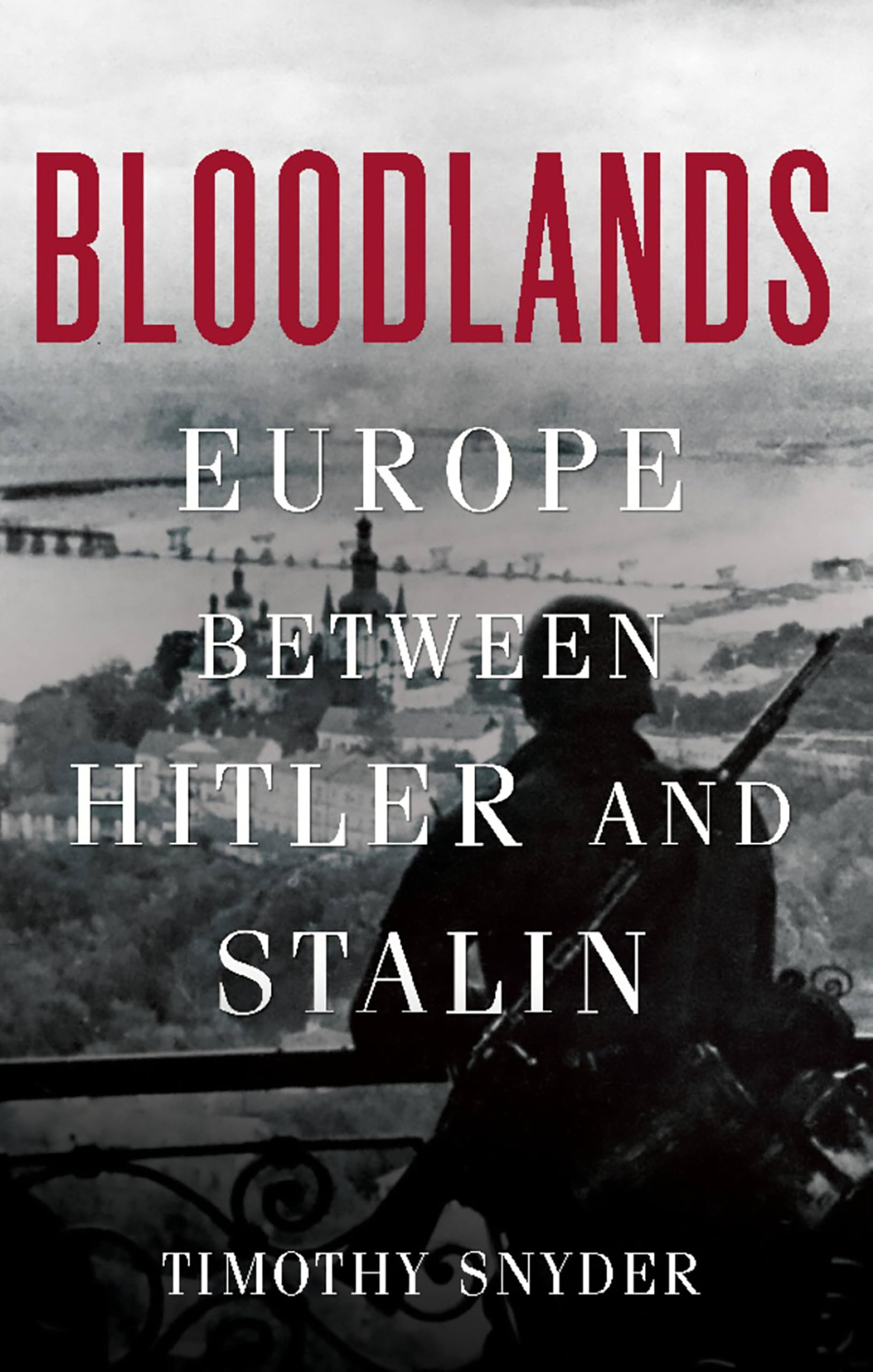
Bloodlands
Inclusive of all applicable taxes. FREE shipping on all orders.
Available Offers
- 🚚Free Delivery — Free shipping on all orders
- 💵Cash on Delivery — Pay when your order arrives
- ↩️15-Day Easy Returns — Hassle-free return policy
- 🔒Cash on Delivery — Pay safely when your order arrives
Check Delivery
Product Description
"Bloodlands: Europe Between Hitler and Stalin" by Timothy Snyder, published by Basic Books. FromIf there is an explanation for the political killing perpetrated in eastern Europe in the 1930s and 1940s, historian Snyder roots it in agriculture. Stalin wanted to collectivize farmers; Hitler wanted to eliminate them so Germans could colonize the land. The dictators wielded frightening power to advance such fantasies toward reality, and the despots toted up about 14 million corpses between them, so stupefying a figure that Snyder sets himself three goals here: to break down the number into the various actions of murder that comprise it, from liquidation of the kulaks to the final solution; to restore humanity to the victims via surviving testimony to their fates; and to deny Hitler and Stalin any historical justification for their policies, which at the time had legions of supporters and have some even today. Such scope may render Snyder’s project too imposing to casual readers, but it would engage those exposed to the period’s chronology and major interpretive issues, such as the extent to which the Nazi and Soviet systems may be compared. Solid and judicious scholarship for large WWII collections. --Gilbert Taylor ReviewTony Judt“For over a decade in the middle of twentieth century, the lands between Russia and Germany were the killing fields of Europe. Tens of millions of civilians from Poland to Ukraine, Lithuania to Belarus were starved, beaten, shot and gassed to death by the authorities and armies of the Soviet Union and Nazi Germany. We think we know this story and we assign it shorthand labels: Auschwitz, the Gulag. But neither the concentration camps (which were mostly not death camps) nor the Soviet network of labor camps in Siberia (from which many survived) were representative of the worst crimes committed in these years. Jews were without question the supreme victim (and in the Nazi case, the dominant target); but there were many other victims with whom western readers are far less familiar. Without a better grasp of the scale and breadth of the suffering experienced in these lands, we cannot hope to appreciate the true impact of the twentieth century.“In his path-breaking and often courageous study of Europe’s ‘bloodlands,’ Timothy Snyder shows how very much more complicated the story was. His account of the methods and motives of murderous regimes, both at home and in foreign war, will radically revise our appreciation of the implications of mass extermination in the recent past. Bloodlands – impeccably researched and appropriately sensitive to its volatile material – is the most important book to appear on this subject for decades and will surely become the reference in its field.”Christopher R. Browning, Frank Porter Graham Professor of History, University of North Carolina at Chapel Hill“Historians of Nazi Germany have analyzed Hitler’s war of destruction in the East, Final Solution, and vast racial revolution and colonization project outlined in the Generalplan Ost. Historians of the Soviet Union have analyzed Stalin’s collectivization, Great Terror, Gulag archipelago, deportation and exile of mistrusted minorities, and rapid sovietization of newly-annexed territories on the western border. In both cases the focus has been more often on the politics and decision-making of the dictatorships than on the fate of their victims. The stunning contribution of Tim Snyder’s book is to present a synthetic account by an East European historian in which the focus is on the geographic zone where the lethal policies of Hitler and Stalin interacted, overlapped, and mutually escalated one another. As Snyder vividly demonstrates, their combined impact on the people living in the ‘bloodlands’ was quite simply the greatest man-made demographic catastrophe and human tragedy in European history.”Professor Norman Davies, F.B.A., author of Europe: A History “Nearly seventy years after VE-Day, World War Two continues to be perceived through a narrow Western perspective, and many basic problems about the war of 1939-45 remain unresolved. In Bloodlands – which refers to the huge belt of territory between Germany and Russia – Timothy Snyder examines the little known tract of the European continent that was scourged by Stalin as well as Hitler, and reaches some disturbing conclusions. Combining formidable linguistic and detective skills with a fine sense of impartiality, he tackles vital questions which have deterred less courageous historians: Where and when were the largest casualties inflicted? Who were the perpetrators, and which ethnic and national groups were victimized? How can one calculate and verify the numbers? This is a book which will force its readers to rethink history.”Timothy Garton Ash, Professor of European Studies, University of Oxford, and author of The File“Timothy Snyder has written a nuanced, original and penetrating analysis of Europe’s twentieth century killing fields between Russia and Germany, drawing on many little-known sources. History of a high order, Bloodlands may also point us towards lessons for our own time.”Kirkus, Starred Review “A chillingly systematic study of the mass murder mutually perpetrated by the Soviet Union and Nazi Germany…. A significant work of staggering figures and scholarship.”Booklist“Solid and judicious scholarship.”The Sunday Times (London)“This is a superb work of scholarship, full of revealing detail, cleverly compiled from a number of previously little-known sources, and in places beautifully written…. He searched hidden archives in five countries and judiciously mined unknown memoirs and diaries. . . . Snyder does justice to the horror of his subject through the power of his storytelling.” Guardian (London)“[ Bloodlands ] modifies our view of this appalling period. . . . Snyder insists that the colossal atrocities in his ‘bloodlands’ have to be set inside a single historical frame. To look at them separately – for instance, to see Hitler’s crimes as ‘so great as to stand outside history’, or Stalin’s as a monstrous device to achieve modernisation – is to let the two dictators ‘define their own works for us’. . . .This book’s unforgettable account of the Ukraine famine shows conclusively that Stalin knew what was happening in the countryside and chose to let it run its course. . . . The figures are so huge and so awful that grief could grow numb. But Snyder, who is a noble writer as well as a great researcher, knows that. He asks us not to think in those round numbers.” The Economist “[G]ripping and comprehensive…. Mr. Snyder’s book is revisionist history of the best kind: in spare, closely argued prose, with meticulous use of statistics, he makes the reader rethink some of the best-known episodes in Europe’s modern history…. Even those who pride themselves on knowing their history will find themselves repeatedly brought up short by his insights, contrasts and comparisons…. Mr. Snyder’s scrupulous and nuanced book steers clear of the sterile, sloganising exchanges about whether Stalin was as bad as Hitler, or whether Soviet mass murder in Ukraine or elsewhere is a moral equivalent of the Nazis’ extermination of the Jews. What it does do, admirably, is to explain and record. Both totalitarian empires turned human beings into statistics, and their deaths into a necessary step towards a better future. Mr. Snyder’s book explains, with sympathy, fairness and insight, how that happened, and to whom.”Anne Applebaum, New York Review of Books “[A] brave and original history of mass killing in the twentieth century…. Snyder’s original contribution is to treat all of these episodes—the Ukrainian famine, the Holocaust, Stalin’s mass executions, the planned starvation of Soviet POWs, postwar ethnic cleansing—as different facets of the same phenomenon. Instead of studying Nazi atrocities or Soviet atrocities separately, as many others have done, he looks at them together. Yet Snyder does not exactly compare the two systems either. His intention, rather, is to show that the two systems committed the same kinds of crimes at the same times and in the same places, that they aided and abetted one another, and above all that their interaction with one another led to more mass killing than either might have carried out alone.” The Wall Street Journal “The story of World War II, like that of most wars, usually gets told by the victors. Diplomatic and military accounts are set largely in the West and star the morally upright Allies—the U.S., Britain and Soviet Union—in battles against fascism. The Holocaust gets its own separate history, as a case apart in its genocidal intent and human tragedy. Timothy Snyder’s Bloodlands: Europe Between Hitler and Stalin forces a dramatic shift in these perceptions…. Among his other goals in Bloodlands, Mr. Snyder attempts to put the Holocaust in context—to restore it, in a sense, to the history of the wider European conflict. This is a task that no historian can attempt without risking controversy. Yet far from minimizing Jewish suffering, Bloodlands gives a fuller picture of the Nazi killing machine.”The Economist “[G]ripping and comprehensive…. Mr. Snyder’s book is revisionist history of the best kind: in spare, closely argued prose, with meticulous use of statistics, he makes the reader rethink some of the best-known episodes in Europe’s modern history…. Even those who pride themselves on knowing their history will find themselves repeatedly brought up short by his insights, contrasts and comparisons…. Mr. Snyder’s scrupulous and nuanced book steers clear of the sterile, sloganising exchanges about whether Stalin was as bad as Hitler, or whether Soviet mass murder in Ukraine or elsewhere is a moral equivalent of the Nazis’ extermination of the Jews. What it does do, admirably, is to explain and record. Both totalitarian empires turned human beings into statistics, and their deaths into a necessary step towards a better future. Mr. Snyder’s book explains, with sympathy, fairness and insight, how that happened, and to whom.”Anne Applebaum, New York Review of Books “[A] brave and original history of mass killing in the twentieth century…. Snyder’s original contribution is to treat all of these episodes—the Ukrainian famin... Book details: published 2010. Order now on BookShops.in with fast, reliable delivery across India.
Book Specifications
| ISBN-13 | 9780465002399 |
| ISBN-10 | 0465002390 |
| Publisher | Basic Books |
| Language | english |
| Print Length | 560 pages |
| Category | Politics |
Frequently Asked Questions
What is the price of Bloodlands?
Does BookShops.in offer free delivery for Bloodlands?
Is Cash on Delivery available for Bloodlands?
What is the return policy for Bloodlands?
Is Bloodlands authentic?
Related Products
View All
Politics
Liberty and Legislation
Politics
Israel's National Security Towards the 21st Century
Politics
Russia in the National Interest
Politics
Social Science In Government
Politics
Sport and Peace-Building in Divided Societies: Playing with Enemies
Politics