
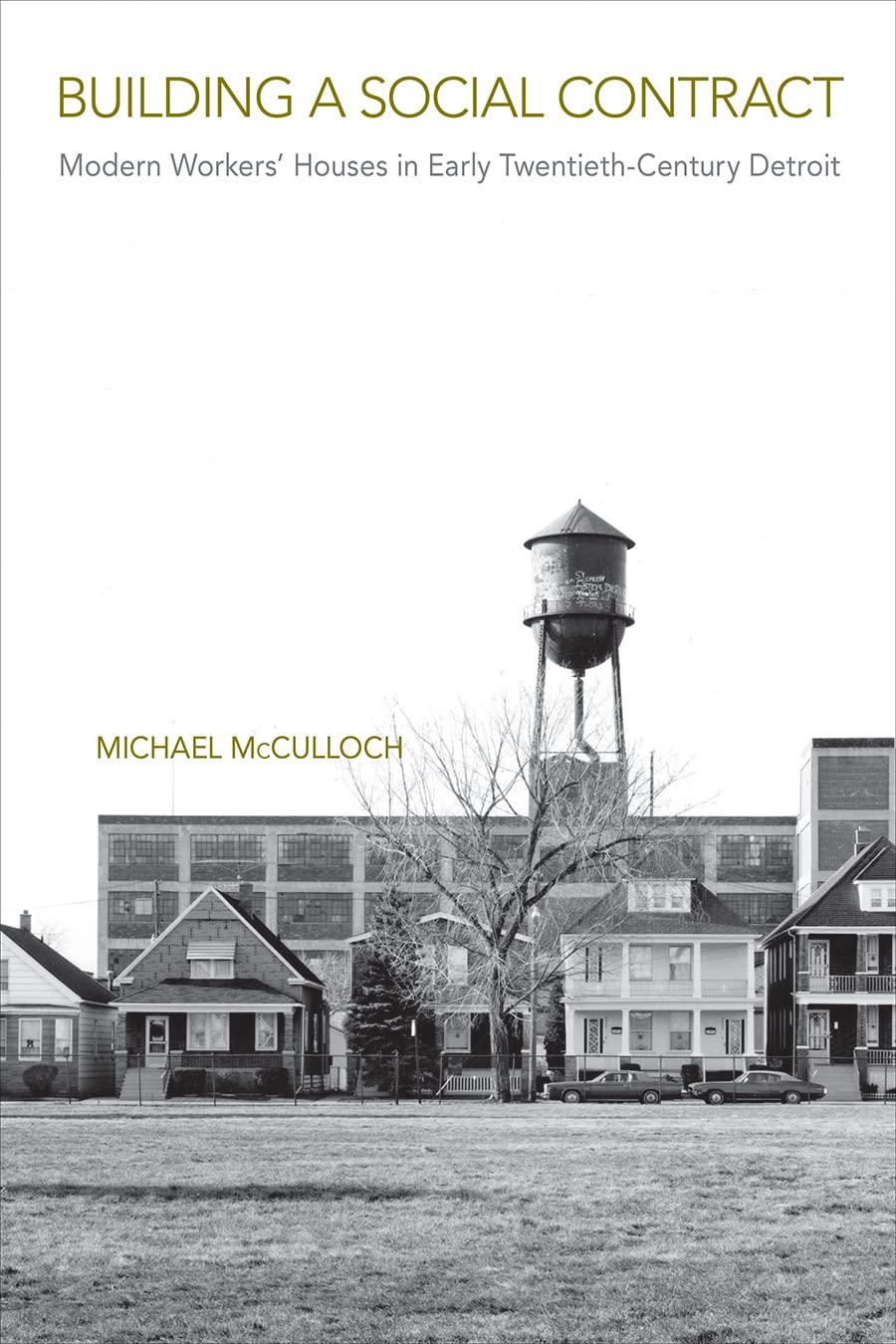
Building a Social Contract: Modern Workers Houses in Early-twentieth Century Detroit by Michael McCulloch – A Deep Dive
Inclusive of all applicable taxes. FREE shipping on all orders.
Available Offers
- 🚚Free Delivery — Free shipping on all orders
- 💵Cash on Delivery — Pay when your order arrives
- ↩️15-Day Easy Returns — Hassle-free return policy
- 🔒Cash on Delivery — Pay safely when your order arrives
Check Delivery
Product Description
Introduction
Building a Social Contract: Modern Workers Houses in Early-twentieth Century Detroit by Michael McCulloch is a compelling historical account that explores the intersection of housing, labour, and social change in early twentieth-century America. This hardbound volume from Temple University Press offers Indian readers, especially students of urban studies, sociology, and economic history, a rare lens into how the dream of a modern home shaped the lives of industrial workers. Through meticulous research and vivid narratives, McCulloch reveals how Detroit’s working class negotiated a new social compact that promised upward mobility through better housing — a story that resonates with India’s own urbanisation and housing challenges today.
Book Overview
Set against the backdrop of early twentieth-century Detroit, this book chronicles the unprecedented boom in worker housing that peaked in the mid-1920s. McCulloch traces how employers, government agencies, and the building industry collaborated — and sometimes clashed — with wage earners to produce larger, better-equipped homes. The narrative draws on oral histories, personal letters, period photographs, and even fiction to show how workers actively shaped their living conditions. The result is a nuanced history of a social contract where hard work was rewarded with modern houses, even as it left workers vulnerable to economic downturns. For Indian readers, this story offers powerful parallels with the growth of industrial cities like Mumbai, Chennai, and Bengaluru.
Key Highlights
- Original research: Based on rare primary sources including worker testimonies, letters, and photographs.
- Focus on agency: Highlights how workers themselves negotiated for better housing, not just as beneficiaries but as active participants.
- Urban transformation: Examines Detroit as a quintessential industrial city where migrant workers were Americanised through housing.
- Social contract theory: Introduces a fresh framework linking housing to implicit agreements between labour and capital.
- Relevant to India: Offers insights into the politics of affordable housing, urban planning, and labour rights in a developing economy.
Inside the Book
The book is divided into thematic chapters that move from the dream of the modern house to its material realities. Readers will encounter detailed descriptions of house designs, financing models, and the role of real estate agents. McCulloch also explores how speculative builders shaped neighbourhoods, and how workers’ increased bargaining power during the boom era eventually gave way to the Great Depression. The narrative is enriched with floor plans, archival images, and excerpts from period fiction that bring the era to life. Each chapter builds a layered understanding of how a house was never just a structure but a symbol of dignity, aspiration, and risk.
Key Topics
- History of working-class housing in early twentieth-century America
- Role of employers in providing or influencing worker accommodation
- Government housing policies and their impact on urban development
- Real estate speculation and the construction industry’s dynamics
- Migration, Americanisation, and the cultural meaning of home ownership
- Labour movements and the negotiation of social contracts
- Economic vulnerability and the limits of upward mobility through housing
Reader Benefits
This book equips readers with a deeper understanding of how housing is never just a physical asset but a site of social struggle and aspiration. For Indian students and professionals in architecture, urban planning, sociology, and economics, it provides comparative insights into how industrial cities worldwide have grappled with the challenge of providing dignified housing for workers. The rich storytelling makes complex historical processes accessible, while the analytical framework helps readers think critically about contemporary housing crises in Indian cities. The book also inspires reflection on the role of government, private sector, and communities in shaping urban futures.
Learning Outcomes
- Understand the historical evolution of worker housing in industrial America
- Analyse the concept of a social contract as it applies to housing and labour
- Evaluate the role of multiple stakeholders — employers, state, builders, workers — in housing provision
- Draw parallels between Detroit’s experience and India’s urbanisation patterns
- Critically assess the promises and pitfalls of home ownership as a pathway to social mobility
- Develop a nuanced view of how architecture and urban form reflect power relations
Who Should Read
This book is ideal for undergraduate and postgraduate students of history, sociology, urban studies, architecture, and economics. It is equally valuable for researchers focusing on labour history, housing policy, or comparative urbanism. Professionals in real estate, urban planning, and public policy will find the historical perspective enriching for their current work. General readers with an interest in social history or the stories behind the built environment will also enjoy McCulloch’s engaging prose. The book is especially recommended for Indian readers curious about how industrial cities elsewhere have tackled the housing question — lessons that remain urgent today.
About the Author
Michael McCulloch is a historian whose work centres on the social and material lives of working people in early twentieth-century America. His research combines archival depth with a sensitivity to the voices of ordinary individuals, making his scholarship both rigorous and humane. McCulloch’s expertise in urban history and labour studies is evident in this carefully crafted volume, which has been praised for its original use of oral histories and visual sources. He teaches at a leading American university and continues to explore how everyday spaces — like houses — reflect broader social contracts.
About the Publisher
Temple University Press is a respected academic publisher based in Philadelphia, USA, known for its strong lists in urban studies, sociology, history, and public policy. Since its founding, the press has championed works that bridge scholarly research and public discourse, making complex ideas accessible to a wider audience. This hardcover edition of Building a Social Contract reflects the press’s commitment to high-quality production and enduring scholarship — a valuable addition to any library or personal collection.
Conclusion
Building a Social Contract is more than a history of houses; it is a profound exploration of how working people fought for — and sometimes won — a place in the modern city. Michael McCulloch’s vivid storytelling and rigorous analysis make this book a vital resource for anyone interested in the social dimensions of urban life. For Indian readers, it offers not just a window into Detroit’s past but a mirror for reflecting on our own urban present. Order your hardcover copy from Bookshops.in today and add this essential work to your collection.
Quick Summary
Building a Social Contract: Modern Workers Houses in Early-twentieth Century Detroit by Michael McCulloch is a compelling historical study that examines the rise of modern worker housing in industrial America. The book focuses on Detroit, the heart of the automobile industry, where wage earners gained unprecedented access to new, larger, and better-equipped homes during the early 1900s. McCulloch draws on oral histories, letters, photographs, and period fiction to reveal how workers actively negotiated a new social contract that rewarded hard work with upward mobility through homeownership. The book is ideal for students and scholars of labor history, urban studies, architecture, and sociology, as well as general readers interested in the roots of housing inequality. Readers will learn how employers, government agencies, and the building industry collaborated with workers to produce a housing boom that peaked in the mid-1920s. They will also discover the limits of this social contract, which excluded many based on race and class. By purchasing from Bookshops.in, Indian readers gain access to a premium imported hardcover edition with fast delivery and excellent customer service.
Book Highlights
Book Specifications
| ISBN-13 | 9781439923924 |
| ISBN-10 | 1439923922 |
| Publisher | Temple Univ Pr |
| Language | English |
| Dimensions | 15.24 x 1.78 x 22.86 cm |
| Weight | 408 g |
| Category | Economics › Labor & Industrial Relations |
| Genre | History |
| Reading Age | Adult |
| Original Language | English |
Frequently Asked Questions
What is Building a Social Contract about?
Who is the author of Building a Social Contract?
What time period does the book cover?
What sources does the author use?
Is this book suitable for Indian readers?
What is the main argument of the book?
Does the book discuss race or gender?
What is the price of the book?
What is the ISBN of the book?
What is the reading level?
Does the book include illustrations?
Why buy from Bookshops.in?
Readers Also Search For
Customers Also Bought
Entrepreneurship
Chinese Economic Revolution (English, Linda Grove)

Entrepreneurship
Engines of Innovation: The Entrepreneurial University in the Twenty-First Century by Holden Thorp

Entrepreneurship
Invention to Innovation (English, PhD Marshall Larry | Jenna Daroczy)

Entrepreneurship
Database Management Systems by Raghu Ramakrishnan – DBMS Textbook

Entrepreneurship
Decision-making for Technology Executives by Harold A. Linstone

Entrepreneurship
The Business Innovation Audit (English, William Tate)
Related Products
View All
Economics
Political Economy from Pufendorf to Marx (English, István Hont | Lasse S. Andersen | Béla Kapossy)

Economics
Women's Entrepreneurship and Economics (English, Miguel-Angel Galindo | Domingo Ribeiro)

Economics
Trade Policy and Industrialization in Turbulent Times | by Gerry Helleiner | Routledge | by Gerry Helleiner | Routledge | by Gerry Helleiner | Routledge | by Gerry Helleiner | Routledge | by Gerry Helleiner | Routledge | by Gerry Helleiner | Routledge | by Gerry Helleiner | Routledge | by Gerry Helleiner | Routledge | by Gerry Helleiner | Routledge | by Gerry Helleiner | Routledge | by Gerry Helleiner | Routledge | by Gerry Helleiner | Routledge | by Gerry Helleiner | Routledge | by Gerry Hellei

Economics
History of Economic Analysis | by Schumpeter Joseph A. | Taylor & Francis Ltd | by Schumpeter Joseph A. | Taylor & Francis Ltd | by Schumpeter Joseph A. | Taylor & Francis Ltd | by Schumpeter Joseph A. | Taylor & Francis Ltd | by Schumpeter Joseph A. | Taylor & Francis Ltd | by Schumpeter Joseph A. | Taylor & Francis Ltd | by Schumpeter Joseph A. | Taylor & Francis Ltd | by Schumpeter Joseph A. | Taylor & Francis Ltd | by Schumpeter Joseph A. | Taylor & Franci

Economics
OECD Compendium of Productivity Indicators 2015 | by Organization for Economic Cooperation an | Organization for Economic Co-Operation & Deve | by Organization for Economic Cooperation an | Organization for Economic Co-Operation & Deve | by Organization for Economic Cooperation an | Organization for Economic Co-Operation & Deve | by Organization for Economic Cooperation an | Organization for Economic Co-Operation & Deve | by Organization for Economic Cooperation an | Organization

Economics