
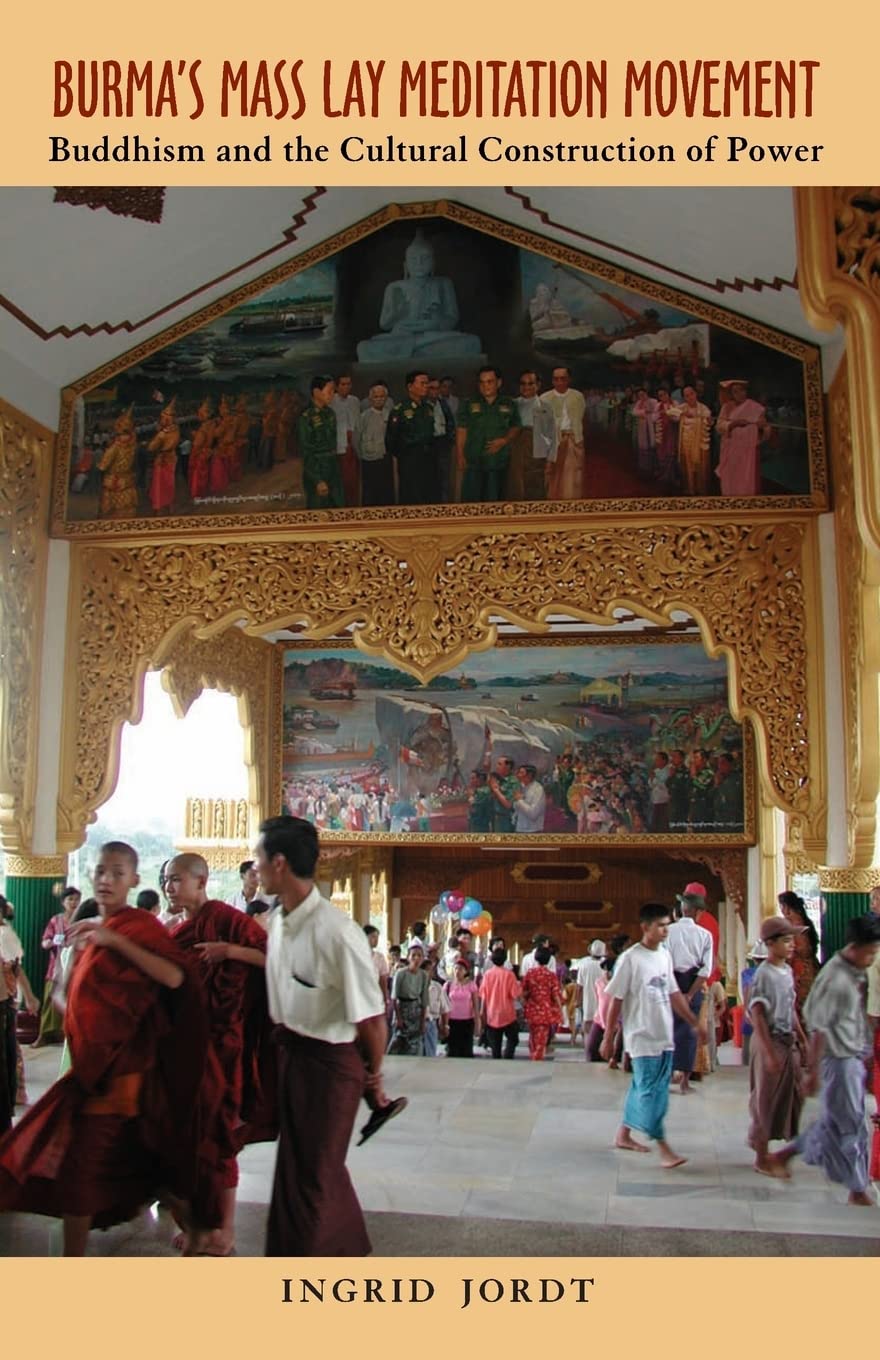
Burma's Mass Lay Meditation Movement: Buddhism and the Cultural Construction of Power by Ingrid Jordt
Inclusive of all applicable taxes. FREE shipping on all orders.
Available Offers
- 🚚Free Delivery — Free shipping on all orders
- 💵Cash on Delivery — Pay when your order arrives
- ↩️15-Day Easy Returns — Hassle-free return policy
- 🔒Cash on Delivery — Pay safely when your order arrives
Check Delivery
Product Description
Introduction
In the landscape of contemporary Buddhist studies, few works offer as profound and politically charged an analysis as Ingrid Jordt's Burma's Mass Lay Meditation Movement: Buddhism and the Cultural Construction of Power. This hardcover volume, published by Ohio University Press, takes readers deep into the heart of Myanmar (Burma) to explore how a quiet, meditative revolution has reshaped the relationship between spiritual practice and authoritarian rule. For Indian readers and students of religion, politics, and South Asian studies, this book provides an indispensable lens through which to understand the subtle yet powerful ways Buddhism can challenge state power without overt confrontation.
Book Overview
Drawing on over a decade of immersive fieldwork, Jordt documents the rise of the vipassanā (insight meditation) movement among laypeople in Burma. Unlike traditional monastic practice, this movement empowered ordinary citizens to cultivate inner awareness and moral autonomy. The book argues that this shift in worldview—from passive acceptance to active, mindful engagement—enabled millions to resist the psychological grip of a totalitarian regime. The meditation movement did not topple the junta, but it created a cultural space where individuals could think and act independently, undermining the regime's monopoly on power. The author's unprecedented access to both political and religious elites makes this a uniquely authoritative account.
Key Highlights
- Original Fieldwork: Ten years of on-the-ground research in Burma, including access to meditation centers and government circles.
- Unique Perspective: Explains how a religious movement succeeded where political resistance failed in challenging dictatorship.
- Cultural Power Analysis: Examines how meditation reshapes concepts of authority, selfhood, and social order.
- Human Rights Context: Connects spiritual practice to broader struggles for freedom and dignity under oppression.
- Buddhist Modernity: Shows how ancient practices are adapted to confront modern political realities.
Inside the Book
The book is structured to guide readers through the historical, religious, and political layers of the movement. Early chapters lay out the colonial and post-colonial context of Buddhism in Burma, while later sections delve into the phenomenology of meditation as a transformative practice. Jordt uses ethnographic vignettes—conversations with meditators, monks, and military officers—to bring the narrative to life. The final chapters offer a theoretical framework for understanding how a mass lay movement can generate cultural power that rivals the state's coercive apparatus. The writing is rigorous yet accessible, making complex ideas understandable without oversimplification.
Key Topics
- Vipassanā Meditation: Its history, techniques, and role in lay practice.
- Military Junta Rule: Mechanisms of control and the limits of state power.
- Buddhist Ethics and Politics: How moral cultivation becomes political resistance.
- Cultural Construction of Power: The interplay between religion, authority, and social change.
- Totalitarianism and Subjectivity: How regimes shape inner lives and how individuals reclaim agency.
- Modern Burmese History: From independence to the 2007 Saffron Revolution and beyond.
Reader Benefits
- Gain a deep understanding of how non-violent, spiritual movements can challenge authoritarian systems.
- Learn about a lesser-known but historically significant Buddhist revival in Southeast Asia.
- Appreciate the role of laypeople in transforming religious traditions.
- Develop critical insights into the relationship between religion and state power—relevant to Indian contexts as well.
- Enhance your knowledge of ethnographic research methods and cultural analysis.
Learning Outcomes
- Explain the key features of the mass lay meditation movement in Burma.
- Analyze how meditation practices can reconfigure individual and collective agency.
- Critically evaluate the concept of “cultural power” as distinct from political or military power.
- Identify parallels between Buddhist activism in Burma and other religious movements in South Asia.
- Understand the methodological challenges of conducting fieldwork in repressive environments.
Who Should Read
- Students of Buddhist Studies: Essential for courses on modern Buddhism and meditation.
- Political Scientists: Those interested in non-traditional forms of resistance and authoritarianism.
- Anthropologists: A model of engaged, long-term ethnographic research.
- Indian Readers: Given India's shared Buddhist heritage and similar political challenges, the book offers valuable comparative insights.
- General Readers: Anyone curious about how inner transformation can spark outer change.
About the Author
Ingrid Jordt is a professor of anthropology at the University of Wisconsin-Milwaukee. She has conducted extensive fieldwork in Burma since the 1990s, focusing on Buddhism, politics, and social change. Her work bridges religious studies, political theory, and cultural anthropology, earning her international recognition. She is also the author of several scholarly articles on Burmese Buddhism and human rights.
About the Publisher
Ohio University Press is a respected academic publisher based in Athens, Ohio, known for its rigorous scholarship in the humanities and social sciences. The press has a strong list in Southeast Asian studies, with a commitment to publishing works that illuminate complex cultural and political dynamics. This hardcover edition reflects the press's dedication to quality production and enduring academic value.
Conclusion
Burma's Mass Lay Meditation Movement is more than a book about Buddhism; it is a profound meditation on power, resistance, and the human spirit. Ingrid Jordt's work reveals how a simple act—sitting in silent awareness—can become a revolutionary force. For Indian readers, who live in a land where spirituality and politics often intersect, this book offers both a mirror and a window: a mirror reflecting our own struggles for dignity, and a window into a neighboring world where quiet minds shook a mighty regime. Add this essential volume to your library and discover the transformative power of insight.
Quick Summary
Ingrid Jordt's 'Burma's Mass Lay Meditation Movement' is a groundbreaking ethnographic study of how vipassanā meditation evolved into a mass lay movement that reshaped Burmese society under a military dictatorship. Based on over ten years of fieldwork, Jordt reveals how this Buddhist revitalization movement empowered millions to think and act independently, challenging the totalitarian regime's control. The book explores the cultural construction of power, the entanglement of religion and politics, and the role of meditation in fostering human rights consciousness. Ideal for students of Buddhist studies, anthropology, and political science, this work offers a unique lens into nonviolent resistance. Readers will gain a deep understanding of how spiritual practice can become a form of political agency. By purchasing from Bookshops.in, you support an Indian bookstore dedicated to bringing scholarly works to local readers with reliable service.
Book Highlights
Book Specifications
| ISBN-13 | 9780896802551 |
| ISBN-10 | 0896802558 |
| Publisher | Ohio Univ Pr |
| Language | English |
| Dimensions | 13.97 x 2.03 x 21.59 cm |
| Weight | 363 g |
| Country | India |
| Category | Political Science › International Relations |
| Genre | Non-fiction |
| Original Language | English |
Frequently Asked Questions
What is 'Burma's Mass Lay Meditation Movement' about?
Who is the author Ingrid Jordt?
Is this book suitable for beginners in Buddhist studies?
Does the book cover recent events in Myanmar?
What is vipassanā meditation?
How does the book relate to human rights?
What makes this book unique?
Can I use this book for academic research?
Does the book discuss the military junta?
Is the book written in English?
What is the ISBN-13?
Where can I buy this book in India?
Readers Also Search For
Customers Also Bought

International Relations
Clients, Rivals, and Rogues: Why Great Powers Intervene in Revolutionary Civil Wars
International Relations
Foreign Ministries and the Information Revolution: Going Virtual?: 2 (Diplomatic Studies)
International Relations
From Pki to Comintern, 1924-1941: The Apprenticeship of the Malayan Communist Party: 8 (Southeast Asia Program Series, 8)
International Relations
The Evolving Terrorist Threat to Southeast Asia: A Net Assessment

International Relations
The Naval Policy of Austria-Hungary 1867-1918: Navalism, Industrial Development, and the Politics of Dualism (Central European Studies)

International Relations
New Technologies and Law of the Marine Environment: Nouvelles Technologies Et Droit De L'Environment Marin: 55 (International Enviornmental Law and Policy, 55)
Related Products
View AllInternational Relations
Clients, Rivals, and Rogues: Why Great Powers Intervene in Revolutionary Civil Wars
International Relations
Foreign Ministries and the Information Revolution: Going Virtual?: 2 (Diplomatic Studies)
International Relations
From Pki to Comintern, 1924-1941: The Apprenticeship of the Malayan Communist Party: 8 (Southeast Asia Program Series, 8)
International Relations
The Evolving Terrorist Threat to Southeast Asia: A Net Assessment
International Relations
The Naval Policy of Austria-Hungary 1867-1918: Navalism, Industrial Development, and the Politics of Dualism (Central European Studies)
International Relations