
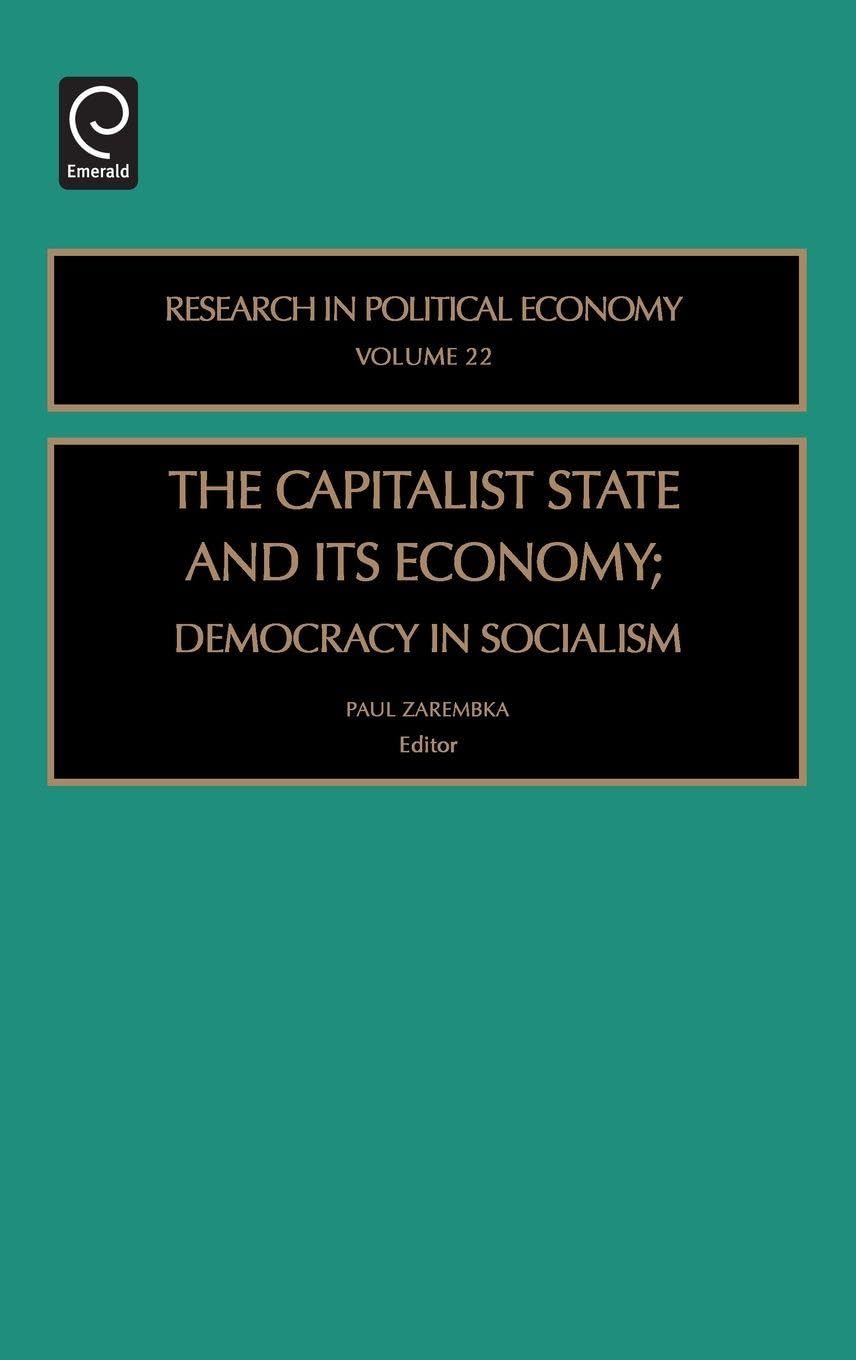
The Capitalist State And Its Economy: Democracy In Socialism – A Marxist Analysis of State and Capital by Paul Zarembka
Inclusive of all applicable taxes. FREE shipping on all orders.
Available Offers
- 🚚Free Delivery — Free shipping on all orders
- 💵Cash on Delivery — Pay when your order arrives
- ↩️15-Day Easy Returns — Hassle-free return policy
- 🔒Cash on Delivery — Pay safely when your order arrives
Check Delivery
Product Description
Introduction
In an era where economic systems and political structures are increasingly intertwined, understanding the role of the state within capitalism has never been more critical. The Capitalist State And Its Economy: Democracy In Socialism by Paul Zarembka offers a rigorous, scholarly exploration of how state power shapes economic realities. Published by Jai Press Inc., this hardcover volume is an indispensable resource for Indian students, researchers, and policy enthusiasts seeking to grasp the complex dynamics between democracy, socialism, and the capitalist state. This book moves beyond surface-level analysis, diving deep into historical and contemporary mechanisms that define state-capital relations.
Book Overview
This meticulously researched work examines the capitalist state not as a neutral arbiter but as an active participant in the evolution of economic systems. Zarembka traces the welfare state's origins to the class structures of English agrarian capitalism, then expands the lens to European colonies, including Africa, where taxation was weaponized to coerce indigenous populations into wage labor. The book then shifts to modern debates, probing how contradictions between labor and capital reshape nation-state relationships. A significant portion also addresses price formation and technical choice under capitalism, offering a fresh hermeneutic approach to understanding capitalist institutions. This is not a textbook; it is a critical inquiry into the very foundations of political economy.
Key Highlights
- Historical Depth: Connects the welfare state to agrarian class struggles in England, providing a genealogical perspective.
- Colonial Context: Analyzes how taxation in African colonies functioned as a tool for primitive accumulation, referencing Marx’s theories.
- Contemporary Relevance: Explores the shifting relationship between nation-states and capital in the modern era, driven by labor-capital contradictions.
- Hermeneutic Approach: Proposes a novel method for analyzing capitalist institutions, emphasizing interpretation and understanding over rigid models.
- Price and Technical Choice: Delves into the formation of prices and technological decisions within capitalist frameworks, challenging mainstream economic assumptions.
Inside the Book
The volume is structured into two major parts. The first part focuses on the state in capitalist society, beginning with the historical emergence of the welfare state from English agrarian capitalism. It then moves to colonial taxation as a mechanism of primitive accumulation, followed by chapters on the contemporary nation-state’s contradictions and a hermeneutic analysis of institutions. The second part tackles price and technical choice, with chapters suggesting that price formation follows the same logic as the foundational processes of capitalism. Each chapter builds on rigorous theoretical frameworks, supported by historical evidence and critical engagement with Marxist thought.
Key Topics
- The welfare state as a product of class structure in agrarian capitalism
- Taxation and primitive accumulation in European colonies
- Contradictions between labor and capital in nation-state dynamics
- Hermeneutic understanding of capitalist institutions
- Price formation and technical choice under capitalism
- Marxist analysis of state power and economic policy
Reader Benefits
Readers will gain a sophisticated understanding of how state actions—from welfare policies to taxation—are not arbitrary but deeply embedded in class relations. This book equips you with the analytical tools to deconstruct contemporary economic debates, whether about government intervention, market regulation, or the future of democracy in socialist contexts. Indian readers will particularly appreciate the colonial and post-colonial perspectives, which offer parallels to India’s own economic history and state-building processes. The hermeneutic approach also encourages critical thinking, moving beyond simplistic economic models to interpret institutional realities.
Learning Outcomes
By engaging with this book, you will be able to: identify the historical roots of the welfare state in class struggles; explain how colonial taxation facilitated primitive accumulation; analyze the contradictory relationship between nation-states and global capital; apply hermeneutic methods to understand capitalist institutions; critique mainstream economic theories of price and technical choice; and connect Marxist theory to contemporary political-economic challenges. This book will deepen your capacity for critical analysis in economics, political science, and sociology.
Who Should Read
This book is ideal for postgraduate students and researchers in economics, political science, sociology, and history. It is also highly valuable for policy analysts, activists, and anyone interested in Marxist theory, state theory, and the political economy of development. Indian readers studying political economy, colonial history, or contemporary capitalism will find the theoretical frameworks directly applicable to understanding India’s own state-capital dynamics. Academics teaching courses on economic thought or comparative political systems will also benefit from this rigorous text.
About the Author
Paul Zarembka is a distinguished scholar known for his critical contributions to Marxist economics and political economy. His work focuses on the intersections of state power, class conflict, and economic transformation. With a career spanning decades, Zarembka has edited and authored numerous volumes that challenge orthodox economic thinking, making him a respected voice in heterodox economics. His research often bridges historical analysis with contemporary issues, offering insights that are both theoretically profound and empirically grounded.
About the Publisher
Jai Press Inc. is a reputable academic publisher known for producing high-quality scholarly works in the social sciences, particularly economics, political science, and sociology. Their publications are characterized by rigorous peer review and a commitment to advancing critical knowledge. This hardcover edition reflects the publisher’s dedication to durable, long-lasting books that serve as lasting resources for libraries, universities, and serious readers.
Conclusion
The Capitalist State And Its Economy: Democracy In Socialism is a powerful, thought-provoking work that challenges readers to rethink the relationship between state and economy. Paul Zarembka’s incisive analysis, combined with historical depth and theoretical innovation, makes this book a vital addition to any serious student’s library. For Indian readers seeking to understand the complexities of capitalism, democracy, and socialism in a global context, this hardcover edition offers enduring value. Order your copy from Bookshops.in today and deepen your understanding of the forces that shape our world.
Quick Summary
The Capitalist State And Its Economy: Democracy In Socialism by Paul Zarembka is a rigorous academic work that dissects the capitalist state's role through a Marxist lens. It begins by tracing the welfare state's origins to the class structure of English agrarian capitalism, then examines how colonial taxation in Africa served as a mechanism for primitive accumulation, forcing indigenous populations into wage labor. Subsequent chapters analyze the contemporary contradictory relationship between nation-state and capital, rooted in labor versus capital needs, and propose a hermeneutic approach to understanding capitalist institutions. This book is ideal for postgraduate students, researchers, and academics in political economy, development studies, and critical theory. Readers will gain a deep understanding of how state power is shaped by class struggle and capital accumulation, with direct relevance to Indian colonial and post-colonial contexts. By purchasing from Bookshops.in, you receive a high-quality hardcover edition from Jai Press Inc., ensuring access to this essential scholarly resource.
Book Highlights
Book Specifications
| ISBN-13 | 9780762311767 |
| ISBN-10 | 0762311762 |
| Publisher | Jai |
| Language | English |
| Dimensions | 15.6 x 1.9 x 23.4 cm |
| Weight | 590 g |
| Category | Economics › Free Enterprise |
| Genre | Non-fiction |
| Reading Age | Adult |
| Original Language | English |
Frequently Asked Questions
What is the main argument of The Capitalist State And Its Economy?
Who is Paul Zarembka?
Is this book relevant for Indian readers?
What does the book say about democracy and socialism?
Does the book cover contemporary issues?
What is primitive accumulation according to this book?
Is this book suitable for undergraduate students?
What methodology does the book use?
How does the book connect to Indian economics?
What is the ISBN for this book?
Is this book part of a series?
What language is the book in?
Where can I buy this book in India?
Does the book include case studies?
Readers Also Search For
Customers Also Bought
Entrepreneurship
Chinese Economic Revolution (English, Linda Grove)
Entrepreneurship
Engines of Innovation: The Entrepreneurial University in the Twenty-First Century by Holden Thorp

Entrepreneurship
Invention to Innovation (English, PhD Marshall Larry | Jenna Daroczy)

Entrepreneurship
Database Management Systems by Raghu Ramakrishnan – DBMS Textbook

Entrepreneurship
Decision-making for Technology Executives by Harold A. Linstone
Entrepreneurship
The Business Innovation Audit (English, William Tate)
Related Products
View All
Economics
Political Economy from Pufendorf to Marx (English, István Hont | Lasse S. Andersen | Béla Kapossy)
Economics
Women's Entrepreneurship and Economics (English, Miguel-Angel Galindo | Domingo Ribeiro)
Economics
Trade Policy and Industrialization in Turbulent Times | by Gerry Helleiner | Routledge | by Gerry Helleiner | Routledge | by Gerry Helleiner | Routledge | by Gerry Helleiner | Routledge | by Gerry Helleiner | Routledge | by Gerry Helleiner | Routledge | by Gerry Helleiner | Routledge | by Gerry Helleiner | Routledge | by Gerry Helleiner | Routledge | by Gerry Helleiner | Routledge | by Gerry Helleiner | Routledge | by Gerry Helleiner | Routledge | by Gerry Helleiner | Routledge | by Gerry Hellei

Economics
History of Economic Analysis | by Schumpeter Joseph A. | Taylor & Francis Ltd | by Schumpeter Joseph A. | Taylor & Francis Ltd | by Schumpeter Joseph A. | Taylor & Francis Ltd | by Schumpeter Joseph A. | Taylor & Francis Ltd | by Schumpeter Joseph A. | Taylor & Francis Ltd | by Schumpeter Joseph A. | Taylor & Francis Ltd | by Schumpeter Joseph A. | Taylor & Francis Ltd | by Schumpeter Joseph A. | Taylor & Francis Ltd | by Schumpeter Joseph A. | Taylor & Franci

Economics
OECD Compendium of Productivity Indicators 2015 | by Organization for Economic Cooperation an | Organization for Economic Co-Operation & Deve | by Organization for Economic Cooperation an | Organization for Economic Co-Operation & Deve | by Organization for Economic Cooperation an | Organization for Economic Co-Operation & Deve | by Organization for Economic Cooperation an | Organization for Economic Co-Operation & Deve | by Organization for Economic Cooperation an | Organization

Economics