
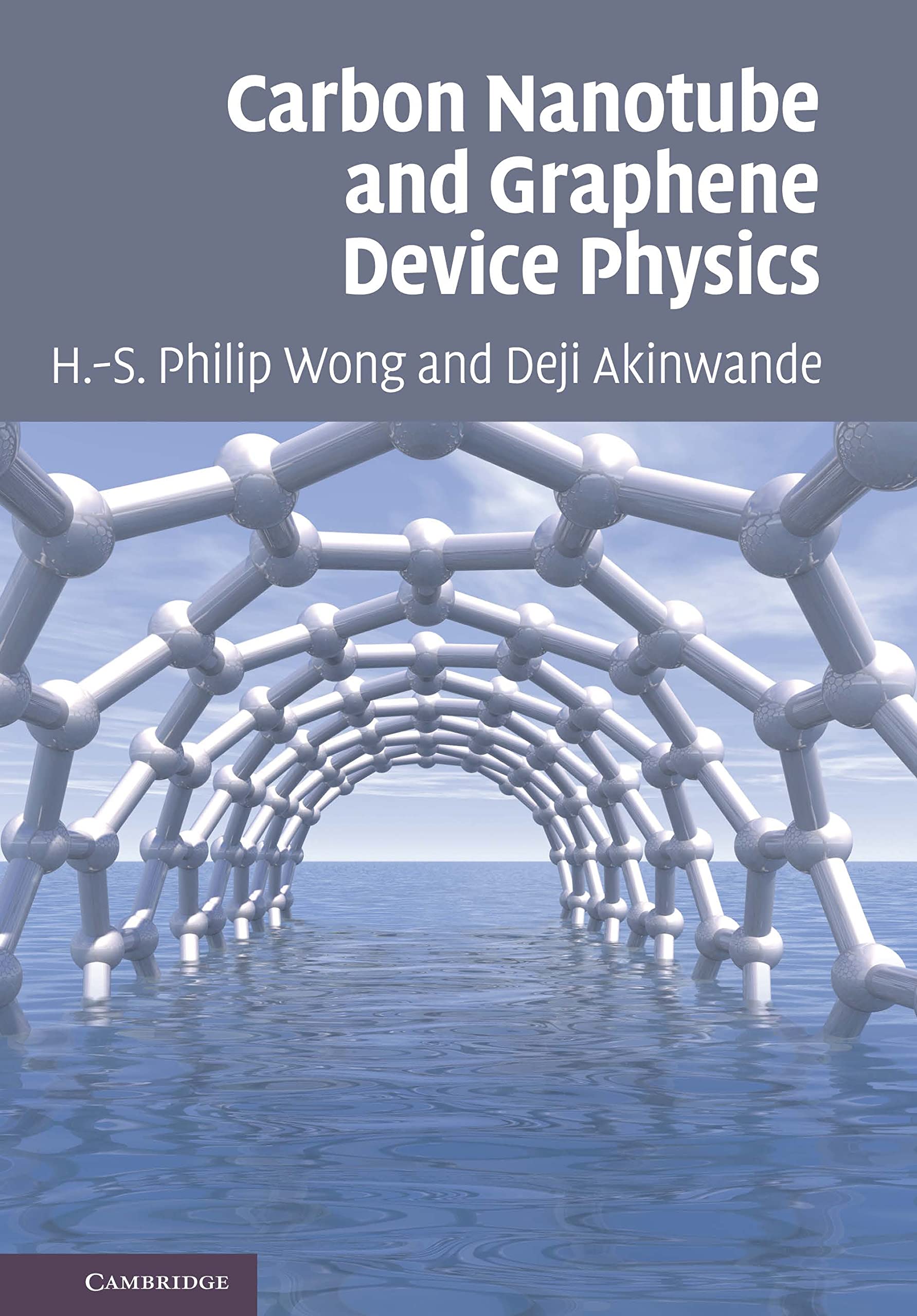
Carbon Nanotube and Graphene Device Physics by Hon-Sum Philip Wong – A Definitive Guide to Nanoscale Carbon-Based Electr
Inclusive of all applicable taxes. FREE shipping on all orders.
Available Offers
- 🚚Free Delivery — Free shipping on all orders
- 💵Cash on Delivery — Pay when your order arrives
- ↩️15-Day Easy Returns — Hassle-free return policy
- 🔒Cash on Delivery — Pay safely when your order arrives
Check Delivery
Product Description
Introduction
Carbon Nanotube and Graphene Device Physics, authored by Hon-Sum Philip Wong and published by Cambridge University Press, is a definitive guide to the rapidly evolving field of nanoscale electronic materials. This hardcover volume offers a rigorous yet accessible exploration of carbon-based nanostructures, their fundamental physics, and their practical applications in next-generation devices. Perfectly suited for Indian students and researchers in physics, materials science, and electrical engineering, this book bridges the gap between theoretical concepts and real-world device design.
Book Overview
This comprehensive textbook delves into the unique electronic, thermal, and mechanical properties of carbon nanotubes and graphene. It systematically covers the underlying quantum mechanics, band structure, transport phenomena, and device architectures. With a focus on both single-walled and multi-walled nanotubes, as well as monolayer and few-layer graphene, the book provides a unified framework for understanding how these materials behave in transistors, interconnects, sensors, and energy devices. The author’s clear exposition makes complex topics like ballistic transport, phonon scattering, and contact resistance accessible to advanced undergraduate and graduate students.
Key Highlights
- Authoritative Content: Written by Hon-Sum Philip Wong, a leading expert in nanoelectronics from Stanford University.
- Comprehensive Coverage: Integrates theory with device physics, including quantum capacitance, field-effect transistors, and optoelectronic applications.
- Pedagogical Approach: Richly illustrated with diagrams, band structure plots, and device schematics to aid visual learning.
- Cutting-Edge Research: Includes recent advances in graphene-based heterostructures and carbon nanotube interconnects.
- Indian Context: Relevant for IITs, NITs, and central universities offering advanced courses in nanotechnology and condensed matter physics.
Inside the Book
The book is structured into twelve well-organized chapters. It begins with a historical perspective on carbon allotropes and progresses through quantum confinement effects, band engineering, and carrier transport. Later chapters focus on device modeling, including Schottky barrier transistors, tunnel field-effect transistors, and RF devices. Practical aspects such as fabrication techniques, doping strategies, and measurement challenges are also discussed. Each chapter concludes with problem sets and references, making it ideal for self-study or classroom use.
Key Topics
- Electronic structure of carbon nanotubes and graphene
- Quantum transport and ballistic conduction
- Metal-semiconductor contacts and interface physics
- Carbon nanotube field-effect transistors (CNTFETs)
- Graphene-based sensors and photodetectors
- Interconnect performance and thermal management
- Device scaling and integration challenges
Reader Benefits
Students will gain a deep understanding of how carbon nanomaterials can replace silicon in future electronics. Researchers will find advanced models and simulation techniques to guide their experiments. The book’s emphasis on physical intuition over abstract mathematics makes it particularly valuable for Indian readers who are new to the field. Additionally, the inclusion of solved examples and end-of-chapter exercises helps reinforce learning and prepares readers for competitive exams like GATE, JEST, and NET.
Learning Outcomes
- Analyze the band structure of graphene and carbon nanotubes using tight-binding models.
- Design and evaluate basic nanotube and graphene-based transistor architectures.
- Understand the role of quantum capacitance and contact resistance in device performance.
- Apply transport theories to predict current-voltage characteristics.
- Identify opportunities and limitations for carbon-based electronics in real-world applications.
Who Should Read
This book is essential for postgraduate students in physics, electrical engineering, and materials science. It is also highly recommended for PhD scholars and faculty members working on nanoelectronics, optoelectronics, or advanced semiconductor devices. Industry professionals involved in research and development of emerging technologies will find it a valuable reference. Undergraduate students with a strong background in solid-state physics will also benefit from this text.
About the Author
Hon-Sum Philip Wong is a Professor of Electrical Engineering at Stanford University and a Fellow of the IEEE. He has made pioneering contributions to nanoscale devices, including carbon nanotube transistors, resistive memories, and 3D integrated circuits. His extensive experience in both academia and industry (IBM T.J. Watson Research Center) lends exceptional depth and credibility to this work.
About the Publisher
Cambridge University Press is a globally respected academic publisher known for its high-quality textbooks and reference works. With a strong presence in India, CUP ensures that this hardcover edition meets the rigorous standards of scholarship and production expected by Indian institutions.
Conclusion
Carbon Nanotube and Graphene Device Physics is a masterful synthesis of theory and application, offering Indian readers a clear pathway into the fascinating world of carbon nanomaterials. Whether you are a student aiming to excel in your studies or a researcher pushing the boundaries of nanoelectronics, this book will serve as an indispensable companion. Order your copy today from Bookshops.in and explore the future of device physics.
Quick Summary
Carbon Nanotube and Graphene Device Physics by Hon-Sum Philip Wong is a comprehensive textbook that delves into the physics and engineering of carbon-based nanoscale devices. It systematically covers the electronic structure, transport mechanisms, and device applications of carbon nanotubes and graphene, two of the most promising materials for post-silicon electronics. The book is designed for graduate students and researchers in electrical engineering, physics, and materials science who wish to understand the fundamental principles underlying carbon-based nanoelectronics. Readers will learn about quantum transport, ballistic conduction, field-effect transistors, and the unique properties that make carbon nanomaterials attractive for future technologies. The author, a leading expert from Stanford University, brings both academic rigor and practical insights. Buying from Bookshops.in ensures you receive a genuine hardcover copy with fast delivery across India, making it a reliable choice for Indian students and professionals.
Book Highlights
Book Specifications
| ISBN-13 | 9780521519052 |
| ISBN-10 | 0521519055 |
| Publisher | Cambridge University Press |
| Language | English |
| Dimensions | 18.42 x 1.27 x 26.04 cm |
| Weight | 660 g |
| Category | Electrical & Electronic Engineering › Electronics |
| Genre | Science & Mathematics |
| Original Language | English |
Frequently Asked Questions
What is the main focus of this book?
Who is the author of this book?
Is this book suitable for beginners?
Does the book cover practical device fabrication?
How is this book different from other nanotechnology textbooks?
Can this book be used for self-study?
Are there exercises or problems in the book?
Is this book available in hardcover?
Does the book cover graphene transistors?
What is the ISBN of this book?
Is this book relevant for Indian students?
Can I use this book for a PhD research project?
Does the book include recent research developments?
Where can I buy this book in India?
Readers Also Search For
Customers Also Bought
Computer Science
Spring 2.5 Aspect Oriented Programming (English, Massimiliano Dess� | Massimiliano Dessi)

Computer Science
Asterisk 1.4 - the Professional's Guide (English, Colman Carpenter | David Duffett | Nik Middleton)
Computer Science
Advances In Natural Language Processing: 4th International Conference, Estal 2004, Alicante, Spain, October 20-22, 2004. Proceedings: 3230 (Lecture Notes in Computer Science)
Computer Science
Multimedia, Communication and Computing Application: Proceedings of the 2014 International Conference on Multimedia, Communication and Computing ... 2014), Xiamen, China, October 16-17, 2014
Computer Science
Cases on Database Technologies and Applications (Cases on Information Technology Series)
Computer Science
ASP.Net 3.5 Social Networking (English, Andrew Siemer)
Related Products
View All
Electronics
Multiprocessor System-on-Chip: Hardware Design and Tool Integration
Electronics
Robust Sram Designs and Analysis
Electronics
Computational Accelerator Physics 2003 (English, M. Berz | K. Makino)
Electronics
Tiny Machine Learning Techniques for Constrained Devices (English, Khalid El-Makkaoui | Ismail Lamaakal | Ibrahim Ouahbi)
Electronics
Applied Computer Vision and Soft Computing with Interpretable AI (English, Swati V. Shinde | Darshan V. Medhane | Oscar Castillo)

Electronics