
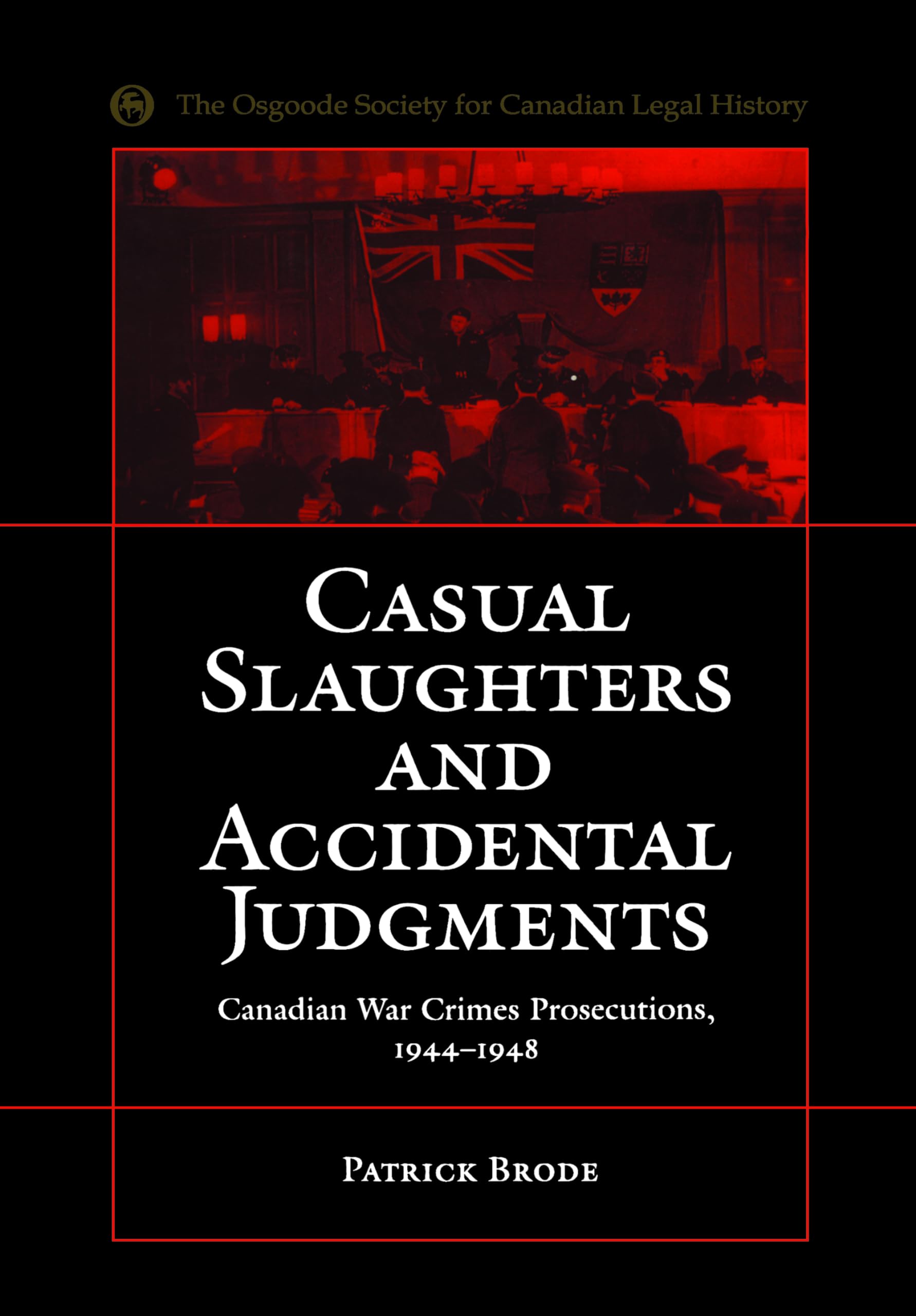
Casual Slaughters and Accidental Judgments: Canadian War Crimes Prosecutions 1944-1948 by Patrick Brode – A Deep Dive in
Inclusive of all applicable taxes. FREE shipping on all orders.
Available Offers
- 🚚Free Delivery — Free shipping on all orders
- 💵Cash on Delivery — Pay when your order arrives
- ↩️15-Day Easy Returns — Hassle-free return policy
- 🔒Cash on Delivery — Pay safely when your order arrives
Check Delivery
Product Description
Introduction
In the aftermath of the Second World War, the world grappled with the immense challenge of holding perpetrators of wartime atrocities accountable. While the Nuremberg trials often dominate historical memory, lesser-known but equally significant prosecutions took place across Allied nations. Casual Slaughters and Accidental Judgments: Canadian War Crimes Prosecutions, 1944-1948 by Patrick Brode offers a compelling, deeply researched account of Canada's often-overlooked role in pursuing justice against war criminals. This hardcover volume from the University of Toronto Press is an essential read for students of law, history, and international relations, providing a nuanced look at how a democratic nation navigated the murky waters of post-war justice.
Book Overview
Patrick Brode’s work is not merely a chronicle of trials; it is a probing examination of the legal, political, and emotional complexities that arise when civilian legal standards are applied to the extraordinary chaos of war. The book reveals how Canada, initially hesitant to engage in what officials called the 'war crimes business,' eventually mounted prosecutions that tested the very foundations of impartial justice. Through vivid narrative and meticulous scholarship, Brode explores the tension between the desire for retribution and the principles of fair trial, all set against the backdrop of a war-weary world.
Key Highlights
- First comprehensive study of Canada’s war crimes prosecutions after WWII, filling a crucial gap in legal and military history.
- Focuses on the pivotal role of Lt. Col. Bruce Macdonald, whose persistence overcame government reluctance to pursue justice.
- Detailed account of the controversial trial of SS Brigadeführer Kurt Meyer, including his dramatic last-minute reprieve from execution.
- Examines the influence of public emotion and post-war politics on legal proceedings, raising timeless questions about impartiality.
- Draws on archival records and personal testimonies to recreate the courtroom dramas and diplomatic manoeuvres.
Inside the Book
The narrative unfolds through a series of gripping chapters that blend legal analysis with human drama. Brode begins by setting the stage: the end of the war, the discovery of atrocities, and the initial reluctance of Canadian authorities to act. He then introduces key figures like Bruce Macdonald, a determined lawyer who championed the cause. The heart of the book is the trial of Kurt Meyer, a charismatic SS general accused of ordering the murder of Canadian prisoners. Brode reconstructs the courtroom scenes with cinematic detail, showing how the prosecution struggled with shaky evidence and the defence exploited legal loopholes. The final chapters explore the aftermath, including the controversial commutation of Meyer’s death sentence and the broader implications for international law.
Key Topics
- War crimes law and jurisprudence – the challenge of applying domestic legal frameworks to battlefield conduct.
- Canadian legal history – the evolution of military justice and government policy during the 1940s.
- Post-war diplomacy – tensions between Allied nations over how to handle defeated enemies.
- Moral philosophy of punishment – questions of revenge, deterrence, and reconciliation.
- Historiography of WWII – how memory and politics shape our understanding of war crimes.
Reader Benefits
- Gain a deeper understanding of a lesser-known chapter in World War II history.
- Explore the practical difficulties of prosecuting war crimes, from gathering evidence to managing public opinion.
- Learn how Canada’s legal system adapted to unprecedented challenges.
- Appreciate the human stories behind the headlines – the lawyers, judges, defendants, and victims.
- Develop critical thinking about justice, fairness, and the rule of law in times of conflict.
Learning Outcomes
- Understand the legal principles governing war crimes prosecutions, including command responsibility and due process.
- Analyze the political and social factors that influenced trial outcomes.
- Evaluate the legacy of these trials for modern international criminal courts.
- Compare Canadian approaches with those of other Allied nations, such as the United States and Britain.
- Recognize the ethical dilemmas inherent in seeking justice after mass violence.
Who Should Read
This book is ideal for law students specializing in international or criminal law, history scholars focusing on World War II or Canadian studies, political science students examining post-war governance, and general readers with an interest in true crime, military history, or legal drama. It is also highly recommended for Indian readers who wish to understand how a Commonwealth nation approached the complex task of war crimes accountability, offering parallels to contemporary debates about justice in conflict zones.
About the Author
Patrick Brode is a Canadian historian and lawyer with a deep expertise in legal history. He has written extensively on the intersection of law and war, bringing a practitioner’s insight to his research. Brode’s ability to combine rigorous scholarship with accessible storytelling makes his work valuable for both academic and general audiences. His previous publications have been praised for shedding light on overlooked aspects of Canada’s legal past.
About the Publisher
University of Toronto Press is one of Canada’s leading academic publishers, known for producing authoritative works in the humanities and social sciences. With a commitment to scholarly excellence, UTP has published seminal texts on Canadian history, law, and politics. This hardcover edition reflects the publisher’s dedication to quality, featuring durable binding and clear typography suitable for long-term study.
Conclusion
Casual Slaughters and Accidental Judgments is more than a historical account; it is a thought-provoking meditation on the nature of justice itself. Patrick Brode’s masterful narrative reminds us that even in the face of unimaginable horrors, the pursuit of fairness remains fraught with difficulty. For anyone seeking to understand the challenges of post-conflict justice, this book offers invaluable lessons that resonate far beyond the Canadian context. Order your copy from Bookshops.in today and add this essential volume to your library.
Quick Summary
'Casual Slaughters and Accidental Judgments' by Patrick Brode is a meticulously researched history of Canada's war crimes prosecutions following World War II. The book delves into the legal, political, and moral challenges faced by Canadian authorities as they sought to bring Nazi war criminals to justice between 1944 and 1948. Central to the narrative is the trial of SS Brigadeführer Kurt Meyer, a case filled with courtroom drama and last-minute reprieves. Brode also highlights the pivotal role of Lt. Col. Bruce Macdonald, whose persistence overcame Ottawa's initial reluctance. This book is ideal for law students, history scholars, and anyone interested in the complexities of post-war justice. Readers will learn how civilian legal standards were strained by the extraordinary circumstances of war, and why governments often hesitate to pursue war crimes. By purchasing from Bookshops.in, you get a premium hardcover edition of this important academic work, delivered to your doorstep across India.
Book Highlights
Book Specifications
| ISBN-13 | 9781442652330 |
| ISBN-10 | 1442652330 |
| Publisher | University of Toronto Press |
| Language | English |
| Dimensions | 17.02 x 1.6 x 24.38 cm |
| Weight | 517 g |
| Category | Americas › United States |
| Genre | History |
| Reading Age | Adult |
| Original Language | English |
Frequently Asked Questions
What is 'Casual Slaughters and Accidental Judgments' about?
Who is the author of this book?
Why did Canada hesitate to prosecute war criminals?
Who was Kurt Meyer?
Is this book suitable for Indian students?
What makes this book unique?
Does the book cover the Nuremberg trials?
What is the reading level of this book?
Can I use this book for research?
Is the book available in physical format only?
What is the price of this book in India?
What are some related books?
How is the book structured?
Readers Also Search For
Related Products
View All
History
The Information Revolution: Transforming the World Through Technology (World History)
History
Human Nature and the French Revolution: From the Enlightenment to the Napoleonic Code: 3 (Polygons: Cultural Diversities and Intersections, 3)
History
The Unmaking of Home in Contemporary Art (Cultural Spaces)

History
Handbook to Life in Medieval and Early Modern Japan | by William E. Deal | Oxford University Press | by William E. Deal | Oxford University Press | by William E. Deal | Oxford University Press | by William E. Deal | Oxford University Press | by William E. Deal | Oxford University Press | by William E. Deal | Oxford University Press | by William E. Deal | Oxford University Press | by William E. Deal | Oxford University Press | by William E. Deal | Oxford University Press | by William E. Deal | Ox

History
The Narrators of Barbarian History (A.D. 550-800) | by Walter Goffart | University of Notre Dame Press | by Walter Goffart | University of Notre Dame Press | by Walter Goffart | University of Notre Dame Press | by Walter Goffart | University of Notre Dame Press | by Walter Goffart | University of Notre Dame Press | by Walter Goffart | University of Notre Dame Press | by Walter Goffart | University of Notre Dame Press | by Walter Goffart | University of Notre Dame Press | by Walter Goffart | Univ
History