
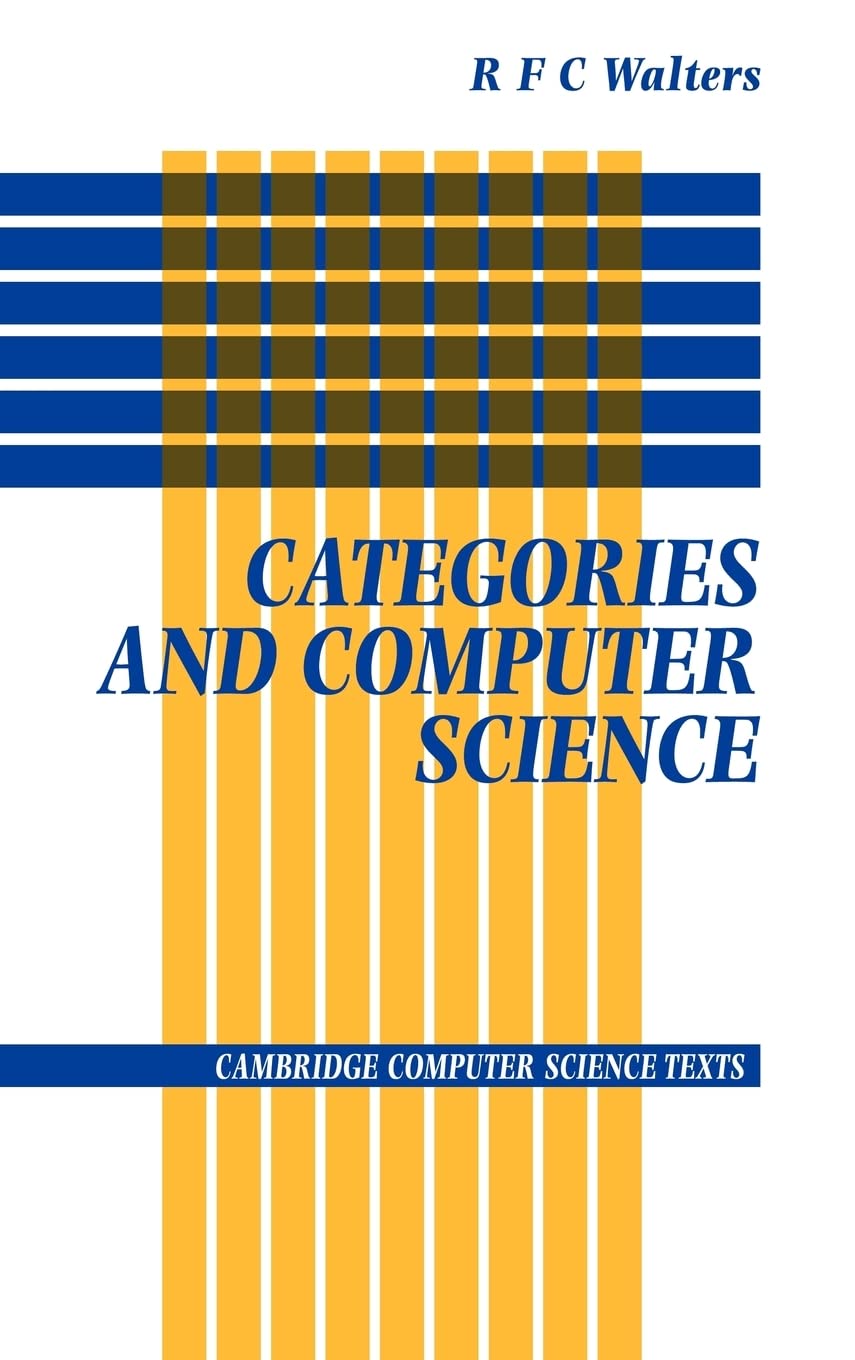
Categories and Computer Science: A Category Theory Textbook for Computer Science Students by R. F. C. Walters
Inclusive of all applicable taxes. FREE shipping on all orders.
Available Offers
- 🚚Free Delivery — Free shipping on all orders
- 💵Cash on Delivery — Pay when your order arrives
- ↩️15-Day Easy Returns — Hassle-free return policy
- 🔒Cash on Delivery — Pay safely when your order arrives
Check Delivery
Product Description
Introduction
If you are a student or professional in computer science looking to deepen your understanding of the mathematical structures that underpin modern computing, Categories and Computer Science by R. F. C. Walters is an essential addition to your library. Published by Cambridge University Press, this hardcover volume bridges the gap between abstract category theory and practical computer science applications. Designed specifically for undergraduate learners, the book makes a traditionally challenging subject accessible without sacrificing mathematical rigour. Whether you are studying at an Indian university or pursuing self-study, this text will help you grasp the foundational concepts that power programming languages, data types, and software design.
Book Overview
This book presents category theory as a unifying framework for computer science. Starting from basic definitions, it gradually builds up to more advanced topics, all while illustrating each concept with concrete examples drawn from computing. The author, a respected category theorist, has refined the material through years of teaching at the University of Sydney. The result is a textbook that feels both scholarly and approachable. The hardcover edition ensures durability for frequent reference, making it ideal for students who want a long-lasting resource.
Key Highlights
- Tailored for Computer Scientists: Every concept is linked to programming, data structures, or computational logic.
- Rigorous Yet Readable: Maintains mathematical correctness while explaining ideas in plain language.
- Progressive Difficulty: Chapters are arranged to build confidence, from simple categories to functors, natural transformations, and beyond.
- Real-World Examples: Includes examples from functional programming, type theory, and database design.
- Trusted Publisher: Cambridge University Press guarantees high editorial and production standards.
Inside the Book
The book is structured into clear chapters that guide the reader step by step. Early chapters introduce categories, objects, and arrows, using familiar computer science constructs like sets and functions. Later chapters explore functors, natural transformations, limits, colimits, and adjunctions. Each chapter ends with exercises that test understanding and encourage application. The author also includes diagrams and visual aids to make abstract relationships tangible. A comprehensive index and bibliography support further study.
Key Topics
- Basic Category Theory: Definitions, examples, and properties of categories.
- Functors and Natural Transformations: Mapping between categories and their structural relationships.
- Limits and Colimits: Universal constructions used in data types and recursion.
- Adjunctions: Core concepts behind free constructions and monads.
- Cartesian Closed Categories: Foundation for typed lambda calculus and functional programming.
- Applications in Computing: Type systems, semantics, and database queries.
Reader Benefits
- Build Mathematical Maturity: Develop skills to reason abstractly about software systems.
- Enhance Problem-Solving: Learn to identify patterns and structures in code.
- Prepare for Advanced Study: Ideal groundwork for research in programming languages, verification, or theoretical computer science.
- Practical Insights: Understand how category theory influences modern languages like Haskell and Scala.
- Self-Paced Learning: Clear exposition allows independent study without a teacher.
Learning Outcomes
By the end of this book, readers will be able to define and work with categories, functors, and natural transformations. They will understand how limits and colimits model common programming constructs, and how adjunctions unify concepts like free monoids and product types. The reader will also gain the confidence to read advanced literature on categorical logic and semantics. For computer science students, this knowledge translates into better-designed software and a deeper appreciation of the theoretical foundations of the field.
Who Should Read
- Undergraduate Computer Science Students: Especially those in their second or third year seeking to understand theoretical underpinnings.
- Mathematics Students: Those new to category theory who want a computing-oriented introduction.
- Software Developers: Professionals curious about the mathematical basis of functional programming and type systems.
- Researchers: Anyone entering fields like program semantics, formal methods, or categorical logic.
About the Author
R. F. C. Walters is a distinguished category theorist and educator. He has spent decades teaching and researching at the University of Sydney, where he developed the course that inspired this book. His work focuses on applying categorical ideas to computer science, and he is known for his clear, student-friendly writing style. Walters has also contributed to the study of bicategories and categorical algebra, making him a trusted voice in the field.
About the Publisher
Cambridge University Press is one of the world's oldest and most respected academic publishers. With a history dating back to 1534, it has a reputation for producing high-quality textbooks and reference works. This hardcover edition reflects their commitment to durability and scholarly accuracy, making it a reliable resource for Indian students and libraries alike.
Conclusion
Categories and Computer Science is more than just a textbook—it is a gateway to understanding the deep structures that make computer science a rigorous discipline. Whether you are preparing for exams, writing better code, or exploring new research avenues, this book offers the clarity and depth you need. Order your copy from Bookshops.in today and take a decisive step toward mastering the categorical foundations of computing.
Quick Summary
Categories and Computer Science by R. F. C. Walters is a foundational textbook that introduces category theory specifically for computer science students. Based on a course taught at the University of Sydney, the book develops the theory in a clear, step-by-step manner while enriching each concept with practical examples from computing. Readers will learn about categories, functors, natural transformations, universal properties, limits, colimits, adjunctions, and monads — all presented with a computer science perspective. The author, a respected category theorist, ensures mathematical correctness without sacrificing accessibility. This hardcover edition from Cambridge University Press is ideal for undergraduate courses or self-study. By purchasing from Bookshops.in, Indian students receive a genuine copy with fast delivery and excellent customer service.
Book Highlights
Book Specifications
| ISBN-13 | 9780521419970 |
| ISBN-10 | 0521419972 |
| Publisher | Cambridge University Press |
| Language | English |
| Dimensions | 15.88 x 1.27 x 24.13 cm |
| Weight | 372 g |
| Country | India |
| Category | Software Design, Testing & Engineering › Software Architecture |
| Genre | Non-fiction |
| Reading Age | Adult |
| Original Language | English |
Frequently Asked Questions
What is Categories and Computer Science about?
Who is the author of this book?
Is this book suitable for beginners?
Does the book include examples from computer science?
What topics are covered in the book?
Is this a hardcover or paperback edition?
Which publisher released this book?
What is the ISBN for this book?
Can I use this book for self-study?
Does the book require a strong math background?
How is this book different from other category theory texts?
Is this book still relevant today?
What is the price of this book on Bookshops.in?
Why should I buy from Bookshops.in?
Readers Also Search For
Customers Also Bought

Programming
Algorithmische Sprache Und Programmentwicklung | by H. Partsch | F. L. Bauer | P. Pepper | Springer | by H. Partsch | F. L. Bauer | P. Pepper | Springer | by H. Partsch | F. L. Bauer | P. Pepper | Springer | by H. Partsch | F. L. Bauer | P. Pepper | Springer | by H. Partsch | F. L. Bauer | P. Pepper | Springer | by H. Partsch | F. L. Bauer | P. Pepper | Springer | by H. Partsch | F. L. Bauer | P. Pepper | Springer | by H. Partsch | F. L. Bauer | P. Pepper | Springer | by H. Partsch | F. L. Bauer
Programming
Distributed Algorithms | by Jean-Claude Bermond | Michel Raynal | Springer | by Jean-Claude Bermond | Michel Raynal | Springer | by Jean-Claude Bermond | Michel Raynal | Springer | by Jean-Claude Bermond | Michel Raynal | Springer | by Jean-Claude Bermond | Michel Raynal | Springer | by Jean-Claude Bermond | Michel Raynal | Springer | by Jean-Claude Bermond | Michel Raynal | Springer | by Jean-Claude Bermond | Michel Raynal | Springer | by Jean-Claude Bermond | Michel Raynal | Springer | by Jean
Programming
Meta-Level Control for Deductive Database Systems | by Helmut Schmidt | Springer | by Helmut Schmidt | Springer | by Helmut Schmidt | Springer | by Helmut Schmidt | Springer | by Helmut Schmidt | Springer | by Helmut Schmidt | Springer | by Helmut Schmidt | Springer | by Helmut Schmidt | Springer | by Helmut Schmidt | Springer | by Helmut Schmidt | Springer | by Helmut Schmidt | Springer | by Helmut Schmidt | Springer | by Helmut Schmidt | Springer | by Helmut Schmidt | Springer | by Helmut Schm
Programming
Java Web Services | by David A. Chappell | Tyler Jewell | O'Reilly Media | by David A. Chappell | Tyler Jewell | O'Reilly Media | by David A. Chappell | Tyler Jewell | O'Reilly Media | by David A. Chappell | Tyler Jewell | O'Reilly Media | by David A. Chappell | Tyler Jewell | O'Reilly Media | by David A. Chappell | Tyler Jewell | O'Reilly Media | by David A. Chappell | Tyler Jewell | O'Reilly Media | by David A. Chappell | Tyler Jewell | O'Reilly Media | by David A. Chappell | Tyler Jewell | O'
Programming
Database in Depth | by Chris J. Date | O'Reilly Media | by Chris J. Date | O'Reilly Media | by Chris J. Date | O'Reilly Media | by Chris J. Date | O'Reilly Media | by Chris J. Date | O'Reilly Media | by Chris J. Date | O'Reilly Media | by Chris J. Date | O'Reilly Media | by Chris J. Date | O'Reilly Media | by Chris J. Date | O'Reilly Media | by Chris J. Date | O'Reilly Media | by Chris J. Date | O'Reilly Media | by Chris J. Date | O'Reilly Media | by Chris J. Date | O'Reilly Media | by Chris J.
Programming
Integration of AI and OR Techniques in Constraint Programming for Combinatorial Optimization Problem | by Nicolas Beldiceanu | Narendra Jussien | Eric Pinson | Springer | by Nicolas Beldiceanu | Narendra Jussien | Eric Pinson | Springer | by Nicolas Beldiceanu | Narendra Jussien | Eric Pinson | Springer | by Nicolas Beldiceanu | Narendra Jussien | Eric Pinson | Springer | by Nicolas Beldiceanu | Narendra Jussien | Eric Pinson | Springer | by Nicolas Beldiceanu | Narendra Jussien | Eric Pinson |
Related Products
View All
Computers & Internet
Modern Full-Stack React Projects by Daniel Bugl
Computers & Internet
Mootools 1.2 Beginner's Guide (English, Jacob Gube)
Computers & Internet
Contemporary Methods for Speech Parameterization (Springerbriefs in Electrical and Computer Engineering / Springerbriefs in Speech Technology)

Computers & Internet
Information Technology and Lawyers | by Arno R. Lodder | Anja Oskamp | Springer | by Arno R. Lodder | Anja Oskamp | Springer | by Arno R. Lodder | Anja Oskamp | Springer | by Arno R. Lodder | Anja Oskamp | Springer | by Arno R. Lodder | Anja Oskamp | Springer | by Arno R. Lodder | Anja Oskamp | Springer | by Arno R. Lodder | Anja Oskamp | Springer | by Arno R. Lodder | Anja Oskamp | Springer | by Arno R. Lodder | Anja Oskamp | Springer | by Arno R. Lodder | Anja Oskamp | Springer | by Arno R. Lo

Computers & Internet
Digital Analysis of Remotely Sensed Imagery | by Jay Gao | McGraw-Hill Companies | by Jay Gao | McGraw-Hill Companies | by Jay Gao | McGraw-Hill Companies | by Jay Gao | McGraw-Hill Companies | by Jay Gao | McGraw-Hill Companies | by Jay Gao | McGraw-Hill Companies | by Jay Gao | McGraw-Hill Companies | by Jay Gao | McGraw-Hill Companies | by Jay Gao | McGraw-Hill Companies | by Jay Gao | McGraw-Hill Companies | by Jay Gao | McGraw-Hill Companies | by Jay Gao | McGraw-Hill Companies | by Jay Gao
Computers & Internet