
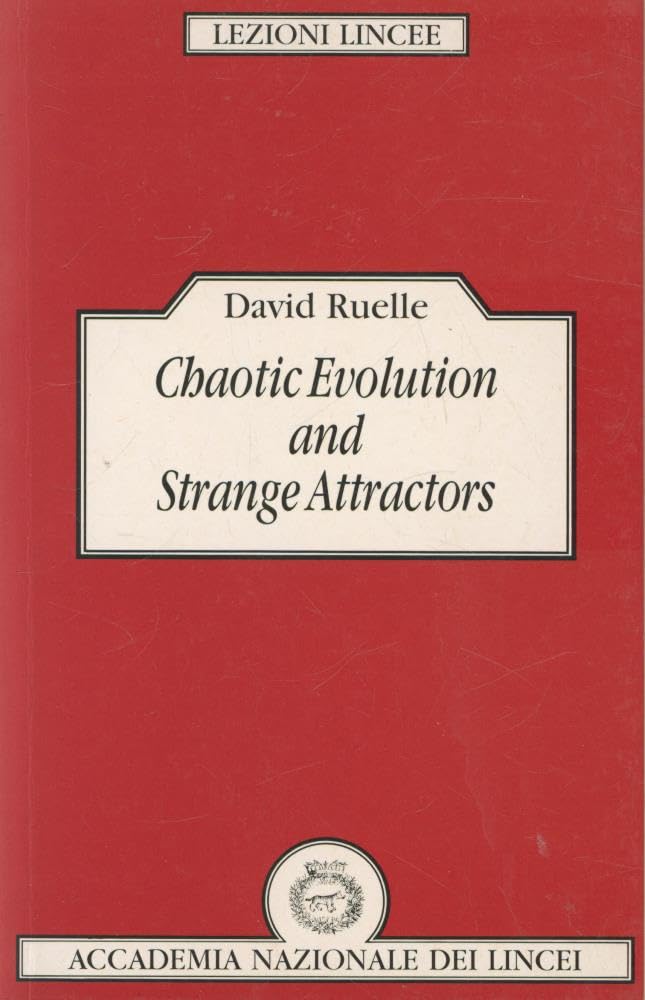
Chaotic Evolution and Strange Attractors: The Statistical Analysis of Time Series for Deterministic Nonlinear Systems by
Inclusive of all applicable taxes. FREE shipping on all orders.
Available Offers
- 🚚Free Delivery — Free shipping on all orders
- 💵Cash on Delivery — Pay when your order arrives
- ↩️15-Day Easy Returns — Hassle-free return policy
- 🔒Cash on Delivery — Pay safely when your order arrives
Check Delivery
Product Description
Introduction
Chaos is not random—it follows hidden patterns that deterministic nonlinear systems reveal through their wildly unpredictable yet structured behaviour. In Chaotic Evolution and Strange Attractors: The Statistical Analysis of Time Series for Deterministic Nonlinear Systems, David Ruelle—one of the founding architects of chaos theory—presents a masterful yet accessible guide to understanding how order emerges from apparent disorder. This book is a vital resource for Indian students, researchers, and professionals in physics, engineering, biology, chemistry, and economics who grapple with nonlinear systems in their daily work.
Book Overview
Originally based on a series of lectures delivered at the Accademia dei Lincei, this volume distils complex ideas into a leisurely, conversational narrative. Ruelle avoids dense mathematical formalism, instead leaning on the powerful framework of time series analysis to explore chaotic evolution and strange attractors. The book bridges the gap between deterministic dynamics and statistical methods, offering a fresh perspective on how we can analyse and predict the behaviour of systems that appear random but are governed by precise rules. It is a classic reference that remains remarkably relevant for contemporary science and mathematics in India and worldwide.
Key Highlights
- Foundational insights into chaotic dynamics from one of the pioneers of the field
- Statistical approach using time series analysis to study nonlinear systems without heavy mathematics
- Clear exposition of strange attractors, sensitive dependence on initial conditions, and deterministic chaos
- Interdisciplinary relevance for physics, engineering, biology, chemistry, economics, and climate science
- Lecture-based style that makes advanced concepts accessible to graduate students and early-career researchers
Inside the Book
The book guides readers step by step through the core ideas of chaotic evolution. It begins with simple deterministic systems and gradually introduces the concept of strange attractors—fractal objects that govern the long-term behaviour of chaotic systems. Ruelle explains how statistical tools can extract meaningful information from seemingly erratic time series data, enabling scientists to distinguish between true randomness and deterministic chaos. The text includes illustrative examples, thought-provoking discussions, and practical insights that help readers apply these ideas to real-world problems, from weather prediction to population dynamics and economic fluctuations.
Key Topics
- Deterministic chaos and its statistical signatures
- Strange attractors and fractal dimensions
- Time series analysis for nonlinear systems
- Sensitive dependence on initial conditions
- Lyapunov exponents and entropy
- Reconstruction of dynamics from experimental data
- Connections between chaos and turbulence
Reader Benefits
- Gain a solid conceptual foundation in chaos theory without being overwhelmed by advanced mathematics
- Learn practical statistical techniques to analyse time series from experiments or simulations
- Understand how to identify chaos in real-world data from diverse scientific fields
- Develop intuition for the behaviour of nonlinear systems, a critical skill in modern research
- Access a classic text written by a Nobel Prize-calibre thinker in an engaging, lecture-style format
Learning Outcomes
By studying this book, readers will be able to explain the fundamental properties of chaotic systems, interpret strange attractors and their dimensions, apply time series analysis to detect deterministic chaos, and critically evaluate claims about randomness in natural and engineered systems. They will also gain the ability to reconstruct phase-space dynamics from single-variable measurements and appreciate the deep connections between chaos, information theory, and statistical mechanics.
Who Should Read
- Graduate students in physics, applied mathematics, and engineering seeking a clear introduction to chaos theory
- Researchers and professors in nonlinear dynamics, statistical mechanics, and complex systems
- Professionals in data science and signal processing working with time series from chaotic sources
- Biologists and ecologists studying population cycles, neural dynamics, or epidemic spread
- Economists and financial analysts interested in nonlinear market behaviour and volatility
- Climate scientists exploring deterministic chaos in atmospheric and oceanographic models
About the Author
David Ruelle is a Belgian-French mathematical physicist of towering reputation. He is best known for coining the term “strange attractor” and for his pioneering contributions to chaos theory, statistical mechanics, and dynamical systems. Ruelle’s work has profoundly influenced modern science, and he has received numerous honours, including the Boltzmann Medal and the Max Planck Medal. His ability to communicate deep ideas with clarity and elegance makes this book a timeless gem for anyone curious about the mathematics of chaos.
About the Publisher
Cambridge University Press is one of the world’s oldest and most respected academic publishers, with a legacy of producing authoritative works in science, mathematics, and the humanities. Their commitment to rigorous scholarship and accessible writing ensures that this volume meets the highest standards for both research and education.
Conclusion
Whether you are a student beginning your journey into nonlinear dynamics or an experienced researcher seeking a deeper statistical understanding of chaos, Chaotic Evolution and Strange Attractors is an indispensable addition to your library. David Ruelle’s lucid exposition, grounded in time series analysis, demystifies one of the most fascinating frontiers of modern science. Order your hardcover copy from Bookshops.in today and explore the hidden order within chaos.
Quick Summary
Chaotic Evolution and Strange Attractors by David Ruelle is a seminal work that demystifies chaotic behavior in deterministic systems using statistical time series analysis. Based on lectures at the Accademia dei Lincei, the book presents complex ideas in an accessible, leisurely manner without overwhelming mathematics. Ruelle, a pioneer in chaos theory, explains how systems governed by precise laws can exhibit unpredictable, seemingly random evolution, and introduces strange attractors as key geometric structures. Readers will learn to apply statistical techniques to analyze time series data, understand sensitive dependence on initial conditions, and quantify chaos through measures like Lyapunov exponents and fractal dimensions. The book is written for scientists and researchers in physics, engineering, biology, chemistry, and economics who encounter nonlinear systems. By focusing on conceptual clarity, it bridges the gap between rigorous theory and practical understanding. This hardcover edition from Cambridge University Press is a durable reference for Indian students and academics. Purchasing from Bookshops.in ensures fast delivery, authentic copies, and competitive pricing, making it a valuable addition to any research library.
Book Highlights
Book Specifications
| ISBN-13 | 9780521368308 |
| ISBN-10 | 0521368308 |
| Publisher | Cambridge University Press |
| Language | English |
| Dimensions | 13.97 x 0.74 x 21.59 cm |
| Weight | 154 g |
| Country | India |
| Category | Mathematics › Statistics |
| Genre | Nonfiction |
| Original Language | English |
Frequently Asked Questions
What is chaotic evolution?
Who is David Ruelle?
Is this book suitable for beginners in chaos theory?
What are strange attractors?
Does the book include mathematical derivations?
Which fields can benefit from this book?
Is this a textbook or a monograph?
What is the ISBN?
Is the book available in hardcover?
Can I use this for a research paper?
Does the book cover practical applications?
What is the price in India?
How is this book different from other chaos books?
Readers Also Search For
Customers Also Bought
Mathematics
Stereotype Spaces and Algebras: 73 (De Gruyter Expositions in Mathematics, 73)
Mathematics
Semigroups in Algebra, Geometry and Analysis: 20 (De Gruyter Expositions in Mathematics, 20)
Mathematics
Geometry from the Pacific Rim: Proceedings of the Pacific Rim Geometry Conference held at National University of Singapore, Republic of Singapore, ... 1994 (De Gruyter Proceedings in Mathematics)
Mathematics
First International Tainan-Moscow Algebra Workshop: Proceedings of the International Conference held at National Cheng Kung University Tainan, Taiwan, ... 1994 (De Gruyter Proceedings in Mathematics)
Mathematics
Differential Geometry - Proceedings of the VIII International Colloquium (English, Jesus A. Alvarez Lopez | Eduardo Garcia-Rio)
Mathematics
Mathematical Theory of Optimal Processes (Classics of Soviet Mathematics)
Related Products
View All
Statistics
Asymptotics in Statistics and Probability: Papers in Honor of George Gregory Roussas
Statistics
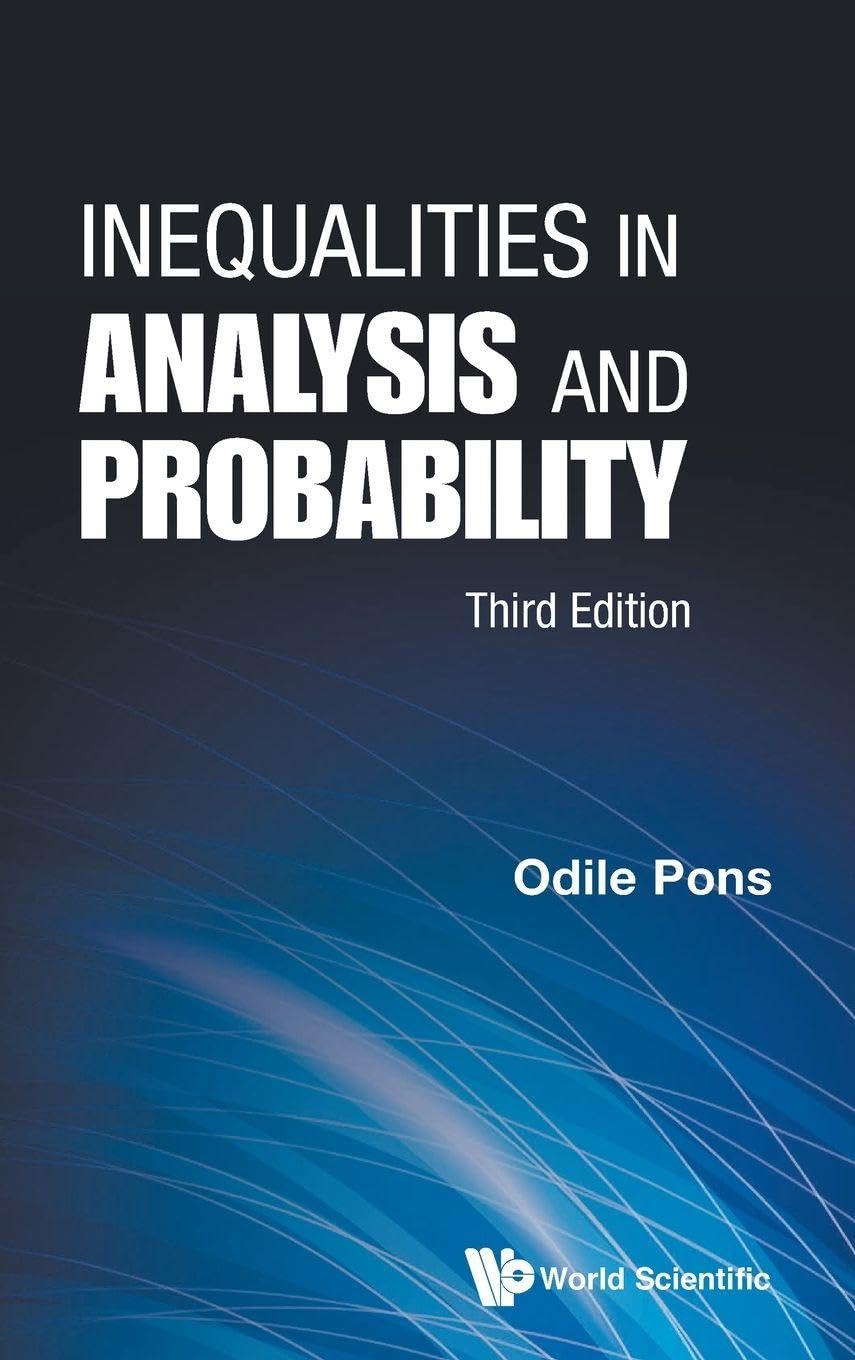
Inequalities in Analysis and Probability: 3rd Edition
Statistics
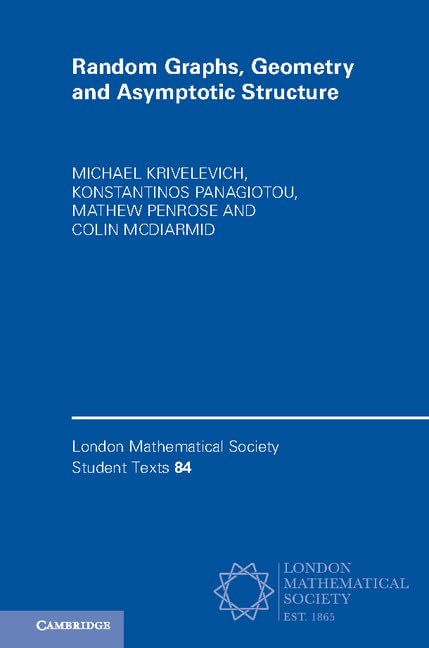
Random Graphs, Geometry and Asymptotic Structure
Statistics
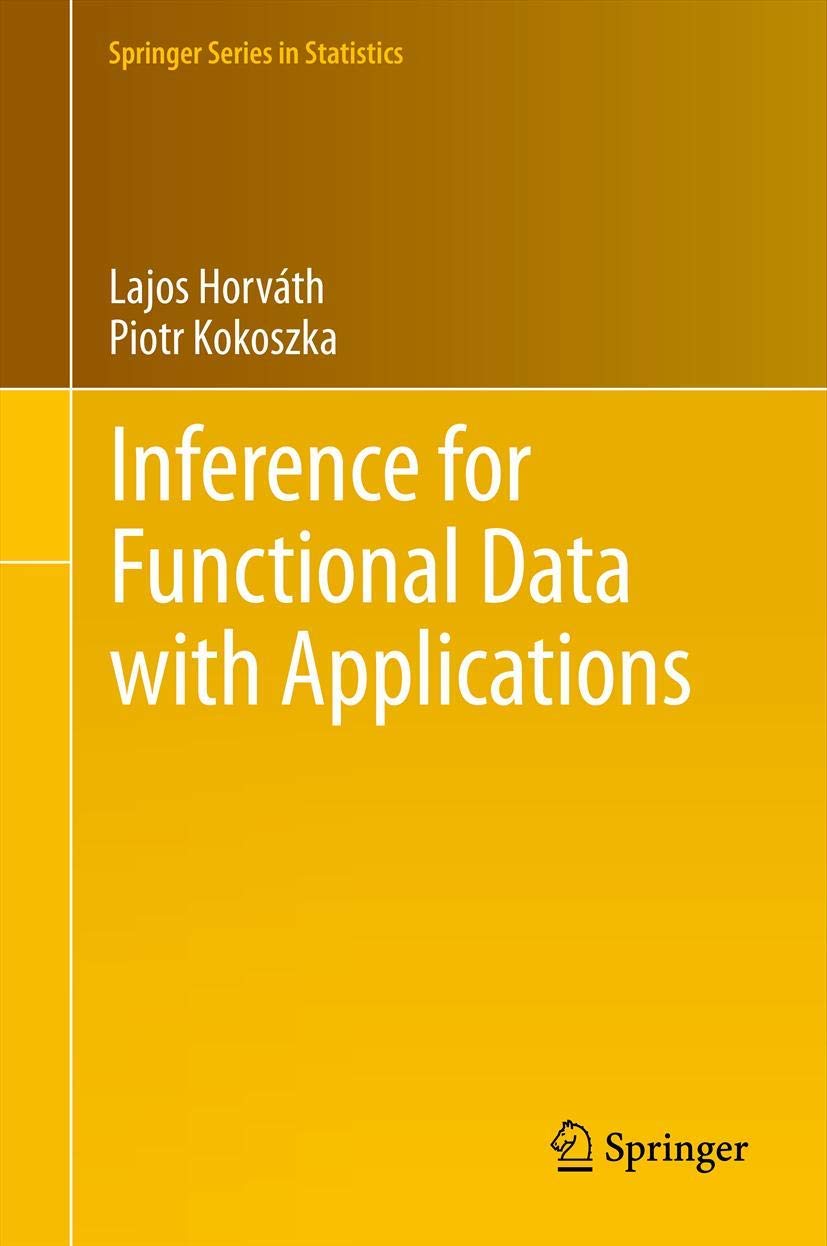
Inference for Functional Data With Applications: 200 (Springer Series in Statistics, 692)
Statistics
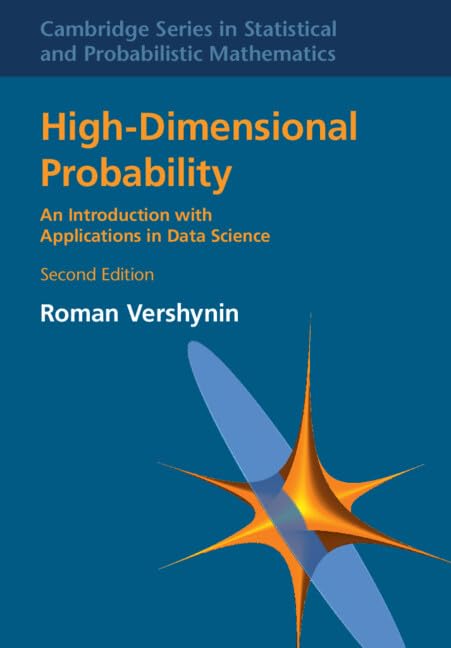
High-Dimensional Probability: An Introduction with Applications in Data Science (Cambridge Series in Statistical and Probabilistic Mathematics)
Statistics