
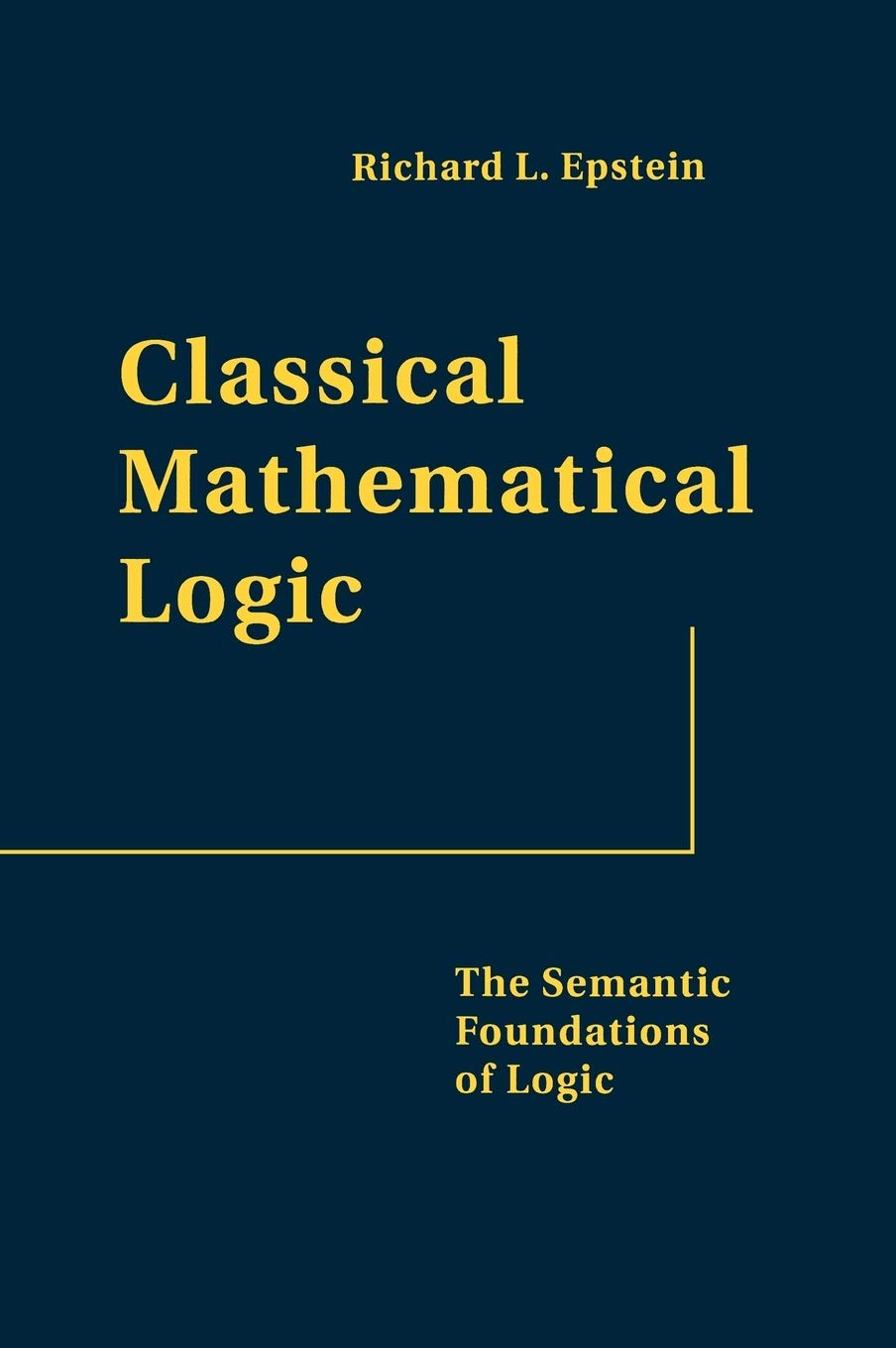
Classical Mathematical Logic: The Semantic Foundations of Logic by Richard L. Epstein – A Rigorous Textbook for Mathemat
Inclusive of all applicable taxes. FREE shipping on all orders.
Available Offers
- 🚚Free Delivery — Free shipping on all orders
- 💵Cash on Delivery — Pay when your order arrives
- ↩️15-Day Easy Returns — Hassle-free return policy
- 🔒Cash on Delivery — Pay safely when your order arrives
Check Delivery
Product Description
Introduction
For students and scholars of logic, mathematics, and philosophy, Classical Mathematical Logic: The Semantic Foundations of Logic by Richard L. Epstein offers a rigorous yet accessible exploration of the core principles that underpin modern logical reasoning. Published by Princeton University Press, this hardcover volume is an indispensable resource for anyone seeking a deep understanding of classical logic from its semantic roots upward. Whether you are preparing for advanced studies in mathematics or simply wish to sharpen your analytical skills, this book provides a clear pathway through complex ideas.
Book Overview
This comprehensive work systematically develops classical mathematical logic, focusing on the semantic foundations that give meaning to logical systems. Epstein begins with basic concepts such as truth, validity, and logical consequence, then builds up to more advanced topics like first-order logic, completeness, and incompleteness theorems. The book is designed to be self-contained, making it suitable for both classroom use and independent study. With its careful explanations, numerous examples, and engaging exercises, it bridges the gap between introductory logic texts and specialized research monographs.
Key Highlights
- Semantic Approach: Emphasizes understanding logic through meaning and interpretation rather than purely syntactic manipulation.
- Rigorous Yet Readable: Written in a clear, conversational style that makes difficult concepts accessible without sacrificing precision.
- Comprehensive Coverage: Covers propositional logic, predicate logic, completeness, compactness, and Gödel's incompleteness theorems.
- Pedagogical Tools: Includes hundreds of exercises, proofs, and illustrative examples to reinforce learning.
- Historical Context: Provides insights into the development of logical ideas, connecting them to broader mathematical and philosophical traditions.
Inside the Book
The book is organized into well-structured chapters that guide the reader from elementary notions to sophisticated results. Early chapters introduce syntax and semantics of propositional logic, followed by natural deduction and axiomatic systems. Later chapters delve into first-order logic, model theory, and the limitations of formal systems. Each section ends with a summary and exercises that challenge the reader to apply concepts. Appendices on set theory and metamathematics provide additional support, ensuring that even readers with minimal background can follow the arguments.
Key Topics
- Propositional logic: truth tables, tautologies, logical equivalence
- Predicate logic: quantifiers, variables, and interpretations
- Completeness and compactness theorems
- Gödel's first and second incompleteness theorems
- Formal systems, proofs, and model theory
- Decidability and undecidability
Reader Benefits
By studying this book, readers will gain not only a solid grasp of classical logic but also the ability to think critically about arguments, proofs, and the foundations of mathematics. The semantic perspective helps in understanding why logical rules work, making it easier to apply them in real-world reasoning. The exercises develop problem-solving skills that are valuable in mathematics, computer science, philosophy, and law. Moreover, the historical notes enrich the learning experience by showing how logic evolved as a discipline.
Learning Outcomes
- Understand the difference between syntax and semantics in logic.
- Construct and evaluate formal proofs using natural deduction and axiomatic methods.
- Apply the completeness theorem to relate syntactic provability and semantic validity.
- Explain the significance of Gödel's incompleteness theorems for mathematics and logic.
- Analyze logical arguments from a foundational perspective.
- Develop a strong foundation for advanced study in mathematical logic or philosophy.
Who Should Read
This book is ideal for undergraduate and graduate students in mathematics, philosophy, computer science, and linguistics who have some prior exposure to logic. It is also suitable for self-learners and professionals who wish to deepen their understanding of logical theory. Teachers and researchers will find it a valuable reference for its clear exposition and comprehensive coverage. Anyone with a curiosity about the nature of truth, proof, and reasoning will benefit from Epstein's masterful presentation.
About the Author
Richard L. Epstein is a renowned logician and author of numerous books on logic, mathematics, and philosophy. He has taught at several universities and is known for his ability to explain complex ideas in a clear and engaging manner. His works, including The Semantic Foundations of Logic series, are widely used in logic courses around the world. Epstein's deep expertise and pedagogical skill shine through every page of this book.
About the Publisher
Princeton University Press is a prestigious academic publisher based in the United States, known for producing high-quality scholarly works in the sciences, humanities, and social sciences. With a history spanning over a century, Princeton University Press is committed to publishing books that advance knowledge and education. This hardcover edition reflects their dedication to durable, well-crafted books that will stand the test of time.
Conclusion
Classical Mathematical Logic: The Semantic Foundations of Logic is more than just a textbook—it is a journey into the heart of logical reasoning. By grounding abstract concepts in semantic intuition, Richard L. Epstein provides readers with a powerful framework for understanding the foundations of mathematics. Whether you are a student preparing for exams, a researcher exploring new ideas, or a lifelong learner curious about logic, this book deserves a place on your shelf. Order your copy today from Bookshops.in and begin your exploration of the beautiful structure of classical logic.
Quick Summary
Classical Mathematical Logic: The Semantic Foundations of Logic by Richard L. Epstein is a definitive textbook that delves deep into the semantic underpinnings of classical logic. Written for advanced undergraduate and graduate students, the book covers formal systems, model theory, completeness and compactness theorems, and Gödel's incompleteness results. Epstein's clear exposition makes complex ideas accessible, while rigorous proofs build a solid foundation for further study. This hardcover edition from Princeton University Press is a valuable resource for Indian students of mathematics, philosophy, and computer science, whether used in classrooms or for self-study. By purchasing from Bookshops.in, you get a premium print edition delivered to your doorstep, supporting local reading culture.
Book Highlights
Book Specifications
| ISBN-13 | 9780691123004 |
| ISBN-10 | 0691123004 |
| Publisher | Princeton University Press |
| Language | English |
| Dimensions | 17.78 x 3.18 x 25.4 cm |
| Weight | 1 kg 130 g |
| Country | India |
| Category | Mathematics › Mathematical Logic |
| Genre | Science & Mathematics |
| Original Language | English |
Frequently Asked Questions
What is Classical Mathematical Logic about?
Who is the author of this book?
Who should read this book?
Is this book suitable for Indian students?
What are the key topics covered?
Does the book include exercises?
What is the ISBN-13?
Can I use this book for self-study?
What makes this book different from other logic textbooks?
Is this book available in India?
What is the price in INR?
Does the book cover non-classical logic?
Readers Also Search For
Customers Also Bought
Mathematics
Stereotype Spaces and Algebras: 73 (De Gruyter Expositions in Mathematics, 73)
Mathematics
Semigroups in Algebra, Geometry and Analysis: 20 (De Gruyter Expositions in Mathematics, 20)
Mathematics
Geometry from the Pacific Rim: Proceedings of the Pacific Rim Geometry Conference held at National University of Singapore, Republic of Singapore, ... 1994 (De Gruyter Proceedings in Mathematics)
Mathematics
First International Tainan-Moscow Algebra Workshop: Proceedings of the International Conference held at National Cheng Kung University Tainan, Taiwan, ... 1994 (De Gruyter Proceedings in Mathematics)
Mathematics
Differential Geometry - Proceedings of the VIII International Colloquium (English, Jesus A. Alvarez Lopez | Eduardo Garcia-Rio)
Mathematics
Mathematical Theory of Optimal Processes (Classics of Soviet Mathematics)
Related Products
View AllMathematics
Mathematical Theory of Optimal Processes (Classics of Soviet Mathematics)
Mathematics
Stereotype Spaces and Algebras: 73 (De Gruyter Expositions in Mathematics, 73)
Mathematics
Semigroups in Algebra, Geometry and Analysis: 20 (De Gruyter Expositions in Mathematics, 20)
Mathematics
Geometry from the Pacific Rim: Proceedings of the Pacific Rim Geometry Conference held at National University of Singapore, Republic of Singapore, ... 1994 (De Gruyter Proceedings in Mathematics)
Mathematics
First International Tainan-Moscow Algebra Workshop: Proceedings of the International Conference held at National Cheng Kung University Tainan, Taiwan, ... 1994 (De Gruyter Proceedings in Mathematics)
Mathematics