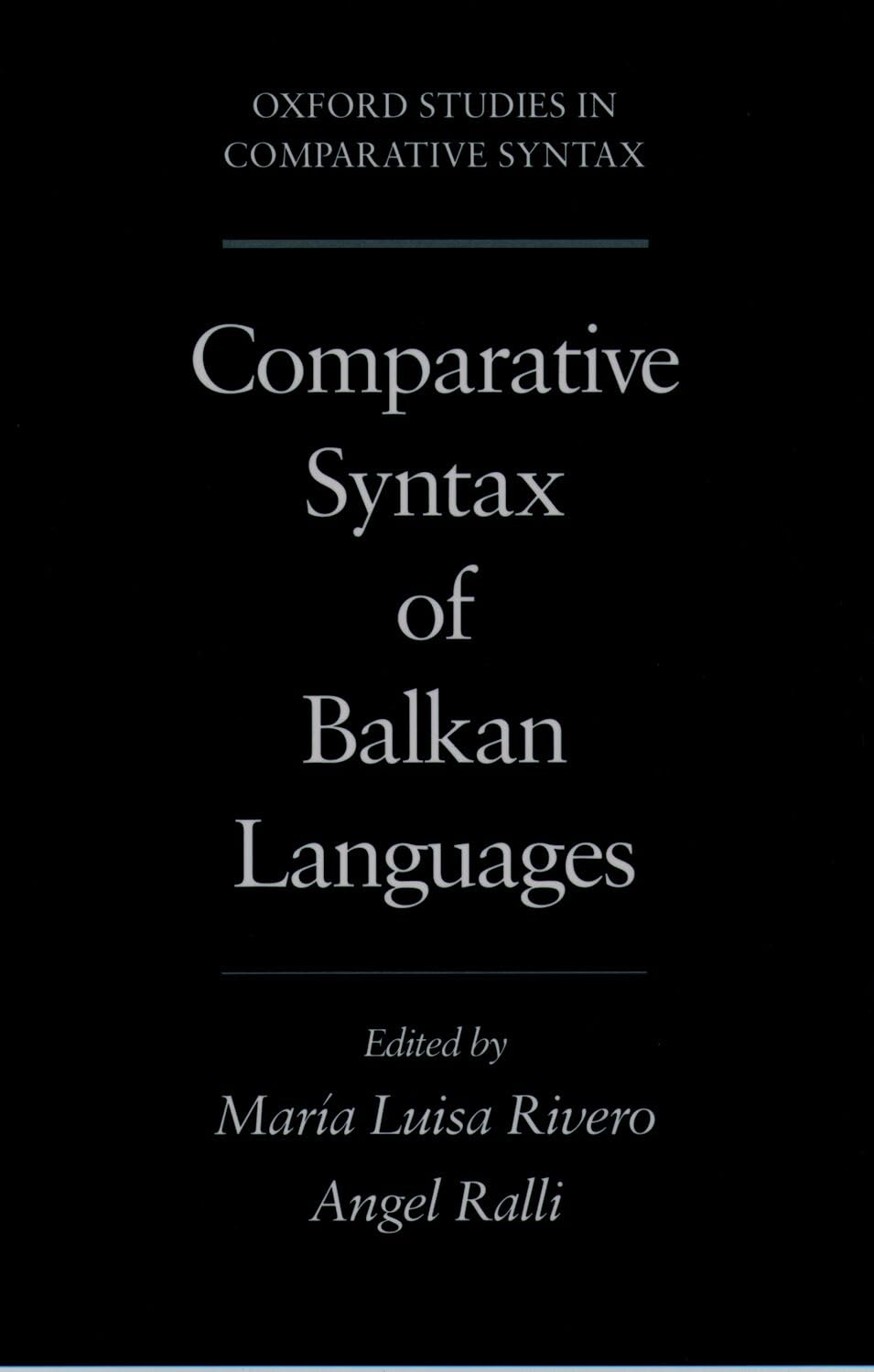
Comparative Syntax of Balkan Languages by Maria Luisa Rivero – A Deep Dive into Albanian, Bulgarian, Greek, and Romanian
Inclusive of all applicable taxes. FREE shipping on all orders.
Available Offers
- 🚚Free Delivery — Free shipping on all orders
- 💵Cash on Delivery — Pay when your order arrives
- ↩️15-Day Easy Returns — Hassle-free return policy
- 🔒Cash on Delivery — Pay safely when your order arrives
Check Delivery
Product Description
Introduction
For students and researchers of comparative linguistics, the syntactic structures of Balkan languages present a fascinating puzzle. Comparative Syntax of Balkan Languages by Maria Luisa Rivero offers a rigorous yet accessible exploration of how Albanian, Bulgarian, Greek, and Romanian share deep structural patterns while maintaining distinct identities. This hardcover volume from Oxford University Press is an essential addition to any serious linguistics library in India, where the study of language families and syntactic theory is increasingly valued.
Book Overview
This collection brings together seven scholarly papers that examine critical aspects of Balkan syntax through the lens of contemporary linguistic frameworks, including the Minimalist Program. Rather than simply describing differences, the book seeks to uncover the underlying principles that govern sentence formation, negation, and clause structure across these four languages. Each chapter builds a comparative picture that reveals both the unity and diversity within the Balkan Sprachbund, making it a vital resource for understanding how languages influence one another at the syntactic level.
Key Highlights
- Comparative Approach: Directly compares Albanian, Bulgarian, Greek, and Romanian, highlighting shared syntactic features and language-specific variations.
- Minimalist Framework: Applies Noam Chomsky's Minimalist Program, offering a modern theoretical perspective that aligns with current generative grammar research.
- In-Depth Case Studies: Each paper focuses on a specific syntactic phenomenon, providing detailed empirical evidence and theoretical analysis.
- Authoritative Scholarship: Edited by Maria Luisa Rivero, a renowned syntactician with decades of expertise in Balkan and Romance linguistics.
- Hardcover Quality: A durable Oxford University Press edition, perfect for academic libraries and long-term reference.
Inside the Book
The volume opens with an introduction to the Balkan language area and the theoretical tools used. Subsequent chapters delve into control structures, raising constructions, and obviation phenomena—areas where Balkan languages exhibit intriguing cross-linguistic patterns. Negation is examined across all four languages, revealing how negative markers interact with verb movement and clause structure. Noun phrase structure receives dedicated attention, particularly the placement of articles and demonstratives. Clitic pronouns, a hallmark of Balkan syntax, are analyzed for their distribution and doubling properties. Finally, verb movement is explored to understand how tense and agreement features drive syntactic operations.
Key Topics
- Control, raising, and obviation in Balkan clauses
- Negation systems and negative concord
- Noun phrase structure and definiteness marking
- Clitic pronouns and clitic doubling
- Verb movement and head-to-head movement
- Subjunctive complements and mood selection
- Grammaticalization and language contact effects
Reader Benefits
Readers gain a nuanced understanding of how syntactic theory applies to real language data. The comparative methodology sharpens analytical skills, enabling linguists to identify patterns across languages. For Indian students, this book offers a model for studying Indo-European languages outside the familiar Romance-Germanic axis, broadening perspectives on language typology. The clear presentation of complex ideas makes it suitable for advanced undergraduate and postgraduate courses in syntax, language contact, and areal linguistics.
Learning Outcomes
- Master the core syntactic structures of Albanian, Bulgarian, Greek, and Romanian.
- Apply the Minimalist Program to analyze clause structure, negation, and pronominal systems.
- Identify areal features that define the Balkan Sprachbund.
- Develop skills in cross-linguistic syntactic comparison.
- Critically evaluate theoretical proposals using empirical evidence.
Who Should Read
This book is ideal for postgraduate students and faculty in linguistics departments across India, particularly those specializing in syntax, language typology, or Indo-European studies. It also benefits researchers in language contact and historical linguistics who wish to understand synchronic syntactic patterns. Advanced undergraduates with a solid background in generative grammar will find the chapters stimulating. Anyone preparing for competitive exams or research in comparative linguistics will treasure this authoritative reference.
About the Author
Maria Luisa Rivero is a distinguished professor of linguistics at the University of Ottawa, with a prolific career spanning over four decades. Her research focuses on syntax, semantics, and language variation, with special emphasis on Balkan and Romance languages. She has authored numerous influential papers and books, including Parameter Theory and Linguistic Change and Noun Phrase Structure in Romance. Her work on clitic doubling and verb movement is widely cited in the generative tradition.
About the Publisher
Oxford University Press (OUP) is one of the world's most respected academic publishers, with a legacy dating back to 1586. OUP's linguistics list includes landmark titles by Chomsky, Pinker, and Jackendoff. This hardcover edition reflects OUP's commitment to scholarly excellence, with careful editing, comprehensive indexing, and durable binding suitable for years of use.
Conclusion
Comparative Syntax of Balkan Languages is more than a collection of papers—it is a gateway to understanding how languages shape and are shaped by their neighbours. For Indian linguists eager to explore syntactic theory beyond English and Hindi, this book offers a rich comparative perspective that will inform teaching, research, and intellectual curiosity. Order your copy from Bookshops.in today and deepen your command of syntactic analysis.
Quick Summary
Comparative Syntax of Balkan Languages by Maria Luisa Rivero is a scholarly collection that delves into the syntactic properties of Albanian, Bulgarian, Greek, and Romanian. Using the Minimalist Program as its theoretical lens, the book examines crucial topics such as control, raising, obviation, negation, noun phrase structure, clitic pronouns, and verb movement. This work is intended for advanced linguistics students, researchers, and faculty who seek a deeper understanding of how these languages compare at the syntactic level. Readers will gain insights into shared Balkan features as well as language-specific variations, making it an essential reference for comparative and generative syntax. Published by Oxford University Press, this hardcover edition ensures durability for frequent use. By purchasing from Bookshops.in, Indian customers receive a genuine copy with prompt service, supporting their academic journey with a trusted source.
Book Highlights
Book Specifications
| ISBN-13 | 9780195129526 |
| ISBN-10 | 0195129520 |
| Publisher | OUP USA |
| Language | English |
| Dimensions | 15.24 x 1.55 x 22.86 cm |
| Weight | 363 g |
| Category | Words, Language & Grammar › Alphabet |
| Genre | Non-fiction |
| Reading Age | Adult |
| Original Language | English |
Frequently Asked Questions
What is the main focus of this book?
Who is the author?
Is this book suitable for beginners?
Which languages are covered?
What theoretical framework is used?
Does the book include data from all four languages?
Is this book part of a series?
What is the ISBN?
Can I use this book for my PhD research?
Is this book available in paperback?
Does the book cover historical syntax?
What is the price in India?
Why should I buy from Bookshops.in?
Readers Also Search For
Customers Also Bought
Related Products
View All![Buy Language in the Context of Use: Discourse and Cognitive Approaches to Language: 37 (Cognitive Linguistics Research [CLR], 37) — BookShops.in](/book-covers/language-in-the-context-of-use-english-andrea-tyler-or-yiyoung-kim-or-mari-takad-img-0.jpg)
Reference
Language in the Context of Use: Discourse and Cognitive Approaches to Language: 37 (Cognitive Linguistics Research [CLR], 37)
Reference
Elements Of Fractional Distillation
Reference
Oxford Handbook of the Septuagint by Law Salvesen – Biblical Studies
Reference
Retellings: The Bible in Literature, Music, Art and Film
Reference
Aviation English as a Global Lingua Franca (Elements in Applied Linguistics)
Reference