
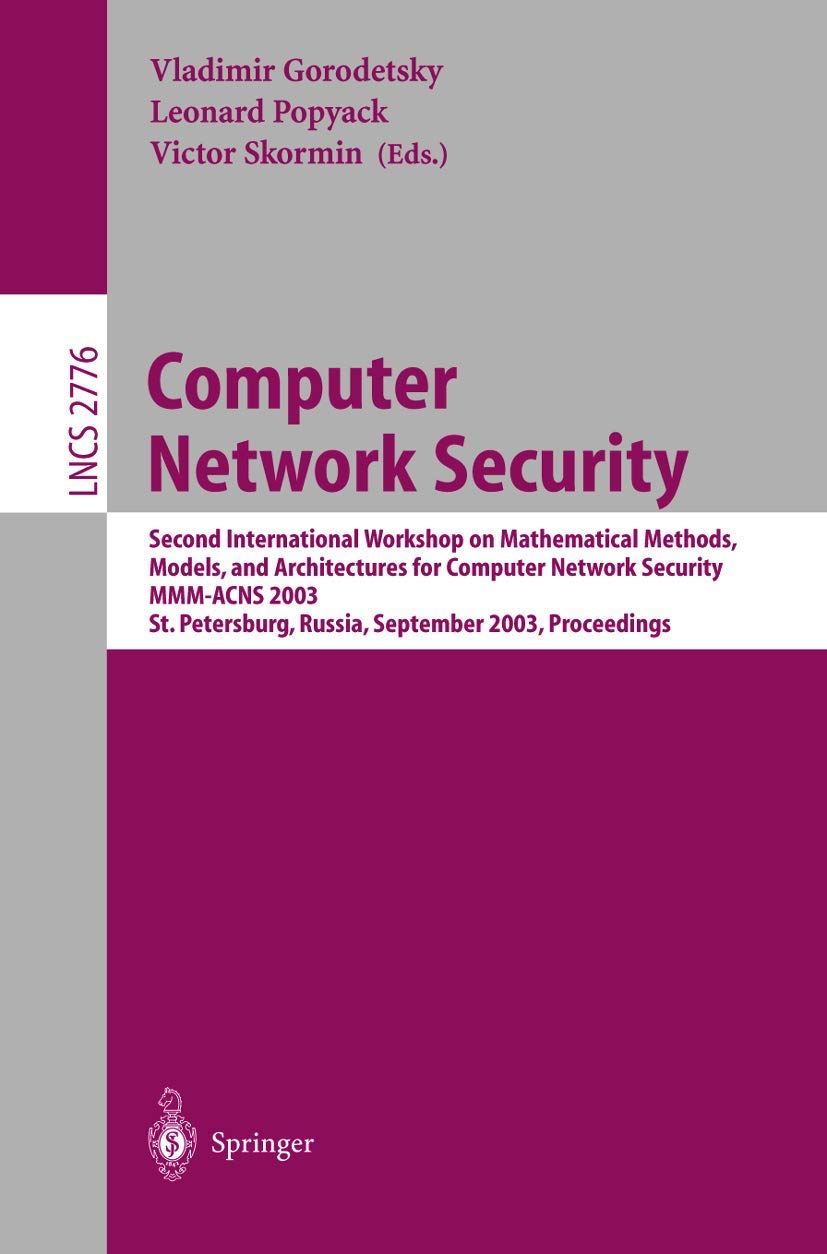
Computer Network Security: Mathematical Methods, Models, and Architectures
Inclusive of all applicable taxes. FREE shipping on all orders.
Available Offers
- 🚚Free Delivery — Free shipping on all orders
- 💵Cash on Delivery — Pay when your order arrives
- ↩️15-Day Easy Returns — Hassle-free return policy
- 🔒Cash on Delivery — Pay safely when your order arrives
Check Delivery
Product Description
Introduction
In an era where cyber threats evolve with alarming sophistication, a deep understanding of the mathematical and architectural foundations of network security is no longer optional—it is essential. Computer Network Security: Second International Workshop on Mathematical Methods, Models, and Architectures for Computer Network Security, MMM-ACNS ... 2776, edited by Vladimir Gorodetsky, offers a rigorous, research-driven exploration of the theoretical underpinnings that safeguard modern digital infrastructures. Published by Springer, this hardcover volume is an indispensable resource for Indian students, researchers, and cybersecurity professionals who seek to move beyond surface-level practices and engage with the core principles that define resilient network defence.
Book Overview
This book compiles the peer-reviewed proceedings of the Second International Workshop on Mathematical Methods, Models, and Architectures for Computer Network Security (MMM-ACNS 2003), held in St. Petersburg, Russia. It captures the cutting-edge discussions and breakthroughs presented by leading international experts. Far from being a simple collection of papers, the volume serves as a coherent narrative on how mathematical models—ranging from algebraic structures to probabilistic frameworks—can be applied to design secure networks, detect intrusions, and ensure data integrity. For Indian readers pursuing advanced studies in computer science or information security, this work bridges the gap between abstract theory and real-world implementation.
Key Highlights
- Peer-Reviewed Scholarship: Every chapter has undergone rigorous academic review, ensuring high-quality, reliable content.
- Mathematical Rigour: Emphasises formal methods, cryptographic protocols, and quantitative models over superficial tool-based approaches.
- Global Perspective: Contributions from researchers across Russia, the USA, and Europe provide a diverse, international viewpoint.
- Foundational Focus: Ideal for those who want to understand the 'why' behind security mechanisms, not just the 'how'.
- Hardcover Durability: A sturdy edition suitable for repeated reference in libraries, labs, and personal collections.
Inside the Book
The volume is structured around three core themes: mathematical methods, security models, and network architectures. Early chapters delve into algebraic and combinatorial approaches to cryptography and access control. Middle sections explore formal verification techniques for security protocols, including game-theoretic models for threat analysis. Later chapters shift to architectural considerations, presenting novel designs for intrusion detection systems, secure routing, and distributed firewall mechanisms. Each contribution is self-contained yet interlinked, allowing readers to either focus on specific topics or absorb the full spectrum of ideas. The book also includes discussions on emerging challenges of the early 2000s that remain relevant today, such as denial-of-service resilience and secure multi-party computation.
Key Topics
- Mathematical foundations of cryptography and cryptanalysis
- Formal models for security policies and access control
- Intrusion detection using statistical and machine learning approaches
- Secure network architecture design and verification
- Game theory and decision-making in adversarial environments
- Protocol analysis and automated security verification
- Resilience against distributed denial-of-service attacks
- Trust management and reputation systems
Reader Benefits
- Deepen Theoretical Knowledge: Gain a solid grasp of the mathematics that underpin modern cybersecurity solutions.
- Enhance Research Skills: Learn how to apply formal methods to analyse and design secure systems.
- Stay Ahead of the Curve: Understand foundational concepts that remain constant even as technology evolves.
- Practical Insights: Discover how theoretical models translate into real-world security architectures.
- Academic Edge: Ideal for preparing for advanced coursework, seminars, or research projects in network security.
Learning Outcomes
By engaging with this book, readers will be able to: critically evaluate cryptographic protocols using mathematical rigour; design and model secure network architectures based on formal specifications; apply probabilistic and statistical methods to detect anomalies and intrusions; analyse security trade-offs using game-theoretic frameworks; and contribute original ideas to the field of computer network security. The knowledge gained here forms a strong foundation for pursuing certifications, higher degrees, or specialised roles in cybersecurity.
Who Should Read
- Graduate Students: Those pursuing M.Tech, MS, or PhD in computer science, information security, or applied mathematics.
- Cybersecurity Researchers: Academics and industry professionals looking for advanced theoretical perspectives.
- Network Engineers: Professionals seeking to strengthen their understanding of security principles beyond configuration.
- Faculty Members: Educators who want to incorporate rigorous mathematical content into their security curriculum.
- Policy Makers: Individuals involved in crafting security standards and frameworks at organisational or national levels.
About the Author
Vladimir Gorodetsky is a distinguished researcher affiliated with the St. Petersburg Institute for Informatics and Automation of the Russian Academy of Sciences (SPIIRAS). With decades of experience in computer science, his work has significantly advanced the fields of multi-agent systems, information security, and mathematical modelling. As the editor of this volume, he has curated contributions from some of the brightest minds in network security, ensuring a cohesive and intellectually stimulating collection. His leadership in organising the MMM-ACNS workshop series underscores his commitment to fostering international collaboration in cybersecurity research.
About the Publisher
Springer is one of the world's most respected academic publishers, known for its rigorous editorial standards and extensive catalogue of scientific and technical literature. With a legacy spanning over 180 years, Springer delivers cutting-edge research in computer science, engineering, and mathematics to scholars and practitioners worldwide. This hardcover edition reflects Springer's commitment to quality, making it a trusted addition to any serious academic or professional library. For Indian readers, Springer books are widely recognised as authoritative references in universities and research institutions across the country.
Conclusion
Computer Network Security: Second International Workshop on Mathematical Methods, Models, and Architectures for Computer Network Security, MMM-ACNS ... 2776 is more than a proceedings volume—it is a gateway to mastering the mathematical soul of cybersecurity. For Indian students and professionals who aspire to build secure digital futures, this book offers the theoretical depth and intellectual rigour required to stand out in a competitive field. Whether you are a researcher seeking inspiration, a student preparing for advanced studies, or a practitioner aiming to elevate your expertise, this hardcover edition from Springer is a worthy investment. Order your copy today from Bookshops.in and take a decisive step toward cybersecurity excellence.
Quick Summary
Computer Network Security: Mathematical Methods, Models, and Architectures is a scholarly hardcover volume edited by Vladimir Gorodetsky, presenting proceedings from the Second International Workshop on Mathematical Methods, Models, and Architectures for Computer Network Security (MMM-ACNS 2003) held in St. Petersburg, Russia. The book brings together cutting-edge research on formal mathematical approaches to securing computer networks, including intrusion detection models, cryptographic protocol analysis, distributed system security, and access control architectures. It is designed for cybersecurity researchers, postgraduate students, and network security professionals who seek deep theoretical understanding. Readers will explore advanced topics such as threat modeling, security policy frameworks, and network resilience. Published by Springer, this edition is a durable hardcover reference. By purchasing from Bookshops.in, Indian customers receive an authentic copy with reliable delivery and customer support.
Book Highlights
Book Specifications
| ISBN-13 | 9783540407973 |
| ISBN-10 | 3540407979 |
| Publisher | Springer Verlag |
| Language | English |
| Dimensions | 15.49 x 2.82 x 23.5 cm |
| Weight | 318 g |
| Country | India |
| Category | Computer Science › Networking |
| Genre | Nonfiction |
| Original Language | English |
Frequently Asked Questions
What is Computer Network Security about?
Who is the author of this book?
Is this book suitable for beginners?
What is the binding of this book?
Which publisher released this book?
Does this book include practical examples?
Can I use this book for my PhD research?
Is this book available in Indian bookstores?
What is the price of this book?
Does this book cover cryptography?
What is the language of the book?
What is the ISBN of this book?
Is this a workshop proceedings book?
Why should I buy from Bookshops.in?
Readers Also Search For
Customers Also Bought

Programming
Algorithmische Sprache Und Programmentwicklung | by H. Partsch | F. L. Bauer | P. Pepper | Springer | by H. Partsch | F. L. Bauer | P. Pepper | Springer | by H. Partsch | F. L. Bauer | P. Pepper | Springer | by H. Partsch | F. L. Bauer | P. Pepper | Springer | by H. Partsch | F. L. Bauer | P. Pepper | Springer | by H. Partsch | F. L. Bauer | P. Pepper | Springer | by H. Partsch | F. L. Bauer | P. Pepper | Springer | by H. Partsch | F. L. Bauer | P. Pepper | Springer | by H. Partsch | F. L. Bauer
Programming
Distributed Algorithms | by Jean-Claude Bermond | Michel Raynal | Springer | by Jean-Claude Bermond | Michel Raynal | Springer | by Jean-Claude Bermond | Michel Raynal | Springer | by Jean-Claude Bermond | Michel Raynal | Springer | by Jean-Claude Bermond | Michel Raynal | Springer | by Jean-Claude Bermond | Michel Raynal | Springer | by Jean-Claude Bermond | Michel Raynal | Springer | by Jean-Claude Bermond | Michel Raynal | Springer | by Jean-Claude Bermond | Michel Raynal | Springer | by Jean

Programming
Meta-Level Control for Deductive Database Systems | by Helmut Schmidt | Springer | by Helmut Schmidt | Springer | by Helmut Schmidt | Springer | by Helmut Schmidt | Springer | by Helmut Schmidt | Springer | by Helmut Schmidt | Springer | by Helmut Schmidt | Springer | by Helmut Schmidt | Springer | by Helmut Schmidt | Springer | by Helmut Schmidt | Springer | by Helmut Schmidt | Springer | by Helmut Schmidt | Springer | by Helmut Schmidt | Springer | by Helmut Schmidt | Springer | by Helmut Schm

Programming
Java Web Services | by David A. Chappell | Tyler Jewell | O'Reilly Media | by David A. Chappell | Tyler Jewell | O'Reilly Media | by David A. Chappell | Tyler Jewell | O'Reilly Media | by David A. Chappell | Tyler Jewell | O'Reilly Media | by David A. Chappell | Tyler Jewell | O'Reilly Media | by David A. Chappell | Tyler Jewell | O'Reilly Media | by David A. Chappell | Tyler Jewell | O'Reilly Media | by David A. Chappell | Tyler Jewell | O'Reilly Media | by David A. Chappell | Tyler Jewell | O'

Programming
Database in Depth | by Chris J. Date | O'Reilly Media | by Chris J. Date | O'Reilly Media | by Chris J. Date | O'Reilly Media | by Chris J. Date | O'Reilly Media | by Chris J. Date | O'Reilly Media | by Chris J. Date | O'Reilly Media | by Chris J. Date | O'Reilly Media | by Chris J. Date | O'Reilly Media | by Chris J. Date | O'Reilly Media | by Chris J. Date | O'Reilly Media | by Chris J. Date | O'Reilly Media | by Chris J. Date | O'Reilly Media | by Chris J. Date | O'Reilly Media | by Chris J.

Programming
Integration of AI and OR Techniques in Constraint Programming for Combinatorial Optimization Problem | by Nicolas Beldiceanu | Narendra Jussien | Eric Pinson | Springer | by Nicolas Beldiceanu | Narendra Jussien | Eric Pinson | Springer | by Nicolas Beldiceanu | Narendra Jussien | Eric Pinson | Springer | by Nicolas Beldiceanu | Narendra Jussien | Eric Pinson | Springer | by Nicolas Beldiceanu | Narendra Jussien | Eric Pinson | Springer | by Nicolas Beldiceanu | Narendra Jussien | Eric Pinson |
Related Products
View All
Networking
Wireless AD Hoc Networking | by Shih-Lin Wu | Yu-Chee Tseng | Auerbach Publications | by Shih-Lin Wu | Yu-Chee Tseng | Auerbach Publications | by Shih-Lin Wu | Yu-Chee Tseng | Auerbach Publications | by Shih-Lin Wu | Yu-Chee Tseng | Auerbach Publications | by Shih-Lin Wu | Yu-Chee Tseng | Auerbach Publications | by Shih-Lin Wu | Yu-Chee Tseng | Auerbach Publications | by Shih-Lin Wu | Yu-Chee Tseng | Auerbach Publications | by Shih-Lin Wu | Yu-Chee Tseng | Auerbach Publications | by Shih-Lin Wu

Networking
Data Dissemination and Query in Mobile Social Networks (SpringerBriefs in Computer Science)

Networking
Innovations in Internetworking (Professional development library)

Networking
Internet E-Mail: Protocols, Standards, and Implementation by Lawrence Hughes

Networking
Library Automation and Networking-New Tools for a New Identity: European Conference, 9-11 May 1990, Brussels

Networking