
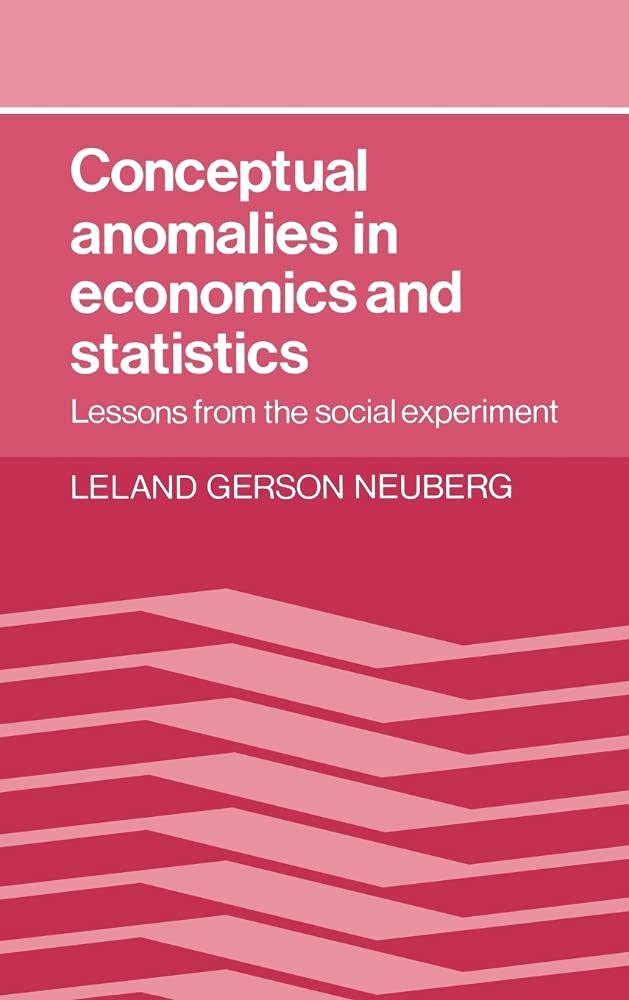
Conceptual Anomalies in Economics and Statistics: Lessons from the Social Experiment by Leland Gerson Neuberg – A Critic
Inclusive of all applicable taxes. FREE shipping on all orders.
Available Offers
- 🚚Free Delivery — Free shipping on all orders
- 💵Cash on Delivery — Pay when your order arrives
- ↩️15-Day Easy Returns — Hassle-free return policy
- 🔒Cash on Delivery — Pay safely when your order arrives
Check Delivery
Product Description
Introduction
In an age where data drives policy and numbers shape our understanding of human behaviour, a critical question emerges: can economics and statistics truly explain why we act the way we do? Conceptual Anomalies in Economics and Statistics: Lessons from the Social Experiment by Leland Gerson Neuberg dares to challenge the very foundations of these disciplines. This thought-provoking hardcover from Cambridge University Press invites Indian readers—students, researchers, and policy enthusiasts alike—to step into a world where controlled social experiments reveal unexpected cracks in the scientific armour of social sciences.
Book Overview
Published by the prestigious Cambridge University Press, this rigorous work delves into the conceptual puzzles that arise when economists and statisticians attempt to apply experimental methods to human society. Starting with the pioneering negative income tax experiments of the late 1960s, Neuberg examines how random assignment trials—designed to improve social policy—unearth anomalies that physical sciences rarely encounter. The book argues that these anomalies are not mere glitches but fundamental challenges to the coherence of microeconomics and statistics as explanatory sciences. Written for an academic audience, it bridges philosophy, methodology, and real-world policy, offering a rare critique that is both scholarly and accessible.
Key Highlights
- Pioneering Critique: One of the first book-length examinations of conceptual anomalies in controlled social experiments, challenging the assumption that economics and statistics mirror physical sciences.
- Real-World Case Studies: Detailed analysis of landmark social experiments, including income guarantee trials, revealing methodological blind spots.
- Interdisciplinary Approach: Merges philosophy of science, economics, and statistics to uncover why human behaviour resists neat mathematical modelling.
- Authored by an Expert: Leland Gerson Neuberg brings decades of academic rigour, making complex ideas understandable for graduate students and professionals.
Inside the Book
Neuberg systematically unpacks the conceptual foundations of controlled experiments. He begins with the philosophical problems that all scientific inquiry faces, then zeroes in on the unique methodological difficulties that plague human social experiments—difficulties that physical scientists rarely confront. Through vivid examples, he shows how randomness, causation, and inference become tangled when humans are the subjects. The book does not offer easy solutions but instead forces readers to rethink what it means to explain social behaviour scientifically. Each chapter builds a case that the anomalies are not peripheral but central to the identity of economics and statistics.
Key Topics
- Philosophical underpinnings of controlled social experiments
- Negative income tax experiments and their conceptual flaws
- Anomalies in random assignment and statistical inference
- Comparison between physical science and social science methodologies
- The limits of microeconomics in explaining human behaviour
- Role of causation and probability in social policy evaluation
Reader Benefits
This book equips readers with a critical lens to evaluate policy claims and statistical arguments that dominate public discourse. For Indian students and professionals navigating data-driven decision-making, it offers a deeper understanding of why some social interventions succeed or fail—and why numbers alone cannot capture human complexity. It sharpens analytical thinking, fosters scepticism towards oversimplified models, and provides a robust framework for interdisciplinary research. Whether you are a policy analyst in Delhi or an economics student in Mumbai, this work will transform how you read graphs, surveys, and experimental results.
Learning Outcomes
- Identify conceptual anomalies in experimental designs involving human subjects
- Critically evaluate the explanatory power of economic and statistical models
- Understand the philosophical limits of random assignment in social contexts
- Compare methodological challenges across physical and social sciences
- Apply insights to real-world policy evaluation and academic research
Who Should Read
This book is essential for graduate students and researchers in economics, statistics, sociology, and public policy. It also appeals to philosophers of science, data scientists questioning the limits of their tools, and policy professionals who design or evaluate social programmes. Undergraduate students with a strong foundation in statistics or economics will find it challenging but rewarding. Anyone curious about why human behaviour often defies prediction—and what that means for science—will be captivated.
About the Author
Leland Gerson Neuberg is a scholar known for his incisive work at the intersection of economics, statistics, and philosophy. With a career dedicated to questioning methodological orthodoxies, he brings a rare blend of technical expertise and philosophical depth. His research has influenced debates on experimental design and the limits of quantification in social sciences. This book reflects his lifelong commitment to understanding how we know what we think we know about human society.
About the Publisher
Cambridge University Press is one of the world's oldest and most respected academic publishers, with a legacy of advancing knowledge across disciplines. Known for rigorous peer review and high editorial standards, Cambridge publishes works that shape scholarly discourse globally. This hardcover edition reflects their commitment to producing durable, authoritative texts that stand the test of time—ideal for libraries, institutions, and serious readers in India.
Conclusion
Conceptual Anomalies in Economics and Statistics is not a comfortable read—it is a necessary one. By exposing the hidden fractures in two disciplines that claim to explain human behaviour, Leland Gerson Neuberg invites us to embrace humility in the face of complexity. For Indian readers who value critical thought and intellectual rigour, this book is a rare gem that will provoke debate, deepen understanding, and inspire a more nuanced approach to social science. Add it to your collection and join the conversation on what science can—and cannot—tell us about ourselves.
Quick Summary
Conceptual Anomalies in Economics and Statistics: Lessons from the Social Experiment by Leland Gerson Neuberg is a thought-provoking academic work that delves into the philosophical and methodological challenges underlying controlled social experiments. Starting with the negative income tax experiments of the late 1960s, Neuberg critically examines how economics and statistics attempt to explain human social behaviour, revealing conceptual anomalies that are absent in physical sciences. This book is ideal for graduate students, researchers, and policy analysts in economics, statistics, and social sciences who seek a deeper understanding of experimental design limitations. Readers will learn to identify and navigate methodological difficulties, question the foundations of social science inquiry, and apply these lessons to improve policy evaluation. Available at Bookshops.in, this hardcover edition from Cambridge University Press is a valuable addition to any serious academic library in India.
Book Highlights
Book Specifications
| ISBN-13 | 9780521304443 |
| ISBN-10 | 052130444X |
| Publisher | Cambridge University Press |
| Language | English |
| Dimensions | 15.24 x 2.54 x 22.86 cm |
| Weight | 652 g |
| Country | India |
| Category | Economics › Econometrics & Statistics |
| Genre | Non-fiction |
| Original Language | English |
Frequently Asked Questions
What is the main theme of Conceptual Anomalies in Economics and Statistics?
Who is the author Leland Gerson Neuberg?
Is this book suitable for beginners in economics?
What specific experiments does the book analyze?
How does this book differ from standard economics textbooks?
Does the book cover statistical methods?
Is this book relevant for Indian students?
Does the book offer practical lessons for policy making?
What is the binding of this book?
Can I find this book in Indian bookstores?
What is the ISBN of this book?
Is this book part of a series?
Does the book compare social experiments with physical science experiments?
Readers Also Search For
Customers Also Bought

Entrepreneurship
Chinese Economic Revolution (English, Linda Grove)
Entrepreneurship
Engines of Innovation: The Entrepreneurial University in the Twenty-First Century by Holden Thorp
Entrepreneurship
Invention to Innovation (English, PhD Marshall Larry | Jenna Daroczy)

Entrepreneurship
Database Management Systems by Raghu Ramakrishnan – DBMS Textbook

Entrepreneurship
Decision-making for Technology Executives by Harold A. Linstone
Entrepreneurship
The Business Innovation Audit (English, William Tate)
Related Products
View All
Economics
Political Economy from Pufendorf to Marx (English, István Hont | Lasse S. Andersen | Béla Kapossy)
Economics
Women's Entrepreneurship and Economics (English, Miguel-Angel Galindo | Domingo Ribeiro)
Economics
Trade Policy and Industrialization in Turbulent Times | by Gerry Helleiner | Routledge | by Gerry Helleiner | Routledge | by Gerry Helleiner | Routledge | by Gerry Helleiner | Routledge | by Gerry Helleiner | Routledge | by Gerry Helleiner | Routledge | by Gerry Helleiner | Routledge | by Gerry Helleiner | Routledge | by Gerry Helleiner | Routledge | by Gerry Helleiner | Routledge | by Gerry Helleiner | Routledge | by Gerry Helleiner | Routledge | by Gerry Helleiner | Routledge | by Gerry Hellei
Economics
History of Economic Analysis | by Schumpeter Joseph A. | Taylor & Francis Ltd | by Schumpeter Joseph A. | Taylor & Francis Ltd | by Schumpeter Joseph A. | Taylor & Francis Ltd | by Schumpeter Joseph A. | Taylor & Francis Ltd | by Schumpeter Joseph A. | Taylor & Francis Ltd | by Schumpeter Joseph A. | Taylor & Francis Ltd | by Schumpeter Joseph A. | Taylor & Francis Ltd | by Schumpeter Joseph A. | Taylor & Francis Ltd | by Schumpeter Joseph A. | Taylor & Franci

Economics
OECD Compendium of Productivity Indicators 2015 | by Organization for Economic Cooperation an | Organization for Economic Co-Operation & Deve | by Organization for Economic Cooperation an | Organization for Economic Co-Operation & Deve | by Organization for Economic Cooperation an | Organization for Economic Co-Operation & Deve | by Organization for Economic Cooperation an | Organization for Economic Co-Operation & Deve | by Organization for Economic Cooperation an | Organization

Economics