
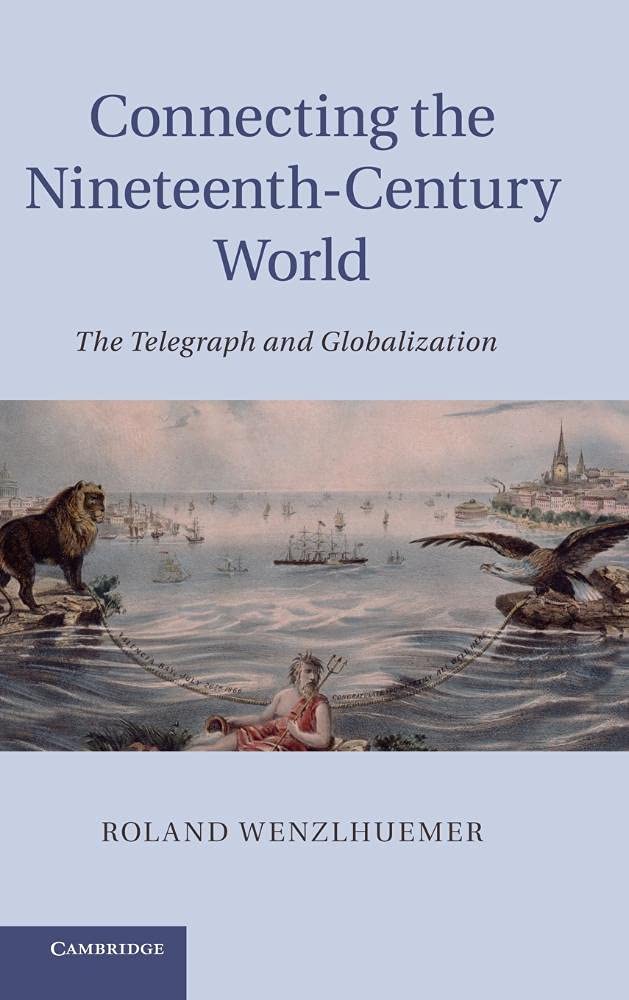
Connecting the Nineteenth-Century World: The Telegraph and Globalization
Inclusive of all applicable taxes. FREE shipping on all orders.
Available Offers
- 🚚Free Delivery — Free shipping on all orders
- 💵Cash on Delivery — Pay when your order arrives
- ↩️15-Day Easy Returns — Hassle-free return policy
- 🔒Cash on Delivery — Pay safely when your order arrives
Check Delivery
Product Description
Introduction
In an age where instant global communication is taken for granted, it is easy to forget the revolutionary impact of the telegraph. Connecting the Nineteenth-Century World: The Telegraph and Globalization by Roland Wenzlhuemer offers a profound exploration of how the telegraph transformed the world in the 1800s, laying the groundwork for the interconnected global society we inhabit today. This hardcover volume from Cambridge University Press is an essential read for students, historians, and anyone curious about the roots of globalization.
Book Overview
This meticulously researched work examines the intricate relationship between the telegraph network and the forces of globalization during the nineteenth century. Wenzlhuemer goes beyond a simple technological history, delving into the social, cultural, and economic implications of telegraphy. By the end of the 1800s, the global telegraph grid had linked every continent, enabling direct communication at unprecedented speed. The book investigates how this new connectivity reshaped human interaction, commerce, and power dynamics across the world.
Key Highlights
- Groundbreaking approach: Combines cultural studies with social science methodology, including historical GIS mapping, to offer fresh insights into the telegraph network and its users.
- Global perspective: Covers the telegraph's impact on diverse regions, including India, where the British Raj used the technology to consolidate control and integrate the subcontinent into global circuits.
- User-centric analysis: Explores what it meant for people to be connected or disconnected, and how they engaged with this transformative technology.
- Critical examination of globalization: Challenges simplistic narratives by questioning whether faster communication alone explains the telegraph's central role in nineteenth-century globalization.
Inside the Book
The book is structured to guide readers through the technological, spatial, and human dimensions of the telegraph. Wenzlhuemer uses evidence-based mapping to visualize the uneven spread of the network, revealing how some regions thrived while others were left behind. Rich case studies illustrate how telegraphy affected communication itself—changing the tempo of business, diplomacy, and personal correspondence. The text is supported by maps, diagrams, and archival material that bring the era to life.
Key Topics
- The rise of the global telegraph network and its physical infrastructure
- Telegraphy as a driver of economic integration and colonial expansion
- Social and cultural impacts of instantaneous communication
- Historical GIS and spatial analysis of telegraph connections
- The relationship between technology and globalization in the nineteenth century
Reader Benefits
This book offers Indian readers a unique lens to understand how telegraphy shaped colonial India and its integration into global networks. It provides critical insights into the origins of modern communication, helping readers appreciate the historical forces behind today's digital world. The accessible yet scholarly style makes complex ideas easy to grasp, while the interdisciplinary approach enriches perspectives on history, technology, and society.
Learning Outcomes
- Understand the technological and social history of the telegraph
- Analyze the role of communication networks in globalization
- Evaluate the impact of telegraphy on colonial and postcolonial societies
- Apply historical GIS methods to study spatial patterns of connectivity
- Critically assess the relationship between speed of communication and social change
Who Should Read
This book is ideal for undergraduate and postgraduate students of history, sociology, media studies, and science and technology studies. It is also valuable for researchers interested in globalization, colonial history, and the history of communication. General readers with a curiosity about how the world became connected will find it equally rewarding.
About the Author
Roland Wenzlhuemer is a distinguished historian at the University of Munich, specializing in global history and the history of communication. His research focuses on the interplay between technology, space, and society. He has published extensively on the telegraph, globalization, and historical GIS, bringing a rigorous interdisciplinary lens to his work.
About the Publisher
Cambridge University Press is one of the world's oldest and most respected academic publishers. Known for its commitment to scholarly excellence, Cambridge publishes works that shape research and education globally. This hardcover edition reflects the publisher's high standards of production and editorial quality.
Conclusion
Connecting the Nineteenth-Century World is a masterful study that reveals how the telegraph rewired the planet and set the stage for today's hyperconnected age. Whether you are a student, scholar, or history enthusiast, this book provides an indispensable understanding of the forces that made our modern world. Order your copy from Bookshops.in today and travel back to the dawn of global communication.
Quick Summary
Connecting the Nineteenth-Century World: The Telegraph and Globalization by Roland Wenzlhuemer is a groundbreaking study of the first global communication network – the electric telegraph. The book moves beyond a simple technological history to examine how telegraphy reshaped space, time, and society. Wenzlhuemer combines cultural analysis with quantitative methods, including historical GIS mapping, to show who was connected and who was left out. He explores the roles of imperial powers, cable companies, telegraph operators, and ordinary users. The book covers the laying of undersea cables, the spread of telegraph lines across India and other colonies, and the impact on news, finance, diplomacy, and daily life. It reveals how the telegraph accelerated globalization while also reinforcing inequalities. This book is ideal for students and scholars of global history, communication studies, and science and technology studies. Indian readers will find valuable insights into the colonial telegraph network that linked Bombay, Calcutta, and Madras to London. By purchasing from Bookshops.in, you get a genuine hardcover edition delivered to your doorstep anywhere in India.
Book Highlights
Book Specifications
| ISBN-13 | 9781107025288 |
| ISBN-10 | 1107025281 |
| Publisher | Cambridge University Press |
| Language | English |
| Dimensions | 16.51 x 2.54 x 24.13 cm |
| Weight | 650 g |
| Country | India |
| Category | Economics › Economic History |
| Genre | History |
| Original Language | English |
Frequently Asked Questions
What is this book about?
Who is the author?
Is this book suitable for Indian readers?
What makes this book different from other telegraph histories?
Does it include maps?
What is the ISBN?
Is this a hardcover or paperback?
Which publisher released this book?
What language is the book in?
Can I use this book for my university course?
Does the book discuss undersea cables?
Is there a focus on any particular region?
Why should I buy from Bookshops.in?
Readers Also Search For
Customers Also Bought
Entrepreneurship
Chinese Economic Revolution (English, Linda Grove)
Entrepreneurship
Engines of Innovation: The Entrepreneurial University in the Twenty-First Century by Holden Thorp

Entrepreneurship
Invention to Innovation (English, PhD Marshall Larry | Jenna Daroczy)

Entrepreneurship
Database Management Systems by Raghu Ramakrishnan – DBMS Textbook

Entrepreneurship
Decision-making for Technology Executives by Harold A. Linstone

Entrepreneurship
The Business Innovation Audit (English, William Tate)
Related Products
View All
Economics
Political Economy from Pufendorf to Marx (English, István Hont | Lasse S. Andersen | Béla Kapossy)
Economics
Women's Entrepreneurship and Economics (English, Miguel-Angel Galindo | Domingo Ribeiro)

Economics
Trade Policy and Industrialization in Turbulent Times | by Gerry Helleiner | Routledge | by Gerry Helleiner | Routledge | by Gerry Helleiner | Routledge | by Gerry Helleiner | Routledge | by Gerry Helleiner | Routledge | by Gerry Helleiner | Routledge | by Gerry Helleiner | Routledge | by Gerry Helleiner | Routledge | by Gerry Helleiner | Routledge | by Gerry Helleiner | Routledge | by Gerry Helleiner | Routledge | by Gerry Helleiner | Routledge | by Gerry Helleiner | Routledge | by Gerry Hellei
Economics
History of Economic Analysis | by Schumpeter Joseph A. | Taylor & Francis Ltd | by Schumpeter Joseph A. | Taylor & Francis Ltd | by Schumpeter Joseph A. | Taylor & Francis Ltd | by Schumpeter Joseph A. | Taylor & Francis Ltd | by Schumpeter Joseph A. | Taylor & Francis Ltd | by Schumpeter Joseph A. | Taylor & Francis Ltd | by Schumpeter Joseph A. | Taylor & Francis Ltd | by Schumpeter Joseph A. | Taylor & Francis Ltd | by Schumpeter Joseph A. | Taylor & Franci
Economics
OECD Compendium of Productivity Indicators 2015 | by Organization for Economic Cooperation an | Organization for Economic Co-Operation & Deve | by Organization for Economic Cooperation an | Organization for Economic Co-Operation & Deve | by Organization for Economic Cooperation an | Organization for Economic Co-Operation & Deve | by Organization for Economic Cooperation an | Organization for Economic Co-Operation & Deve | by Organization for Economic Cooperation an | Organization

Economics