
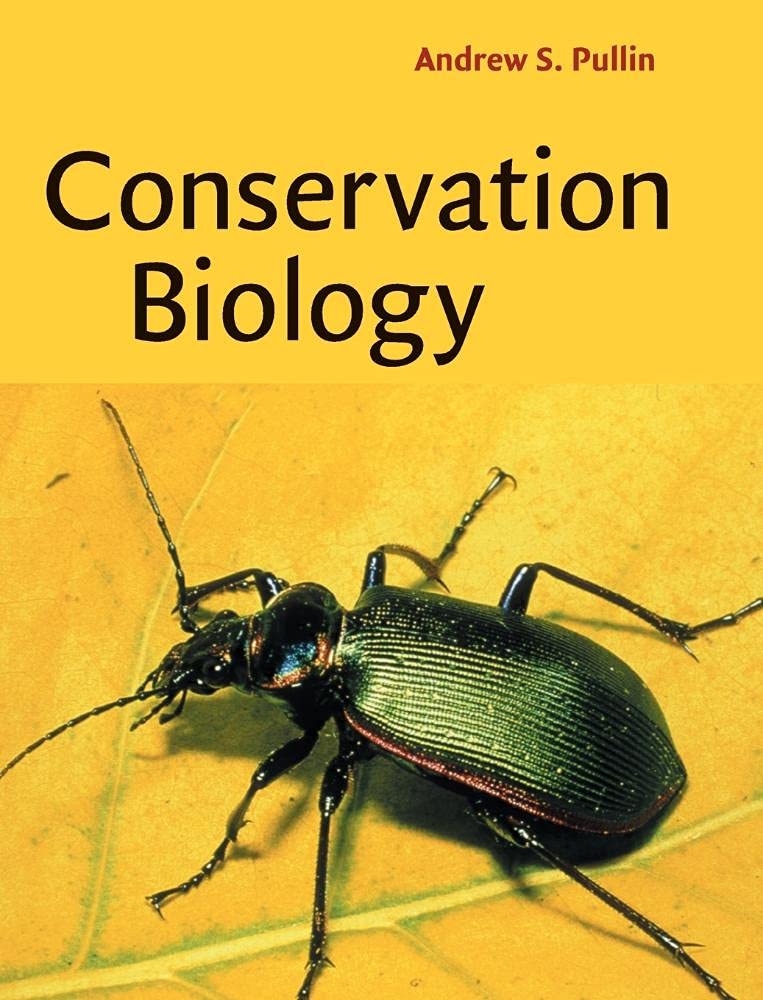
Conservation Biology: An Illustrated Introduction to Biodiversity and Ecosystem Conservation by Andrew S. Pullin
Inclusive of all applicable taxes. FREE shipping on all orders.
Available Offers
- 🚚Free Delivery — Free shipping on all orders
- 💵Cash on Delivery — Pay when your order arrives
- ↩️15-Day Easy Returns — Hassle-free return policy
- 🔒Cash on Delivery — Pay safely when your order arrives
Check Delivery
Product Description
Introduction
In an age where the natural world faces unprecedented challenges, understanding the science behind preserving life on Earth has never been more critical. Conservation Biology by Andrew S. Pullin offers a comprehensive and engaging exploration of the principles and practices that guide efforts to protect biodiversity. Published by Cambridge University Press, this hardbound volume is an essential resource for students, researchers, and anyone passionate about safeguarding our planet's rich tapestry of species and ecosystems. Written with clarity and depth, this book bridges the gap between theoretical ecology and real-world conservation action, making it a cornerstone text for Indian and global readers alike.
Book Overview
Conservation Biology takes readers on an immersive journey across diverse ecosystems—from tropical rainforests and coral reefs to arid deserts and temperate grasslands. Andrew S. Pullin masterfully weaves together case studies, scientific data, and practical insights to illustrate the urgent need for conservation in the face of habitat loss, climate change, and overexploitation. The book is structured to first introduce the fundamental concepts of biodiversity and its value, then delve into the threats it faces, and finally present the tools and strategies—ranging from genetic management to landscape-level planning—that conservationists use to mitigate these threats. Each chapter is enriched with stunning illustrations, diagrams, and real-world examples that make complex ideas accessible and memorable.
Key Highlights
- Comprehensive Coverage: Explores both terrestrial and aquatic ecosystems, offering a holistic view of conservation challenges and solutions.
- Applied Approach: Translates scientific theory into actionable conservation strategies, from protected area design to species recovery programs.
- Rich Visuals: Includes full-color photographs, maps, and infographics that enhance understanding of ecological concepts.
- Global Perspective with Local Relevance: Features case studies from across the world, including examples from India and other biodiversity hotspots.
- Up-to-Date Science: Reflects the latest research in conservation genetics, landscape ecology, and community-based conservation.
Inside the Book
Divided into three major parts, the book begins with Part I: The Context of Conservation, which sets the stage by defining biodiversity, its distribution, and its intrinsic and utilitarian value. Part II: Threats to Biodiversity systematically examines habitat destruction, fragmentation, invasive species, pollution, and overharvesting, with detailed analysis of how these factors interact. Part III: Conservation in Practice presents a toolbox of methods, including in-situ and ex-situ conservation, restoration ecology, and policy frameworks. The narrative is supported by end-of-chapter summaries, discussion questions, and a glossary that aids self-study.
Key Topics
- Biodiversity patterns and measurement
- Habitat loss, fragmentation, and degradation
- Overexploitation of species in fisheries and forests
- Climate change impacts on ecosystems
- Conservation genetics and population viability analysis
- Designing and managing protected areas
- Ecological restoration and rewilding
- Community-based conservation and sustainable development
- Conservation policy, law, and international agreements
Reader Benefits
By engaging with this book, readers will gain a solid foundation in conservation biology that empowers them to think critically about environmental issues. The clear, jargon-free writing style ensures that even those new to the subject can grasp complex concepts. Students will find the book invaluable for coursework, while practitioners can use it as a reference for designing conservation projects. Additionally, the emphasis on case studies from diverse regions—including India's Western Ghats and Sundarbans—makes the content relatable for Indian readers, helping them connect global principles to local challenges.
Learning Outcomes
- Understand the scientific basis of biodiversity and its importance for ecosystem health and human well-being.
- Identify major threats to species and ecosystems and evaluate their relative impacts.
- Apply conservation tools such as habitat corridors, captive breeding, and landscape planning to real-world scenarios.
- Analyze the role of policy, economics, and community engagement in successful conservation outcomes.
- Develop a multidisciplinary perspective that integrates ecology, sociology, and ethics in conservation decision-making.
Who Should Read
This book is ideal for undergraduate and postgraduate students of environmental science, ecology, wildlife biology, and forestry. It is also highly recommended for conservation professionals, park managers, NGO workers, and policy makers seeking a thorough yet accessible reference. Additionally, environmentally conscious readers who wish to deepen their understanding of conservation challenges will find this book both enlightening and inspiring.
About the Author
Andrew S. Pullin is a distinguished ecologist and conservation biologist with extensive experience in both research and teaching. He has served as a professor at the University of Birmingham and has contributed to numerous international conservation initiatives. His work focuses on evidence-based conservation, systematic review of conservation interventions, and bridging the gap between science and practice. Pullin's clear, engaging writing style reflects his commitment to making conservation science accessible to a broad audience.
About the Publisher
Cambridge University Press is a world-leading academic publisher known for its rigorous peer-review process and high-quality educational materials. With a history spanning over four centuries, Cambridge University Press publishes groundbreaking works in science, humanities, and social sciences. This hardcover edition reflects the publisher's dedication to producing durable, beautifully crafted books that stand the test of time—both in content and physical form.
Conclusion
Conservation Biology is more than a textbook; it is a call to action for everyone who cares about the future of life on Earth. Andrew S. Pullin's masterful synthesis of science, strategy, and storytelling equips readers with the knowledge and inspiration to contribute meaningfully to conservation efforts. Whether you are a student beginning your journey or a seasoned professional seeking fresh perspectives, this book will deepen your understanding and ignite your passion for preserving our planet's irreplaceable biodiversity. Add this essential volume to your library today and become part of the solution.
Quick Summary
Conservation Biology by Andrew S. Pullin is a foundational textbook that takes readers on a vivid tour of Earth's ecosystems, examining the alarming loss of biodiversity. It delves into critical issues like habitat loss, fragmentation, disturbance, and unsustainable exploitation in both land and water environments. The book then presents a range of conservation methods—from traditional practices to modern approaches at genetic, species, and landscape scales—showing how science translates into real-world action. Designed for undergraduate and postgraduate students, it is equally valuable for researchers, conservationists, and environmental professionals. Indian readers will find the global perspective enriching, especially for courses in ecology, wildlife biology, and environmental science. By purchasing from Bookshops.in, you get a high-quality hardcover edition delivered across India, ensuring a reliable and trusted shopping experience for academic and professional needs.
Book Highlights
Book Specifications
| ISBN-13 | 9780521642842 |
| ISBN-10 | 0521642841 |
| Publisher | Cambridge University Press |
| Language | English |
| Dimensions | 19.69 x 1.91 x 24.77 cm |
| Weight | 960 g |
| Country | India |
| Category | Biology & Life Sciences › Biology |
| Genre | Non-fiction |
| Original Language | English |
Frequently Asked Questions
What is Conservation Biology about?
Who is the author of Conservation Biology?
Is this book suitable for Indian students?
What topics does the book cover?
Does the book include illustrations?
What is the ISBN of this book?
Is this a hardcover edition?
Can I use this book for self-study?
Does the book discuss Indian ecosystems?
What is the price of the book?
Is the book available in other languages?
Who should buy this book?
How can I order this book?
Readers Also Search For
Customers Also Bought
Mathematics
Stereotype Spaces and Algebras: 73 (De Gruyter Expositions in Mathematics, 73)
Mathematics
Semigroups in Algebra, Geometry and Analysis: 20 (De Gruyter Expositions in Mathematics, 20)

Mathematics
Geometry from the Pacific Rim: Proceedings of the Pacific Rim Geometry Conference held at National University of Singapore, Republic of Singapore, ... 1994 (De Gruyter Proceedings in Mathematics)
Mathematics
First International Tainan-Moscow Algebra Workshop: Proceedings of the International Conference held at National Cheng Kung University Tainan, Taiwan, ... 1994 (De Gruyter Proceedings in Mathematics)
Mathematics
Differential Geometry - Proceedings of the VIII International Colloquium (English, Jesus A. Alvarez Lopez | Eduardo Garcia-Rio)
Mathematics
Mathematical Theory of Optimal Processes (Classics of Soviet Mathematics)
Related Products
View All
Biology
Evolution: What the Fossils Say and Why It Matters by Donald R. Prothero
Biology
From Taxonomy to Phylogenetics – Life and Work of Willi Hennig
Biology
The Marine Biology of the South China Sea
Biology
Genetics Meets Metabolomics: from Experiment to Systems Biology
Biology
The Elements of Natural or Experimental Philosophy: 2
Biology