
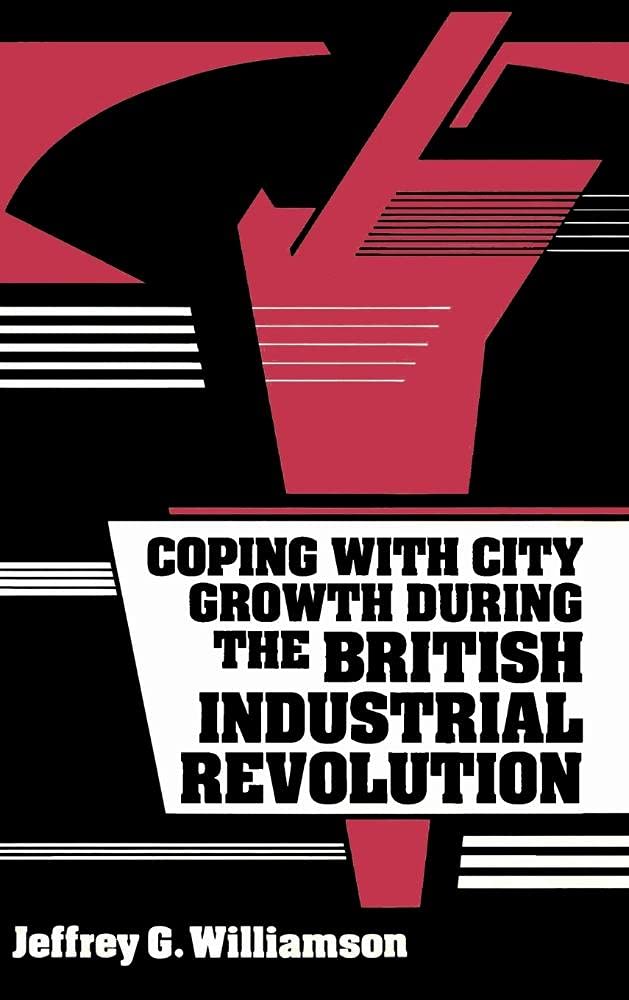
Coping with City Growth during the British Industrial Revolution by Jeffrey G. Williamson – A Deep Dive into Urbanizatio
Inclusive of all applicable taxes. FREE shipping on all orders.
Available Offers
- 🚚Free Delivery — Free shipping on all orders
- 💵Cash on Delivery — Pay when your order arrives
- ↩️15-Day Easy Returns — Hassle-free return policy
- 🔒Cash on Delivery — Pay safely when your order arrives
Check Delivery
Product Description
Introduction
In Coping with City Growth during the British Industrial Revolution, Jeffrey G. Williamson offers a masterful blend of economic history and development economics to explore how Britain managed the unprecedented urban expansion of the First Industrial Revolution. This hardcover volume from Cambridge University Press is an essential read for Indian students, researchers, and policy enthusiasts who seek to understand the parallels between historical urbanization and the challenges facing modern Indian cities today.
Book Overview
Williamson applies the analytical tools used by contemporary Third World development economists to the British experience of the late eighteenth and early nineteenth centuries. The result is a provocative and deeply researched account that examines urban unemployment, underemployment, labour market absorption, municipal planning, slum formation, and environmental degradation. The book argues that Britain’s urban transition offers critical lessons for rapidly growing economies—including India—where city populations continue to swell.
Key Highlights
- Interdisciplinary Approach: Combines rigorous economic modeling with archival historical research.
- Relevant for India: Directly addresses issues of rural-to-urban migration, informal labour markets, and municipal infrastructure strain.
- Provocative Thesis: Challenges the notion that city labour markets failed to absorb rural migrants, offering a nuanced perspective.
- Data-Rich Analysis: Uses historical census data, wage records, and urban density metrics to support arguments.
- Environmental Focus: Examines how rising density and city size led to pollution and declining quality of urban life.
Inside the Book
The book is structured around a series of thematic chapters that move from the macroeconomics of urban growth to the micro-realities of slum life. Williamson begins by setting the stage with Britain’s demographic transition and the surge of migration from countryside to industrial towns like Manchester, Leeds, and Birmingham. He then delves into the failures and successes of municipal governance, the evolution of urban labour markets, and the social costs of overcrowding. Each chapter is supported by tables, graphs, and archival evidence that bring the historical narrative to life.
Key Topics
- Rural-to-urban migration and labour absorption
- Urban unemployment and underemployment in industrializing economies
- Municipal planning and social overhead provision
- Slum formation, density, and housing quality
- Environmental pollution and public health in growing cities
- Comparative perspectives between historical Britain and modern developing nations
Reader Benefits
- Historical Insight: Gain a deep understanding of how Britain navigated the world’s first industrial urbanization.
- Policy Relevance: Learn lessons applicable to contemporary Indian urban challenges like Delhi’s migration influx, Mumbai’s housing crisis, and Bangalore’s infrastructure strain.
- Analytical Skills: Develop the ability to apply economic history frameworks to current development problems.
- Academic Edge: Perfect for students preparing for competitive exams or writing research papers on urbanization and economic history.
Learning Outcomes
By reading this book, you will be able to critically assess the relationship between economic growth and urban expansion. You will understand why some cities succeed in integrating migrants while others struggle. You will also learn to identify the early warning signs of urban distress—such as rising density without corresponding infrastructure—and evaluate policy responses that have worked in historical contexts. The book equips you with a comparative lens to view India’s own urban transformation through the mirror of British history.
Who Should Read
- Undergraduate and postgraduate students of economics, history, and urban studies
- Civil services aspirants preparing for topics on urbanization and economic development
- Urban planners, municipal administrators, and policy researchers
- Development economists and scholars interested in comparative historical analysis
- General readers curious about how cities grow and the social costs of industrialization
About the Author
Jeffrey G. Williamson is one of the most distinguished economic historians of our time. He is the Laird Bell Professor of Economics Emeritus at Harvard University and has held visiting positions at leading institutions worldwide. His extensive body of work spans global economic history, inequality, migration, and urban development. Williamson’s research has shaped how scholars understand the interplay between economic growth and demographic change, and his writings remain foundational for students of development economics.
About the Publisher
Cambridge University Press is a world-renowned academic publisher with a legacy of over four centuries. Known for its rigorous peer-review process and high-quality scholarly works, Cambridge University Press publishes titles that set the standard in fields ranging from economics to history. This hardcover edition reflects the publisher’s commitment to durable binding and clear typography, making it a valuable addition to any serious library.
Conclusion
Coping with City Growth during the British Industrial Revolution is not just a history book—it is a tool for understanding the present. As Indian cities continue to expand at breakneck speed, Williamson’s insights offer a roadmap for policymakers, students, and citizens alike. By studying Britain’s successes and failures, we can better navigate our own urban future. Order your copy today from Bookshops.in and add this essential volume to your collection.
Quick Summary
Coping with City Growth during the British Industrial Revolution by Jeffrey G. Williamson is a seminal work in economic history that explores how Britain handled the unprecedented urban expansion triggered by the First Industrial Revolution. The author applies the analytical tools of modern development economics to historical archives, examining issues such as rural-to-urban migration, urban unemployment, underemployment, the formation of slums, and the strain on municipal services. The book also delves into environmental degradation caused by rising population density and city size. This volume is ideal for students of economic history, urban planners, policy makers, and anyone interested in understanding the historical roots of contemporary urban challenges. By drawing parallels between 19th-century Britain and today's developing nations, Williamson offers timeless lessons. Readers will gain a nuanced perspective on labour market dynamics, infrastructure planning, and the social costs of rapid urbanization. Published by Cambridge University Press, this hardcover edition is a valuable addition to any academic library. Purchase from Bookshops.in to receive a carefully curated, authentic print copy delivered across India.
Book Highlights
Book Specifications
| ISBN-13 | 9780521364805 |
| ISBN-10 | 0521364809 |
| Publisher | Cambridge University Press |
| Language | English |
| Dimensions | 16.51 x 3.18 x 24.13 cm |
| Weight | 710 g |
| Country | India |
| Category | Economics › Economic History |
| Genre | Non-fiction |
| Original Language | English |
Frequently Asked Questions
What is the main theme of Coping with City Growth during the British Industrial Revolution?
Who is the author of this book?
Is this book relevant for Indian readers?
What type of binding does this book have?
What is the ISBN-13 of this book?
What is the price of this book in India?
What category does this book belong to?
Does this book include modern economic theories?
What are some key topics covered in the book?
Is this book suitable for academic research?
What rating does this book have?
Can I buy this book from Bookshops.in?
Readers Also Search For
Related Products
View All
Science & Mathematics
Elements of Pelagos Biology: With Focus on the Mediterranean Sea
Science & Mathematics
Mathematical Theory of Optimal Processes (Classics of Soviet Mathematics)
Science & Mathematics
Cambridge IGCSE and O Level Additional Mathematics by Val Hanrahan – Textbook for 0606/4037

Science & Mathematics
Theorie der algebraischen Gleichungen: 9 (Gschens Lehrbcherei/ Gruppe I: Reine Und Angewandte Mathematik)

Science & Mathematics
Algebra (De Gruyter Lehrbuch)
Science & Mathematics