
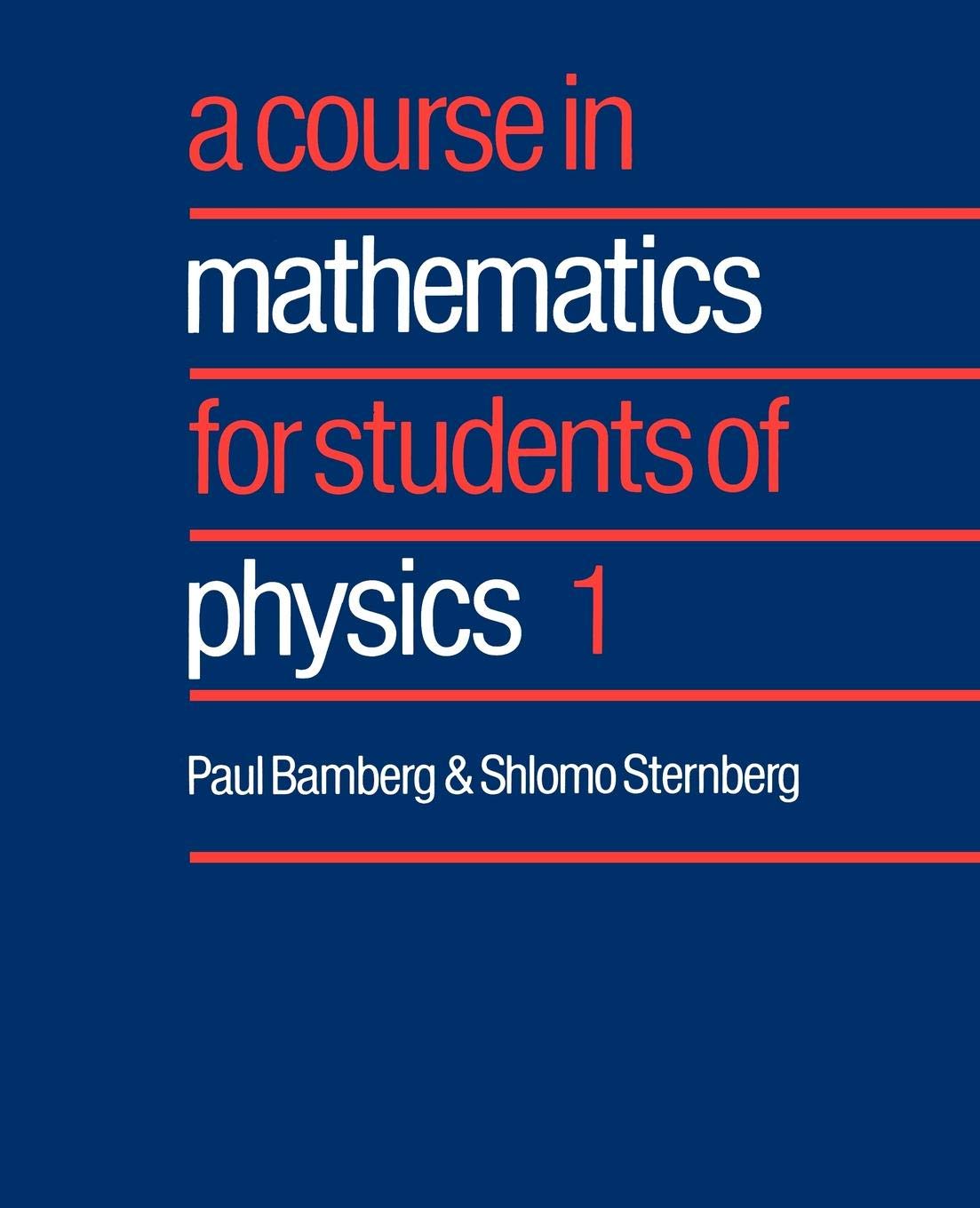
A Course in Mathematics for Students of Physics: A Comprehensive Textbook on Linear Algebra and Calculus by Paul Bamberg
Inclusive of all applicable taxes. FREE shipping on all orders.
Available Offers
- 🚚Free Delivery — Free shipping on all orders
- 💵Cash on Delivery — Pay when your order arrives
- ↩️15-Day Easy Returns — Hassle-free return policy
- 🔒Cash on Delivery — Pay safely when your order arrives
Check Delivery
Product Description
Introduction
For Indian students of physics and engineering who often find themselves grappling with the mathematical underpinnings of their field, A Course in Mathematics for Students of Physics: Volume 1 by Paul Bamberg offers a refreshingly intuitive and rigorous pathway. Published by Cambridge University Press, this hardbound volume is the first of a two-part series that bridges the gap between abstract mathematical theory and its concrete physical applications. Unlike standard mathematics texts that treat physics as an afterthought, this book places physical problems at the very heart of the learning process, making it an indispensable resource for serious learners across Indian universities.
Book Overview
Developed from a course taught at Harvard University over a decade, this volume covers the core areas of linear algebra and the calculus of several variables, with a special emphasis on the powerful yet often overlooked exterior calculus. The authors employ a unique 'spiral method' of teaching, revisiting key topics multiple times at increasing levels of depth and sophistication. This approach ensures that a student does not just memorise formulas but develops a deep, intuitive understanding of how mathematical ideas naturally unfold and interconnect. From algebraic topology introduced through the analysis of electrical networks to the application of Lie derivatives and star operators in Maxwell's equations and optics, this text breaks new ground by presenting advanced mathematics in an elementary, accessible setting.
Key Highlights
- Spiral Learning Approach: Concepts are introduced gently and revisited with greater complexity, reinforcing understanding at each stage.
- Physics-First Pedagogy: Every mathematical tool is motivated by a real physical problem, ensuring relevance and retention.
- Exterior Calculus Focus: A rare and powerful treatment of differential forms, Lie derivatives, and star operators, usually reserved for advanced courses.
- Topology via Circuits: Algebraic topology is introduced through the concrete analysis of electrical networks, making abstract ideas tangible.
- Rigorous Yet Accessible: Suitable for undergraduate students while also serving as a reference for postgraduate learners and researchers.
Inside the Book
The volume is structured to guide the reader from foundational concepts to sophisticated applications. Early chapters build a solid grounding in linear algebra, vector spaces, and linear transformations, always with an eye on physical examples like rotations, reflections, and the behaviour of dynamical systems. The middle sections delve into multivariable calculus, including partial derivatives, multiple integrals, and the change of variables theorem, all illustrated with problems from mechanics and electromagnetism. The latter part of the book introduces the exterior algebra of differential forms, the Hodge star operator, and the generalised Stokes theorem, culminating in a beautiful treatment of Maxwell's equations in their natural geometric language. Each chapter is punctuated with numerous worked examples and exercises, many with a distinctly physical flavour.
Key Topics
- Linear algebra: vector spaces, matrices, eigenvalues, and eigenvectors
- Calculus of several variables: partial derivatives, gradients, divergence, curl
- Exterior calculus: differential forms, wedge product, exterior derivative
- Integration on manifolds: line integrals, surface integrals, volume integrals
- Generalised Stokes theorem and its applications
- Lie derivatives and their role in fluid dynamics and electromagnetism
- Star operators and the geometric formulation of Maxwell's equations
- Algebraic topology via electrical network analysis
Reader Benefits
- Deep Conceptual Clarity: The spiral method ensures that students truly understand, not just memorise, mathematical concepts.
- Practical Problem-Solving Skills: Hundreds of physics-based exercises prepare students for real-world research and competitive exams like GATE, JEST, and TIFR.
- Advanced Preparation: Exposure to topics like exterior calculus and Lie derivatives gives Indian students a head start in modern theoretical physics.
- Self-Paced Learning: The clear, conversational style makes it suitable for self-study alongside classroom instruction.
- Lasting Reference: The hardcover binding and comprehensive content make this a valuable addition to any personal or institutional library.
Learning Outcomes
By working through this volume, readers will be able to confidently apply linear algebra and multivariable calculus to physical problems, manipulate differential forms and understand their geometric meaning, derive and interpret Maxwell's equations using the language of exterior calculus, analyse electrical networks using topological concepts, and develop a robust mathematical foundation for advanced study in quantum mechanics, general relativity, and field theory. The skills acquired here are directly transferable to research and professional practice in physics, engineering, and applied mathematics.
Who Should Read
- Undergraduate and postgraduate students of physics in Indian universities (B.Sc., M.Sc., B.Tech., M.Tech.)
- Engineering students specialising in electrical, mechanical, or aerospace disciplines who need a deeper mathematical toolkit
- Self-learners and enthusiasts preparing for competitive examinations or research careers
- Teachers and professors seeking a fresh, application-driven textbook for their courses
- Anyone who has ever felt that mathematics textbooks are too abstract and disconnected from physical reality
About the Author
Paul Bamberg is a distinguished educator and mathematician who has spent decades teaching at Harvard University. His experience in bridging the gap between pure mathematics and its physical applications is evident in every page of this book. He has a rare gift for making complex ideas seem simple and for showing students the beauty and utility of mathematics in describing the natural world. His work on this two-volume series reflects a deep commitment to pedagogical innovation and student success.
About the Publisher
Cambridge University Press is one of the world's oldest and most respected academic publishers, known for its rigorous editorial standards and commitment to scholarly excellence. Their science and mathematics titles are trusted by universities and research institutions globally, including many across India. This hardcover edition is produced to the highest quality, ensuring durability and readability for years of use in classrooms, libraries, and personal study spaces.
Conclusion
A Course in Mathematics for Students of Physics: Volume 1 is more than just a textbook; it is a companion for anyone serious about mastering the mathematical language of physics. Whether you are a student at an IIT, a university college, or a dedicated self-learner, this book will transform the way you think about mathematics and its role in understanding the universe. Order your copy today from Bookshops.in and take a decisive step towards mathematical and physical fluency.
Quick Summary
A Course in Mathematics for Students of Physics: Volume 1 by Paul Bamberg is a rigorous yet accessible textbook developed from a decade-long Harvard course. It covers linear algebra and multivariable calculus with a strong emphasis on physical applications, introducing advanced topics like exterior calculus, Lie derivatives, star operators, and algebraic topology through electrical networks. The spiral method revisits concepts at increasing levels of sophistication, fostering deep intuitive understanding. This book is ideal for undergraduate and graduate physics students, as well as self-learners and educators seeking a comprehensive mathematical foundation. Published by Cambridge University Press, it combines theoretical depth with practical relevance. Purchasing from Bookshops.in ensures a reliable source for Indian students, with competitive pricing and quality service.
Book Highlights
Book Specifications
| ISBN-13 | 9780521406499 |
| ISBN-10 | 0521406498 |
| Publisher | Cambridge University Press |
| Language | English |
| Dimensions | 19.05 x 2.44 x 23.5 cm |
| Weight | 730 g |
| Country | India |
| Category | Science & Mathematics › Mathematics |
| Series | A Course in Mathematics for Students of Physics |
| Genre | Non-fiction |
| Original Language | English |
Frequently Asked Questions
What topics does this book cover?
Who is the author of this book?
Is this book suitable for Indian students?
What is the spiral method?
Does this book include exercises?
Is this book part of a series?
What is the ISBN?
Is the book hardcover?
Can I buy this book from Bookshops.in?
What is the price?
Does the book cover differential geometry?
Is prior knowledge of physics required?
How is this book different from standard math texts?
What languages is the book available in?
Readers Also Search For
Customers Also Bought
Mathematics
Stereotype Spaces and Algebras: 73 (De Gruyter Expositions in Mathematics, 73)

Chemistry
Concise Encyclopedia of Biochemistry

Chemistry
Proceedings of the Third USSR - FRG Symposium, Makhachkala (USSR), October 2–6, 1980: 001
Physics
Quantum Theory at the Crossroads by Guido Bacciagaluppi – Quantum Mechanics History
Physics
The Quantum and Cosmic Codes of the Universe
Mathematics
Mathematical Theory of Optimal Processes (Classics of Soviet Mathematics)
Related Products
View AllMathematics
Mathematical Theory of Optimal Processes (Classics of Soviet Mathematics)
Mathematics
Stereotype Spaces and Algebras: 73 (De Gruyter Expositions in Mathematics, 73)
Mathematics
Semigroups in Algebra, Geometry and Analysis: 20 (De Gruyter Expositions in Mathematics, 20)
Mathematics
Geometry from the Pacific Rim: Proceedings of the Pacific Rim Geometry Conference held at National University of Singapore, Republic of Singapore, ... 1994 (De Gruyter Proceedings in Mathematics)
Mathematics
First International Tainan-Moscow Algebra Workshop: Proceedings of the International Conference held at National Cheng Kung University Tainan, Taiwan, ... 1994 (De Gruyter Proceedings in Mathematics)
Mathematics