
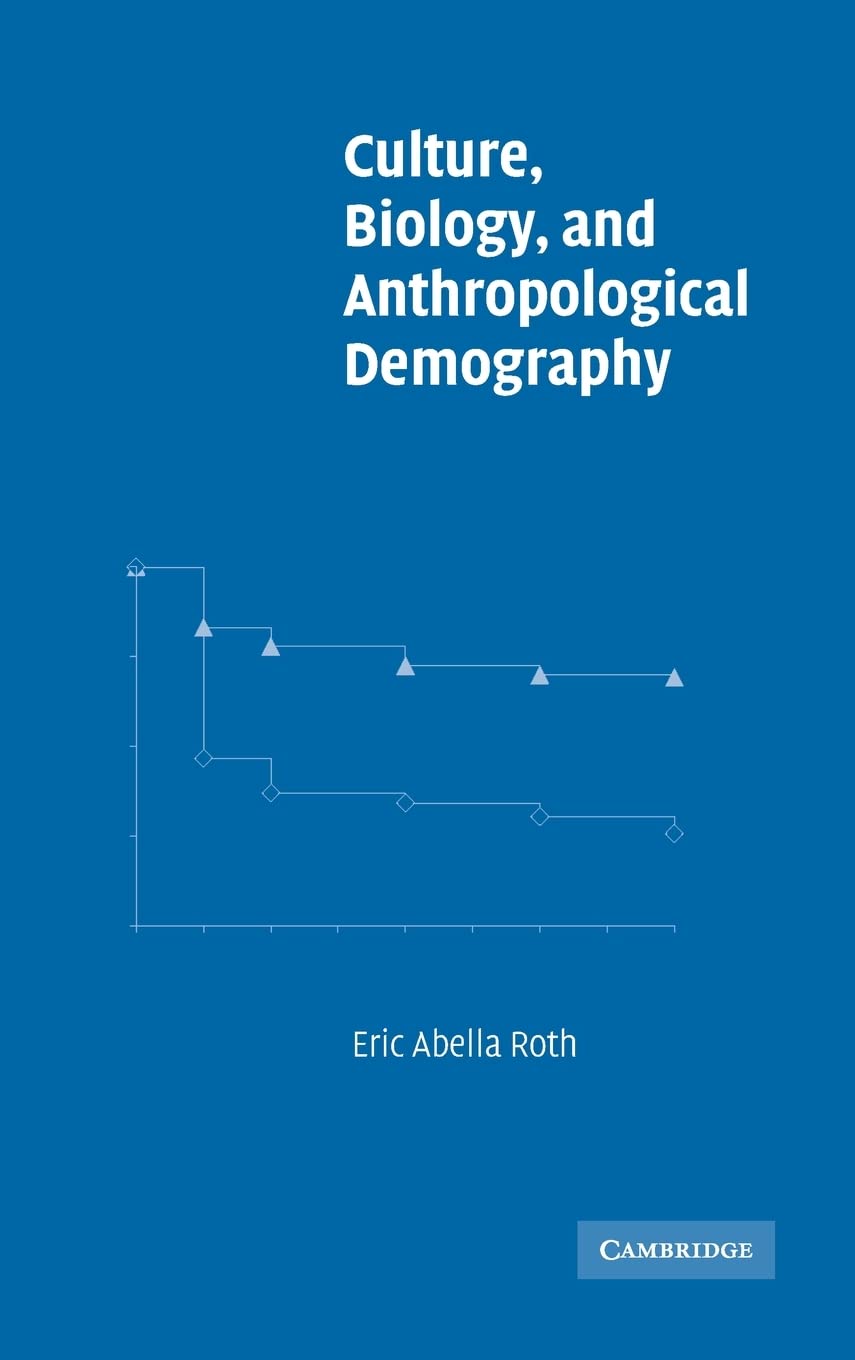
Culture, Biology, and Anthropological Demography by Eric Abella Roth – Bridging Cultural and Evolutionary Approaches in
Inclusive of all applicable taxes. FREE shipping on all orders.
Available Offers
- 🚚Free Delivery — Free shipping on all orders
- 💵Cash on Delivery — Pay when your order arrives
- ↩️15-Day Easy Returns — Hassle-free return policy
- 🔒Cash on Delivery — Pay safely when your order arrives
Check Delivery
Product Description
Introduction
Anthropology has long grappled with the question of why human populations grow, shrink, or remain stable. Culture, Biology, and Anthropological Demography by Eric Abella Roth offers a groundbreaking synthesis of two often conflicting approaches: the cultural lens of anthropological demography and the evolutionary lens of human evolutionary ecology. This hardcover volume, published by Cambridge University Press, is an essential read for students and researchers in India and beyond who wish to understand how both culture and biology shape human reproductive behaviour, mortality, and migration.
Book Overview
This book bridges a long-standing divide in anthropology. On one side, anthropological demography emphasises how cultural norms, kinship systems, and social institutions influence population dynamics. On the other, human evolutionary ecology argues that demographic patterns reflect adaptive behaviours shaped by natural selection. Roth systematically explores common ground between these perspectives, proposing a unified theoretical framework that respects both cultural motivation and biological imperatives. Drawing on case studies from African pastoralists to North American post-industrial societies, the book demonstrates how demography can be studied as a product of both culture and evolution.
Key Highlights
- Interdisciplinary synthesis: Merges cultural anthropology and evolutionary biology into a coherent demographic framework.
- Global case studies: Includes examples from diverse settings, including African pastoral communities, historical European populations, and modern industrial societies.
- Methodological rigour: Offers clear explanations of demographic models, life history theory, and cultural transmission.
- Critical analysis: Challenges the assumptions of both sub-disciplines while respecting their contributions.
- Accessible writing: Written for advanced undergraduates, graduate students, and professionals in anthropology, demography, and related fields.
Inside the Book
The volume is structured to guide readers from foundational concepts to advanced applications. Early chapters introduce the history and key debates in anthropological demography and human evolutionary ecology. Middle chapters present a comparative analysis of fertility, mortality, and migration across cultures, using both qualitative ethnographic data and quantitative models. Later sections explore how cultural norms—such as marriage practices, inheritance rules, and religious beliefs—interact with biological factors like nutrition, disease, and genetic relatedness to shape demographic outcomes. The book concludes with a call for a more integrated, holistic approach to studying human populations.
Key Topics
- Cultural versus biological determinants of fertility and mortality
- Life history theory and its application to human populations
- Kinship, marriage systems, and reproductive strategies
- Demographic transitions in historical and contemporary societies
- Methods for combining ethnographic fieldwork with demographic analysis
- Evolutionary perspectives on parental investment and child survival
- Role of cultural transmission in shaping demographic behaviour
Reader Benefits
- Gain a nuanced understanding of how culture and biology jointly influence population patterns.
- Learn to critically evaluate demographic data from both anthropological and evolutionary perspectives.
- Develop skills to design research that integrates qualitative and quantitative methods.
- Access a wealth of case studies from around the world, including non-Western societies.
- Understand contemporary debates in demography, such as the role of culture in fertility decline.
Learning Outcomes
By the end of this book, readers will be able to: analyse demographic data using both cultural and evolutionary frameworks; identify the strengths and limitations of each approach; apply life history theory to real-world demographic questions; and contribute to interdisciplinary research that bridges anthropology, biology, and demography. The book also prepares students for advanced study in human ecology, population studies, and cultural anthropology.
Who Should Read
This book is ideal for postgraduate students and researchers in anthropology, demography, sociology, and evolutionary biology. It is also valuable for Indian scholars working on population issues—such as fertility trends, migration patterns, and health disparities—who seek a more integrated theoretical toolkit. Undergraduates with a background in social sciences or life sciences will find the content accessible with some effort. Professionals in public health, development studies, and policy-making will benefit from the book’s insights into the cultural and biological roots of demographic change.
About the Author
Eric Abella Roth is a distinguished anthropologist and demographer whose work has focused on the intersection of culture, biology, and population dynamics. He has conducted extensive fieldwork in East Africa, particularly among pastoralist communities, and has published widely on topics such as fertility, mortality, and reproductive strategies. Roth’s research is known for its methodological innovation and its commitment to bridging sub-disciplinary divides within anthropology. He has taught at universities in North America and has been a key figure in advancing anthropological demography as a rigorous, interdisciplinary field.
About the Publisher
Cambridge University Press is one of the world’s oldest and most respected academic publishers, with a strong tradition of producing high-quality works in the sciences, social sciences, and humanities. Their publications are known for their scholarly rigour, editorial excellence, and global reach. This hardcover edition reflects Cambridge’s commitment to making cutting-edge research accessible to students and academics worldwide, including in India, where the press has a long-standing presence and distribution network.
Conclusion
Culture, Biology, and Anthropological Demography is a vital contribution to the study of human populations. By reconciling cultural and evolutionary perspectives, Eric Abella Roth provides a roadmap for future research that is both scientifically robust and culturally sensitive. Whether you are a student preparing for a career in anthropology or a researcher seeking new theoretical tools, this book will deepen your understanding of why humans live, reproduce, and die the way they do. Order your copy from Bookshops.in today and add this essential volume to your library.
Quick Summary
Culture, Biology, and Anthropological Demography by Eric Abella Roth is a landmark academic work that reconciles two often adversarial subfields within anthropology: anthropological demography, which emphasizes cultural determinants of population dynamics, and human evolutionary ecology, which views demographic patterns as outcomes of natural selection. Roth constructs a broad theoretical framework that incorporates both cultural and biological motivations, demonstrating how they jointly influence fertility, mortality, and migration. The book is intended for advanced students, researchers, and academics in anthropology, demography, evolutionary biology, and related social sciences. Readers will gain a nuanced understanding of how human populations adapt through both cultural practices and biological imperatives. By purchasing from Bookshops.in, Indian readers receive a high-quality hardcover edition with fast delivery and trusted service, making this essential reference accessible for academic libraries and personal collections.
Book Highlights
Book Specifications
| ISBN-13 | 9780521809054 |
| ISBN-10 | 0521809053 |
| Publisher | Cambridge University Press |
| Language | English |
| Dimensions | 15.24 x 1.27 x 22.86 cm |
| Weight | 423 g |
| Category | Social Sciences › Sociology |
| Series | Cambridge Studies in Biological and Evolutionary Anthropology |
| Genre | Non-fiction |
| Reading Age | Adult |
| Original Language | English |
Frequently Asked Questions
What is this book about?
Who is the author?
Is this book suitable for beginners?
What topics does it cover?
How does it differ from other demography books?
Does it include case studies?
What is the binding?
Can I use this for my PhD research?
Is the language complex?
Does it offer practical frameworks?
What is the price in India?
Where can I buy it?
Readers Also Search For
Customers Also Bought
Sociology
Imagination Beyond Nation: Latin American Popular Culture: 349 (Pitt Latin American Series)
Sociology
Boomer Volunteer Engagement: Facilitator's Tool Kit

Sociology
Making a Success of Marriage: Planning for Happily Ever After

Sociology
Causal Mediation Analysis (Analytical Methods for Social Research)
Sociology
Marriage and the Moral Imagination (New Departures in Anthropology)

Sociology
Social Change, Resistance and Social Practices: 19 (Studies in Critical Social Sciences, 19)
Related Products
View AllSociology
Imagination Beyond Nation: Latin American Popular Culture: 349 (Pitt Latin American Series)
Sociology
Boomer Volunteer Engagement: Facilitator's Tool Kit
Sociology
Making a Success of Marriage: Planning for Happily Ever After
Sociology
Causal Mediation Analysis (Analytical Methods for Social Research)
Sociology
Marriage and the Moral Imagination (New Departures in Anthropology)
Sociology