
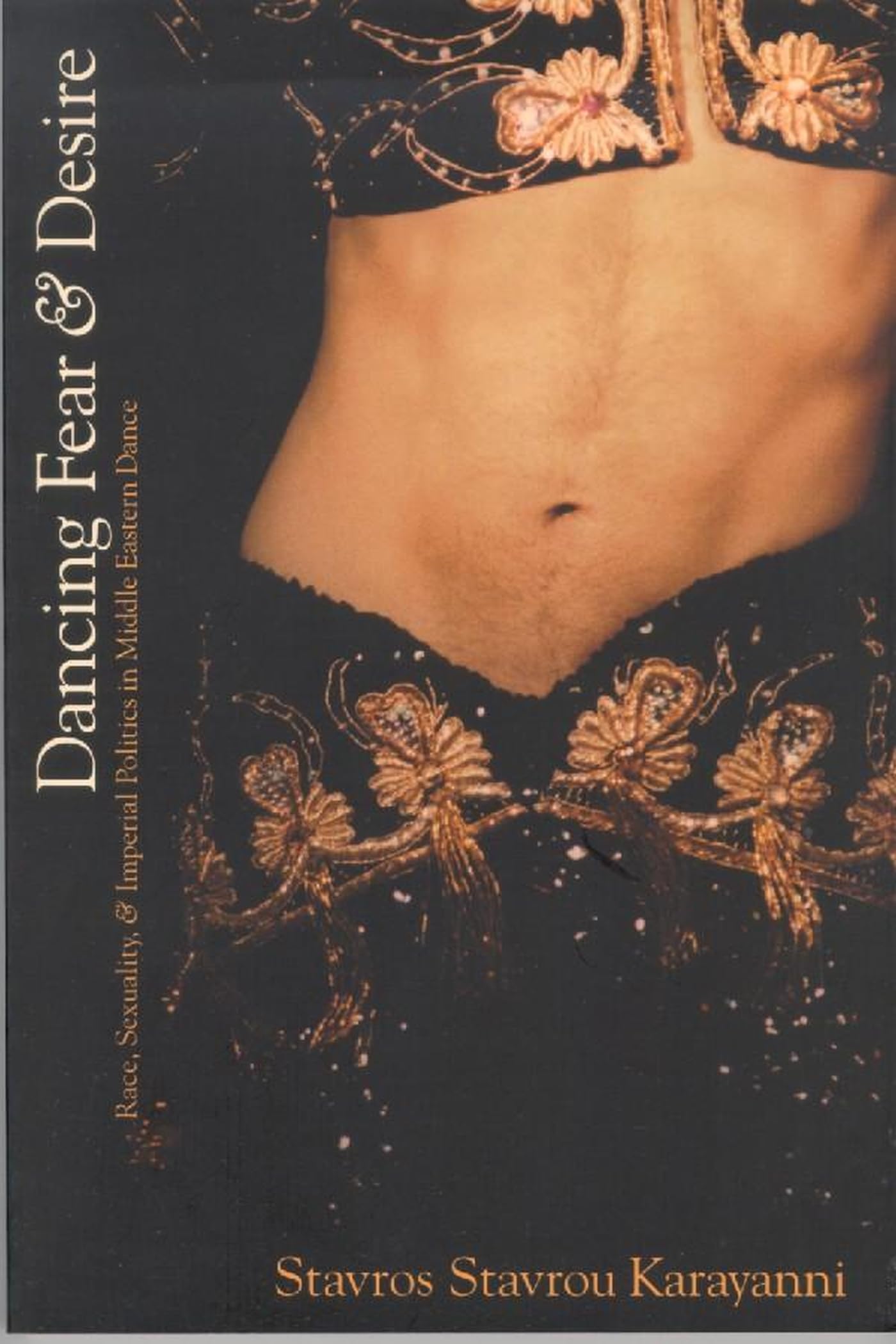
Dancing Fear and Desire: Race, Sexuality, and Imperial Politics in Middle Eastern Dance by Stavros Stavrou Karayanni
Inclusive of all applicable taxes. FREE shipping on all orders.
Available Offers
- 🚚Free Delivery — Free shipping on all orders
- 💵Cash on Delivery — Pay when your order arrives
- ↩️15-Day Easy Returns — Hassle-free return policy
- 🔒Cash on Delivery — Pay safely when your order arrives
Check Delivery
Product Description
Introduction
In Dancing Fear and Desire: Race, Sexuality, and Imperial Politics in Middle Eastern Dance, Stavros Stavrou Karayanni offers a groundbreaking exploration of how Middle Eastern dance—often reduced to the exoticised label of 'belly dance'—has been entangled with colonial power, racial stereotypes, and sexual politics. This meticulously researched work combines historical investigation, theoretical analysis, and personal reflection to unravel the complex ways in which dance becomes a site of struggle over identity, representation, and resistance. For Indian readers and students interested in postcolonial studies, performance theory, or cultural history, this book provides a vital lens to understand how art forms are shaped by and resist imperial narratives.
Book Overview
Karayanni traces the journey of Middle Eastern dance from the pages of Western travel journals to contemporary performance stages, revealing a persistent ambivalence: dancers are simultaneously desired and derided, admired and reviled. The book examines how colonial travellers, writers, and artists projected their fears and fantasies onto the dancing body, constructing it as both seductive and savage. Through close readings of colonial travelogues, Oscar Wilde's Salome, and treatises on Greek dance, Karayanni demonstrates how Eurocentric models have defined and controlled identity performance. The narrative moves beyond mere critique to explore how dancers themselves have navigated, subverted, and reclaimed these representations.
Key Highlights
- Interdisciplinary Approach: Merges dance studies, postcolonial theory, queer studies, and cultural history for a rich, layered analysis.
- Colonial Travel Narratives: Unpacks how Western travellers documented and distorted Middle Eastern dance, creating enduring stereotypes.
- Salome Revisited: Offers a fresh reading of Oscar Wilde's play, linking its portrayal of dance to imperial anxieties about race and sexuality.
- Greek Dance Connections: Examines how Greek dance was positioned within Western classical traditions, revealing hierarchies of cultural value.
- Personal Reflection: Karayanni’s own background as a Cypriot-Greek dancer and scholar adds a poignant, embodied perspective to the analysis.
Inside the Book
The book is structured around three core areas: historical contexts, theoretical frameworks, and personal narratives. The first section deconstructs colonial travel writing, showing how descriptions of dancers served to reinforce European superiority. The second section delves into the politics of performance, including the racialisation of male dancers and the gendering of dance as inherently feminine. The third section offers a reflexive account of Karayanni’s own journey as a dancer, connecting academic inquiry with lived experience. Each chapter is supported by meticulous archival research and critical theory from thinkers like Foucault, Said, and Butler.
Key Topics
- Orientalism and the representation of Middle Eastern dance in Western art and literature.
- The intersection of race, gender, and sexuality in performance.
- Imperial politics and the control of bodily expression.
- Resistance and agency among dancers in colonial and postcolonial contexts.
- The cultural politics of 'belly dance' as a globalised phenomenon.
Reader Benefits
This book equips readers with critical tools to deconstruct exoticising narratives about non-Western art forms. It encourages a nuanced understanding of how dance can be both a tool of oppression and a medium of liberation. Students and scholars will gain insights into applying postcolonial theory to performance studies, while general readers will appreciate the accessible yet rigorous prose that brings historical figures and contemporary debates to life.
Learning Outcomes
- Understand the historical roots of Orientalist stereotypes in dance.
- Analyse the role of race and sexuality in shaping cultural performance.
- Evaluate the impact of colonial politics on artistic expression.
- Develop critical perspectives on globalised dance forms.
- Engage with reflexive methodologies in cultural studies.
Who Should Read
Dancing Fear and Desire is essential for students and academics in dance studies, postcolonial literature, gender and queer studies, Middle Eastern history, and cultural anthropology. It is also highly relevant for practitioners of Middle Eastern dance seeking a deeper understanding of their art form’s political dimensions. Indian readers interested in comparative colonial experiences will find parallels with South Asian dance histories, making this book a valuable addition to courses on performance and power.
About the Author
Stavros Stavrou Karayanni is a scholar, dancer, and educator whose work bridges performance studies and postcolonial theory. Born in Cyprus and trained in both Western and Middle Eastern dance forms, he brings a unique insider-outsider perspective to the subject. He has published widely on dance, sexuality, and cultural identity, and his research is marked by a commitment to decolonising knowledge and amplifying marginalised voices.
About the Publisher
Wilfrid Laurier University Press, based in Canada, is renowned for its academic publications in the humanities and social sciences. The press is dedicated to fostering critical scholarship that addresses pressing cultural and political issues, making it a fitting home for Karayanni’s provocative and timely work.
Conclusion
Dancing Fear and Desire is a compelling and necessary intervention in dance studies and postcolonial thought. By exposing the intricate connections between movement, power, and identity, Karayanni invites readers to see dance not merely as art but as a battleground where histories of domination and resistance are choreographed. For anyone seeking to understand how bodies speak in the shadow of empire, this book is an indispensable guide.
Quick Summary
Dancing Fear and Desire by Stavros Stavrou Karayanni is a groundbreaking study that unpacks the complex ways Middle Eastern dance has been viewed through colonial, racial, and sexual lenses. The book moves from historical travel narratives to literary works like Oscar Wilde’s Salome, and even examines Greek dance treatises, to show how the dancing body becomes a site of both fascination and contempt. Karayanni combines rigorous scholarship with personal insight, making the work not only intellectually rich but also deeply human. This book is ideal for students and scholars of postcolonial studies, performance theory, gender studies, and cultural history. Readers will learn how imperial politics shaped the reception of belly dance and other Middle Eastern movement traditions, and how these dances continue to challenge stereotypes today. By choosing to buy from Bookshops.in, Indian readers support a local bookstore that values critical scholarship and offers authentic hardcover editions.
Book Highlights
Book Specifications
| ISBN-13 | 9780889204546 |
| ISBN-10 | 0889204543 |
| Publisher | Wilfrid Laurier University Press |
| Language | English |
| Dimensions | 15.24 x 1.57 x 22.86 cm |
| Weight | 454 g |
| Category | Arts, Film & Photography › Dance |
| Genre | Academic / Cultural Studies |
| Reading Age | Adult |
| Original Language | English |
Frequently Asked Questions
What is the main subject of Dancing Fear and Desire?
Who is the author Stavros Stavrou Karayanni?
Does the book focus only on belly dance?
Is this book suitable for undergraduate students?
What theoretical approaches does the author use?
Does the book include personal reflection?
How does the book relate to Oscar Wilde?
Is the book available in hardcover?
What is the ISBN of this book?
Can Indian readers relate to this book?
Does the book discuss male dancers?
What kind of sources does the author use?
Is this book part of a series?
Where can I buy this book in India?
Readers Also Search For
Customers Also Bought
Art History
The Italian Renaissance in Art

Art History
Photovoltaic Design & Installation For Dummies | by Mayfield | ForDummies | by Mayfield | ForDummies | by Mayfield | ForDummies | by Mayfield | ForDummies | by Mayfield | ForDummies | by Mayfield | ForDummies | by Mayfield | ForDummies | by Mayfield | ForDummies | by Mayfield | ForDummies | by Mayfield | ForDummies | by Mayfield | ForDummies | by Mayfield | ForDummies | by Mayfield | ForDummies | by Mayfield | ForDummies | by Mayfield | ForDummies | by Mayfield | ForDummies | by Mayfield | ForDu

Art History
Designing School Systems for All Students (English, Robert J. Manley | Richard J. Hawkins)

Art History
Routledge Library Editions: Art and Culture in the Nineteenth Century

Art History
An Errant Design (English, S. H. Long)

Art History
Distributed System Design | by Jie Wu | CRC Press | by Jie Wu | CRC Press | by Jie Wu | CRC Press | by Jie Wu | CRC Press | by Jie Wu | CRC Press | by Jie Wu | CRC Press | by Jie Wu | CRC Press | by Jie Wu | CRC Press | by Jie Wu | CRC Press | by Jie Wu | CRC Press | by Jie Wu | CRC Press | by Jie Wu | CRC Press | by Jie Wu | CRC Press | by Jie Wu | CRC Press | by Jie Wu | CRC Press | by Jie Wu | CRC Press | by Jie Wu | CRC Press | by Jie Wu | CRC Press | by Jie Wu | CRC Press | by Jie Wu | CRC
Related Products
View All
Arts, Film & Photography
Stars of '90s Dance Pop: 29 Hitmakers Discuss Their Careers by James Arena

Arts, Film & Photography
Edgar Heap of Birds by Bill Anthes – Native American Art Study

Arts, Film & Photography
Movement, Text, Performance (Elements in Contemporary Performance Texts)

Arts, Film & Photography
Analyzing Art, Culture, and Design in the Digital Age (English, Gianluca Mura)

Arts, Film & Photography
From The Inside: A Backdrop to the Music of My Life

Arts, Film & Photography