
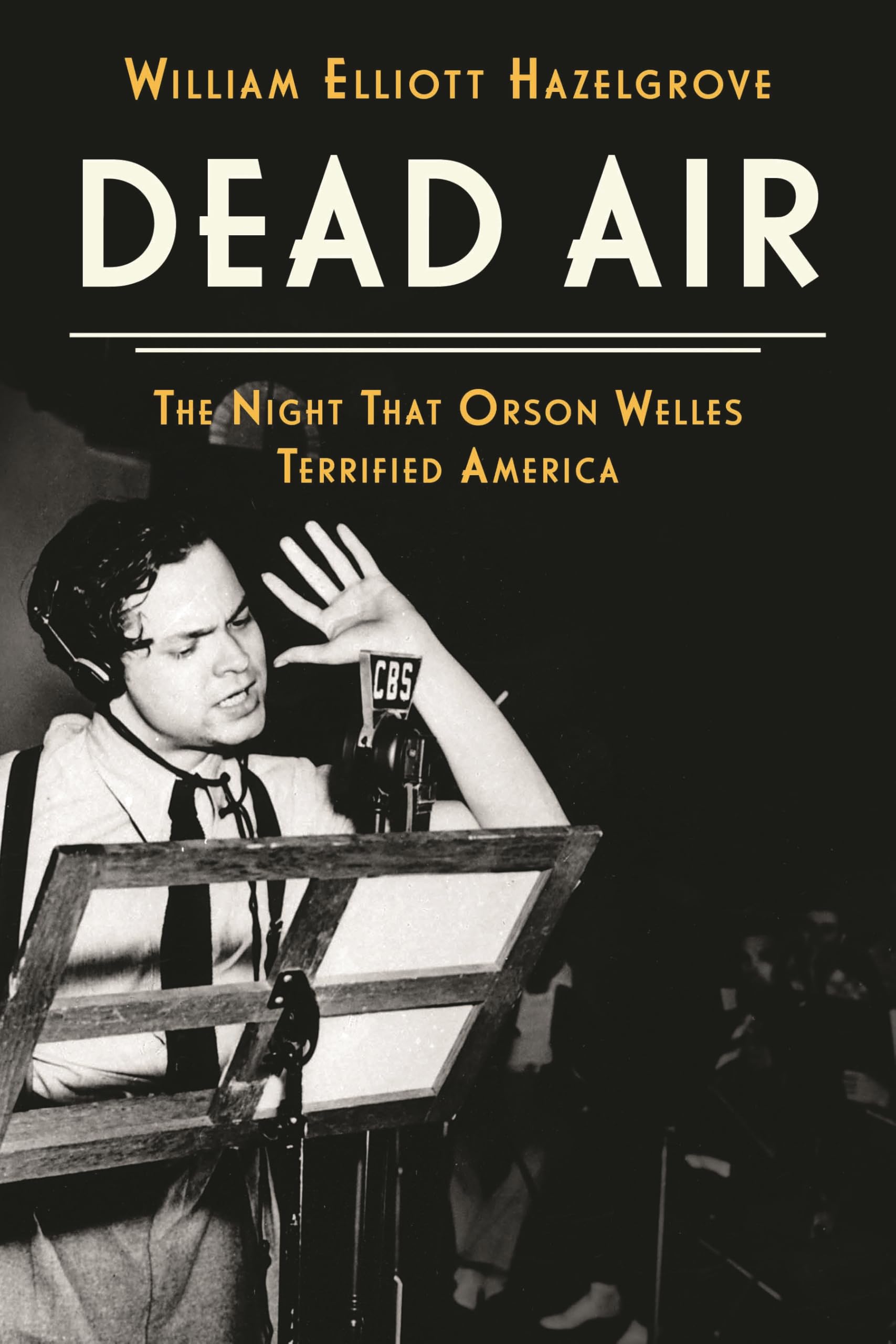
Dead Air: The Night That Orson Welles Terrified America by William Elliott Hazelgrove – The Untold Story of Radio's Grea
Inclusive of all applicable taxes. FREE shipping on all orders.
Available Offers
- 🚚Free Delivery — Free shipping on all orders
- 💵Cash on Delivery — Pay when your order arrives
- ↩️15-Day Easy Returns — Hassle-free return policy
- 🔒Cash on Delivery — Pay safely when your order arrives
Check Delivery
Product Description
Introduction
On the night of October 30, 1938, millions of Americans tuned into their radios and believed the world was ending. A young Orson Welles, barely twenty-three years old, had transformed a routine radio drama into a nationwide frenzy. Dead Air: The Night That Orson Welles Terrified America by William Elliott Hazelgrove is a gripping account of that fateful evening and its lasting impact on media, culture, and the human psyche. This hardcover edition from Rowman & Littlefield Publishers is a must-read for students of history, journalism, and mass communication in India and beyond.
Book Overview
This meticulously researched book goes beyond the familiar story of the War of the Worlds broadcast. Hazelgrove reveals how Welles used just six seconds of silence—dead air—to create an atmosphere of absolute terror. The narrative traces Welles’s rise from an orphaned child prodigy to a theatrical genius, culminating in the night that made him a household name. Drawing on contemporary newspaper accounts, the author demonstrates the real panic that gripped the nation, with listeners flooding phone lines, fleeing their homes, and even calling the military. This is not just a story about radio; it is a story about fear, trust, and the power of storytelling.
Key Highlights
- Original research: Uses primary sources like newspaper reports and firsthand accounts to show the true scale of the panic.
- Focus on the “dead air” technique: Explores how Welles weaponized silence to heighten suspense and trigger mass hysteria.
- Biographical depth: Chronicles Welles’s early life, his struggles, and his meteoric rise to fame before the broadcast.
- Cultural impact: Examines how the event changed the way governments, media houses, and audiences view the power of radio and live broadcasts.
Inside the Book
The book opens with the chaos of the broadcast night, then flashes back to Welles’s childhood in Kenosha, Wisconsin, where he lost both parents and discovered his passion for theater. Hazelgrove details Welles’s early successes on stage and his move to New York, where he joined the Federal Theatre Project. The narrative builds to the Mercury Theatre on Air’s adaptation of H.G. Wells’s novel, showing how budget constraints, last-minute script changes, and Welles’s improvisational genius created a perfect storm. The final chapters examine the aftermath: the public outcry, the FCC investigations, and the sudden celebrity that both thrilled and haunted Welles.
Key Topics
- The anatomy of mass hysteria and how it spreads through media
- The role of radio in 1930s America as a trusted source of news
- Orson Welles as a symbol of creative ambition and its risks
- The ethical boundaries of entertainment and journalism
- How a single broadcast reshaped public trust in media forever
Reader Benefits
- For history students: Gain a vivid, detailed case study of a pivotal moment in media history.
- For journalism and communication students: Understand the power of narrative and the responsibility of broadcasters.
- For psychology enthusiasts: Explore the mechanisms of collective fear and panic.
- For general readers: Enjoy a thrilling, well-told story that reads like a suspense novel.
Learning Outcomes
- Understand the historical context of radio broadcasting in the 1930s.
- Analyze how non-verbal cues like silence can manipulate audience emotions.
- Identify the factors that turn a fictional story into a real-world crisis.
- Evaluate the long-term effects of the broadcast on media regulation and public perception.
Who Should Read
This book is ideal for Indian students of mass communication, journalism, history, and cultural studies. It is also perfect for teachers, researchers, and anyone fascinated by the intersection of media, psychology, and society. If you enjoy stories that peel back the layers of a legendary event, Dead Air will keep you turning pages.
About the Author
William Elliott Hazelgrove is an acclaimed American author and historian. He has written several books on American history and culture, including Al Capone and the 1933 World’s Fair and Greed in the Gilded Age. Known for his engaging narrative style and deep research, Hazelgrove brings history to life for modern readers. He has been a featured speaker at universities and literary festivals across the United States.
About the Publisher
Rowman & Littlefield Publishers is a prestigious academic and trade publishing house based in the United States. Established in 1949, it is known for producing high-quality books in history, biography, media studies, and the social sciences. This hardcover edition reflects the publisher’s commitment to durable, well-crafted books that stand the test of time.
Conclusion
Dead Air: The Night That Orson Welles Terrified America is more than a history book—it is a chilling reminder of how easily truth can be bent and how fear can spread like wildfire. William Elliott Hazelgrove’s masterful storytelling and thorough research make this an essential addition to any library. Whether you are a student, a teacher, or a curious reader, this book will change the way you think about media, silence, and the stories we tell. Order your hardcover copy from Bookshops.in today and discover the night that terrified a nation.
Quick Summary
Dead Air: The Night That Orson Welles Terrified America by William Elliott Hazelgrove is a meticulously researched historical account of the 1938 radio broadcast that plunged America into panic. The book reveals how Orson Welles and his Mercury Theatre team used six seconds of dead air to create a terrifying illusion of a Martian invasion, leading to mass hysteria, military intervention, and a lasting transformation of media culture. Drawing from newspaper archives and official records, Hazelgrove debunks myths and presents the true scale of the chaos. This book is ideal for history enthusiasts, media students, and anyone fascinated by the psychology of fear and the power of storytelling. Readers will gain insights into the birth of modern media manipulation and the ethical questions it raises. By purchasing from Bookshops.in, Indian readers get a premium hardcover edition with reliable delivery and customer support.
Book Highlights
Book Specifications
| ISBN-13 | 9781538187166 |
| ISBN-10 | 1538187167 |
| Publisher | Rowman & Littlefield Pub Inc |
| Language | English |
| Dimensions | 16 x 2.16 x 23.5 cm |
| Weight | 508 g |
| Category | Words, Language & Grammar › Communication |
| Genre | Nonfiction |
| Original Language | English |
Frequently Asked Questions
What is Dead Air: The Night That Orson Welles Terrified America about?
Who is the author of Dead Air?
Is this book based on real events?
What makes this book different from other books on Orson Welles?
Who would enjoy reading this book?
Does the book cover Orson Welles' entire career?
Is this book suitable for Indian readers?
What binding is this edition?
Can I buy this book on Bookshops.in?
Does this book cover the social context of 1930s America?
Is the book well-researched?
What is the primary theme of the book?
Will I learn about modern media from this book?
Readers Also Search For
Customers Also Bought

Related Products
View All
Reference
Discourses of the Developing World: Researching Properties, Problems, and Potentials of the Developing World (Cultural Discourse Studies Series)
![Buy Language in the Context of Use: Discourse and Cognitive Approaches to Language: 37 (Cognitive Linguistics Research [CLR], 37) — BookShops.in](/book-covers/language-in-the-context-of-use-english-andrea-tyler-or-yiyoung-kim-or-mari-takad-img-0.jpg)
Reference
Language in the Context of Use: Discourse and Cognitive Approaches to Language: 37 (Cognitive Linguistics Research [CLR], 37)
Reference
Elements Of Fractional Distillation
Reference
Oxford Handbook of the Septuagint by Law Salvesen – Biblical Studies
Reference
Retellings: The Bible in Literature, Music, Art and Film

Reference