
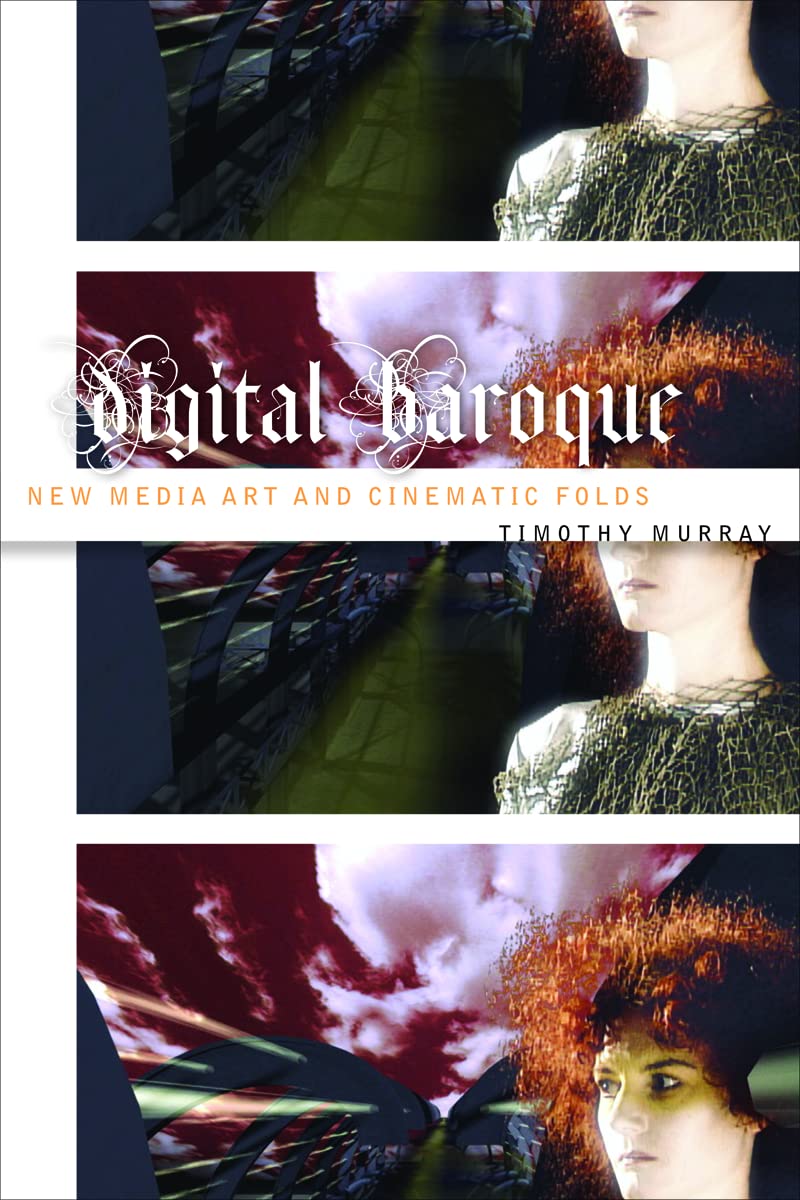
Digital Baroque: New Media Art and Cinematic Folds by Timothy Murray – A Philosophical Journey into Digital Aesthetics a
Inclusive of all applicable taxes. FREE shipping on all orders.
Available Offers
- 🚚Free Delivery — Free shipping on all orders
- 💵Cash on Delivery — Pay when your order arrives
- ↩️15-Day Easy Returns — Hassle-free return policy
- 🔒Cash on Delivery — Pay safely when your order arrives
Check Delivery
Product Description
Introduction
In an age where screens dominate our visual and intellectual landscapes, Digital Baroque: New Media Art and Cinematic Folds by Timothy Murray offers a thought-provoking bridge between centuries. This hardcover volume, published by the University of Minnesota Press, invites Indian readers—students, artists, and technologists alike—to explore how the ornate, layered aesthetics of the Baroque era resonate within today's digital and new media art. Instead of treating old and new as opposites, Murray reveals their surprising kinship, making this book a must-read for anyone curious about the philosophical underpinnings of contemporary screen-based creativity.
Book Overview
Digital Baroque is a rigorous yet accessible exploration of how early modern artistic and philosophical traditions inform the creation and reception of new media art. Timothy Murray, a leading scholar in visual culture and digital aesthetics, examines a rich array of works—from digitally oriented films by Peter Greenaway, Jean-Luc Godard, and Chris Marker to video installations by Thierry Kuntzel, Keith Piper, and Renate Ferro, as well as interactive media by Toni Dove, David Rokeby, and Jill Scott. The book argues that the Baroque's fascination with folds, mirrors, and layered realities finds a powerful echo in the fragmented, networked, and immersive experiences of digital art. Murray's analysis is not merely academic; it is a passionate engagement with the ways screens shape our emotions, social bonds, and sense of self.
Key Highlights
- Interdisciplinary Approach: Seamlessly blends art history, philosophy, film studies, and digital theory to offer a holistic understanding of new media.
- Global Perspective: Features works by artists from Europe, North America, and beyond, providing a diverse range of examples relevant to Indian art students and practitioners.
- Original Thesis: Challenges conventional boundaries between the historical Baroque and the digital present, proposing a “neo-Baroque” lens for reading contemporary screen arts.
- Critical Engagement: Goes beyond description to interrogate the rhetorical, emotive, and social forces at play in digital installations, video art, and interactive media.
- Richly Referenced: Draws on thinkers like Gilles Deleuze, Walter Benjamin, and Jacques Derrida, making complex ideas accessible without oversimplification.
Inside the Book
This hardcover edition is structured around close readings of specific artworks and films, each chapter unfolding like a philosophical dialogue. Murray begins by establishing the Baroque concept of the “fold”—a term borrowed from Deleuze to describe infinite layers and curves—and then applies it to the digital realm. Readers will encounter detailed analyses of how Godard’s montage techniques mirror Baroque juxtapositions, how Greenaway’s cinematic frames recall the theatricality of Baroque painting, and how interactive installations by Dove and Rokeby create immersive spaces reminiscent of Baroque chapels. The book also delves into the psychosocial webs of electronic media, examining how digital representations alter our perceptions of time, space, and identity.
Key Topics
- Cinematic Folds: How film and video art use layering, superimposition, and fragmentation to create new narrative forms.
- Baroque Aesthetics in Digital Art: The recurrence of ornamentation, illusion, and theatricality in new media works.
- Philosophy of Screens: What it means to view art through screens, and how this changes the viewer’s relationship to the artwork.
- Interactive Media and Participation: The role of the user in completing the artistic experience, echoing Baroque participatory spectacles.
- Emotion and Affect: How digital art elicits emotional responses through rhythm, color, and movement, much like Baroque music and painting.
- Social and Political Dimensions: The ways in which new media art comments on surveillance, globalization, and cultural memory.
Reader Benefits
- Deepen Your Understanding: Gain a sophisticated framework for analyzing and appreciating new media art beyond surface-level impressions.
- Connect Past and Present: See how historical art movements continue to influence cutting-edge creative practices.
- Enhance Critical Thinking: Develop the ability to critique digital culture using philosophical tools from both Baroque and contemporary thought.
- Inspire Creative Practice: Artists and designers can draw on Murray’s insights to inform their own work in video, installation, or interactive media.
- Academic Edge: Ideal for students of art history, visual studies, film theory, and digital humanities, offering a unique perspective for essays and research projects.
Learning Outcomes
By reading Digital Baroque, you will be able to: articulate the key features of Baroque aesthetics and their relevance to new media; analyze specific artworks using the concept of the “fold”; critique the philosophical assumptions behind screen-based art; recognize the emotional and social impacts of digital installations; and apply interdisciplinary methods to your own study or practice of art. This book equips you with a vocabulary and conceptual toolkit that is rare in conventional art history or media studies courses.
Who Should Read
- Art and Film Students in Indian universities looking for a fresh theoretical framework for their assignments.
- Media Practitioners—video artists, installation designers, and digital filmmakers—seeking inspiration from historical and philosophical sources.
- Academics and Researchers in visual culture, new media studies, and comparative literature who want a rigorous yet readable text.
- Curious General Readers passionate about the intersection of technology, art, and philosophy.
- Indian Art Enthusiasts interested in how global digital art dialogues with classical Indian aesthetics, even as the book focuses on Western traditions.
About the Author
Timothy Murray is a professor of comparative literature and English at Cornell University, where he also directs the Society for the Humanities and the Rose Goldsen Archive of New Media Art. He is a prolific scholar whose work spans film theory, digital culture, and Baroque philosophy. His writings have influenced a generation of thinkers in art and media studies, and he is known for making complex theoretical ideas accessible to a broad audience. Murray’s curatorial work and essays have been published internationally, cementing his reputation as a leading voice in the study of screen arts.
About the Publisher
University of Minnesota Press is a distinguished academic publisher known for its cutting-edge titles in cultural theory, art history, and media studies. With a commitment to intellectual rigor and interdisciplinary dialogue, the press has published seminal works by thinkers like Jean-François Lyotard, Donna Haraway, and Fredric Jameson. This hardcover edition of Digital Baroque reflects the press’s dedication to producing beautifully bound, enduring volumes that serve scholars and serious readers alike.
Conclusion
Digital Baroque: New Media Art and Cinematic Folds is an essential addition to the library of anyone invested in understanding the depth and complexity of contemporary screen art. Timothy Murray’s eloquent prose and original thesis make this book not just an academic text but a journey through time, technology, and imagination. For Indian readers, it offers a valuable lens to view global digital practices while encouraging a deeper appreciation of how historical aesthetics continue to shape our visual world. Order your hardcover copy today from Bookshops.in and embark on a fascinating exploration of art’s enduring dialogue with the digital.
Quick Summary
Digital Baroque: New Media Art and Cinematic Folds by Timothy Murray is a groundbreaking philosophical work that investigates the unexpected parallels between baroque art and contemporary digital media. The book delves into how early modern artistic concepts, particularly from the baroque period, resonate within today's screen-based arts, including digitally oriented films, video installations, and new media artworks. Murray analyzes works by renowned artists such as Peter Greenaway, Jean-Luc Godard, Chris Marker, and Thierry Kuntzel, reflecting on the rhetorical, emotive, and social forces at play. This book is ideal for Indian students and scholars of art history, media studies, philosophy, and visual culture who seek a deeper understanding of how technology transforms artistic expression. Readers will learn to see digital screens as extensions of baroque folds, gaining a fresh perspective on the evolution of visual aesthetics. By purchasing from Bookshops.in, you support a trusted Indian bookstore that offers curated academic titles in premium condition, ensuring a valuable addition to your library.
Book Highlights
Book Specifications
| ISBN-13 | 9780816634026 |
| ISBN-10 | 0816634025 |
| Publisher | Univ of Minnesota Pr |
| Language | English |
| Dimensions | 15.24 x 2.29 x 22.86 cm |
| Weight | 454 g |
| Category | Performing Arts › Film & Television |
| Genre | Non-fiction |
| Reading Age | Adult |
| Original Language | English |
Frequently Asked Questions
What is Digital Baroque about?
Who is the author of Digital Baroque?
Is this book suitable for Indian students?
What topics does the book cover?
Is this a hardcover edition?
Does the book include illustrations?
What is the price in INR?
Can I use this for academic research?
What is the ISBN?
What is the language?
What makes this book unique?
Where can I buy this book in India?
Readers Also Search For
Customers Also Bought

Programming
Algorithmische Sprache Und Programmentwicklung | by H. Partsch | F. L. Bauer | P. Pepper | Springer | by H. Partsch | F. L. Bauer | P. Pepper | Springer | by H. Partsch | F. L. Bauer | P. Pepper | Springer | by H. Partsch | F. L. Bauer | P. Pepper | Springer | by H. Partsch | F. L. Bauer | P. Pepper | Springer | by H. Partsch | F. L. Bauer | P. Pepper | Springer | by H. Partsch | F. L. Bauer | P. Pepper | Springer | by H. Partsch | F. L. Bauer | P. Pepper | Springer | by H. Partsch | F. L. Bauer
Programming
Distributed Algorithms | by Jean-Claude Bermond | Michel Raynal | Springer | by Jean-Claude Bermond | Michel Raynal | Springer | by Jean-Claude Bermond | Michel Raynal | Springer | by Jean-Claude Bermond | Michel Raynal | Springer | by Jean-Claude Bermond | Michel Raynal | Springer | by Jean-Claude Bermond | Michel Raynal | Springer | by Jean-Claude Bermond | Michel Raynal | Springer | by Jean-Claude Bermond | Michel Raynal | Springer | by Jean-Claude Bermond | Michel Raynal | Springer | by Jean
Programming
Meta-Level Control for Deductive Database Systems | by Helmut Schmidt | Springer | by Helmut Schmidt | Springer | by Helmut Schmidt | Springer | by Helmut Schmidt | Springer | by Helmut Schmidt | Springer | by Helmut Schmidt | Springer | by Helmut Schmidt | Springer | by Helmut Schmidt | Springer | by Helmut Schmidt | Springer | by Helmut Schmidt | Springer | by Helmut Schmidt | Springer | by Helmut Schmidt | Springer | by Helmut Schmidt | Springer | by Helmut Schmidt | Springer | by Helmut Schm
Programming
Java Web Services | by David A. Chappell | Tyler Jewell | O'Reilly Media | by David A. Chappell | Tyler Jewell | O'Reilly Media | by David A. Chappell | Tyler Jewell | O'Reilly Media | by David A. Chappell | Tyler Jewell | O'Reilly Media | by David A. Chappell | Tyler Jewell | O'Reilly Media | by David A. Chappell | Tyler Jewell | O'Reilly Media | by David A. Chappell | Tyler Jewell | O'Reilly Media | by David A. Chappell | Tyler Jewell | O'Reilly Media | by David A. Chappell | Tyler Jewell | O'
Programming
Database in Depth | by Chris J. Date | O'Reilly Media | by Chris J. Date | O'Reilly Media | by Chris J. Date | O'Reilly Media | by Chris J. Date | O'Reilly Media | by Chris J. Date | O'Reilly Media | by Chris J. Date | O'Reilly Media | by Chris J. Date | O'Reilly Media | by Chris J. Date | O'Reilly Media | by Chris J. Date | O'Reilly Media | by Chris J. Date | O'Reilly Media | by Chris J. Date | O'Reilly Media | by Chris J. Date | O'Reilly Media | by Chris J. Date | O'Reilly Media | by Chris J.
Programming
Integration of AI and OR Techniques in Constraint Programming for Combinatorial Optimization Problem | by Nicolas Beldiceanu | Narendra Jussien | Eric Pinson | Springer | by Nicolas Beldiceanu | Narendra Jussien | Eric Pinson | Springer | by Nicolas Beldiceanu | Narendra Jussien | Eric Pinson | Springer | by Nicolas Beldiceanu | Narendra Jussien | Eric Pinson | Springer | by Nicolas Beldiceanu | Narendra Jussien | Eric Pinson | Springer | by Nicolas Beldiceanu | Narendra Jussien | Eric Pinson |
Related Products
View All
Computers & Internet
Modern Full-Stack React Projects by Daniel Bugl
Computers & Internet
Mootools 1.2 Beginner's Guide (English, Jacob Gube)
Computers & Internet
Contemporary Methods for Speech Parameterization (Springerbriefs in Electrical and Computer Engineering / Springerbriefs in Speech Technology)

Computers & Internet
Information Technology and Lawyers | by Arno R. Lodder | Anja Oskamp | Springer | by Arno R. Lodder | Anja Oskamp | Springer | by Arno R. Lodder | Anja Oskamp | Springer | by Arno R. Lodder | Anja Oskamp | Springer | by Arno R. Lodder | Anja Oskamp | Springer | by Arno R. Lodder | Anja Oskamp | Springer | by Arno R. Lodder | Anja Oskamp | Springer | by Arno R. Lodder | Anja Oskamp | Springer | by Arno R. Lodder | Anja Oskamp | Springer | by Arno R. Lodder | Anja Oskamp | Springer | by Arno R. Lo
Computers & Internet
Digital Analysis of Remotely Sensed Imagery | by Jay Gao | McGraw-Hill Companies | by Jay Gao | McGraw-Hill Companies | by Jay Gao | McGraw-Hill Companies | by Jay Gao | McGraw-Hill Companies | by Jay Gao | McGraw-Hill Companies | by Jay Gao | McGraw-Hill Companies | by Jay Gao | McGraw-Hill Companies | by Jay Gao | McGraw-Hill Companies | by Jay Gao | McGraw-Hill Companies | by Jay Gao | McGraw-Hill Companies | by Jay Gao | McGraw-Hill Companies | by Jay Gao | McGraw-Hill Companies | by Jay Gao

Computers & Internet