
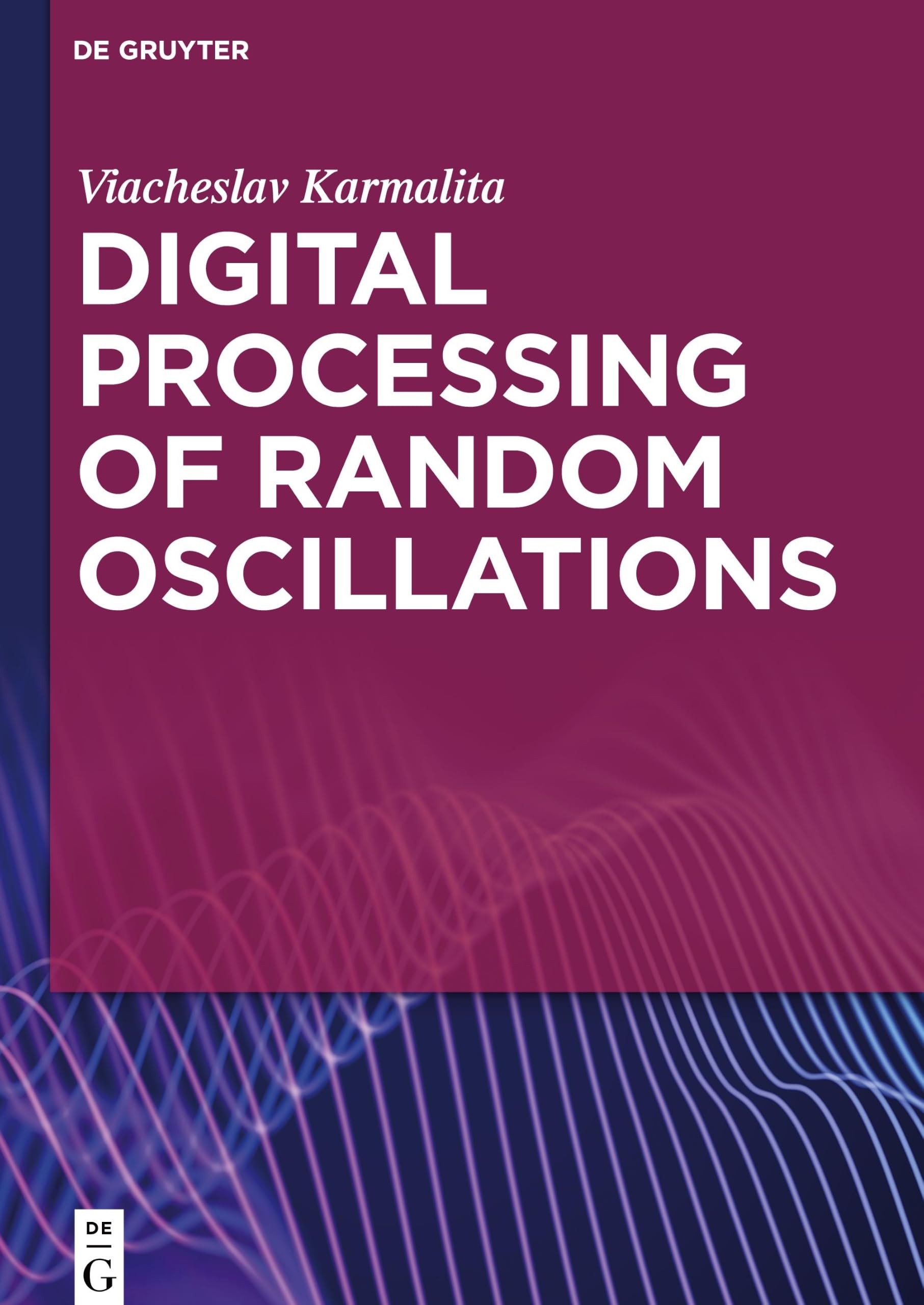
Digital Processing of Random Oscillations
Inclusive of all applicable taxes. FREE shipping on all orders.
Available Offers
- 🚚Free Delivery — Free shipping on all orders
- 💵Cash on Delivery — Pay when your order arrives
- ↩️15-Day Easy Returns — Hassle-free return policy
- 🔒Cash on Delivery — Pay safely when your order arrives
Check Delivery
Product Description
"Digital Processing of Random Oscillations" by Karmalita, Viacheslav , published by De Gruyter. This book deals with the autoregressive method for digital processing of random oscillations. The method is based on a one-to-one transformation of the numeric factors of the Yule series model to linear elastic system characteristics. This parametric approach allowed to develop a formal processing procedure from the experimental data to obtain estimates of logarithmic decrement and natural frequency of random oscillations. A straightforward mathematical description of the procedure makes it possible to optimize a discretization of oscillation realizations providing efficient estimates. The derived analytical expressions for confidence intervals of estimates enable a priori evaluation of their accuracy. Experimental validation of the method is also provided. Statistical applications for the analysis of mechanical systems arise from the fact that the loads experienced by machineries and various structures often cannot be described by deterministic vibration theory. Therefore, a sufficient description of real oscillatory processes (vibrations) calls for the use of random functions. In engineering practice, the linear vibration theory (modeling phenomena by common linear differential equations) is generally used. This theory’s fundamental concepts such as natural frequency, oscillation decrement, resonance, etc. are credited for its wide use in different technical tasks. In technical applications two types of research tasks exist: direct and inverse. The former allows to determine stochastic characteristics of the system output X(t) resulting from a random process E(t) when the object model is considered known. The direct task enables to evaluate the effect of an operational environment on the designed object and to predict its operation under various loads. The inverse task is aimed at evaluating the object model on known processes E(t) and X(t), i.e. finding model (equations) factors. This task is usually met at the tests of prototypes to identify (or verify) its model experimentally. To characterize random processes a notion of "shaping dynamic system" is commonly used. This concept allows to consider the observing process as the output of a hypothetical system with the input being stationary Gauss-distributed ("white") noise. Therefore, the process may be exhaustively described in terms of parameters of that system. In the case of random oscillations, the "shaping system" is an elastic system described by the common differential equation of the second order: X ̈(t)+2hX ̇(t)+ ω_0^2 X(t)=E(t), where ω0 = 2π/Т0 is the natural frequency, T0 is the oscillation period, and h is a damping factor. As a result, the process X(t) can be characterized in terms of the system parameters – natural frequency and logarithmic oscillations decrement δ = hT0 as well as the process variance. Evaluation of these parameters is subjected to experimental data processing based on frequency or time-domain representations of oscillations. It must be noted that a concept of these parameters evaluation did not change much during the last century. For instance, in case of the spectral density utilization, evaluation of the decrement values is linked with bandwidth measurements at the points of half-power of the observed oscillations. For a time-domain presentation, evaluation of the decrement requires measuring covariance values delayed by a time interval divisible by T0. Both estimation procedures are derived from a continuous description of research phenomena, so the accuracy of estimates is linked directly to the adequacy of discrete representation of random oscillations. This approach is similar a concept of transforming differential equations to difference ones with derivative approximation by corresponding finite differences. The resulting discrete model, being an approximation, features a methodical error which can be decreased but never eliminated. To render such a presentation more accurate it is imperative to decrease the discretization interval and to increase realization size growing requirements for computing power. The spectral density and covariance function estimates comprise a non-parametric (non-formal) approach. In principle, any non-formal approach is a kind of art i.e. the results depend on the performer’s skills. Due to interference of subjective factors in spectral or covariance estimates of random signals, accuracy of results cannot be properly determined or justified. To avoid the abovementioned difficulties, the application of linear time-series models with well-developed procedures for parameter estimates is more advantageous. A method for the analysis of random oscillations using a parametric model corresponding discretely (no approximation error) with a linear elastic system is developed and presented in this book. As a result, a one-to-one transformation of the model’s numerical factors to logarithmic decrement and natural frequency of random oscillations is established. It allowed to develop a formal processing procedure from experimental data to obtain the estimates of δ and ω0. The proposed approach allows researchers to replace traditional subjective techniques by a formal processing procedure providing efficient estimates with analytically defined statistical uncertainties. Theory, method and validation presented together. Straightforward mathematical description of the procedure. Top level research. Book details: 97 pages, published 2019. Order now on BookShops.in with fast, reliable delivery across India.
Book Specifications
| ISBN-13 | 9783110625004 |
| ISBN-10 | 3110625008 |
| Publisher | De Gruyter |
| Language | english |
| Print Length | 97 pages |
| Category | Computers & Internet |
Frequently Asked Questions
What is the price of Digital Processing of Random Oscillations?
Does BookShops.in offer free delivery for Digital Processing of Random Oscillations?
Is Cash on Delivery available for Digital Processing of Random Oscillations?
What is the return policy for Digital Processing of Random Oscillations?
Is Digital Processing of Random Oscillations authentic?
Customers Also Bought
Software
User-centered Computer Aided Language Learning
Software
Emerging Free and Open Source Software Practices by Sulayman K. Sowe – F/OSS Development

Software
Microsoft Dynamics NAV 2009 Programming Cookbook by Matt Traxinger

Software
Religion Enters the Academy: The Origins of the Scholarly Study of Religion in America

Software
Opposites as Equals: Standard Differences Between Men and Women and How to Resolve T Hem

Software
Advanced Mathematical and Computational Tools in Metrology and Testing X
Related Products
View All
Computers & Internet
Computer Security: 20 Things Every Employee Should Know (McGraw-Hill Professional Education)
Computers & Internet
30-Second AI & Robotics

Computers & Internet
Fortnite: the Essential Guide to Battle Royale and Other Survival Games: Stories from the Colorado Rockies Dugout, Locker Room, and Press Box

Computers & Internet
Microsoft Word Guide for Success
Computers & Internet
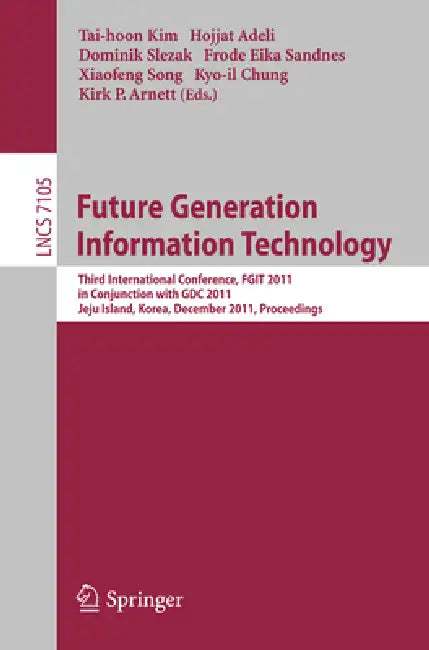
Future Generation Information Technology | by Tai-hoon Kim | Hojjat Adeli | Dominik Slezak | Springer | by Tai-hoon Kim | Hojjat Adeli | Dominik Slezak | Springer | by Tai-hoon Kim | Hojjat Adeli | Dominik Slezak | Springer | by Tai-hoon Kim | Hojjat Adeli | Dominik Slezak | Springer | by Tai-hoon Kim | Hojjat Adeli | Dominik Slezak | Springer | by Tai-hoon Kim | Hojjat Adeli | Dominik Slezak | Springer | by Tai-hoon Kim | Hojjat Adeli | Dominik Slezak | Springer | by Tai-hoon Kim | Hojjat Adeli
Computers & Internet