
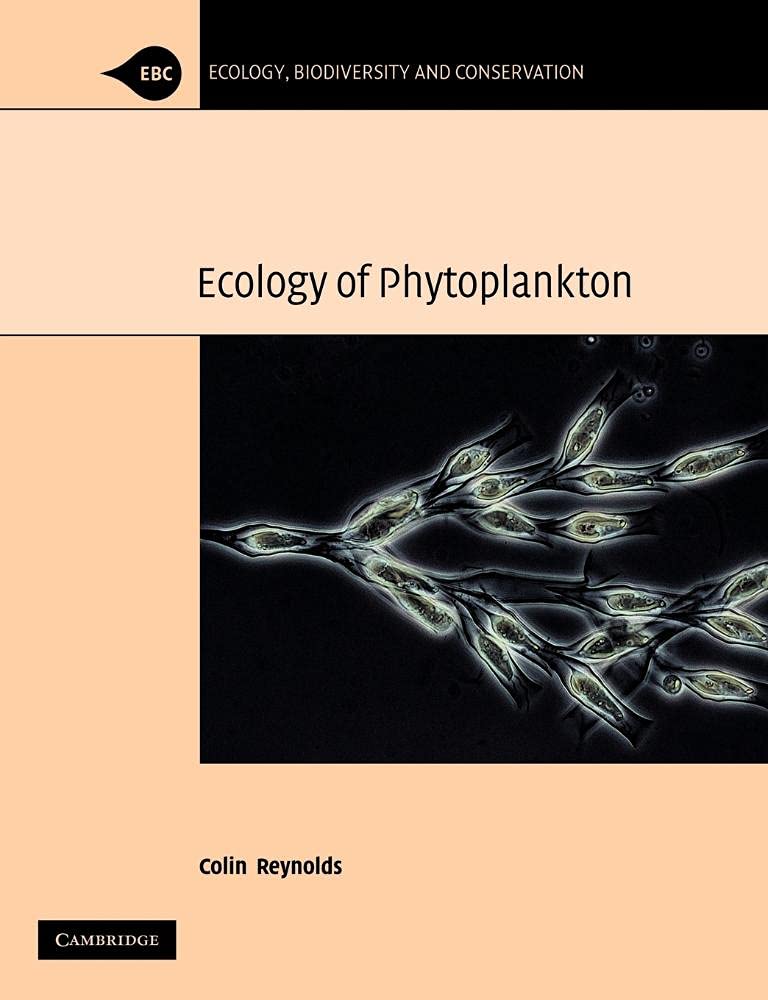
Ecology of Phytoplankton by Colin Reynolds – An In-Depth Study of Freshwater Phytoplankton Communities and Their Environ
Inclusive of all applicable taxes. FREE shipping on all orders.
Available Offers
- 🚚Free Delivery — Free shipping on all orders
- 💵Cash on Delivery — Pay when your order arrives
- ↩️15-Day Easy Returns — Hassle-free return policy
- 🔒Cash on Delivery — Pay safely when your order arrives
Check Delivery
Product Description
Introduction
In the vast and often invisible world of aquatic ecosystems, phytoplankton serves as the silent engine driving life in oceans, lakes, and rivers. For students, researchers, and ecology enthusiasts in India, understanding the dynamics of these microscopic organisms is essential for grasping broader environmental patterns. ECOLOGY OF PHYTOPLANKTON by Colin Reynolds, published by Cambridge University Press, is a definitive hardcover reference that delves deep into the biology, ecology, and functional roles of phytoplankton. This book is not just a scientific text; it is a gateway to appreciating how these tiny organisms influence climate, fisheries, and water quality in Indian waters and beyond.
Book Overview
This hardcover edition, with ISBN 9780521605199, presents a comprehensive synthesis of phytoplankton ecology, blending classical limnology with modern ecological theory. Colin Reynolds, a world-renowned authority, offers a rigorous yet accessible exploration of phytoplankton communities, their growth strategies, and their interactions with the environment. The book is structured to guide readers from fundamental concepts to advanced ecological models, making it an invaluable resource for postgraduate students, researchers, and professionals in aquatic sciences, environmental studies, and related fields across India.
Key Highlights
- Authoritative Author: Colin Reynolds is a celebrated figure in aquatic ecology, known for his pioneering work on phytoplankton functional classification.
- Comprehensive Coverage: From cell physiology to community dynamics, the book covers all scales of phytoplankton ecology.
- Practical Applications: Includes insights into water quality management, algal blooms, and climate change impacts relevant to Indian water bodies.
- Clear Illustrations: Features numerous diagrams, graphs, and tables that simplify complex ecological processes.
- Updated Edition: This 2006 hardcover edition reflects decades of research and remains a standard reference in the field.
Inside the Book
The book is divided into logical sections that build knowledge progressively. Early chapters introduce phytoplankton diversity, morphology, and physiology, while later chapters delve into population dynamics, trophic interactions, and ecological succession. Special attention is given to the role of phytoplankton in carbon cycling and nutrient dynamics, topics of great significance in Indian contexts like the Sundarbans, the Ganga basin, and coastal aquaculture zones. Each chapter concludes with summaries and references, aiding self-study and research.
Key Topics
- Phytoplankton classification and functional groups
- Photosynthesis, light adaptation, and nutrient uptake
- Population growth, competition, and predation
- Spatial and temporal patterns in lakes and oceans
- Algal blooms, eutrophication, and water quality management
- Climate change impacts on phytoplankton communities
- Methods for sampling and data analysis
Reader Benefits
Indian readers will find this book particularly useful for understanding local water bodies, from the Himalayan lakes to tropical coastal waters. The ecological principles discussed are directly applicable to managing reservoirs, fish ponds, and polluted urban lakes. Researchers will appreciate the critical evaluation of classical theories, while students will benefit from the clear explanations and case studies. The hardcover binding ensures durability for frequent use in libraries and field stations.
Learning Outcomes
By studying this book, readers will be able to: identify major phytoplankton groups and their ecological roles; explain the factors controlling phytoplankton growth and distribution; analyze the impact of human activities on aquatic ecosystems; apply ecological models to predict algal blooms; and design effective monitoring and management strategies for water bodies. These skills are increasingly sought after in Indian environmental consulting, research institutes, and government agencies like the Central Pollution Control Board.
Who Should Read
This book is ideal for postgraduate students of ecology, limnology, marine biology, and environmental science. It is also a valuable resource for PhD researchers, faculty members, and professionals working in water resource management, fisheries, and climate research. Undergraduate students with a strong foundation in biology will also find it rewarding. For anyone involved in the study or conservation of Indian aquatic ecosystems, this book is an essential addition to their library.
About the Author
Colin Reynolds was a distinguished freshwater ecologist and a long-time researcher at the Centre for Ecology and Hydrology in the United Kingdom. He is best known for developing the functional classification of phytoplankton, which revolutionized the way scientists understand algal communities. His work has been cited extensively in both temperate and tropical contexts, including Indian research on lake eutrophication and bloom dynamics. Reynolds authored several seminal books and numerous scientific papers, leaving a lasting legacy in aquatic ecology.
About the Publisher
Cambridge University Press is one of the world's oldest and most respected academic publishers, with a strong commitment to advancing knowledge across all disciplines. Their science and mathematics catalog includes foundational texts and cutting-edge research. For Indian readers, Cambridge University Press books are widely available and trusted for their editorial quality, rigorous peer review, and durability. This hardcover edition is a testament to their dedication to producing lasting academic resources.
Conclusion
ECOLOGY OF PHYTOPLANKTON is more than a textbook; it is an enduring reference that connects microscopic life to global ecological processes. For Indian students and professionals navigating the challenges of water security, pollution, and climate change, this book provides the scientific foundation needed to make informed decisions. Whether you are studying the monsoon-driven blooms in Kerala's backwaters or the pristine lakes of Sikkim, Colin Reynolds' work will illuminate the hidden world of phytoplankton. Order your copy from Bookshops.in today and deepen your understanding of the aquatic world.
Quick Summary
Ecology of Phytoplankton by Colin Reynolds is a definitive academic resource that delves into the intricate world of freshwater phytoplankton. The book systematically covers the biology, ecology, and dynamics of these microscopic organisms, from their physiological adaptations to their role in aquatic food webs and nutrient cycling. Readers will explore how light, temperature, nutrients, and grazing shape phytoplankton communities, and how these communities respond to environmental changes such as eutrophication and climate change. Written by a leading limnologist, this text is ideal for advanced undergraduate and postgraduate students of ecology, limnology, and environmental science, as well as researchers and water quality managers. By choosing Bookshops.in, Indian readers receive a genuine Cambridge University Press hardcover edition with reliable delivery and support, making it a valuable addition to any academic library.
Book Highlights
Book Specifications
| ISBN-13 | 9780521605199 |
| ISBN-10 | 0521605199 |
| Publisher | CAMBRIDGE UNIVERSITY PRESS |
| Language | English |
| Dimensions | 18.9 x 3.18 x 24.59 cm |
| Weight | 1 kg 180 g |
| Country | India |
| Category | Biology & Life Sciences › Biology |
| Genre | Non-fiction |
| Original Language | English |
Frequently Asked Questions
What is the main focus of Ecology of Phytoplankton?
Who is the author of this book?
Is this book suitable for Indian students?
What level of readers is this book intended for?
Does the book cover harmful algal blooms?
Is this a hardcover or paperback?
What is the ISBN for this book?
Can this book be used for self-study?
Does the book include Indian case studies?
What topics are covered in the book?
Is there a digital version available?
What is the price of this book?
Why should I buy from Bookshops.in?
Readers Also Search For
Customers Also Bought

Mathematics
Stereotype Spaces and Algebras: 73 (De Gruyter Expositions in Mathematics, 73)

Mathematics
Semigroups in Algebra, Geometry and Analysis: 20 (De Gruyter Expositions in Mathematics, 20)

Mathematics
Geometry from the Pacific Rim: Proceedings of the Pacific Rim Geometry Conference held at National University of Singapore, Republic of Singapore, ... 1994 (De Gruyter Proceedings in Mathematics)

Mathematics
First International Tainan-Moscow Algebra Workshop: Proceedings of the International Conference held at National Cheng Kung University Tainan, Taiwan, ... 1994 (De Gruyter Proceedings in Mathematics)

Mathematics
Differential Geometry - Proceedings of the VIII International Colloquium (English, Jesus A. Alvarez Lopez | Eduardo Garcia-Rio)

Mathematics
Mathematical Theory of Optimal Processes (Classics of Soviet Mathematics)
Related Products
View All
Biology
Evolution: What the Fossils Say and Why It Matters by Donald R. Prothero
Biology
From Taxonomy to Phylogenetics – Life and Work of Willi Hennig

Biology
The Marine Biology of the South China Sea

Biology
Genetics Meets Metabolomics: from Experiment to Systems Biology
Biology
The Elements of Natural or Experimental Philosophy: 2

Biology