
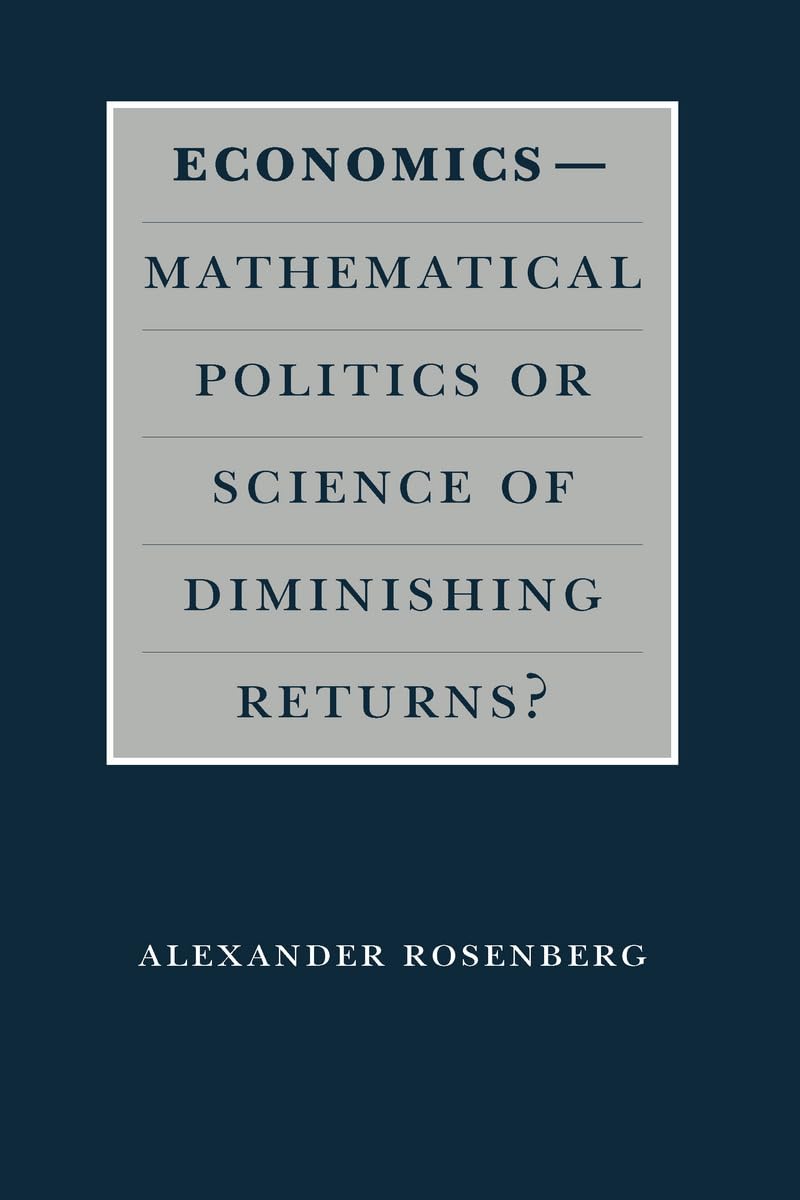
Economics: Mathematical Politics or Science of Diminishing Returns? by Alexander Rosenberg – A Thought-Provoking Critiqu
Inclusive of all applicable taxes. FREE shipping on all orders.
Available Offers
- 🚚Free Delivery — Free shipping on all orders
- 💵Cash on Delivery — Pay when your order arrives
- ↩️15-Day Easy Returns — Hassle-free return policy
- 🔒Cash on Delivery — Pay safely when your order arrives
Check Delivery
Product Description
Introduction
In a world where economic forecasts often miss the mark, Alexander Rosenberg's provocative book, Economics: Mathematical Politics or Science of Diminishing Returns?, asks a fundamental question: Is economics truly a science? For students, researchers, and curious minds in India, this hardcover edition from the University of Chicago Press offers a rigorous and eye-opening exploration of the discipline's predictive limits. Rosenberg challenges the very foundations of economic theory, making this a must-read for anyone who has ever wondered why economists so often fail to foresee recessions, booms, or crises.
Book Overview
This incisive work delves into the history and philosophy of economics, arguing that despite its mathematical sophistication, the field has not improved its ability to predict specific outcomes since the days of Adam Smith. Rosenberg defines science by its capacity for predictive improvability—the ability to refine forecasts through testing—and contends that economics falls short. The book systematically examines the gap between economic theory and real-world events, offering a compelling critique that will reshape how you think about the 'dismal science.'
Key Highlights
- Provocative Thesis: Challenges the scientific status of economics with clear, logical arguments.
- Historical Perspective: Traces predictive failures from classical to modern economics.
- Philosophical Depth: Engages with the philosophy of science to define what makes a discipline scientific.
- Accessible Yet Scholarly: Written for both academics and general readers interested in economic thought.
- Timely Relevance: Offers insights into why economic models often fail during crises like recessions or pandemics.
Inside the Book
Rosenberg takes readers on a journey through the core assumptions of economics, from rationality and equilibrium to mathematical modeling. He compares economics with established sciences like physics and biology, highlighting the lack of robust, testable predictions. The book dissects the work of key economists, including Adam Smith, John Maynard Keynes, and Milton Friedman, and evaluates their theories against the yardstick of scientific progress. Each chapter builds a case for why economics may be more akin to politics or ideology than to a genuine science.
Key Topics
- The definition of science and predictive improvability
- Historical failures in economic forecasting
- The role of mathematics in economic theory
- The problem of testing economic hypotheses
- Comparisons with natural sciences
- The influence of values and ideology on economic thought
- Alternatives to mainstream economic methodology
Reader Benefits
By reading this book, you will gain a critical perspective on economic claims made in news, policy debates, and academic circles. You will learn to question the assumptions behind economic models and understand why predictions often go wrong. This knowledge empowers you to make more informed decisions as a student, professional, or engaged citizen. The book also sharpens your analytical thinking, helping you evaluate arguments across disciplines.
Learning Outcomes
- Understand the criteria that distinguish science from non-science.
- Identify the key weaknesses in economic methodology.
- Evaluate historical and contemporary economic predictions critically.
- Appreciate the philosophical debates surrounding economics.
- Develop a nuanced view of the limits and possibilities of economic knowledge.
Who Should Read
This book is ideal for Indian students of economics, philosophy, and political science. It is also perfect for professors, researchers, and policy analysts who want to deepen their understanding of economic theory. General readers with an interest in why economies behave unpredictably will find it equally rewarding. If you have ever felt frustrated by economic explanations that seem detached from reality, this book is for you.
About the Author
Alexander Rosenberg is a distinguished philosopher of science and a professor at Duke University. He has written extensively on the philosophy of economics, biology, and social sciences. His work is known for its clarity, rigor, and willingness to challenge orthodoxies. Rosenberg brings a unique interdisciplinary perspective that bridges economics, philosophy, and the natural sciences.
About the Publisher
The University of Chicago Press is a prestigious academic publisher with a long history of producing influential works in economics, philosophy, and the sciences. Known for its commitment to scholarly excellence, the press ensures that each book meets the highest standards of research and writing. This hardcover edition is built to last, making it a valuable addition to any personal or institutional library.
Conclusion
Economics: Mathematical Politics or Science of Diminishing Returns? is a bold and essential read for anyone seeking to understand the true nature of economics. Alexander Rosenberg's argument is both challenging and enlightening, urging us to rethink what we accept as scientific knowledge. Whether you are a student in Delhi, a researcher in Mumbai, or a policy enthusiast in Bengaluru, this book will change the way you see the economic world. Order your copy from Bookshops.in today and join the debate.
Quick Summary
Economics: Mathematical Politics or Science of Diminishing Returns? by Alexander Rosenberg is a bold and incisive critique of the scientific pretensions of economics. Rosenberg, a distinguished philosopher of science, contends that the defining characteristic of any genuine science is predictive improvability—the ability to generate increasingly accurate forecasts by learning from past errors. He demonstrates that economics, from the time of Adam Smith to the present, has shown no such improvement, remaining unable to predict specific economic events with any greater precision. The book examines the mathematical modeling that dominates modern economics, arguing that it often serves as a form of political rhetoric rather than a tool for genuine scientific discovery. This work is essential for students of economics, philosophy, and social sciences who wish to understand the limits of economic knowledge. Readers will learn to critically assess economic theories and appreciate why economic forecasts frequently fail. By purchasing from Bookshops.in, Indian readers gain access to a premium hardcover edition with reliable delivery and customer support.
Book Highlights
Book Specifications
| ISBN-13 | 9780226727240 |
| ISBN-10 | 0226727246 |
| Publisher | Univ of Chicago Pr |
| Language | English |
| Dimensions | 22.91 x 15.44 x 1.83 cm |
| Weight | 386 g |
| Country | India |
| Category | Economics › Economic Theory |
| Genre | Non-fiction |
| Original Language | English |
Frequently Asked Questions
What is the main argument of this book?
Who is Alexander Rosenberg?
Is this book suitable for beginners in economics?
Does the book cover modern economic theories?
What does 'mathematical politics' mean?
How does this book relate to Indian economics?
Is this a hardcover edition?
Can I use this book for a university course?
Does the book include references?
What is the price in India?
Is this book available at Bookshops.in?
What is the ISBN of this book?
Readers Also Search For
Customers Also Bought

Entrepreneurship
Chinese Economic Revolution (English, Linda Grove)
Entrepreneurship
Engines of Innovation: The Entrepreneurial University in the Twenty-First Century by Holden Thorp
Entrepreneurship
Invention to Innovation (English, PhD Marshall Larry | Jenna Daroczy)
Entrepreneurship
Database Management Systems by Raghu Ramakrishnan – DBMS Textbook
Entrepreneurship
Decision-making for Technology Executives by Harold A. Linstone
Entrepreneurship
The Business Innovation Audit (English, William Tate)
Related Products
View All
Economics
Women's Entrepreneurship and Economics (English, Miguel-Angel Galindo | Domingo Ribeiro)
Economics
Trade Policy and Industrialization in Turbulent Times | by Gerry Helleiner | Routledge | by Gerry Helleiner | Routledge | by Gerry Helleiner | Routledge | by Gerry Helleiner | Routledge | by Gerry Helleiner | Routledge | by Gerry Helleiner | Routledge | by Gerry Helleiner | Routledge | by Gerry Helleiner | Routledge | by Gerry Helleiner | Routledge | by Gerry Helleiner | Routledge | by Gerry Helleiner | Routledge | by Gerry Helleiner | Routledge | by Gerry Helleiner | Routledge | by Gerry Hellei
Economics
History of Economic Analysis | by Schumpeter Joseph A. | Taylor & Francis Ltd | by Schumpeter Joseph A. | Taylor & Francis Ltd | by Schumpeter Joseph A. | Taylor & Francis Ltd | by Schumpeter Joseph A. | Taylor & Francis Ltd | by Schumpeter Joseph A. | Taylor & Francis Ltd | by Schumpeter Joseph A. | Taylor & Francis Ltd | by Schumpeter Joseph A. | Taylor & Francis Ltd | by Schumpeter Joseph A. | Taylor & Francis Ltd | by Schumpeter Joseph A. | Taylor & Franci
Economics
OECD Compendium of Productivity Indicators 2015 | by Organization for Economic Cooperation an | Organization for Economic Co-Operation & Deve | by Organization for Economic Cooperation an | Organization for Economic Co-Operation & Deve | by Organization for Economic Cooperation an | Organization for Economic Co-Operation & Deve | by Organization for Economic Cooperation an | Organization for Economic Co-Operation & Deve | by Organization for Economic Cooperation an | Organization

Economics
The Hacker's Handbook: The Strategy Behind Breaking into and Defending Networks by Susan Young
Economics