
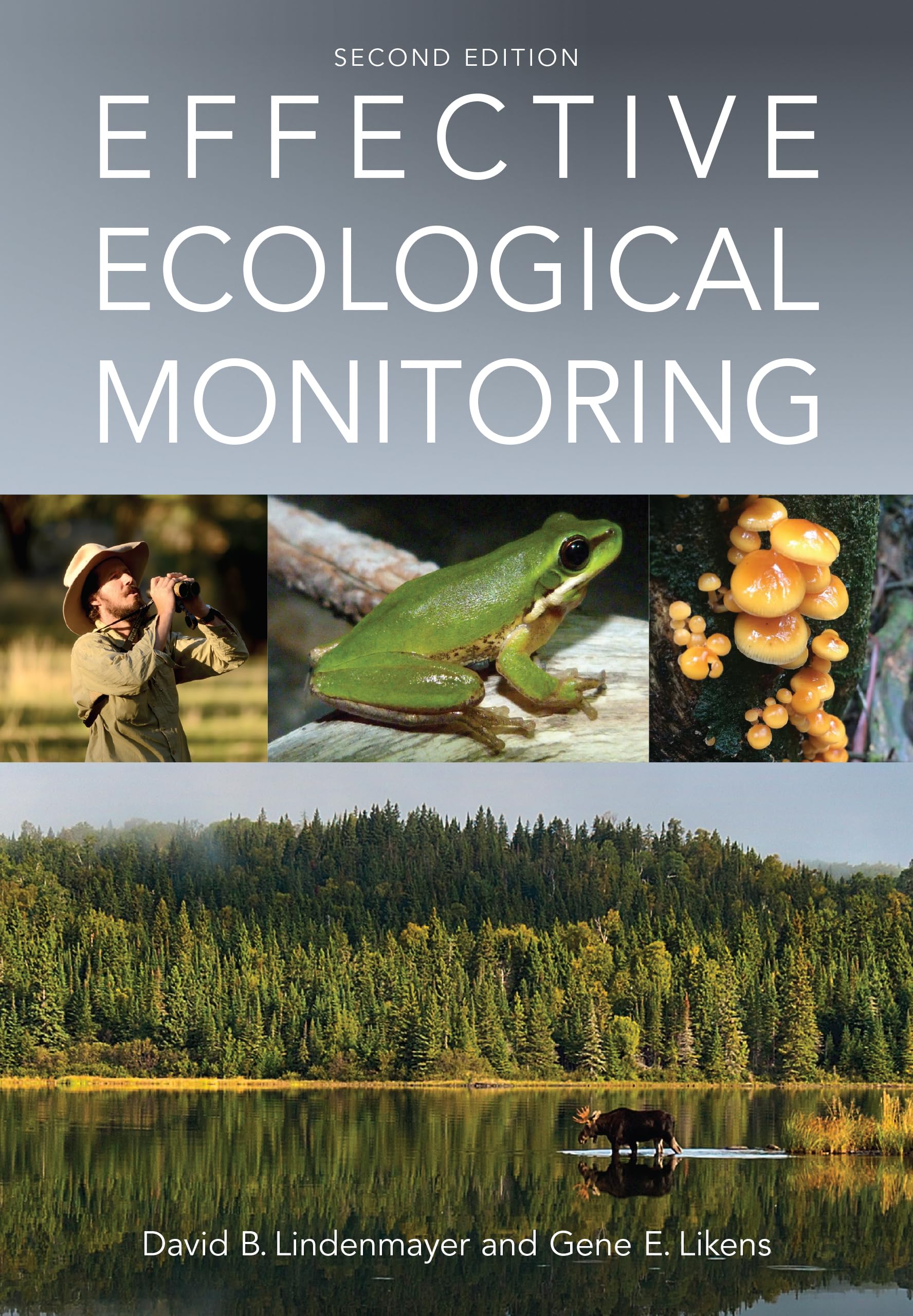
Effective Ecological Monitoring: A Comprehensive Guide to Long-Term Environmental Observation by David B. Lindenmayer
Inclusive of all applicable taxes. FREE shipping on all orders.
Available Offers
- 🚚Free Delivery — Free shipping on all orders
- 💵Cash on Delivery — Pay when your order arrives
- ↩️15-Day Easy Returns — Hassle-free return policy
- 🔒Cash on Delivery — Pay safely when your order arrives
Check Delivery
Product Description
Introduction
In an era where environmental challenges are escalating at an unprecedented rate, the need for reliable and long-term ecological data has never been more critical. Effective Ecological Monitoring by David B. Lindenmayer is a definitive guide that equips researchers, students, and environmental professionals with the tools to design and implement monitoring programs that truly make a difference. This second edition, published by CSIRO Publishing, builds on the success of the first edition to offer fresh insights, practical strategies, and real-world case studies that are essential for anyone involved in natural resource management and ecological science in India and beyond.
Book Overview
This fully revised and updated edition of Effective Ecological Monitoring is a concise yet comprehensive manual that addresses the common pitfalls and successes of long-term monitoring programs. Drawing on the authors' collective 80 years of hands-on experience, the book contrasts surveillance-based monitoring with question-driven approaches, explores the role of environmental observation networks, and introduces the concept of adaptive monitoring. It is designed to help readers move beyond ineffective data collection towards monitoring that informs policy, conservation, and sustainable management. The book is a hardcover edition, ideal for reference in libraries, classrooms, and fieldwork.
Key Highlights
- Second Edition Updates: Includes new sections on adaptive monitoring and environmental observation networks, reflecting the latest advancements in the field.
- Practical Framework: Provides a clear, step-by-step guide to designing monitoring programs that yield actionable results.
- Real-World Case Studies: Features examples from Australia and around the world, illustrating both successful and failed monitoring efforts.
- Author Expertise: Written by David B. Lindenmayer, a world-renowned ecologist with decades of field experience, ensuring authoritative content.
- Concise and Accessible: Despite covering complex topics, the book remains easy to read and apply, making it suitable for students and professionals alike.
Inside the Book
The book is structured to guide the reader through the entire lifecycle of an ecological monitoring program. It begins by defining the purpose and scope of monitoring, then delves into the critical differences between surveillance and question-based approaches. Subsequent chapters cover experimental design, data collection methods, statistical analysis, and the importance of long-term commitment. The new edition also includes a dedicated chapter on adaptive monitoring, which emphasizes flexibility and learning from ongoing results. Each chapter is supported by illustrative tables, diagrams, and summary points that reinforce key concepts.
Key Topics
- Surveillance-based versus question-based monitoring
- Designing monitoring programs for long-term success
- Environmental observation networks and their role
- Adaptive monitoring: integrating learning into practice
- Common reasons for monitoring failure and how to avoid them
- Case studies in forest, freshwater, and marine ecosystems
- Data management, analysis, and reporting for decision-makers
Reader Benefits
By reading this book, you will gain the confidence to design monitoring programs that stand the test of time. You will learn how to ask the right questions, select appropriate indicators, and avoid the common traps that lead to wasted resources. The book empowers you to produce data that is not only scientifically robust but also relevant to policy and management. For Indian readers, the principles are universally applicable, from monitoring Western Ghats biodiversity to tracking the health of the Ganges river system.
Learning Outcomes
- Understand the fundamental differences between surveillance and question-based monitoring approaches.
- Learn to design a monitoring program that is both scientifically rigorous and practically sustainable.
- Identify the key factors that contribute to the success or failure of long-term ecological studies.
- Apply adaptive monitoring techniques to improve program effectiveness over time.
- Evaluate environmental observation networks and their contributions to large-scale conservation.
Who Should Read
This book is an indispensable resource for undergraduate and postgraduate students in ecology, environmental science, wildlife biology, and natural resource management. It is equally valuable for researchers, conservation practitioners, park managers, and government officials involved in environmental monitoring and policy-making. If you are a teacher or professor looking for a textbook that bridges theory and practice, this is an excellent choice for your course. The content is also highly relevant for NGOs and community groups engaged in citizen science projects across India.
About the Author
David B. Lindenmayer is a distinguished professor of ecology at The Australian National University and one of the world's leading experts on forest and landscape ecology. With over 700 scientific publications and 40 books to his name, he has spent decades studying the impacts of land-use change on biodiversity. His hands-on experience in running some of the longest-running ecological monitoring programs in Australia gives him unparalleled insight into what works and what does not in the field of environmental monitoring.
About the Publisher
CSIRO Publishing is the publishing arm of Australia's national science agency, CSIRO. Renowned for producing high-quality scientific and technical books, journals, and magazines, CSIRO Publishing focuses on topics that matter to the environment, agriculture, and natural resource management. Their publications are trusted by scientists, educators, and policymakers worldwide for their rigorous peer-review process and practical relevance. This book continues that tradition of excellence.
Conclusion
Effective Ecological Monitoring is more than just a textbook—it is a practical guide that can transform how we understand and protect our natural world. Whether you are a student embarking on your first research project or a seasoned professional looking to refine your monitoring approach, this book offers the wisdom and tools you need. Its clear writing, real-world examples, and updated content make it a must-have for any serious environmental library in India. Order your hardcover copy today from Bookshops.in and take the first step towards monitoring that truly matters.
Quick Summary
Effective Ecological Monitoring by David B. Lindenmayer is a thoroughly revised second edition of a highly acclaimed guide for ecologists, conservationists, and environmental managers. The book distills over 80 years of combined author experience into practical advice on designing, implementing, and sustaining long-term monitoring programs. It introduces key concepts such as the differences between surveillance-based and question-based monitoring, the role of environmental observation networks, and the principles of adaptive monitoring. Through real-world case studies, readers learn how to avoid common pitfalls, ensure data quality, and maintain program longevity. This book is essential for students, researchers, and professionals in ecology, biodiversity conservation, and natural resource management. By choosing Bookshops.in, Indian readers receive a genuine hardcover copy with reliable delivery and customer service, supporting their academic and professional growth in environmental science.
Book Highlights
Book Specifications
| ISBN-13 | 9781486308927 |
| ISBN-10 | 1486308929 |
| Publisher | CSIRO Publishing |
| Language | English |
| Dimensions | 16.83 x 2.03 x 24.45 cm |
| Weight | 558 g |
| Country | India |
| Category | Biology & Life Sciences › Biology |
| Genre | Non-fiction |
| Original Language | English |
Frequently Asked Questions
What is Effective Ecological Monitoring about?
Who is the author of this book?
Is this book suitable for Indian readers?
What is the difference between this edition and the first?
Does the book cover statistical methods?
Can this book help me set up a monitoring program?
What type of monitoring does it focus on?
Are there real-world examples?
Is this book technical or beginner-friendly?
What is adaptive monitoring?
Does the book address funding challenges?
Is this book used in university courses?
Where can I buy this book in India?
Readers Also Search For
Customers Also Bought

Mathematics
Stereotype Spaces and Algebras: 73 (De Gruyter Expositions in Mathematics, 73)

Mathematics
Semigroups in Algebra, Geometry and Analysis: 20 (De Gruyter Expositions in Mathematics, 20)

Mathematics
Geometry from the Pacific Rim: Proceedings of the Pacific Rim Geometry Conference held at National University of Singapore, Republic of Singapore, ... 1994 (De Gruyter Proceedings in Mathematics)

Mathematics
First International Tainan-Moscow Algebra Workshop: Proceedings of the International Conference held at National Cheng Kung University Tainan, Taiwan, ... 1994 (De Gruyter Proceedings in Mathematics)

Mathematics
Differential Geometry - Proceedings of the VIII International Colloquium (English, Jesus A. Alvarez Lopez | Eduardo Garcia-Rio)

Mathematics
Mathematical Theory of Optimal Processes (Classics of Soviet Mathematics)
Related Products
View All
Biology
Evolution: What the Fossils Say and Why It Matters by Donald R. Prothero

Biology
From Taxonomy to Phylogenetics – Life and Work of Willi Hennig

Biology
The Marine Biology of the South China Sea

Biology
Genetics Meets Metabolomics: from Experiment to Systems Biology
Biology
The Elements of Natural or Experimental Philosophy: 2

Biology