
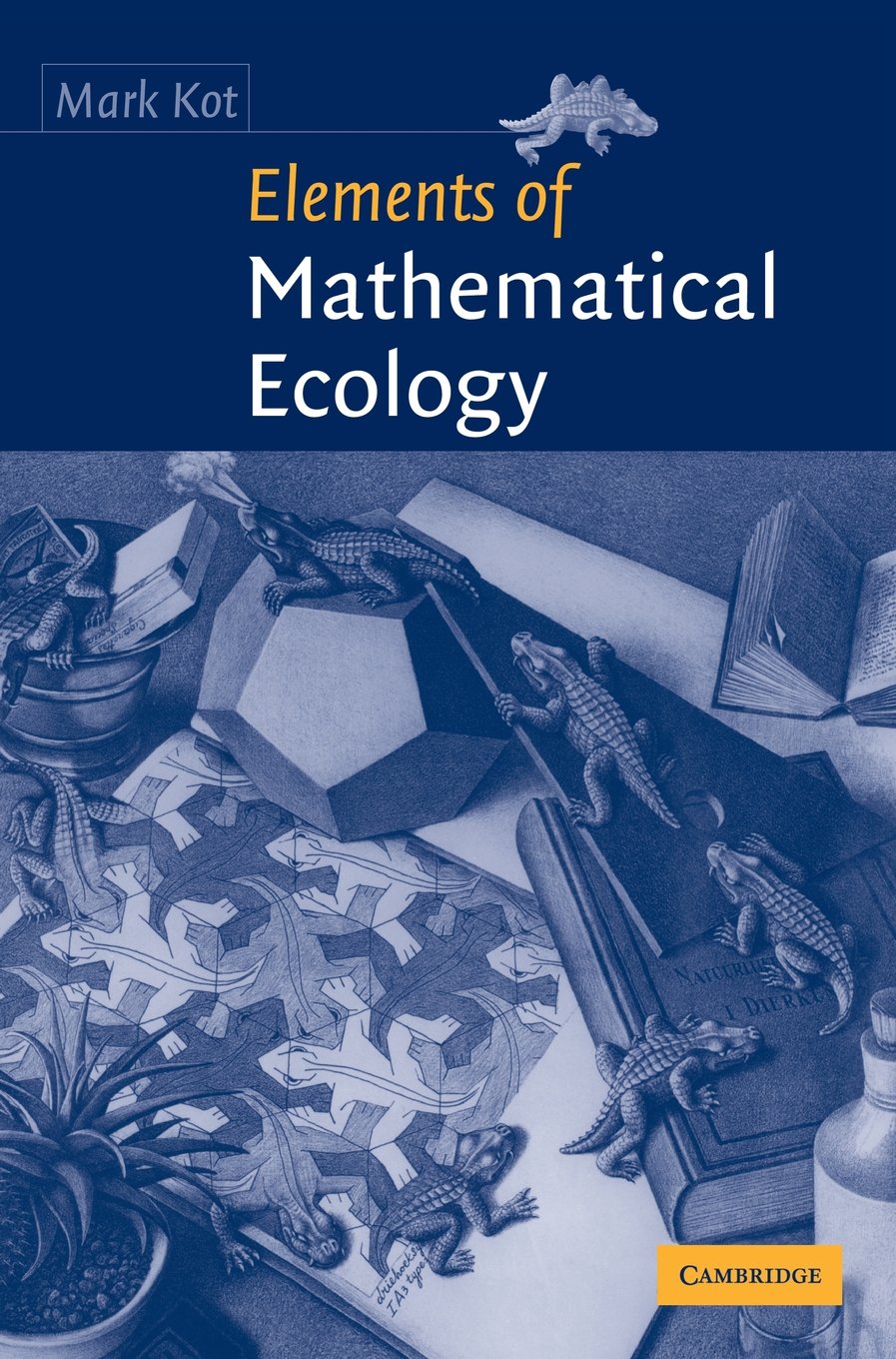
Elements of Mathematical Ecology by Mark Kot – A Foundational Textbook on Population Ecology Models and Methods
Inclusive of all applicable taxes. FREE shipping on all orders.
Available Offers
- 🚚Free Delivery — Free shipping on all orders
- 💵Cash on Delivery — Pay when your order arrives
- ↩️15-Day Easy Returns — Hassle-free return policy
- 🔒Cash on Delivery — Pay safely when your order arrives
Check Delivery
Product Description
Introduction
Mathematical ecology is where the elegance of numbers meets the complexity of nature. For students and researchers in India who are passionate about understanding how populations grow, interact, and evolve, Elements of Mathematical Ecology by Mark Kot is an indispensable guide. Published by Cambridge University Press, this hardcover volume offers a rigorous yet accessible journey into the mathematical frameworks that underpin modern ecology. Whether you are preparing for advanced studies in applied mathematics, biology, or environmental science, this book provides the theoretical foundation you need to model real-world ecological systems.
Book Overview
Elements of Mathematical Ecology is a comprehensive textbook that bridges the gap between classical ecological theory and contemporary mathematical methods. The book is divided into two clear parts: the first deals with simple, unstructured population models, while the second explores more complex structured models. With a focus on clarity and application, Mark Kot guides readers through density dependence, bifurcations, time delays, and population interactions, before moving into spatially structured models, age-structured models, and two-sex models. The book is designed to be both a classroom text and a self-study resource, making it ideal for Indian university courses in mathematical biology and theoretical ecology.
Key Highlights
- Comprehensive coverage of classical and modern mathematical models in population ecology
- Clear line diagrams that visually explain complex mathematical concepts
- Relevant problems at the end of each chapter to reinforce learning
- Application of optimal control theory to renewable resource management
- Structured approach from simple to advanced models for progressive learning
- Hardcover binding for durability and long-term use in academic settings
Inside the Book
Opening the pages of Elements of Mathematical Ecology, you will find a well-organized text that balances theory with practical examples. The first part introduces you to unstructured population models, covering density dependence, bifurcations, demographic stochasticity, and time delays. It also includes detailed discussions on predation, competition, and mutualism, along with optimal control theory for renewable resource management. The second part shifts focus to structured population models, including reaction-diffusion models for spatial ecology, age-structured models using the Leslie matrix, and two-sex models that account for mating systems. Each chapter is supported by numerous line diagrams that make the mathematics intuitive, and end-of-chapter problems challenge you to apply what you have learned.
Key Topics
- Unstructured population models and density dependence
- Bifurcations and demographic stochasticity
- Time delays in population dynamics
- Predator-prey, competition, and mutualism models
- Optimal control theory for resource harvesting
- Reaction-diffusion models for spatial ecology
- Age-structured populations and Leslie matrices
- Two-sex models and mating systems
Reader Benefits
This book offers immense value to Indian students and researchers. It provides a solid mathematical foundation that is essential for understanding ecological patterns and processes. The clear explanations and visual aids make challenging topics accessible, while the problem sets allow you to test your understanding. By working through this text, you will develop the ability to construct and analyse mathematical models of ecological systems, a skill that is highly sought after in academia, wildlife management, and environmental consulting. The hardcover format ensures that this reference will remain on your shelf for years to come.
Learning Outcomes
After studying Elements of Mathematical Ecology, you will be able to:
- Formulate and analyse unstructured population models using differential equations
- Understand bifurcations and stability in ecological systems
- Model population interactions such as predation, competition, and mutualism
- Apply optimal control theory to manage renewable resources sustainably
- Use reaction-diffusion equations to study spatial population dynamics
- Construct age-structured and two-sex models for realistic populations
- Interpret mathematical results in ecological terms
Who Should Read
This book is ideal for upper-level undergraduate and postgraduate students in ecology, mathematical biology, and applied mathematics. It is also an excellent resource for beginning researchers who want to build a strong foundation in theoretical ecology. Indian students preparing for competitive exams like CSIR-NET, GATE in ecology or mathematics, or those pursuing PhDs in related fields will find this book particularly useful. Additionally, professionals working in wildlife conservation, forestry, and environmental management will benefit from the quantitative skills it imparts.
About the Author
Mark Kot is a distinguished professor of applied mathematics at the University of Washington. With decades of experience in teaching and research, he has made significant contributions to the field of mathematical ecology. His writing style is known for being clear, precise, and pedagogically sound, making complex topics accessible to students from diverse backgrounds. His expertise in both mathematics and ecology ensures that the book maintains a perfect balance between theoretical rigour and biological relevance.
About the Publisher
Cambridge University Press is one of the world's oldest and most respected academic publishers. Known for producing high-quality textbooks and reference works, Cambridge University Press ensures that every title meets rigorous academic standards. This hardcover edition is printed on quality paper with durable binding, making it a reliable companion for years of study and research. For Indian readers, Cambridge University Press books are widely available and trusted in university libraries and bookshops across the country.
Conclusion
Elements of Mathematical Ecology is more than just a textbook; it is a gateway to understanding the mathematical principles that govern life on Earth. For students and researchers in India, this book offers a rare combination of depth, clarity, and practical application. Whether you are studying population dynamics, spatial ecology, or resource management, Mark Kot's masterful exposition will equip you with the tools you need to succeed. Add this essential volume to your collection today and take a confident step forward in your ecological journey.
Quick Summary
Elements of Mathematical Ecology by Mark Kot is a comprehensive textbook that introduces students and researchers to the mathematical modeling of populations in ecology. The book is divided into two main parts: the first covers simple, unstructured population models including density dependence, bifurcations, demographic stochasticity, time delays, and interactions such as predation, competition, and mutualism. It also explores the application of optimal control theory to renewable resource management. The second part delves into structured population models, focusing on spatially-structured reaction-diffusion models, age-structured models, and two-sex models. This book is ideal for upper-level undergraduate and graduate students in ecology, biology, and mathematics, as well as professionals in conservation and resource management. Readers will gain a deep understanding of both classical and modern modeling techniques, enabling them to analyze and predict population dynamics in natural and managed systems. Purchasing from Bookshops.in ensures a reliable, high-quality physical copy delivered to your doorstep in India.
Book Highlights
Book Specifications
| ISBN-13 | 9780521802130 |
| ISBN-10 | 052180213X |
| Publisher | Cambridge University Press |
| Language | English |
| Dimensions | 17.78 x 3.18 x 25.4 cm |
| Weight | 940 g |
| Country | India |
| Category | Biology & Life Sciences › Biology |
| Genre | Non-fiction |
| Original Language | English |
Frequently Asked Questions
What is Elements of Mathematical Ecology about?
Who is the author of this book?
Is this book suitable for Indian students?
What topics are covered in the first part?
Does the book include structured population models?
Is this book available in hardcover?
What is the ISBN-13 for this book?
What is the price of this book in India?
What is the rating of this book?
Which category does this book belong to?
Can I use this book for self-study?
Does the book cover optimal control theory?
Where can I buy this book in India?
Readers Also Search For
Customers Also Bought
Mathematics
Stereotype Spaces and Algebras: 73 (De Gruyter Expositions in Mathematics, 73)
Mathematics
Semigroups in Algebra, Geometry and Analysis: 20 (De Gruyter Expositions in Mathematics, 20)
Mathematics
Geometry from the Pacific Rim: Proceedings of the Pacific Rim Geometry Conference held at National University of Singapore, Republic of Singapore, ... 1994 (De Gruyter Proceedings in Mathematics)
Mathematics
First International Tainan-Moscow Algebra Workshop: Proceedings of the International Conference held at National Cheng Kung University Tainan, Taiwan, ... 1994 (De Gruyter Proceedings in Mathematics)
Mathematics
Differential Geometry - Proceedings of the VIII International Colloquium (English, Jesus A. Alvarez Lopez | Eduardo Garcia-Rio)
Mathematics
Mathematical Theory of Optimal Processes (Classics of Soviet Mathematics)
Related Products
View All
Biology
Evolution: What the Fossils Say and Why It Matters by Donald R. Prothero
Biology
From Taxonomy to Phylogenetics – Life and Work of Willi Hennig

Biology
The Marine Biology of the South China Sea
Biology
Genetics Meets Metabolomics: from Experiment to Systems Biology
Biology
The Elements of Natural or Experimental Philosophy: 2
Biology