
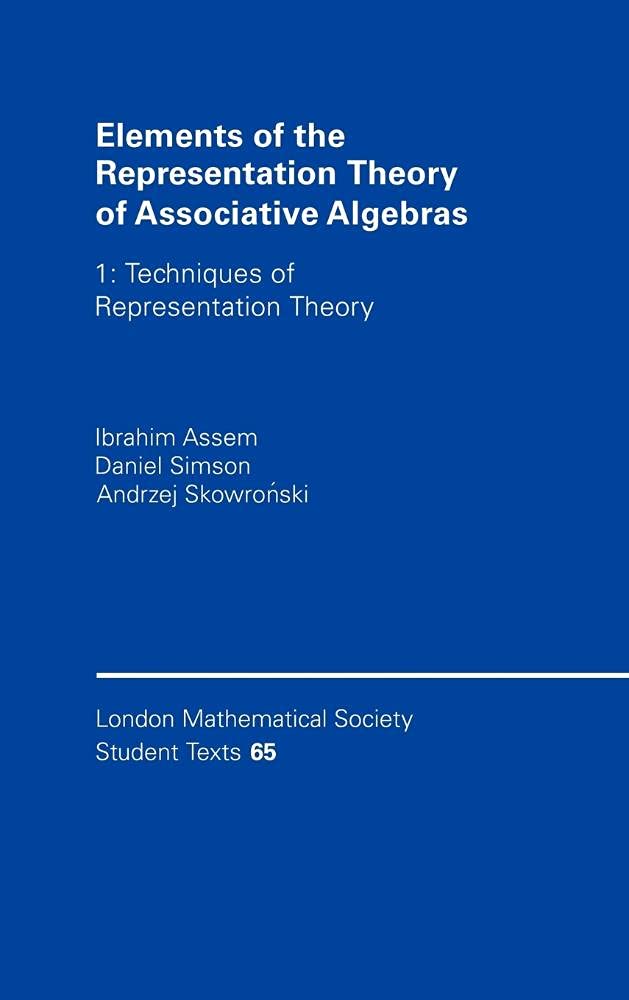
Elements of the Representation Theory of Associative Algebras: Techniques of Representation Theory by Ibrahim Assem – A
Inclusive of all applicable taxes. FREE shipping on all orders.
Available Offers
- 🚚Free Delivery — Free shipping on all orders
- 💵Cash on Delivery — Pay when your order arrives
- ↩️15-Day Easy Returns — Hassle-free return policy
- 🔒Cash on Delivery — Pay safely when your order arrives
Check Delivery
Product Description
Introduction
For graduate students and researchers venturing into the rich landscape of modern algebra, understanding the representation theory of associative algebras is both a challenge and a gateway to deeper mathematical insight. Elements of the Representation Theory of Associative Algebras: Volume 1: Techniques of Representation Theory by Ibrahim Assem offers a rigorous yet accessible entry point. Published by Cambridge University Press, this hardcover volume is an essential resource for Indian mathematics students, particularly those in advanced MSc or PhD programmes who wish to master quiver-theoretical methods and homological algebra.
Book Overview
This is the first of a two-volume set, focusing squarely on the foundational techniques that underpin the representation theory of finite-dimensional associative algebras over an algebraically closed field. Rather than overwhelming the reader with abstract formalism, Assem builds the subject from the ground up using the language of finite-oriented graphs—known as quivers—and the tools of homological algebra. The book is designed to be self-contained, making it suitable for both structured courses and independent study. It bridges classical theory with modern developments, including tilting theory and integral quadratic forms, all while keeping the exposition elementary and example-driven.
Key Highlights
- Quiver-Theoretic Approach: Representations are introduced via quivers, making abstract concepts visually intuitive and computationally manageable.
- Homological Algebra Integration: Essential homological methods are developed alongside representation theory, ensuring a cohesive learning experience.
- Tilting Theory Coverage: A modern perspective on tilting modules and their role in derived equivalences is presented in a clear, step-by-step manner.
- Integral Quadratic Forms: The connection between representation types and quadratic forms is explored, providing a powerful classification tool.
- Extensive Examples and Exercises: Each chapter is enriched with illustrative examples and a large number of end-of-chapter problems, reinforcing understanding.
Inside the Book
The volume begins with a review of basic module theory and then swiftly moves into the heart of the subject. Readers will encounter detailed treatments of Auslander–Reiten theory, almost split sequences, and the Auslander–Reiten quiver. The text carefully explains how to construct and manipulate representations of quivers, including the famous Gabriel's theorem for Dynkin quivers. Later chapters delve into the use of integral quadratic forms to classify representation types, followed by an introduction to tilting theory and its applications. Proofs are presented in full detail, leaving no logical gaps, which is particularly valuable for self-learners.
Key Topics
- Quivers and their representations
- Path algebras and modules over them
- Auslander–Reiten theory and almost split sequences
- Hereditary algebras and tilted algebras
- Integral quadratic forms and Dynkin diagrams
- Homological dimensions and derived categories
- Tilting modules and derived equivalences
Reader Benefits
For Indian students preparing for competitive exams or research fellowships, this book offers a solid foundation in a core area of algebra. The self-contained exposition means you do not need a vast background in homological algebra to start. The detailed proofs and many exercises cultivate problem-solving skills that are essential for original research. Moreover, the quiver-theoretic perspective simplifies complex ideas, making the subject more approachable than traditional texts. By working through this volume, you will gain the confidence to tackle advanced topics in representation theory and its applications to other branches of mathematics.
Learning Outcomes
After studying this book, you will be able to: classify finite-dimensional algebras by their representation type using quivers and quadratic forms; construct and analyse Auslander–Reiten quivers; understand the role of tilting modules in derived equivalences; apply homological algebra techniques to module categories; and read contemporary research papers in representation theory with greater ease. These outcomes directly support the goals of MSc and PhD coursework in algebra at Indian universities.
Who Should Read
This book is ideal for graduate students in mathematics who have completed a standard course in abstract algebra and are beginning research in representation theory. It is also highly suitable for researchers from other fields—such as theoretical physics or computer science—who need a rigorous yet friendly introduction to the subject. Indian students appearing for NET, GATE, or similar examinations in mathematics will find the structured approach and abundant exercises particularly beneficial for advanced study.
About the Author
Ibrahim Assem is a distinguished mathematician and professor known for his significant contributions to the representation theory of algebras. He has authored several influential texts and research articles, and his pedagogical style emphasises clarity and depth. His experience teaching at universities in Canada and abroad informs the careful organisation of this volume, making it a trusted companion for learners worldwide.
About the Publisher
Cambridge University Press is one of the oldest and most respected academic publishers in the world. With a legacy of excellence spanning over four centuries, Cambridge University Press is synonymous with rigorous scholarship and high-quality educational resources. Their mathematics catalogue includes many foundational texts used in Indian universities, and this volume upholds that tradition of precision and accessibility.
Conclusion
Elements of the Representation Theory of Associative Algebras: Volume 1: Techniques of Representation Theory is more than just a textbook—it is a carefully crafted guide that opens the door to a vibrant area of modern mathematics. Whether you are a student in Delhi, Bangalore, or Kolkata, this hardcover edition from Cambridge University Press will serve as a durable and reliable reference for years to come. Order your copy from Bookshops.in today and take a decisive step forward in your algebraic journey.
Quick Summary
Elements of the Representation Theory of Associative Algebras, Volume 1 by Ibrahim Assem is a definitive graduate-level textbook that introduces the representation theory of finite-dimensional algebras over algebraically closed fields. The book centers on the use of quivers (oriented graphs) to study module categories, employing homological algebra, tilting theory, and integral quadratic forms as core techniques. It is designed for graduate students beginning research in algebra, as well as for mathematicians seeking a modern, self-contained treatment. Readers will learn to classify indecomposable modules via Auslander-Reiten theory, understand almost split sequences, and explore derived equivalences through tilting modules. The text is replete with illustrative examples and includes extensive end-of-chapter exercises to solidify understanding. Published by Cambridge University Press, this hardcover volume is an essential resource for advanced courses and seminars. By purchasing from Bookshops.in, Indian students and researchers receive a high-quality physical copy with prompt delivery, supporting local academic needs.
Book Highlights
Book Specifications
| ISBN-13 | 9780521584234 |
| ISBN-10 | 052158423X |
| Publisher | Cambridge University Press |
| Language | English |
| Dimensions | 15.88 x 3.81 x 22.86 cm |
| Weight | 730 g |
| Country | India |
| Category | Mathematics › Algebra & Trigonometry |
| Series | Elements of the Representation Theory of Associative Algebras |
| Genre | Nonfiction |
| Reading Age | Adult |
| Original Language | English |
Frequently Asked Questions
What is the main focus of this book?
Who is the author of this book?
Is this book suitable for self-study?
What prerequisites are needed to read this book?
Does this book cover tilting theory?
Are there exercises in the book?
Is this the first volume of a series?
What is the ISBN for this book?
Is this book available in hardcover?
Can I use this book for a graduate course?
Does the book include applications to other fields?
What is the price of this book on Bookshops.in?
How is this book different from other representation theory texts?
Does Bookshops.in ship this book across India?
Readers Also Search For
Customers Also Bought
Mathematics
Stereotype Spaces and Algebras: 73 (De Gruyter Expositions in Mathematics, 73)
Mathematics
Semigroups in Algebra, Geometry and Analysis: 20 (De Gruyter Expositions in Mathematics, 20)
Mathematics
Geometry from the Pacific Rim: Proceedings of the Pacific Rim Geometry Conference held at National University of Singapore, Republic of Singapore, ... 1994 (De Gruyter Proceedings in Mathematics)
Mathematics
First International Tainan-Moscow Algebra Workshop: Proceedings of the International Conference held at National Cheng Kung University Tainan, Taiwan, ... 1994 (De Gruyter Proceedings in Mathematics)
Mathematics
Differential Geometry - Proceedings of the VIII International Colloquium (English, Jesus A. Alvarez Lopez | Eduardo Garcia-Rio)
Mathematics
Mathematical Theory of Optimal Processes (Classics of Soviet Mathematics)
Related Products
View AllMathematics
Stereotype Spaces and Algebras: 73 (De Gruyter Expositions in Mathematics, 73)
Mathematics
Semigroups in Algebra, Geometry and Analysis: 20 (De Gruyter Expositions in Mathematics, 20)
Mathematics
Geometry from the Pacific Rim: Proceedings of the Pacific Rim Geometry Conference held at National University of Singapore, Republic of Singapore, ... 1994 (De Gruyter Proceedings in Mathematics)
Mathematics
First International Tainan-Moscow Algebra Workshop: Proceedings of the International Conference held at National Cheng Kung University Tainan, Taiwan, ... 1994 (De Gruyter Proceedings in Mathematics)
Mathematics
Differential Geometry - Proceedings of the VIII International Colloquium (English, Jesus A. Alvarez Lopez | Eduardo Garcia-Rio)
Mathematics