
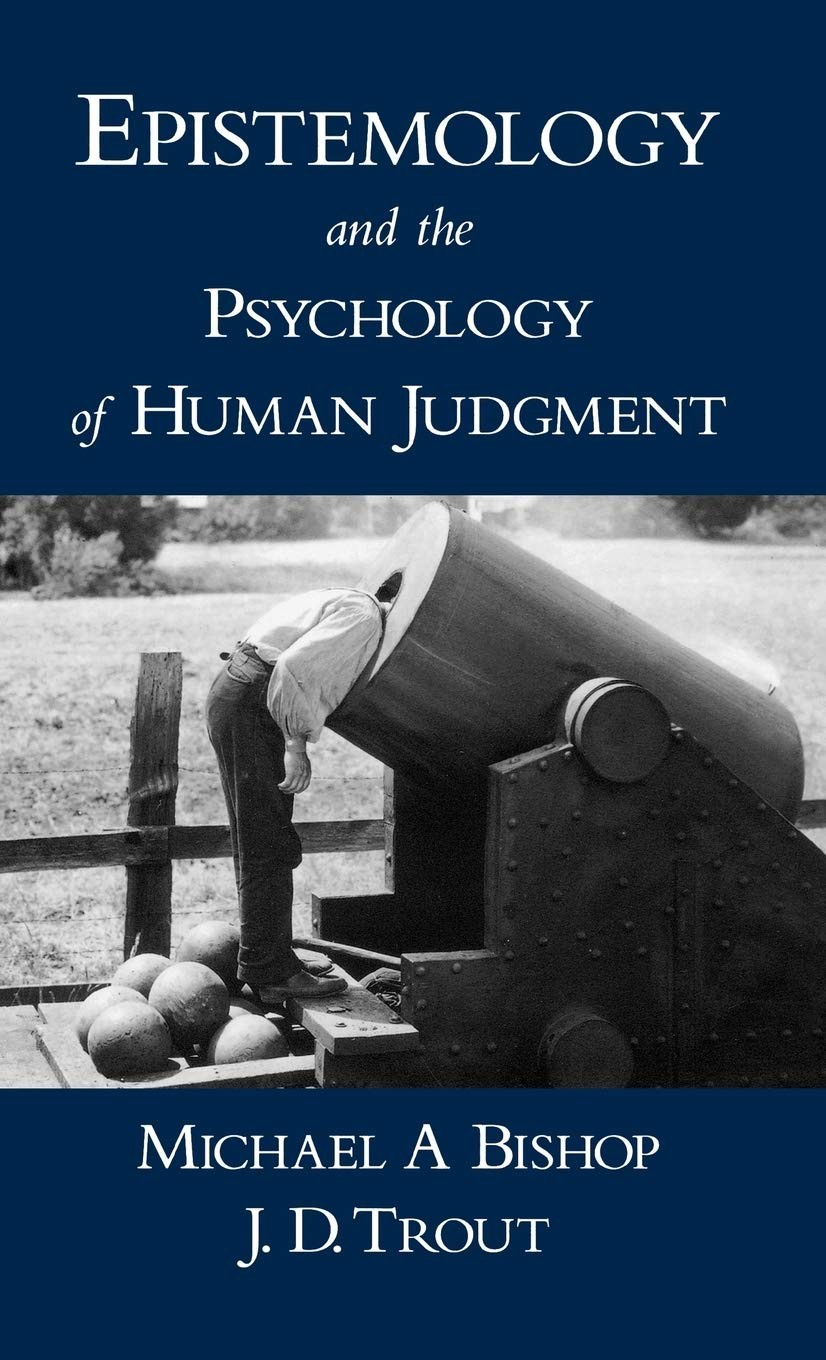
Epistemology and the Psychology of Human Judgment: A Strategic Reliabilist Approach to Knowledge and Reasoning by Michae
Inclusive of all applicable taxes. FREE shipping on all orders.
Available Offers
- 🚚Free Delivery — Free shipping on all orders
- 💵Cash on Delivery — Pay when your order arrives
- ↩️15-Day Easy Returns — Hassle-free return policy
- 🔒Cash on Delivery — Pay safely when your order arrives
Check Delivery
Product Description
Introduction
In an age where information is abundant and reasoning is often clouded by bias, Epistemology and the Psychology of Human Judgment by Michael A. Bishop offers a groundbreaking perspective on how we know what we know. This hardcover edition from Oxford University Press bridges the gap between philosophy and empirical psychology, presenting a fresh, practical approach to epistemology. Designed for students, researchers, and curious minds alike, this book challenges traditional analytic debates and instead grounds knowledge in real-world decision-making. It is an essential read for anyone seeking to sharpen their reasoning skills and understand the science behind judgment.
Book Overview
Bishop and his co-author, J.D. Trout, propose a revolutionary framework called Strategic Reliabilism, which redefines epistemic excellence as the efficient allocation of cognitive resources to reliable reasoning strategies. The book draws on extensive empirical data to argue that human judgment can be significantly improved by using Statistical Prediction Rules (SPRs)—simple, evidence-based formulas that outperform expert intuition in many domains. Rather than getting lost in abstract philosophical debates, this work treats epistemology as a branch of the philosophy of science, focusing on what works in practice. The authors use cost-benefit analysis to guide readers through real reasoning problems, making the content highly applicable to everyday life, academic research, and professional fields.
Key Highlights
- Strategic Reliabilism: A novel theory that combines reliability with resource efficiency, offering a new standard for epistemic excellence.
- Statistical Prediction Rules (SPRs): Practical tools grounded in data that can dramatically improve decision-making in areas like medicine, finance, and law.
- Empirical Foundation: The book is rooted in psychological research, making it a rare blend of philosophy and science.
- Cost-Benefit Approach: A unique method to evaluate reasoning strategies based on their real-world outcomes.
- Critical of Traditional Epistemology: Challenges the relevance of standard analytic epistemology, advocating for a more applied, problem-solving orientation.
Inside the Book
The book is structured into three major parts. The first part introduces the limitations of human reasoning and the power of SPRs, supported by compelling case studies. The second part develops Strategic Reliabilism in detail, explaining how we can allocate our cognitive resources wisely. The final part explores the implications of this view for resolving normative disputes in psychology and for rethinking key issues in epistemology, such as justification, knowledge, and rationality. Each chapter is rich with examples, from clinical diagnosis to legal judgments, making abstract concepts tangible. The writing is clear, engaging, and accessible, with technical terms explained in context.
Key Topics
- Epistemic norms and how they apply to real-life reasoning
- The psychology of judgment and decision-making
- Statistical vs. clinical prediction in expert fields
- Cost-benefit analysis in cognitive strategies
- Reliabilism vs. traditional foundationalist epistemology
- The role of empirical data in philosophical inquiry
- Normative disputes in psychology and their resolution
- Efficient allocation of cognitive resources
Reader Benefits
- Improved Decision-Making: Learn how to use simple rules to make better predictions and choices.
- Critical Thinking Skills: Understand the flaws in human intuition and how to overcome them.
- Interdisciplinary Knowledge: Gain insights that bridge philosophy, psychology, and cognitive science.
- Practical Tools: Apply SPRs and cost-benefit analysis to personal and professional problems.
- Academic Edge: A must-have resource for students and researchers in epistemology, philosophy of science, and psychology.
Learning Outcomes
By the end of this book, readers will be able to identify common reasoning errors, evaluate the reliability of different strategies, and apply Statistical Prediction Rules to improve accuracy in judgments. They will understand the core principles of Strategic Reliabilism and how it offers a more practical, evidence-based approach to knowledge. The book also equips readers with the tools to critically assess normative claims in psychology and philosophy, fostering a deeper appreciation for the interplay between theory and data. Ultimately, readers will emerge with a refined ability to think clearly and make sound decisions in uncertain situations.
Who Should Read
- Philosophy Students: Especially those studying epistemology, philosophy of science, or applied ethics.
- Psychology Students and Researchers: Those interested in judgment, decision-making, and cognitive biases.
- Professionals in Data-Driven Fields: Doctors, lawyers, economists, and policy analysts who rely on predictions and assessments.
- Curious General Readers: Anyone fascinated by how we know things and how to think better.
- Educators: Teachers and professors looking for a fresh perspective on reasoning to incorporate into their curriculum.
About the Author
Michael A. Bishop is a professor of philosophy at Florida State University, with a specialization in epistemology, philosophy of science, and the psychology of reasoning. He has published extensively on the nature of knowledge and the application of empirical methods to philosophical problems. His collaborative work with J.D. Trout has been widely influential in reshaping how philosophers and psychologists think about human judgment. Bishop’s writing is known for its clarity, rigor, and commitment to bridging theory with practice.
About the Publisher
Oxford University Press is one of the oldest and most respected academic publishers in the world. With a legacy spanning over five centuries, OUP is renowned for its high-quality scholarly books, including works in philosophy, science, and social sciences. This hardcover edition reflects OUP’s commitment to excellence, featuring durable binding and clear print that makes it a lasting addition to any library. For Indian readers, OUP titles are widely available and trusted by universities and institutions across the country.
Conclusion
Epistemology and the Psychology of Human Judgment is not just a book for philosophers—it is a practical guide for anyone who wants to reason better in a complex world. By challenging old assumptions and offering evidence-based tools, Bishop and Trout have created a work that is both intellectually stimulating and immediately useful. Whether you are a student grappling with abstract theories or a professional seeking sharper decision-making skills, this book will transform how you think about knowledge and judgment. Order your hardcover copy from Bookshops.in today and take the first step toward more reliable reasoning.
Quick Summary
Epistemology and the Psychology of Human Judgment by Michael A. Bishop is a groundbreaking work that reimagines epistemology as an empirical, science-driven discipline. Instead of engaging in abstract debates, Bishop proposes a practical framework based on cost-benefit analysis and Statistical Prediction Rules (SPRs) to guide real-world reasoning. The book introduces Strategic Reliabilism, a theory that defines epistemic excellence as the efficient allocation of cognitive resources to reliable methods. Drawing on empirical data, it shows how people can overcome cognitive biases and improve their judgments by relying on statistical models. This book is ideal for Indian students and researchers in philosophy, psychology, and cognitive science who seek a rigorous yet applicable approach to knowledge and rationality. Readers will learn how to think more clearly, evaluate evidence better, and make decisions that are both theoretically sound and practically effective. By purchasing from Bookshops.in, you gain access to this premium Oxford University Press hardcover, delivered reliably across India, with the assurance of quality and authenticity.
Book Highlights
Book Specifications
| ISBN-13 | 9780195162301 |
| ISBN-10 | 0195162307 |
| Publisher | OUP USA |
| Language | English |
| Dimensions | 20.42 x 14.63 x 1.22 cm |
| Weight | 1 kg 50 g |
| Category | Philosophy › Epistemology |
| Genre | Non-fiction |
| Original Language | English |
Frequently Asked Questions
What is Epistemology and the Psychology of Human Judgment about?
Who is the author of this book?
Is this book suitable for Indian students?
What is Strategic Reliabilism?
Does the book include practical advice?
What is the ISBN-13 of this book?
Which publisher released this book?
What is the price of this book in India?
What is the book's rating?
Is this book a hardcover edition?
What language is the book written in?
Can I use this book for my research?
Where can I buy this book in India?
Readers Also Search For
Customers Also Bought

Philosophy
Latin American Philosophy: Currents, Issues, Debates by Eduardo Mendieta

Philosophy
Al-Farabi's Short Commentary on Aristotle's Prior Analytics by Nicholas Rescher – Philosophy

Philosophy
Poetics of Imagining: Modern to Post-modern by Richard Kearney

Philosophy
The Metaphysics of Extrinsic Properties: 11 (Metaphysical Research, 11)

Philosophy
Dialogues on Metaphysics and on Religion by Nicolas Malebranche – Philosophy
Philosophy
Metaphysics and Truthmakers: 18 (Philosophische Analyse / Philosophical Analysis, 18)
Related Products
View AllPhilosophy
Latin American Philosophy: Currents, Issues, Debates by Eduardo Mendieta
Philosophy
Al-Farabi's Short Commentary on Aristotle's Prior Analytics by Nicholas Rescher – Philosophy
Philosophy
Poetics of Imagining: Modern to Post-modern by Richard Kearney
Philosophy
The Metaphysics of Extrinsic Properties: 11 (Metaphysical Research, 11)
Philosophy
Dialogues on Metaphysics and on Religion by Nicolas Malebranche – Philosophy
Philosophy