
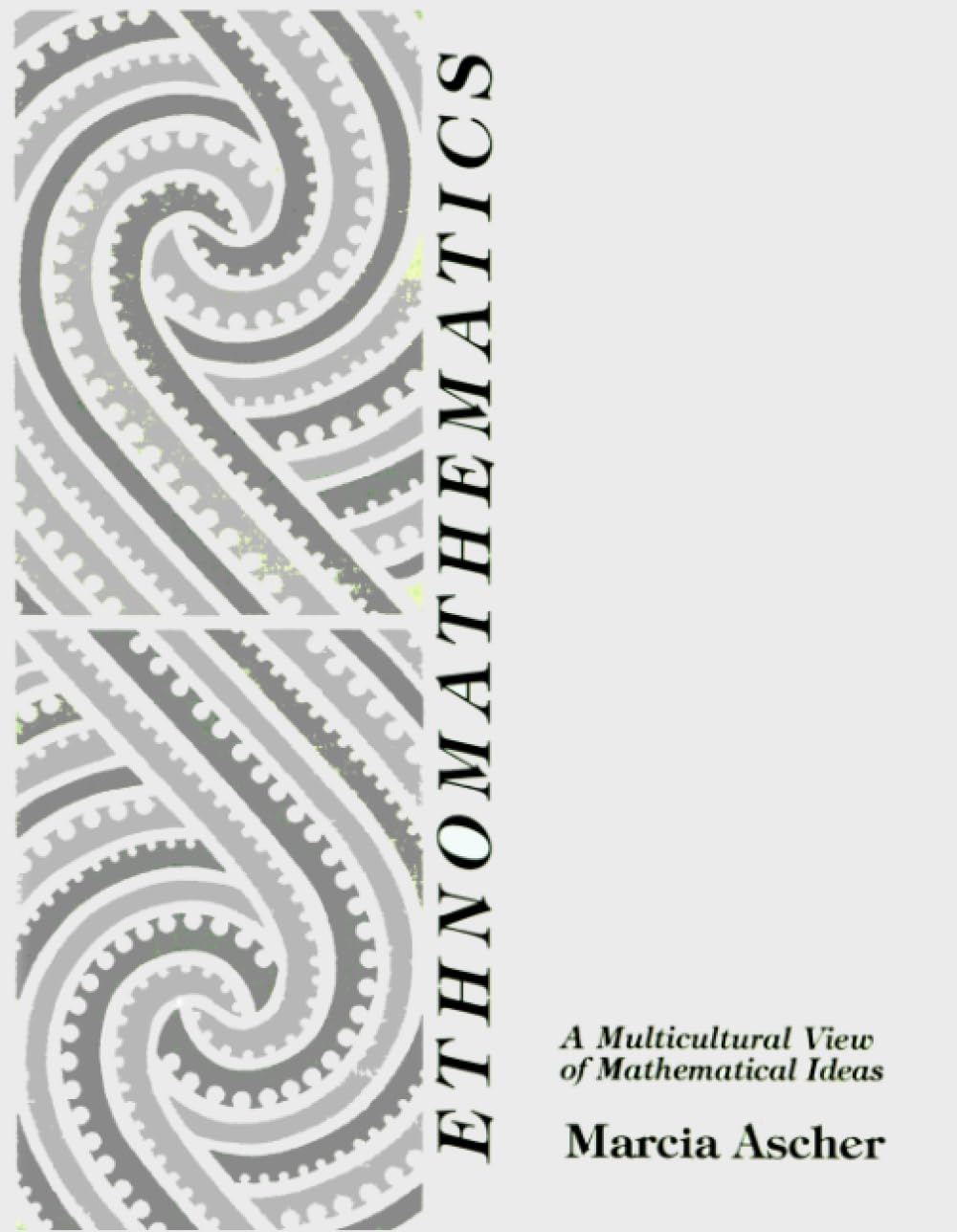
Ethnomathematics: A Multicultural View of Mathematical Ideas by Ascher Marcia – Exploring Math Across Indigenous and Tra
Inclusive of all applicable taxes. FREE shipping on all orders.
Available Offers
- 🚚Free Delivery — Free shipping on all orders
- 💵Cash on Delivery — Pay when your order arrives
- ↩️15-Day Easy Returns — Hassle-free return policy
- 🔒Cash on Delivery — Pay safely when your order arrives
Check Delivery
Product Description
Introduction
Mathematics is often perceived as a universal, unchanging language of numbers and formulas, but what if its roots are far more diverse and culturally rich than we imagine? Ethnomathematics: A Multicultural View of Mathematical Ideas by Ascher Marcia invites readers on a fascinating journey across the globe to discover how different traditional societies have shaped mathematical thought. Published by CRC Press, this hardcover volume is an essential addition to the library of every curious student, educator, and scholar in India who wishes to see mathematics through a new, inclusive lens.
Book Overview
This groundbreaking work challenges the conventional Western-centric narrative of mathematics by exploring the mathematical ideas embedded in the daily lives, art, rituals, and social structures of small-scale cultures. Ascher Marcia meticulously examines how people from the Inuit of North America to the Maori of Oceania, and from the Inca of South America to the Tshokwe of Africa, have developed sophisticated systems of counting, logic, spatial reasoning, and probability. The book is not just a collection of exotic examples; it is a deep, respectful inquiry into how mathematics is a human activity, shaped by environment, culture, and necessity.
Key Highlights
- Authentic cross-cultural perspective: Covers mathematical ideas from over a dozen traditional cultures, including the Navajo, Iroquois, Malekula, Warlpiri, Caroline Islanders, Bushoong, and Kpelle.
- Engaging, non-technical approach: Written for a general audience, making complex concepts accessible without requiring advanced mathematical training.
- Rich with real-world examples: From sand graphs of the Tshokwe to kinship logic of the Warlpiri, every chapter offers concrete illustrations.
- Unique focus on non-Western systems: Highlights the mathematical sophistication often overlooked in standard textbooks.
Inside the Book
The book is structured around key themes that reveal the universality and diversity of mathematical thinking. Each chapter delves into a specific cultural practice: the words and symbols used for numbers, the logic behind kin relationships, the strategies in traditional games and puzzles, and the methods of organizing and modeling space. Readers will encounter the fascinating 'sand graphs' drawn by the Tshokwe people of Africa, which encode complex topological ideas, and the intricate kinship systems of the Warlpiri of Australia, which function as logical structures. The Inca quipu, a system of knotted cords used for record-keeping, is also explored as a sophisticated numerical device.
Key Topics
- Numbers: Words and Symbols across cultures
- Tracing Graphs in the Sand: The Tshokwe tradition
- The Logic of Kin Relations: Social structures as mathematical systems
- Chance and Strategy in Games and Puzzles
- The Organization and Modeling of Space: From navigation to architecture
Reader Benefits
By reading this book, you will develop a deeper appreciation for the global heritage of mathematics. You will learn to see patterns, logic, and structure in cultural practices that might otherwise seem unrelated to math. This perspective is invaluable for students of mathematics, anthropology, and education, as it broadens the definition of mathematical thinking and encourages inclusivity. Teachers will find fresh, engaging examples to bring into their classrooms, showing students that mathematics belongs to everyone, everywhere.
Learning Outcomes
- Understand how different cultures conceptualize numbers and operations
- Analyze kinship systems as logical structures
- Recognize mathematical principles in traditional games and art
- Appreciate the role of environment in shaping mathematical ideas
- Develop a multicultural perspective on the history of mathematics
Who Should Read
This book is ideal for undergraduate and postgraduate students in mathematics, anthropology, and cultural studies. It is also a must-read for school and college teachers looking to diversify their curriculum, as well as for general readers with an interest in the intersection of culture and science. Anyone who has ever wondered why mathematics looks different in different parts of the world will find this book enlightening.
About the Author
Ascher Marcia is a renowned mathematician and educator who has spent decades researching the mathematical practices of traditional cultures. Her work has been instrumental in establishing ethnomathematics as a respected field of study. She brings both scholarly rigor and a warm, accessible writing style to this book, making complex ideas understandable to a wide audience.
About the Publisher
CRC Press is a leading global publisher of scientific and technical content. Known for its high-quality academic books, CRC Press is committed to bringing innovative and diverse perspectives to the world of science and mathematics. This hardcover edition is produced with the durability and clarity that students and professionals expect.
Conclusion
Ethnomathematics: A Multicultural View of Mathematical Ideas is more than a book—it is an invitation to rethink what mathematics is and who creates it. By celebrating the mathematical genius of cultures often ignored, Ascher Marcia opens our eyes to a richer, more inclusive world of numbers and patterns. For Indian readers, who live in a land of immense cultural diversity, this book offers a powerful reminder that mathematics is a shared human treasure. Add this enlightening volume to your collection and see the world of mathematics in a whole new light.
Quick Summary
Ethnomathematics: A Multicultural View of Mathematical Ideas by Ascher Marcia is a groundbreaking work that explores mathematical concepts as they appear in traditional and small-scale cultures worldwide. The book covers a wide range of topics, including number systems, logic in kinship structures, sand tracing graphs, games of chance and strategy, and spatial modeling. It draws examples from diverse cultures such as the Inuit, Navajo, Iroquois, Inca, Malekula, Warlpiri, Maori, Caroline Islanders, Tshokwe, Bushoong, and Kpelle. This book is ideal for students, educators, researchers, and anyone interested in understanding mathematics as a universal yet culturally diverse human activity. Readers will learn to appreciate the sophisticated mathematical thinking embedded in everyday practices of indigenous peoples. By purchasing from Bookshops.in, you support a trusted Indian bookstore offering quality academic titles with reliable delivery.
Book Highlights
Book Specifications
| ISBN-13 | 9780412989414 |
| ISBN-10 | 0412989417 |
| Publisher | Chapman & Hall |
| Language | English |
| Dimensions | 17.81 x 1.24 x 22.91 cm |
| Weight | 386 g |
| Category | Mathematics › Algebra & Trigonometry |
| Genre | Non-fiction |
| Original Language | English |
Frequently Asked Questions
What is ethnomathematics?
Who is Ascher Marcia?
Which cultures are covered in this book?
Is this book suitable for classroom use?
What topics does the book address?
Does the book require advanced math knowledge?
Is this a textbook or a reference work?
Who is the publisher?
How is this book different from standard math books?
Can I use this book for research?
Does the book include examples from India?
What is the binding type?
Where can I buy this book in India?
Readers Also Search For
Customers Also Bought
Mathematics
Stereotype Spaces and Algebras: 73 (De Gruyter Expositions in Mathematics, 73)
Mathematics
Semigroups in Algebra, Geometry and Analysis: 20 (De Gruyter Expositions in Mathematics, 20)
Mathematics
Geometry from the Pacific Rim: Proceedings of the Pacific Rim Geometry Conference held at National University of Singapore, Republic of Singapore, ... 1994 (De Gruyter Proceedings in Mathematics)
Mathematics
First International Tainan-Moscow Algebra Workshop: Proceedings of the International Conference held at National Cheng Kung University Tainan, Taiwan, ... 1994 (De Gruyter Proceedings in Mathematics)
Mathematics
Differential Geometry - Proceedings of the VIII International Colloquium (English, Jesus A. Alvarez Lopez | Eduardo Garcia-Rio)
Mathematics
Mathematical Theory of Optimal Processes (Classics of Soviet Mathematics)
Related Products
View AllMathematics
Mathematical Theory of Optimal Processes (Classics of Soviet Mathematics)
Mathematics
Stereotype Spaces and Algebras: 73 (De Gruyter Expositions in Mathematics, 73)
Mathematics
Semigroups in Algebra, Geometry and Analysis: 20 (De Gruyter Expositions in Mathematics, 20)
Mathematics
Geometry from the Pacific Rim: Proceedings of the Pacific Rim Geometry Conference held at National University of Singapore, Republic of Singapore, ... 1994 (De Gruyter Proceedings in Mathematics)
Mathematics
First International Tainan-Moscow Algebra Workshop: Proceedings of the International Conference held at National Cheng Kung University Tainan, Taiwan, ... 1994 (De Gruyter Proceedings in Mathematics)
Mathematics