
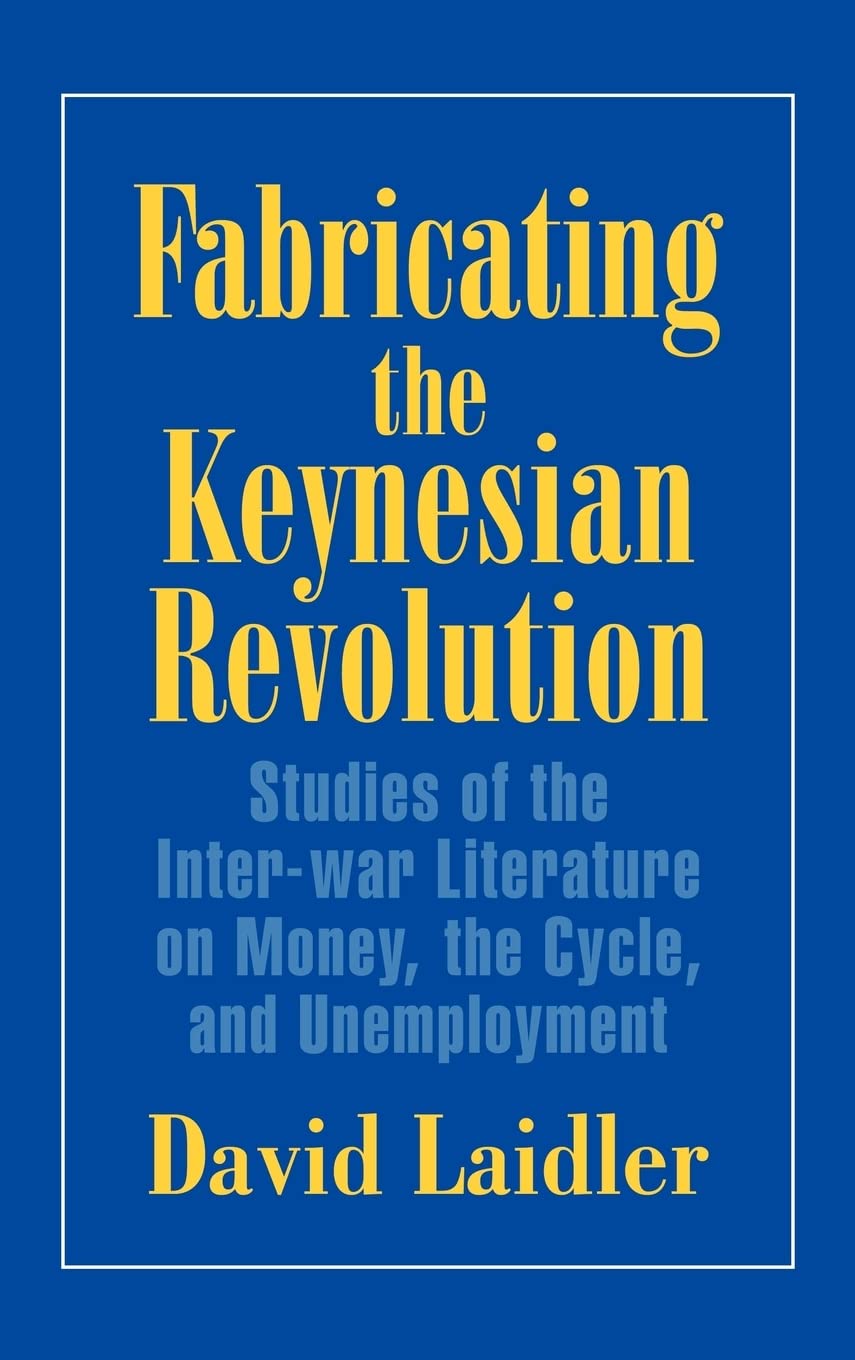
Fabricating the Keynesian Revolution: Studies of the Inter-war Literature on Money, the Cycle, and Unemployment by David
Inclusive of all applicable taxes. FREE shipping on all orders.
Available Offers
- 🚚Free Delivery — Free shipping on all orders
- 💵Cash on Delivery — Pay when your order arrives
- ↩️15-Day Easy Returns — Hassle-free return policy
- 🔒Cash on Delivery — Pay safely when your order arrives
Check Delivery
Product Description
Introduction
In the landscape of economic thought, few concepts have been as influential—and as hotly debated—as the Keynesian Revolution. David Laidler's Fabricating the Keynesian Revolution: Studies of the Inter-war Literature on Money, the Cycle, and Unemployment offers a meticulous re-examination of the intellectual currents that shaped macroeconomics between the two world wars. This hardcover volume, published by Cambridge University Press, is an essential read for students, academics, and anyone passionate about the history of economic ideas.
Book Overview
This scholarly work challenges the conventional narrative that John Maynard Keynes's General Theory single-handedly sparked a radical break in economic thinking. Instead, Laidler argues that what came to be known as Keynesian macroeconomics—embodied in the IS-LM model—was actually a selective synthesis of ideas that had been developing for decades. The book explores how economists like Keynes, along with many others, contributed to a gradual evolution of thought on money, business cycles, and unemployment. Laidler's analysis suggests that the term 'Keynesian Revolution' may be a misnomer, as the most revolutionary aspects of Keynes's own work were often left out of the final synthesis.
Key Highlights
- Original Research: Draws extensively on inter-war periodicals, books, and unpublished papers to reconstruct the intellectual environment of the 1920s and 1930s.
- Critical Reassessment: Questions the revolutionary nature of Keynesian economics by showing its deep roots in earlier debates.
- Focus on IS-LM: Provides a detailed analysis of how the IS-LM model became the dominant framework, and what was lost in that process.
- Global Perspective: Considers contributions from British, American, and European economists, offering a comprehensive view of the period.
Inside the Book
The book is structured around a series of interconnected studies. Laidler begins by setting the stage with the pre-Keynesian consensus on money and cycles. He then moves through the writings of key figures such as Dennis Robertson, Friedrich Hayek, and Gunnar Myrdal, showing how their ideas foreshadowed elements of what later became Keynesianism. The middle chapters focus on the evolution of the multiplier, the liquidity preference theory, and the concept of effective demand. The final section examines the post-1936 literature that crystallized into the IS-LM model, arguing that this framework was a pragmatic compromise rather than a genuine revolution.
Key Topics
- The History of Macroeconomics: How the discipline evolved from the classical tradition to the Keynesian era.
- Monetary Theory: The role of money in economic fluctuations and the development of monetary policy ideas.
- Business Cycle Theory: Inter-war debates on the causes and cures of economic downturns.
- Unemployment Analysis: How economists understood involuntary unemployment before and after Keynes.
- The IS-LM Framework: Its origins, strengths, and limitations as a tool for policy analysis.
Reader Benefits
This book will deepen your understanding of how economic theories are constructed, contested, and institutionalized. By reading Laidler's work, you will gain a nuanced perspective on the history of economic thought—one that moves beyond textbook simplifications. You will learn to appreciate the complexity of intellectual change and the role of contingency in shaping dominant paradigms. The book also equips you with a critical lens to evaluate modern macroeconomic debates by showing how they echo earlier controversies.
Learning Outcomes
- Critical Thinking: Understand why historical narratives of scientific revolutions often oversimplify complex processes.
- Historical Context: Gain a thorough grounding in the inter-war economic literature, including works often overlooked in standard curricula.
- Analytical Skills: Learn to trace the lineage of key concepts like aggregate demand, liquidity preference, and the multiplier.
- Policy Insight: Appreciate how the IS-LM model shaped post-war macroeconomic policy, and why it later faced challenges.
Who Should Read
This book is ideal for postgraduate students and researchers in economics, particularly those specializing in the history of economic thought or macroeconomics. Advanced undergraduates with a strong background in economic theory will also find it accessible and rewarding. Additionally, historians of science, political economists, and anyone interested in how intellectual revolutions are 'fabricated' will discover a wealth of insight. Indian readers, especially those engaged with debates on economic policy and development, will benefit from understanding the origins of tools still used in central banks and finance ministries today.
About the Author
David Laidler is a distinguished economist and professor emeritus at the University of Western Ontario. A leading authority on monetary economics and the history of economic thought, Laidler has authored numerous influential books and articles. His work is known for its rigorous scholarship and its ability to connect historical analysis with contemporary economic issues. In this book, he brings decades of expertise to bear on one of the most fascinating episodes in the development of modern economics.
About the Publisher
Cambridge University Press is one of the world's oldest and most respected academic publishers. With a tradition of excellence dating back to 1534, Cambridge University Press publishes works that advance knowledge across disciplines. This hardcover edition reflects the publisher's commitment to high-quality academic production, making it a durable addition to any serious library.
Conclusion
Fabricating the Keynesian Revolution is not just a book about the past—it is a meditation on how economic knowledge is created and transmitted. David Laidler's careful scholarship invites readers to question received wisdom and to see the history of economics as a living, contested field. For anyone seeking to understand the roots of modern macroeconomics and the enduring legacy of the inter-war period, this volume is indispensable. Order your copy from Bookshops.in today and add a critical voice to your collection.
Quick Summary
David Laidler's 'Fabricating the Keynesian Revolution: Studies of the Inter-war Literature on Money, the Cycle, and Unemployment' is a seminal work that re-examines the origins of Keynesian macroeconomics. Laidler meticulously analyzes the inter-war literature on money, business cycles, and unemployment, arguing that the so-called 'Keynesian Revolution' was not a radical break but rather a highly selective synthesis of pre-existing ideas. The book focuses on the IS-LM model, which dominated macroeconomics for decades, and shows how it excluded the most radical aspects of Keynes's own contributions in 'The General Theory'. This study is essential for advanced economics students, researchers, and historians of economic thought who seek a deeper understanding of how modern macroeconomics was shaped. By challenging the conventional narrative, Laidler provides a nuanced perspective that enriches the study of economic theory. Indian readers, especially those in academic institutions, will find this book invaluable for grasping the historical foundations of policy debates. Buy this hardcover edition from Bookshops.in to add a critical scholarly resource to your library.
Book Highlights
Book Specifications
| ISBN-13 | 9780521641739 |
| ISBN-10 | 052164173X |
| Publisher | Cambridge University Press |
| Language | English |
| Dimensions | 16.51 x 2.54 x 24.13 cm |
| Weight | 760 g |
| Country | India |
| Category | Economics › Economic Theory |
| Genre | Non-fiction |
| Reading Age | Adult |
| Original Language | English |
Frequently Asked Questions
What is 'Fabricating the Keynesian Revolution' about?
Who is the author of this book?
Is this book suitable for undergraduate students?
What is the main argument of the book?
Does the book cover Keynes's General Theory?
Why is this book relevant for Indian readers?
What is the ISBN-13?
Is this book available in hardcover?
What is the price in India?
What is the book's rating?
Does the book challenge conventional Keynesian history?
Where can I buy this book in India?
Readers Also Search For
Customers Also Bought
Entrepreneurship
Chinese Economic Revolution (English, Linda Grove)
Entrepreneurship
Engines of Innovation: The Entrepreneurial University in the Twenty-First Century by Holden Thorp
Entrepreneurship
Invention to Innovation (English, PhD Marshall Larry | Jenna Daroczy)

Entrepreneurship
Database Management Systems by Raghu Ramakrishnan – DBMS Textbook

Entrepreneurship
Decision-making for Technology Executives by Harold A. Linstone
Entrepreneurship
The Business Innovation Audit (English, William Tate)
Related Products
View All
Economics
Women's Entrepreneurship and Economics (English, Miguel-Angel Galindo | Domingo Ribeiro)
Economics
Trade Policy and Industrialization in Turbulent Times | by Gerry Helleiner | Routledge | by Gerry Helleiner | Routledge | by Gerry Helleiner | Routledge | by Gerry Helleiner | Routledge | by Gerry Helleiner | Routledge | by Gerry Helleiner | Routledge | by Gerry Helleiner | Routledge | by Gerry Helleiner | Routledge | by Gerry Helleiner | Routledge | by Gerry Helleiner | Routledge | by Gerry Helleiner | Routledge | by Gerry Helleiner | Routledge | by Gerry Helleiner | Routledge | by Gerry Hellei
Economics
History of Economic Analysis | by Schumpeter Joseph A. | Taylor & Francis Ltd | by Schumpeter Joseph A. | Taylor & Francis Ltd | by Schumpeter Joseph A. | Taylor & Francis Ltd | by Schumpeter Joseph A. | Taylor & Francis Ltd | by Schumpeter Joseph A. | Taylor & Francis Ltd | by Schumpeter Joseph A. | Taylor & Francis Ltd | by Schumpeter Joseph A. | Taylor & Francis Ltd | by Schumpeter Joseph A. | Taylor & Francis Ltd | by Schumpeter Joseph A. | Taylor & Franci
Economics
OECD Compendium of Productivity Indicators 2015 | by Organization for Economic Cooperation an | Organization for Economic Co-Operation & Deve | by Organization for Economic Cooperation an | Organization for Economic Co-Operation & Deve | by Organization for Economic Cooperation an | Organization for Economic Co-Operation & Deve | by Organization for Economic Cooperation an | Organization for Economic Co-Operation & Deve | by Organization for Economic Cooperation an | Organization

Economics
The Hacker's Handbook: The Strategy Behind Breaking into and Defending Networks by Susan Young
Economics