
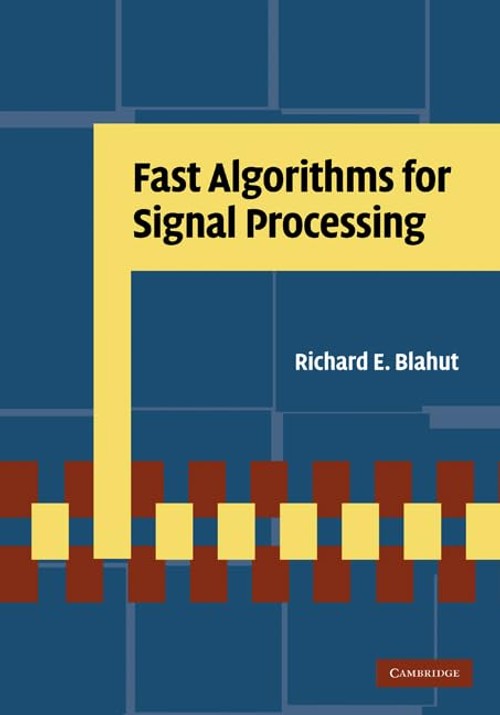
Fast Algorithms for Signal Processing: A Comprehensive Guide by Richard E. Blahut for Engineers and Researchers
Inclusive of all applicable taxes. FREE shipping on all orders.
Available Offers
- 🚚Free Delivery — Free shipping on all orders
- 💵Cash on Delivery — Pay when your order arrives
- ↩️15-Day Easy Returns — Hassle-free return policy
- 🔒Cash on Delivery — Pay safely when your order arrives
Check Delivery
Product Description
Introduction
In an era where every millisecond and every milliwatt matters, the need for speed and efficiency in signal processing has never been greater. Whether you are designing embedded systems for the Internet of Things, working on real-time video analytics, or pushing the boundaries of four-dimensional medical imaging, the algorithms you choose can make or break your application. Fast Algorithms for Signal Processing by Richard E. Blahut is the definitive guide to understanding, selecting, and implementing the most computationally efficient algorithms available. This hardcover volume from Cambridge University Press is an indispensable resource for Indian researchers, practising engineers, and advanced students who want to master the art of fast computation without sacrificing accuracy.
Book Overview
This self-contained reference is the only book of its kind that systematically covers a broad spectrum of fast algorithms for signal processing. It bridges the gap between abstract mathematical theory and practical, real-world implementation. The author, a towering figure in the field, presents each algorithm with clarity, proving the underlying theorems rigorously while always keeping the application in sight. From the discrete Fourier transform to convolution, from number-theoretic transforms to polynomial algorithms, every major technique is explored in depth. The book is designed to help you reduce power consumption in low-energy devices and handle massive datasets in high-performance computing environments—both critical challenges in today's Indian tech landscape.
Key Highlights
- Comprehensive coverage: Includes fast Fourier transforms (FFTs), Winograd algorithms, number-theoretic transforms, and many more.
- Rigorous yet accessible: All necessary background mathematics—from abstract algebra to number theory—is provided within the book.
- Application-focused: Emphasis on reducing computational complexity to save power and time in embedded and large-scale systems.
- One-of-a-kind resource: No other single volume offers such a unified treatment of fast algorithms for signal processing.
- Practical structure: Each algorithm is described with its structure, implementation details, and comparative strengths.
Inside the Book
The book is organised into well-structured chapters that build from foundational concepts to advanced topics. Early chapters review essential mathematics, including groups, rings, and fields, ensuring that readers from diverse backgrounds can follow along. Subsequent chapters dive into specific algorithm families: the Cooley-Tukey FFT, the Good-Thomas algorithm, the Rader prime-factor algorithm, and the Bluestein chirp z-transform. Later sections cover convolution algorithms, both cyclic and acyclic, and explore number-theoretic transforms that leverage modular arithmetic for speed. Each chapter includes worked examples, proofs, and comparisons that help you understand when and why to use a particular algorithm. The final chapters address polynomial algorithms and multidimensional transforms, making the book suitable for advanced research and development work.
Key Topics
- Fast Fourier Transform (FFT) and its variants
- Number-theoretic transforms and modular arithmetic
- Convolution algorithms: overlap-add, overlap-save, and Winograd methods
- Polynomial transforms and their applications
- Multidimensional signal processing algorithms
- Algorithmic complexity analysis and power optimisation
Reader Benefits
- Save development time: Quickly identify the most efficient algorithm for your specific signal processing task.
- Reduce power consumption: Implement algorithms that minimise arithmetic operations, crucial for battery-operated devices.
- Handle larger datasets: Scale your applications to video processing, medical imaging, and real-time communications.
- Build a strong mathematical foundation: Gain confidence in abstract algebra and number theory as applied to computing.
- Stay ahead in research: Understand the theoretical underpinnings that drive innovation in signal processing.
Learning Outcomes
After studying this book, readers will be able to: derive and implement the most efficient FFT algorithms for any transform length; compare and contrast different convolution methods and choose the optimal one for a given constraint; apply number-theoretic transforms to achieve exact computation without rounding errors; design polynomial-based algorithms for filtering and coding; and critically evaluate algorithmic trade-offs in terms of speed, memory, and power. The book equips you not just with recipes, but with the analytical tools to create new algorithms when needed.
Who Should Read
This book is ideal for electrical engineers, computer scientists, applied mathematicians, and physics researchers working on signal processing, communications, image processing, and embedded systems. It is equally valuable for postgraduate students in Indian institutes like IITs, NITs, and IISc who are pursuing courses in digital signal processing or VLSI design. Practising professionals in the semiconductor, defence, telecommunications, and automotive industries will find practical insights for optimising their code. The mathematical prerequisites are moderate, but the book is self-contained, making it accessible to anyone with a basic engineering mathematics background.
About the Author
Richard E. Blahut is a distinguished professor and a pioneer in the field of information theory and signal processing. He served as the head of the Department of Electrical and Computer Engineering at the University of Illinois at Urbana-Champaign and has held leadership roles at the IBM Corporation. He is the author of several seminal textbooks, including Algebraic Codes for Data Transmission and Modern Theory of Error-Correcting Codes. His work has earned him numerous awards, including the IEEE Richard W. Hamming Medal. Blahut's ability to explain complex mathematical concepts with clarity and practical relevance is unmatched.
About the Publisher
Cambridge University Press is one of the oldest and most respected academic publishers in the world. With a legacy spanning over four centuries, it is known for its rigorous editorial standards and commitment to scholarly excellence. This hardcover edition is produced to the highest quality, ensuring durability for frequent reference in libraries, labs, and offices across India. Cambridge's catalogue includes many landmark works in engineering, mathematics, and computer science, making this book a trusted addition to any professional's collection.
Conclusion
Fast Algorithms for Signal Processing is more than a textbook—it is a toolkit for innovation. In a country like India, where energy efficiency and computational speed are critical for everything from mobile communications to AI-driven healthcare, mastering these algorithms can give you a decisive edge. Whether you are a student preparing for a career in technology or a seasoned engineer optimising a real-time system, this book will serve as your constant companion. Order your copy from Bookshops.in today and take the fast track to signal processing mastery.
Quick Summary
Fast Algorithms for Signal Processing by Richard E. Blahut is an authoritative, self-contained guide that empowers engineers and researchers to select and implement the most efficient algorithms for their signal processing needs. The book focuses on computationally-efficient techniques critical for embedded and power-limited applications, as well as large-scale systems like video processing and four-dimensional medical imaging. It covers a broad range of algorithms, detailing their structure, implementation, and performance trade-offs. All necessary mathematical background is provided, with rigorous proofs of theorems, ensuring readers gain a deep theoretical understanding. This Cambridge University Press hardcover is ideal for Indian engineering students, embedded systems professionals, and researchers seeking to optimize computational efficiency. By reading this book, you will learn to reduce power consumption, improve processing speed, and tackle complex real-world problems. Order your copy from Bookshops.in for a trusted, high-quality edition delivered across India.
Book Highlights
Book Specifications
| ISBN-13 | 9780521190497 |
| ISBN-10 | 0521190495 |
| Publisher | Cambridge University Press |
| Language | English |
| Dimensions | 17.78 x 2.54 x 25.4 cm |
| Weight | 1 kg 70 g |
| Category | Engineering Textbooks › Electrical & Electronic Engineering |
| Genre | Non-fiction |
| Original Language | English |
Frequently Asked Questions
What is Fast Algorithms for Signal Processing about?
Who is the author of this book?
What is the ISBN-13 for this book?
Is this book suitable for Indian engineering students?
Does the book include mathematical proofs?
What applications does this book cover?
How is this book different from other signal processing books?
What is the price of this book on Bookshops.in?
Is this a hardcover book?
What language is the book in?
Can this book help reduce power consumption in designs?
Does the book compare different algorithms?
Where can I buy this book in India?
Readers Also Search For
Customers Also Bought

Programming
Algorithmische Sprache Und Programmentwicklung | by H. Partsch | F. L. Bauer | P. Pepper | Springer | by H. Partsch | F. L. Bauer | P. Pepper | Springer | by H. Partsch | F. L. Bauer | P. Pepper | Springer | by H. Partsch | F. L. Bauer | P. Pepper | Springer | by H. Partsch | F. L. Bauer | P. Pepper | Springer | by H. Partsch | F. L. Bauer | P. Pepper | Springer | by H. Partsch | F. L. Bauer | P. Pepper | Springer | by H. Partsch | F. L. Bauer | P. Pepper | Springer | by H. Partsch | F. L. Bauer
Programming
Distributed Algorithms | by Jean-Claude Bermond | Michel Raynal | Springer | by Jean-Claude Bermond | Michel Raynal | Springer | by Jean-Claude Bermond | Michel Raynal | Springer | by Jean-Claude Bermond | Michel Raynal | Springer | by Jean-Claude Bermond | Michel Raynal | Springer | by Jean-Claude Bermond | Michel Raynal | Springer | by Jean-Claude Bermond | Michel Raynal | Springer | by Jean-Claude Bermond | Michel Raynal | Springer | by Jean-Claude Bermond | Michel Raynal | Springer | by Jean
Programming
Meta-Level Control for Deductive Database Systems | by Helmut Schmidt | Springer | by Helmut Schmidt | Springer | by Helmut Schmidt | Springer | by Helmut Schmidt | Springer | by Helmut Schmidt | Springer | by Helmut Schmidt | Springer | by Helmut Schmidt | Springer | by Helmut Schmidt | Springer | by Helmut Schmidt | Springer | by Helmut Schmidt | Springer | by Helmut Schmidt | Springer | by Helmut Schmidt | Springer | by Helmut Schmidt | Springer | by Helmut Schmidt | Springer | by Helmut Schm
Programming
Java Web Services | by David A. Chappell | Tyler Jewell | O'Reilly Media | by David A. Chappell | Tyler Jewell | O'Reilly Media | by David A. Chappell | Tyler Jewell | O'Reilly Media | by David A. Chappell | Tyler Jewell | O'Reilly Media | by David A. Chappell | Tyler Jewell | O'Reilly Media | by David A. Chappell | Tyler Jewell | O'Reilly Media | by David A. Chappell | Tyler Jewell | O'Reilly Media | by David A. Chappell | Tyler Jewell | O'Reilly Media | by David A. Chappell | Tyler Jewell | O'
Programming
Database in Depth | by Chris J. Date | O'Reilly Media | by Chris J. Date | O'Reilly Media | by Chris J. Date | O'Reilly Media | by Chris J. Date | O'Reilly Media | by Chris J. Date | O'Reilly Media | by Chris J. Date | O'Reilly Media | by Chris J. Date | O'Reilly Media | by Chris J. Date | O'Reilly Media | by Chris J. Date | O'Reilly Media | by Chris J. Date | O'Reilly Media | by Chris J. Date | O'Reilly Media | by Chris J. Date | O'Reilly Media | by Chris J. Date | O'Reilly Media | by Chris J.
Programming
Integration of AI and OR Techniques in Constraint Programming for Combinatorial Optimization Problem | by Nicolas Beldiceanu | Narendra Jussien | Eric Pinson | Springer | by Nicolas Beldiceanu | Narendra Jussien | Eric Pinson | Springer | by Nicolas Beldiceanu | Narendra Jussien | Eric Pinson | Springer | by Nicolas Beldiceanu | Narendra Jussien | Eric Pinson | Springer | by Nicolas Beldiceanu | Narendra Jussien | Eric Pinson | Springer | by Nicolas Beldiceanu | Narendra Jussien | Eric Pinson |
Related Products
View AllProgramming
Algorithmische Sprache Und Programmentwicklung | by H. Partsch | F. L. Bauer | P. Pepper | Springer | by H. Partsch | F. L. Bauer | P. Pepper | Springer | by H. Partsch | F. L. Bauer | P. Pepper | Springer | by H. Partsch | F. L. Bauer | P. Pepper | Springer | by H. Partsch | F. L. Bauer | P. Pepper | Springer | by H. Partsch | F. L. Bauer | P. Pepper | Springer | by H. Partsch | F. L. Bauer | P. Pepper | Springer | by H. Partsch | F. L. Bauer | P. Pepper | Springer | by H. Partsch | F. L. Bauer
Programming
Distributed Algorithms | by Jean-Claude Bermond | Michel Raynal | Springer | by Jean-Claude Bermond | Michel Raynal | Springer | by Jean-Claude Bermond | Michel Raynal | Springer | by Jean-Claude Bermond | Michel Raynal | Springer | by Jean-Claude Bermond | Michel Raynal | Springer | by Jean-Claude Bermond | Michel Raynal | Springer | by Jean-Claude Bermond | Michel Raynal | Springer | by Jean-Claude Bermond | Michel Raynal | Springer | by Jean-Claude Bermond | Michel Raynal | Springer | by Jean
Programming
Meta-Level Control for Deductive Database Systems | by Helmut Schmidt | Springer | by Helmut Schmidt | Springer | by Helmut Schmidt | Springer | by Helmut Schmidt | Springer | by Helmut Schmidt | Springer | by Helmut Schmidt | Springer | by Helmut Schmidt | Springer | by Helmut Schmidt | Springer | by Helmut Schmidt | Springer | by Helmut Schmidt | Springer | by Helmut Schmidt | Springer | by Helmut Schmidt | Springer | by Helmut Schmidt | Springer | by Helmut Schmidt | Springer | by Helmut Schm
Programming
Java Web Services | by David A. Chappell | Tyler Jewell | O'Reilly Media | by David A. Chappell | Tyler Jewell | O'Reilly Media | by David A. Chappell | Tyler Jewell | O'Reilly Media | by David A. Chappell | Tyler Jewell | O'Reilly Media | by David A. Chappell | Tyler Jewell | O'Reilly Media | by David A. Chappell | Tyler Jewell | O'Reilly Media | by David A. Chappell | Tyler Jewell | O'Reilly Media | by David A. Chappell | Tyler Jewell | O'Reilly Media | by David A. Chappell | Tyler Jewell | O'
Programming
Database in Depth | by Chris J. Date | O'Reilly Media | by Chris J. Date | O'Reilly Media | by Chris J. Date | O'Reilly Media | by Chris J. Date | O'Reilly Media | by Chris J. Date | O'Reilly Media | by Chris J. Date | O'Reilly Media | by Chris J. Date | O'Reilly Media | by Chris J. Date | O'Reilly Media | by Chris J. Date | O'Reilly Media | by Chris J. Date | O'Reilly Media | by Chris J. Date | O'Reilly Media | by Chris J. Date | O'Reilly Media | by Chris J. Date | O'Reilly Media | by Chris J.
Programming