
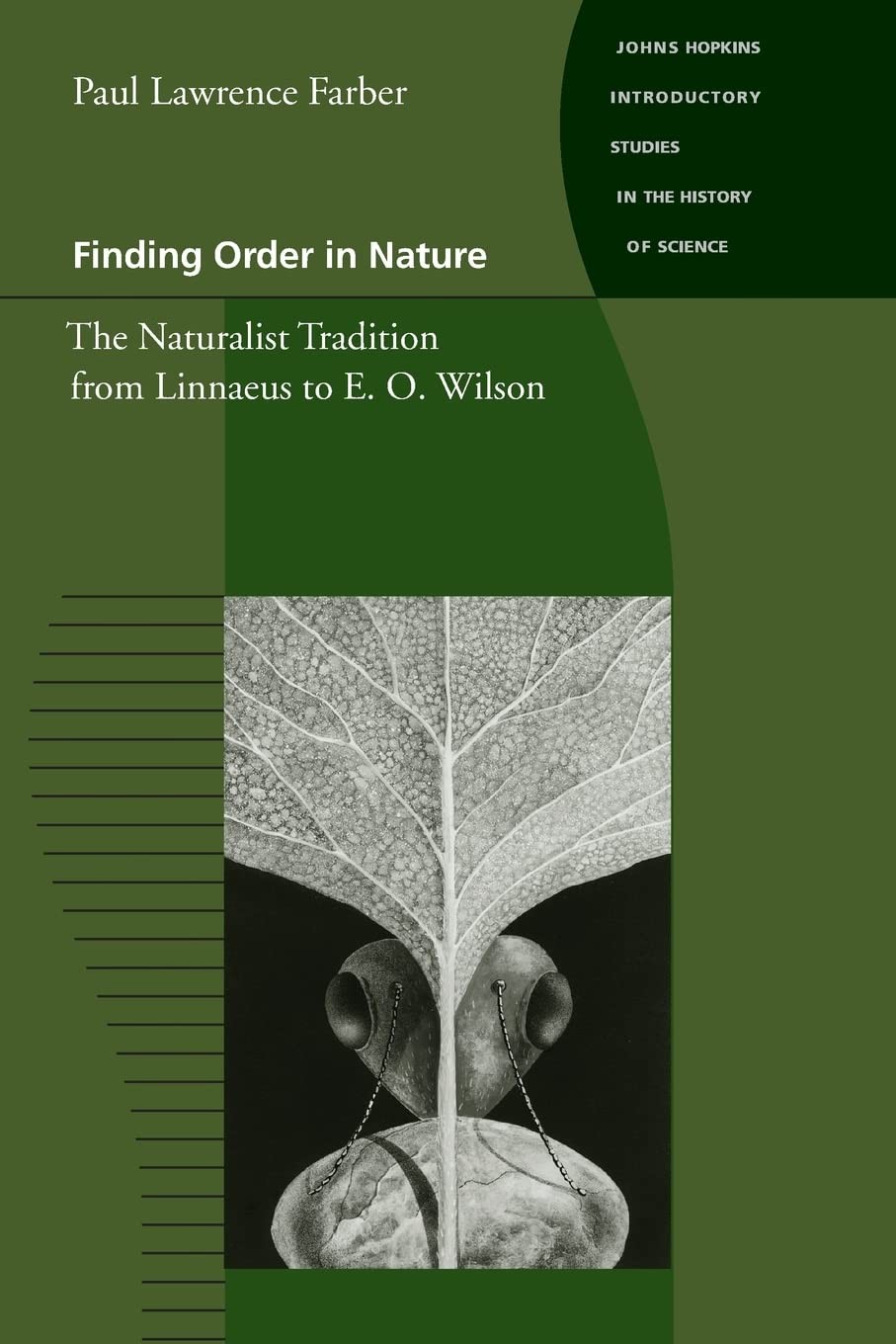
Finding Order in Nature: The Naturalist Tradition from Linnaeus to E. O. Wilson by Paul Lawrence Farber – A Definitive H
Inclusive of all applicable taxes. FREE shipping on all orders.
Available Offers
- 🚚Free Delivery — Free shipping on all orders
- 💵Cash on Delivery — Pay when your order arrives
- ↩️15-Day Easy Returns — Hassle-free return policy
- 🔒Cash on Delivery — Pay safely when your order arrives
Check Delivery
Product Description
Introduction
In an age where the natural world is both celebrated and threatened, understanding how we have come to know and organise life on Earth is more important than ever. Finding Order in Nature: The Naturalist Tradition from Linnaeus to E. O. Wilson by Paul Lawrence Farber offers a compelling journey through the history of natural history itself. This hardcover volume, published by Johns Hopkins University Press, is an essential read for Indian students, researchers, and anyone with a curiosity about the roots of modern biology. Farber masterfully traces the evolution of the naturalist tradition from the eighteenth century to the present, showing how the quest to classify and understand nature has shaped science, culture, and our very perception of life.
Book Overview
This book is not merely a chronicle of scientists and their discoveries; it is a thoughtful exploration of the ideas, motivations, and institutions that have driven the naturalist tradition. Farber examines the lives and work of key figures, from Carl Linnaeus, who created the system of binomial nomenclature, to the twentieth-century biologist E. O. Wilson, a pioneer in sociobiology and biodiversity. The narrative spans the rise of museums and zoos, the development of classification systems, and the shifting goals of collectors and explorers. Importantly, Farber situates natural history within broader social and cultural contexts, including the influence of colonialism, the role of government funding, and the changing relationship between amateur and professional scientists. The result is a rich, accessible account that reveals how natural history has remained a vibrant and practical science, central to fields as diverse as ecology, medicine, agriculture, and environmental conservation.
Key Highlights
- Comprehensive Historical Scope: Covers over 250 years of natural history, from the Enlightenment to the late twentieth century.
- Focus on Key Figures: In-depth analysis of Linnaeus, Darwin, and E. O. Wilson, among many others.
- Institutional Evolution: Explores the development of museums, botanical gardens, zoos, and universities as centres of naturalist research.
- Practical Relevance: Connects historical natural history to modern applications in ecology, agriculture, and medicine.
- Accessible Writing: Written for both general readers and students, without sacrificing scholarly depth.
Inside the Book
The book is organised into thematic chapters that trace the naturalist tradition through different eras and contexts. Early chapters focus on the eighteenth-century passion for collecting and classifying, examining how Linnaeus's system brought order to a chaotic world of specimens. Later chapters explore the impact of Darwin's theory of evolution, which transformed natural history from a descriptive science into a dynamic field focused on change and adaptation. Farber also delves into the professionalisation of natural history in the nineteenth and twentieth centuries, the rise of field biology, and the role of naturalists in conservation movements. The final chapters consider the legacy of E. O. Wilson and the continuing importance of natural history in an age of molecular biology and climate change.
Key Topics
- The rise of systematic classification and Linnaeus's legacy
- The age of exploration and the global exchange of specimens
- Natural history museums and their role in public education
- Darwin, evolution, and the rethinking of natural order
- The professionalisation of biology and the decline of amateur naturalists
- Ecology, conservation, and the modern relevance of natural history
- The interplay between science, culture, and politics in shaping naturalist work
Reader Benefits
- Deepen Your Understanding: Gain a nuanced perspective on how scientific knowledge is built and organised over time.
- Connect Past and Present: See how historical ideas continue to influence contemporary biology and environmental science.
- Enrich Your Studies: Ideal supplementary reading for courses in history of science, biology, environmental studies, and philosophy of science.
- Engage with Big Ideas: Explore themes of order, classification, and the human desire to understand the natural world.
- Expand Your Library: A well-researched, elegantly written hardcover that belongs on every serious reader's shelf.
Learning Outcomes
- Understand the major milestones in the development of natural history from the 1700s to the present.
- Analyse the contributions of key naturalists and the contexts in which they worked.
- Recognise the relationship between natural history and other life sciences, including evolution, ecology, and molecular biology.
- Evaluate the social, cultural, and political factors that have shaped scientific practice.
- Appreciate the enduring value of natural history in addressing modern environmental challenges.
Who Should Read
This book is perfect for undergraduate and postgraduate students in biology, history of science, and environmental studies. It will also appeal to teachers, researchers, and science communicators who want a deeper understanding of their field's roots. For the curious general reader in India, especially those who enjoy nature writing, exploring biodiversity, or visiting botanical gardens and museums, Finding Order in Nature offers a fascinating and accessible gateway into the stories behind the science. If you have ever wondered how we came to name, classify, and understand the living world around us, this book is for you.
About the Author
Paul Lawrence Farber is a distinguished historian of science and a professor emeritus at Oregon State University. He has written extensively on the history of natural history, evolutionary biology, and the life sciences. His works are known for their clarity, depth, and ability to bridge the gap between specialised scholarship and general readership. In Finding Order in Nature, Farber draws on decades of research to present a coherent and engaging narrative that illuminates the human side of scientific discovery.
About the Publisher
Johns Hopkins University Press is one of the oldest and most respected academic publishers in the United States. Founded in 1878, it is renowned for its high-quality scholarly books and journals in the humanities, social sciences, and sciences. This hardcover edition reflects the press's commitment to producing durable, well-edited works that serve both academic and general audiences. For Indian readers, this book represents a reliable and authoritative source on the history of natural history.
Conclusion
Finding Order in Nature is more than a history lesson; it is an invitation to see the natural world through the eyes of the great naturalists who have shaped our understanding. Paul Lawrence Farber's engaging prose and thoughtful analysis make this book a valuable addition to any library. Whether you are a student preparing for exams, a teacher designing a curriculum, or a lifelong learner with a passion for nature, this book will inspire and inform. Order your hardcover copy today from Bookshops.in and begin your journey into the fascinating tradition of natural history.
Quick Summary
Finding Order in Nature: The Naturalist Tradition from Linnaeus to E. O. Wilson by Paul Lawrence Farber is a compelling historical account of how natural history evolved from the Enlightenment to the present day. The book traces the adventures of early naturalists, the development of classification systems, the establishment of museums and zoos, and the profound influence of natural history on evolutionary theory, ecology, agriculture, and medicine. Written for both general readers and students, it shows how the naturalist tradition remains vital for understanding biodiversity and environmental science. This book is ideal for Indian students of biology, history of science, and environmental studies, as well as anyone curious about the roots of modern life sciences. By purchasing from Bookshops.in, you support a trusted Indian bookstore offering premium hardcover editions with reliable delivery and competitive pricing.
Book Highlights
Book Specifications
| ISBN-13 | 9780801863905 |
| ISBN-10 | 0801863902 |
| Publisher | Johns Hopkins Univ Pr |
| Language | English |
| Dimensions | 15.24 x 0.89 x 22.86 cm |
| Weight | 227 g |
| Country | India |
| Category | Biology & Life Sciences › Biology |
| Genre | Nonfiction |
| Original Language | English |
Frequently Asked Questions
What is Finding Order in Nature about?
Who is the author of this book?
Is this book suitable for Indian students?
What is the price of this book?
Does this book cover evolution?
Who is E. O. Wilson?
Is this a textbook?
Does it discuss Indian naturalists?
Can I use this for research?
What is the language?
Where can I buy this book in India?
Is this a new edition?
What is the ISBN?
Readers Also Search For
Customers Also Bought

Mathematics
Stereotype Spaces and Algebras: 73 (De Gruyter Expositions in Mathematics, 73)

Mathematics
Semigroups in Algebra, Geometry and Analysis: 20 (De Gruyter Expositions in Mathematics, 20)

Mathematics
Geometry from the Pacific Rim: Proceedings of the Pacific Rim Geometry Conference held at National University of Singapore, Republic of Singapore, ... 1994 (De Gruyter Proceedings in Mathematics)

Mathematics
First International Tainan-Moscow Algebra Workshop: Proceedings of the International Conference held at National Cheng Kung University Tainan, Taiwan, ... 1994 (De Gruyter Proceedings in Mathematics)

Mathematics
Differential Geometry - Proceedings of the VIII International Colloquium (English, Jesus A. Alvarez Lopez | Eduardo Garcia-Rio)

Mathematics
Mathematical Theory of Optimal Processes (Classics of Soviet Mathematics)
Related Products
View All
Biology
Evolution: What the Fossils Say and Why It Matters by Donald R. Prothero
Biology
From Taxonomy to Phylogenetics – Life and Work of Willi Hennig

Biology
The Marine Biology of the South China Sea

Biology
Genetics Meets Metabolomics: from Experiment to Systems Biology
Biology
The Elements of Natural or Experimental Philosophy: 2

Biology