
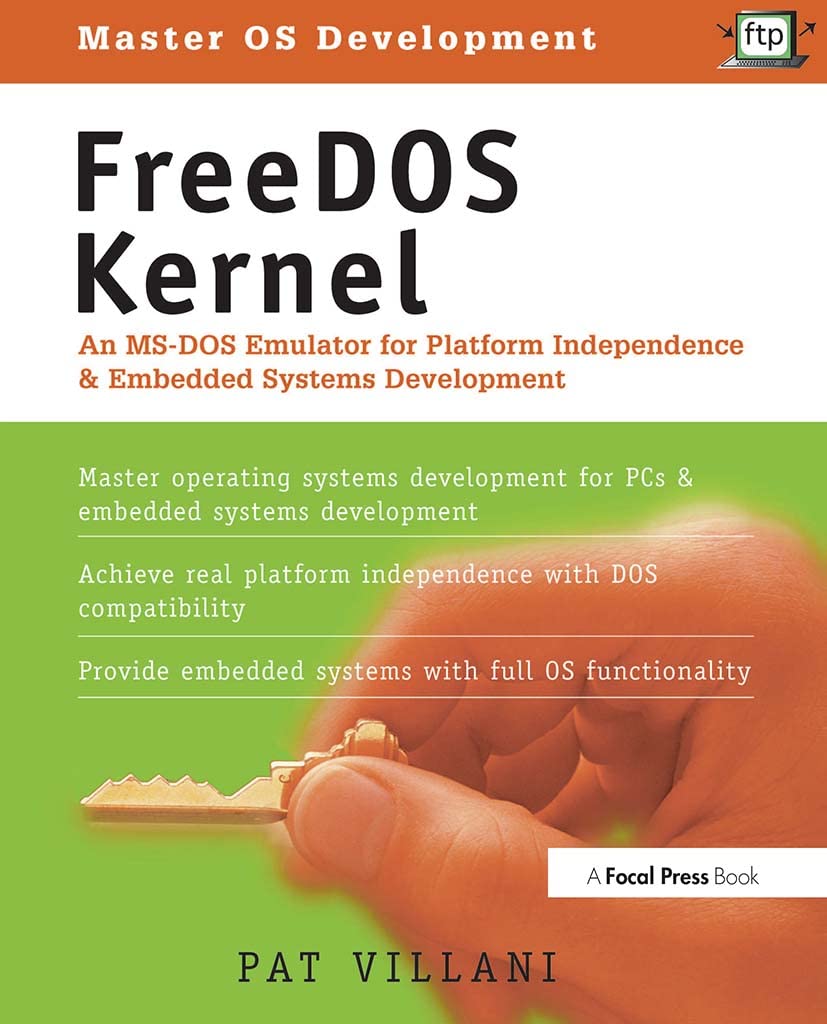
The Freedos Kernel: An MS-DOS Emulator for Platform Independence & Embedded System Development by Pat Villani – Master O
Inclusive of all applicable taxes. FREE shipping on all orders.
Available Offers
- 🚚Free Delivery — Free shipping on all orders
- 💵Cash on Delivery — Pay when your order arrives
- ↩️15-Day Easy Returns — Hassle-free return policy
- 🔒Cash on Delivery — Pay safely when your order arrives
Check Delivery
Product Description
Introduction
For Indian developers, students, and embedded systems enthusiasts seeking a deep understanding of operating system fundamentals without the complexity of modern monolithic kernels, The Freedos Kernel: An MS-DOS Emulator for Platform Independence & Embedded System Development by Pat Villani offers a rare and practical gateway. This hardcover volume from CRC Press demystifies the inner workings of a real, working operating system kernel, making it an indispensable resource for those who want to build, modify, or simply comprehend the core of DOS-compatible environments.
Book Overview
This book is a comprehensive guide to the FreeDOS kernel, known as DOS-C—a highly portable, single-threaded operating system written primarily in C. Unlike many theoretical texts, this work provides a hands-on journey through the kernel's architecture, from bootstrapping to system calls. Pat Villani, the original developer of DOS-C, takes readers through the entire construction process, explaining how the kernel emulates MS-DOS functionality while remaining platform-independent. The book is particularly valuable for embedded system developers who need a lightweight, real-time capable OS without licensing burdens.
Key Highlights
- Complete Kernel Source Code Walkthrough: Understand every critical module, from memory management to file I/O.
- Platform Independence Focus: Learn how DOS-C abstracts hardware details, enabling porting to new architectures.
- Embedded System Ready: Discover how the kernel's minimal footprint and deterministic behavior suit resource-constrained devices.
- Real-World Implementation: The book is based on Pat Villani's own production-ready kernel, not a toy example.
- MS-DOS Compatibility Insights: Grasp the design decisions behind system calls and interrupt handling.
Inside the Book
The content is structured to take you from the kernel's boot sequence through to advanced topics like device drivers and system services. Early chapters cover the kernel's initialization, memory segmentation, and process management. Mid-section chapters delve into file system support, character I/O, and timer services. Later chapters explore portability layers, assembly language interfaces, and debugging techniques. Each concept is illustrated with annotated code snippets from the actual DOS-C source, making abstract ideas concrete.
Key Topics
- Boot loading and system initialization
- Real-mode memory management and segmentation
- Interrupt handling and system call dispatch
- File system architecture (FAT support)
- Device driver framework for character and block devices
- Portability layer: abstracting CPU and platform specifics
- Single-threaded multitasking and cooperative scheduling
- Building and testing the kernel on different hardware
Reader Benefits
Indian engineering students and professionals will gain a solid, practical foundation in OS development that goes beyond textbook theory. The book's focus on a real, working kernel means you can actually compile, run, and modify the code yourself. For embedded systems engineers, the kernel's small size and low overhead make it ideal for projects like industrial controllers, IoT gateways, or retro-computing experiments. The platform-independent design also teaches transferable skills for porting any OS to new hardware.
Learning Outcomes
By the end of this book, readers will be able to: describe the complete boot process of a DOS-compatible kernel; modify and extend system calls; write custom device drivers; port the kernel to a new embedded platform; debug kernel-level code using simple tools; and understand the trade-offs between monolithic and microkernel designs. These skills are directly applicable to courses in operating systems, embedded systems, and computer architecture in Indian universities.
Who Should Read
This book is ideal for third- and fourth-year B.Tech/B.E. students in computer science or electronics engineering, especially those taking courses in operating systems or embedded systems. It also suits hobbyists and professionals working with legacy systems, retro-computing, or bare-metal programming. Developers transitioning from application-level coding to system-level programming will find the clear explanations and complete codebase a gentle yet thorough introduction.
About the Author
Pat Villani is the original author and maintainer of the FreeDOS kernel (DOS-C). With decades of experience in operating system development and embedded systems, Villani designed DOS-C to be both a practical tool and a learning platform. His hands-on approach in this book reflects his belief that the best way to understand an OS is to build one yourself.
About the Publisher
CRC Press is a globally respected publisher of technical and scientific literature, known for high-quality books in computer science, engineering, and mathematics. Their commitment to rigorous content and practical insights makes them a trusted source for students and professionals in India and worldwide.
Conclusion
The Freedos Kernel is more than a book—it is a masterclass in operating system construction. For Indian readers who want to move beyond theory and truly understand how an OS works at the kernel level, this hardcover edition from Bookshops.in is a valuable investment. Whether you are a student, a researcher, or an embedded developer, Pat Villani's clear exposition and complete code will empower you to write your own system software with confidence.
Quick Summary
The Freedos Kernel: An MS-DOS Emulator for Platform Independence & Embedded System Development by Pat Villani is a definitive technical guide for anyone interested in building a lightweight, portable operating system. The book delves into the DOS-C kernel, the core of FreeDOS, explaining its architecture, system calls, memory management, and boot process. Written primarily in C with some x86 assembly, it provides hands-on code examples that readers can compile and run. This book is ideal for Indian computer science students, embedded systems engineers, and hobbyists who want to understand low-level OS design or need a DOS-compatible environment for legacy software or custom hardware. Unlike modern multitasking kernels, this single-threaded, real-mode OS offers simplicity and clarity, making it an excellent learning tool. Readers will gain practical skills in kernel programming, device driver development, and platform-independent software engineering. By purchasing from Bookshops.in, you get a premium hardcover edition with fast delivery across India, ensuring you have a reliable reference for years to come.
Book Highlights
Book Specifications
| ISBN-13 | 9780879304362 |
| ISBN-10 | 0879304367 |
| Publisher | CRC Pr I Llc |
| Language | English |
| Dimensions | 19.1 x 1.96 x 23.5 cm |
| Weight | 590 g |
| Country | India |
| Category | C & C++ › C |
| Genre | Technology & Engineering |
| Reading Age | Adult |
| Original Language | English |
Frequently Asked Questions
What is the FreeDOS Kernel book about?
Who is the author Pat Villani?
Is this book suitable for beginners in OS development?
Does the book include source code?
What programming languages are covered?
Can I use this book for embedded system projects?
Is this book still relevant today?
How is this book different from other OS development books?
Does the book cover modern operating system features?
What hardware do I need to follow the examples?
Is there any online support or community for this book?
Can I use this book to learn about MS-DOS internals?
Where can I buy this book in India?
Does this book cover USB or modern peripherals?
Readers Also Search For
Customers Also Bought

Programming
Algorithmische Sprache Und Programmentwicklung | by H. Partsch | F. L. Bauer | P. Pepper | Springer | by H. Partsch | F. L. Bauer | P. Pepper | Springer | by H. Partsch | F. L. Bauer | P. Pepper | Springer | by H. Partsch | F. L. Bauer | P. Pepper | Springer | by H. Partsch | F. L. Bauer | P. Pepper | Springer | by H. Partsch | F. L. Bauer | P. Pepper | Springer | by H. Partsch | F. L. Bauer | P. Pepper | Springer | by H. Partsch | F. L. Bauer | P. Pepper | Springer | by H. Partsch | F. L. Bauer
Programming
Distributed Algorithms | by Jean-Claude Bermond | Michel Raynal | Springer | by Jean-Claude Bermond | Michel Raynal | Springer | by Jean-Claude Bermond | Michel Raynal | Springer | by Jean-Claude Bermond | Michel Raynal | Springer | by Jean-Claude Bermond | Michel Raynal | Springer | by Jean-Claude Bermond | Michel Raynal | Springer | by Jean-Claude Bermond | Michel Raynal | Springer | by Jean-Claude Bermond | Michel Raynal | Springer | by Jean-Claude Bermond | Michel Raynal | Springer | by Jean
Programming
Meta-Level Control for Deductive Database Systems | by Helmut Schmidt | Springer | by Helmut Schmidt | Springer | by Helmut Schmidt | Springer | by Helmut Schmidt | Springer | by Helmut Schmidt | Springer | by Helmut Schmidt | Springer | by Helmut Schmidt | Springer | by Helmut Schmidt | Springer | by Helmut Schmidt | Springer | by Helmut Schmidt | Springer | by Helmut Schmidt | Springer | by Helmut Schmidt | Springer | by Helmut Schmidt | Springer | by Helmut Schmidt | Springer | by Helmut Schm
Programming
Java Web Services | by David A. Chappell | Tyler Jewell | O'Reilly Media | by David A. Chappell | Tyler Jewell | O'Reilly Media | by David A. Chappell | Tyler Jewell | O'Reilly Media | by David A. Chappell | Tyler Jewell | O'Reilly Media | by David A. Chappell | Tyler Jewell | O'Reilly Media | by David A. Chappell | Tyler Jewell | O'Reilly Media | by David A. Chappell | Tyler Jewell | O'Reilly Media | by David A. Chappell | Tyler Jewell | O'Reilly Media | by David A. Chappell | Tyler Jewell | O'
Programming
Database in Depth | by Chris J. Date | O'Reilly Media | by Chris J. Date | O'Reilly Media | by Chris J. Date | O'Reilly Media | by Chris J. Date | O'Reilly Media | by Chris J. Date | O'Reilly Media | by Chris J. Date | O'Reilly Media | by Chris J. Date | O'Reilly Media | by Chris J. Date | O'Reilly Media | by Chris J. Date | O'Reilly Media | by Chris J. Date | O'Reilly Media | by Chris J. Date | O'Reilly Media | by Chris J. Date | O'Reilly Media | by Chris J. Date | O'Reilly Media | by Chris J.

Programming
Integration of AI and OR Techniques in Constraint Programming for Combinatorial Optimization Problem | by Nicolas Beldiceanu | Narendra Jussien | Eric Pinson | Springer | by Nicolas Beldiceanu | Narendra Jussien | Eric Pinson | Springer | by Nicolas Beldiceanu | Narendra Jussien | Eric Pinson | Springer | by Nicolas Beldiceanu | Narendra Jussien | Eric Pinson | Springer | by Nicolas Beldiceanu | Narendra Jussien | Eric Pinson | Springer | by Nicolas Beldiceanu | Narendra Jussien | Eric Pinson |
Related Products
View All
Computers & Internet
Modern Full-Stack React Projects by Daniel Bugl
Computers & Internet
Mootools 1.2 Beginner's Guide (English, Jacob Gube)

Computers & Internet
Contemporary Methods for Speech Parameterization (Springerbriefs in Electrical and Computer Engineering / Springerbriefs in Speech Technology)

Computers & Internet
Information Technology and Lawyers | by Arno R. Lodder | Anja Oskamp | Springer | by Arno R. Lodder | Anja Oskamp | Springer | by Arno R. Lodder | Anja Oskamp | Springer | by Arno R. Lodder | Anja Oskamp | Springer | by Arno R. Lodder | Anja Oskamp | Springer | by Arno R. Lodder | Anja Oskamp | Springer | by Arno R. Lodder | Anja Oskamp | Springer | by Arno R. Lodder | Anja Oskamp | Springer | by Arno R. Lodder | Anja Oskamp | Springer | by Arno R. Lodder | Anja Oskamp | Springer | by Arno R. Lo

Computers & Internet
Digital Analysis of Remotely Sensed Imagery | by Jay Gao | McGraw-Hill Companies | by Jay Gao | McGraw-Hill Companies | by Jay Gao | McGraw-Hill Companies | by Jay Gao | McGraw-Hill Companies | by Jay Gao | McGraw-Hill Companies | by Jay Gao | McGraw-Hill Companies | by Jay Gao | McGraw-Hill Companies | by Jay Gao | McGraw-Hill Companies | by Jay Gao | McGraw-Hill Companies | by Jay Gao | McGraw-Hill Companies | by Jay Gao | McGraw-Hill Companies | by Jay Gao | McGraw-Hill Companies | by Jay Gao
Computers & Internet