
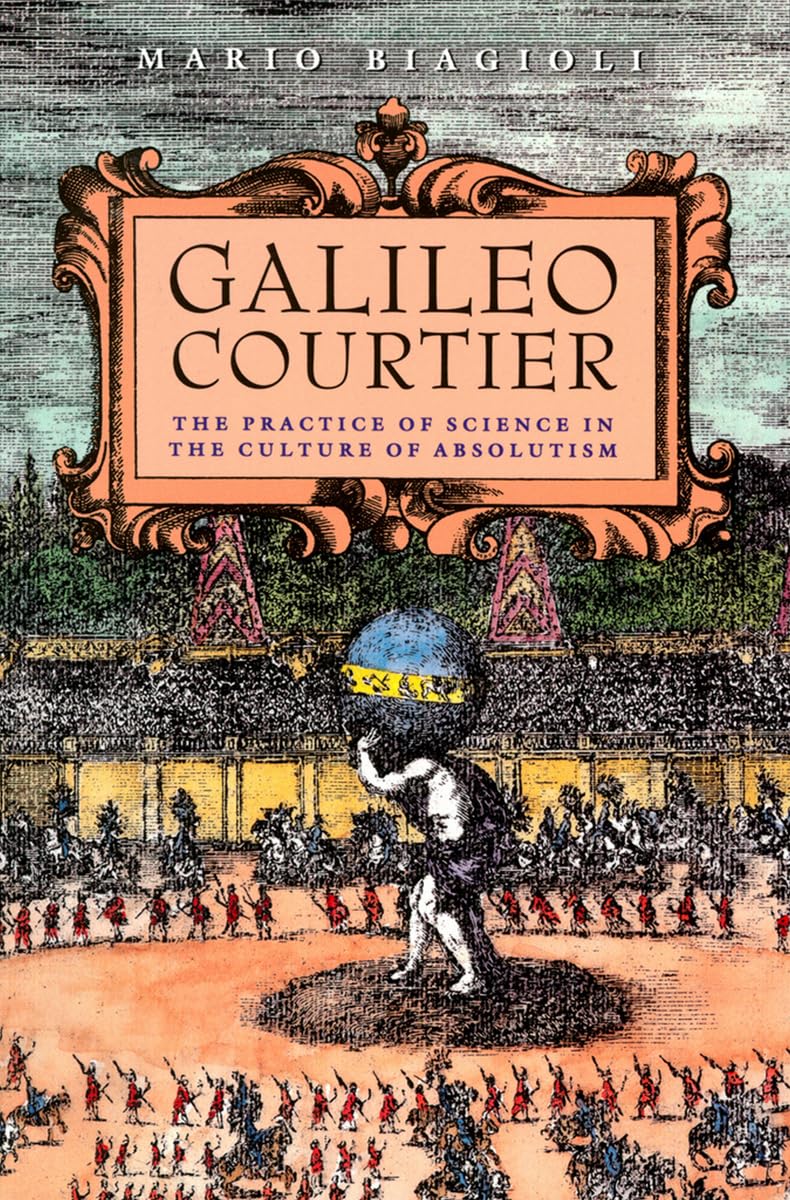
Galileo, Courtier: The Practice of Science in the Culture of Absolutism by Mario Biagioli – A Cultural History of Scienc
Inclusive of all applicable taxes. FREE shipping on all orders.
Available Offers
- 🚚Free Delivery — Free shipping on all orders
- 💵Cash on Delivery — Pay when your order arrives
- ↩️15-Day Easy Returns — Hassle-free return policy
- 🔒Cash on Delivery — Pay safely when your order arrives
Check Delivery
Product Description
Introduction
In the annals of scientific history, Galileo Galilei stands as a towering figure—the father of modern astronomy, a champion of heliocentrism, and a martyr to intellectual freedom. Yet, what if the story of his genius was also a story of courtly ambition, patronage, and political maneuvering? Mario Biagioli’s Galileo, Courtier: The Practice of Science in the Culture of Absolutism offers a groundbreaking reinterpretation of Galileo’s life and work. This is not a conventional biography or a dry history of science; it is a vivid cultural and social history that places Galileo squarely within the glittering, treacherous world of Renaissance courts. For Indian readers and students of history, sociology, or science studies, this book provides a fresh lens through which to understand how power, prestige, and patronage shaped the very fabric of scientific discovery.
Book Overview
Published by the University of Chicago Press, this hardcover volume challenges the traditional image of Galileo as a solitary genius battling dogma. Instead, Biagioli argues that Galileo’s career and science were intimately tied to the demands of courtly patronage—first under the Medici in Florence and later at the Vatican. Drawing on currents from sociology, cultural anthropology, and literary theory, the book reveals how Galileo fashioned his persona, chose his research questions, and presented his findings to appeal to powerful patrons. The court was not merely a backdrop but an active shaper of scientific practice. From the invention of the telescope to the infamous trial, Galileo’s story is reimagined as a masterclass in navigating the politics of absolutism, where credibility, status, and survival depended on pleasing princes and cardinals.
Key Highlights
- A Fresh Perspective: Moves beyond hagiography to reveal Galileo as a strategic courtier who used science as a tool for social advancement.
- Interdisciplinary Approach: Merges history of science with sociology, anthropology, and literary analysis, making it accessible to a wide academic audience.
- Rich Historical Context: Explores the culture of absolutism in 17th-century Italy, including the roles of the Medici court and the Vatican bureaucracy.
- Patronage as Practice: Demonstrates how the system of patronage influenced not just Galileo’s career but the very content and method of his scientific work.
- Critical Reception: Widely acclaimed as a seminal work in science studies, offering a model for analyzing the social dimensions of knowledge production.
Inside the Book
The book is structured around key episodes in Galileo’s life, each examined through the lens of court culture. Biagioli begins by analyzing Galileo’s rise at the Medici court, where he strategically dedicated his discoveries to the Grand Duke to secure patronage. He then explores the construction of Galileo’s scientific persona—how he presented himself as a philosopher, mathematician, and loyal servant. The middle chapters delve into the politics of the telescope, the controversy over sunspots, and the delicate negotiations with the Catholic Church. The final sections address Galileo’s trial, not as a simple conflict between science and religion, but as a clash of courtly protocols and theological authority. Throughout, Biagioli uses primary sources such as letters, dedications, and official documents to reconstruct the intricate social networks that sustained Galileo’s work.
Key Topics
- Patronage and its impact on scientific practice in early modern Europe
- The culture of absolutism and its influence on intellectual life
- Galileo’s strategic use of rhetoric, self-fashioning, and courtly etiquette
- The relationship between scientific credibility and social status
- The role of gift-giving, dedications, and public demonstrations in building scientific authority
- The Galileo affair reinterpreted as a breakdown of courtly negotiations
Reader Benefits
- Gain a deeper understanding of how social context shapes scientific knowledge—a lesson relevant to contemporary debates on science and politics.
- Learn to analyze historical figures not as isolated geniuses but as products of their cultural and institutional environments.
- Enhance your critical thinking by exploring the intersection of power, knowledge, and representation.
- Appreciate the complexity of Galileo’s legacy beyond the simplistic hero-versus-church narrative.
Learning Outcomes
By reading this book, you will be able to: identify the key features of early modern court culture and their impact on scientific practice; evaluate the role of patronage in shaping research agendas and public presentations of science; critically assess traditional narratives of scientific progress; and apply sociological and anthropological frameworks to historical case studies. This book is particularly valuable for students preparing for examinations or research in history of science, sociology of knowledge, Renaissance studies, or cultural history.
Who Should Read
- Students and scholars of history of science, sociology, and cultural anthropology
- Indian university students pursuing courses in modern European history or science and technology studies
- Readers interested in the social dimensions of scientific discovery
- Anyone curious about the real-life politics behind Galileo’s famous battles with the Church
- Book club members looking for a thought-provoking, interdisciplinary work
About the Author
Mario Biagioli is a distinguished professor of law and science studies at the University of California, Los Angeles. His research spans the history of early modern science, intellectual property, and the sociology of knowledge. Biagioli is known for his innovative use of cultural theory to reinterpret canonical figures like Galileo, and his work has influenced fields ranging from legal studies to art history. Galileo, Courtier won the prestigious History of Science Society’s Pfizer Award, cementing his reputation as a leading voice in the field.
About the Publisher
The University of Chicago Press is one of the oldest and most respected academic publishers in the world. Founded in 1890, it is renowned for its rigorous editorial standards and its contributions to scholarship across disciplines, including science, history, and the humanities. This hardcover edition reflects the Press’s commitment to producing durable, beautifully designed books that stand the test of time—perfect for Indian readers who value quality in their personal libraries.
Conclusion
Galileo, Courtier: The Practice of Science in the Culture of Absolutism is a must-read for anyone seeking to understand the messy, human reality behind scientific discovery. By revealing how Galileo’s brilliance was inseparable from his courtly ambitions, Mario Biagioli offers a nuanced portrait that is both intellectually stimulating and deeply relevant to our own age of institutional power and media spectacle. Whether you are a student, a researcher, or a curious reader, this book will transform how you think about science, history, and the enduring dance between knowledge and authority. Add it to your collection today and see Galileo as you have never seen him before.
Quick Summary
'Galileo, Courtier: The Practice of Science in the Culture of Absolutism' by Mario Biagioli is a groundbreaking work that reimagines Galileo Galilei not merely as a scientist but as a courtier navigating the complex worlds of the Medici and Vatican courts. Drawing on sociology, cultural anthropology, and literary theory, Biagioli argues that Galileo's science was profoundly shaped by the patronage system—influencing the questions he pursued, his methods, and even his conclusions. This book is for advanced students and scholars in history of science, sociology, and cultural studies who seek to understand how power, credibility, and social networks drive scientific knowledge. Readers will learn to see science as a deeply social and political practice. By purchasing from Bookshops.in, you support a premium Indian bookstore that offers authentic imported editions with fast delivery across India.
Book Highlights
Book Specifications
| ISBN-13 | 9780226045603 |
| ISBN-10 | 0226045609 |
| Publisher | Univ of Chicago Pr |
| Language | English |
| Dimensions | 23.06 x 15.39 x 2.36 cm |
| Weight | 567 g |
| Country | India |
| Category | Science & Mathematics › Physics |
| Genre | Nonfiction |
| Reading Age | Adult |
| Original Language | English |
Frequently Asked Questions
What is 'Galileo, Courtier' about?
Who is the author of this book?
Is this book a biography of Galileo?
What disciplines does this book draw on?
Why is the book titled 'Galileo, Courtier'?
What time period does the book cover?
Is this book suitable for Indian students?
What is the main argument of the book?
Does the book discuss Galileo's conflict with the Church?
What makes this book different from other Galileo studies?
What is the ISBN-13?
Is the book available in hardcover?
Can I buy this book from Bookshops.in?
Readers Also Search For
Customers Also Bought
Mathematics
Stereotype Spaces and Algebras: 73 (De Gruyter Expositions in Mathematics, 73)
Mathematics
Semigroups in Algebra, Geometry and Analysis: 20 (De Gruyter Expositions in Mathematics, 20)

Mathematics
Geometry from the Pacific Rim: Proceedings of the Pacific Rim Geometry Conference held at National University of Singapore, Republic of Singapore, ... 1994 (De Gruyter Proceedings in Mathematics)
Mathematics
First International Tainan-Moscow Algebra Workshop: Proceedings of the International Conference held at National Cheng Kung University Tainan, Taiwan, ... 1994 (De Gruyter Proceedings in Mathematics)
Mathematics
Differential Geometry - Proceedings of the VIII International Colloquium (English, Jesus A. Alvarez Lopez | Eduardo Garcia-Rio)

Mathematics
Mathematical Theory of Optimal Processes (Classics of Soviet Mathematics)
Related Products
View All
Physics
The Quantum and Cosmic Codes of the Universe
Physics
Physics for You by Keith Johnson – GCSE Physics Textbook
Physics
Experimental Techniques in Nuclear Physics
Physics
Essential Physics I

Physics
Modern Foundations of Quantum Optics
Physics