
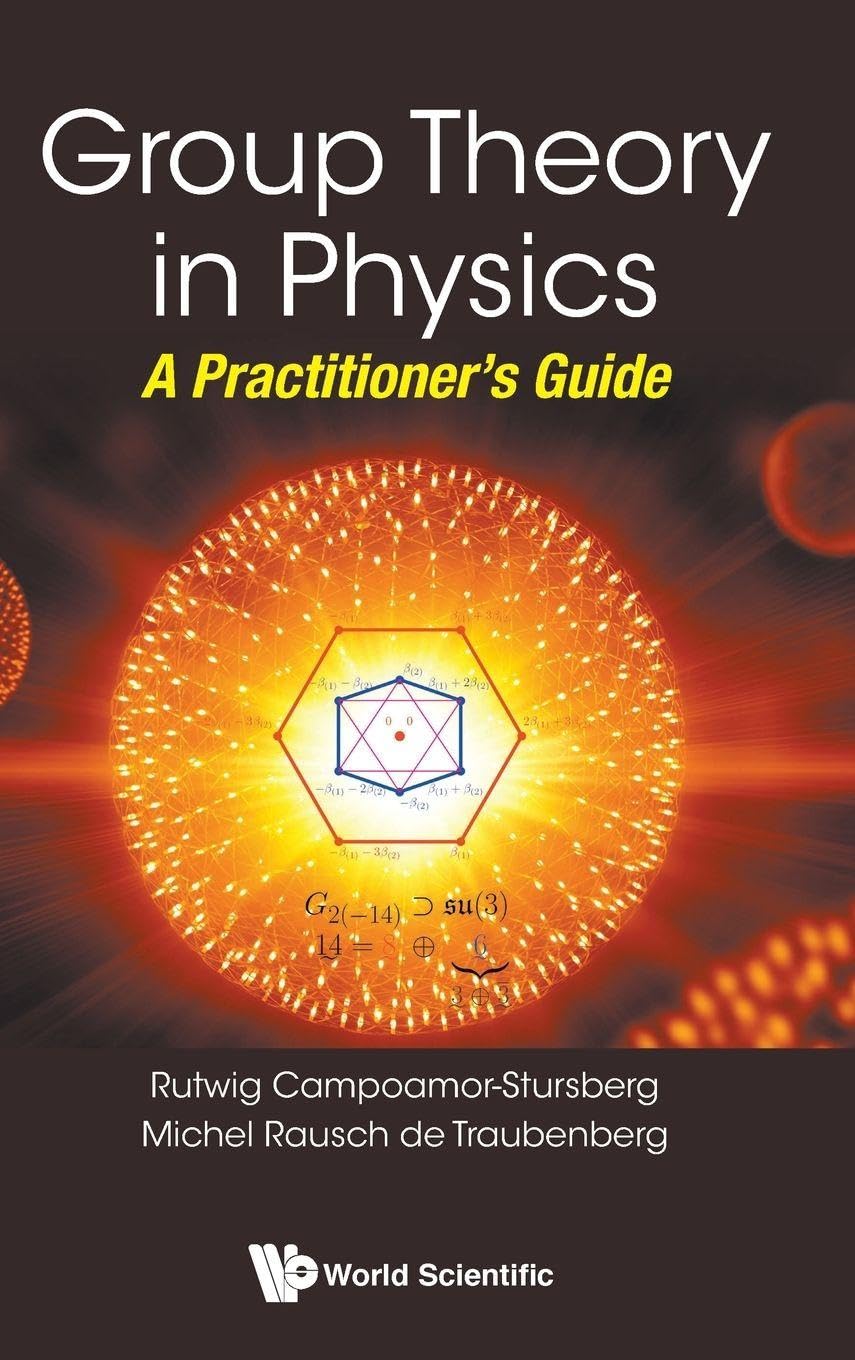
Group Theory In Physics: A Practitioner's Guide by R. Campoamor Strursberg – A Practical Approach to Symmetry Groups, Li
Inclusive of all applicable taxes. FREE shipping on all orders.
Available Offers
- 🚚Free Delivery — Free shipping on all orders
- 💵Cash on Delivery — Pay when your order arrives
- ↩️15-Day Easy Returns — Hassle-free return policy
- 🔒Cash on Delivery — Pay safely when your order arrives
Check Delivery
Product Description
Introduction
For students and researchers navigating the intricate world of theoretical physics, symmetry is not just a concept—it is a fundamental tool that unlocks the deepest laws of nature. Group Theory In Physics: A Practitioner's Guide by R. Campoamor Strursberg offers a refreshingly hands-on approach to this essential subject. Published by the prestigious World Scientific Publishing Company, this hardcover edition is crafted for those who want to move beyond abstract definitions and learn how to actually apply group theory to real physical problems. Whether you are preparing for advanced research or teaching a graduate course, this book serves as a reliable companion that bridges the gap between pure mathematics and practical physics.
Book Overview
This comprehensive volume is structured to take the reader from foundational algebraic and topological concepts all the way to advanced applications in relativistic quantum mechanics. The first half of the book systematically reviews the algebraic, geometrical, and topological ideas that underpin Lie groups, while also providing a thorough refresher on the representation theory of finite groups. What sets this guide apart is its unique treatment of Lie algebras through the lens of realizations—a perspective that makes explicit computations far more accessible. The second half is dedicated entirely to physics applications, divided into three major sections: space-time symmetries, the Wigner method for representations, and applications to relativistic wave equations. Throughout, the authors emphasise explicit methods and algorithms, ensuring that the reader gains practical computational skills alongside theoretical understanding.
Key Highlights
- Practical Focus: Designed for the working physicist, with step-by-step algorithms and explicit computational techniques.
- Rich in Examples: Hundreds of worked examples illustrate every major concept, making abstract ideas tangible.
- Non-Standard Material: Includes topics often omitted from other textbooks, such as realizations of Lie algebras and detailed treatments of space-time symmetries.
- Balanced Approach: Avoids cumbersome calculations while still providing rigorous mathematical depth.
- Authoritative Publisher: Published by World Scientific, a leading academic publisher known for high-quality science titles.
Inside the Book
The journey begins with a review of essential algebraic structures—groups, vector spaces, and algebras—before moving into topological and geometrical preliminaries. Readers will then dive into the representation theory of finite groups, complete with character tables and orthogonality relations. The core of the first half is devoted to Lie groups and Lie algebras, where the concept of realizations is introduced to simplify computations. The second half opens with a detailed study of space-time symmetries, including the Poincaré group and its representations. The Wigner method is explained in depth, followed by its application to relativistic wave equations such as the Dirac, Klein-Gordon, and Proca equations. The book also covers induced representations, little groups, and the classification of elementary particles according to symmetry principles. Each chapter concludes with a set of exercises that reinforce the material and encourage independent exploration.
Key Topics
- Algebraic, geometrical, and topological foundations of group theory
- Representation theory of finite groups and character tables
- Lie groups and Lie algebras: structure, classification, and realizations
- Space-time symmetries: the Poincaré group and Lorentz group
- Wigner's method for unitary representations of the Poincaré group
- Relativistic wave equations: Dirac, Klein-Gordon, Proca, and Rarita-Schwinger
- Induced representations and little groups
- Symmetry in quantum mechanics and particle physics
Reader Benefits
By working through this guide, readers will gain the confidence to tackle complex problems in theoretical physics that require a mastery of symmetry groups. The practical orientation means you will not just understand the theory—you will be able to compute representations, derive wave equations, and classify states using group-theoretic methods. The book's emphasis on realizations and explicit algorithms reduces the learning curve, making it ideal for self-study. Moreover, the inclusion of non-standard material prepares you for advanced research topics that are often missing from conventional curricula. Whether you are solving problems in quantum field theory, condensed matter physics, or string theory, the skills you develop here will prove invaluable.
Learning Outcomes
- Master the algebraic and topological concepts necessary for understanding Lie groups and Lie algebras.
- Apply representation theory of finite groups to physical systems with discrete symmetries.
- Compute with Lie algebras using the method of realizations for explicit calculations.
- Analyze space-time symmetries using the Poincaré group and its representations.
- Use the Wigner method to construct unitary irreducible representations of the Poincaré group.
- Derive and solve relativistic wave equations from symmetry principles.
- Classify elementary particles and fields based on their transformation properties.
Who Should Read
This book is ideally suited for graduate students in physics who have completed a foundational course in quantum mechanics and are beginning their study of advanced topics such as quantum field theory or particle physics. It is also an excellent resource for researchers and practicing physicists who need a practical reference for group-theoretic methods in their daily work. Additionally, advanced undergraduate students with a strong background in linear algebra and abstract algebra will find the book accessible and rewarding. Instructors looking for a textbook that balances mathematical rigor with hands-on applications will appreciate its clear structure and abundant examples. The book is particularly valuable for Indian students preparing for competitive exams or research careers in theoretical physics, as it covers both foundational and contemporary material in a single volume.
About the Author
R. Campoamor Strursberg is a respected mathematician and physicist known for his contributions to the theory of Lie algebras and their applications in physics. With a career spanning several decades, he has published extensively on symmetry groups, representation theory, and mathematical physics. His teaching experience is evident in the clarity and pedagogical flow of this book, which distills complex ideas into digestible lessons. He has collaborated with leading researchers worldwide and is recognised for his ability to make advanced topics accessible to students and practitioners alike.
About the Publisher
World Scientific Publishing Company is a premier academic publisher headquartered in Singapore, with a strong global presence. Renowned for its high-quality titles in science, technology, and medicine, World Scientific has been a trusted name among researchers, educators, and students for over four decades. Their commitment to excellence ensures that every book, including this one, meets rigorous editorial and production standards. For Indian readers, World Scientific books are widely available through quality bookstores like Bookshops.in, offering reliable access to world-class academic resources.
Conclusion
Group Theory In Physics: A Practitioner's Guide is more than just a textbook—it is a toolkit for anyone serious about applying symmetry principles to physical problems. With its unique blend of theoretical depth and practical methodology, this hardcover edition deserves a place on the shelf of every aspiring and established physicist. Whether you are a student in an Indian university or a researcher at a national institute, this guide will empower you to harness the power of group theory in your own work. Order your copy today from Bookshops.in and take a decisive step toward mastering the mathematics that shapes our understanding of the universe.
Quick Summary
Group Theory In Physics: A Practitioner's Guide by R. Campoamor Strursberg is a meticulously crafted textbook designed for graduate students and researchers who need to apply group theory to real physics problems. Unlike many abstract treatments, this book emphasizes explicit methods, algorithms, and a wealth of examples that make the subject accessible and immediately useful. The first half builds a solid foundation in algebraic, geometric, and topological concepts, including a thorough review of finite group representation theory. The second half dives into Lie algebras with a focus on realizations—a practical approach that enables readers to perform explicit computations within Lie groups. Readers will learn how symmetry groups underpin quantum mechanics, particle physics, and other areas, gaining skills in representation theory and computational techniques. Published by the renowned World Scientific, this hardcover edition is a durable addition to any academic library. By choosing Bookshops.in, Indian customers receive a genuine, high-quality copy with reliable delivery. Whether you are a physicist, mathematician, or advanced student, this book will transform your understanding and application of group theory in physics.
Book Highlights
Book Specifications
| ISBN-13 | 9789813273603 |
| ISBN-10 | 9813273607 |
| Publisher | World Scientific Publishing Co Pte Ltd |
| Language | English |
| Dimensions | 15.24 x 3.96 x 22.86 cm |
| Weight | 1 kg 200 g |
| Category | Science & Mathematics › Mathematics |
| Genre | Science & Mathematics |
| Original Language | English |
Frequently Asked Questions
What is Group Theory In Physics: A Practitioner's Guide about?
Who is the author of this book?
Is this book suitable for beginners in group theory?
What topics are covered in the book?
How is this book different from other group theory textbooks?
What is the ISBN of this book?
What is the price of the book in India?
Is this book available at Bookshops.in?
Does the book include exercises?
Can this book be used for a graduate course?
What is the language of the book?
What is the rating of this book?
Readers Also Search For
Customers Also Bought
Mathematics
Stereotype Spaces and Algebras: 73 (De Gruyter Expositions in Mathematics, 73)
Mathematics
Semigroups in Algebra, Geometry and Analysis: 20 (De Gruyter Expositions in Mathematics, 20)
Mathematics
Geometry from the Pacific Rim: Proceedings of the Pacific Rim Geometry Conference held at National University of Singapore, Republic of Singapore, ... 1994 (De Gruyter Proceedings in Mathematics)
Mathematics
First International Tainan-Moscow Algebra Workshop: Proceedings of the International Conference held at National Cheng Kung University Tainan, Taiwan, ... 1994 (De Gruyter Proceedings in Mathematics)
Mathematics
Differential Geometry - Proceedings of the VIII International Colloquium (English, Jesus A. Alvarez Lopez | Eduardo Garcia-Rio)
Mathematics
Mathematical Theory of Optimal Processes (Classics of Soviet Mathematics)
Related Products
View AllMathematics
Stereotype Spaces and Algebras: 73 (De Gruyter Expositions in Mathematics, 73)
Mathematics
Semigroups in Algebra, Geometry and Analysis: 20 (De Gruyter Expositions in Mathematics, 20)
Mathematics
Geometry from the Pacific Rim: Proceedings of the Pacific Rim Geometry Conference held at National University of Singapore, Republic of Singapore, ... 1994 (De Gruyter Proceedings in Mathematics)
Mathematics
First International Tainan-Moscow Algebra Workshop: Proceedings of the International Conference held at National Cheng Kung University Tainan, Taiwan, ... 1994 (De Gruyter Proceedings in Mathematics)
Mathematics
Differential Geometry - Proceedings of the VIII International Colloquium (English, Jesus A. Alvarez Lopez | Eduardo Garcia-Rio)
Mathematics