
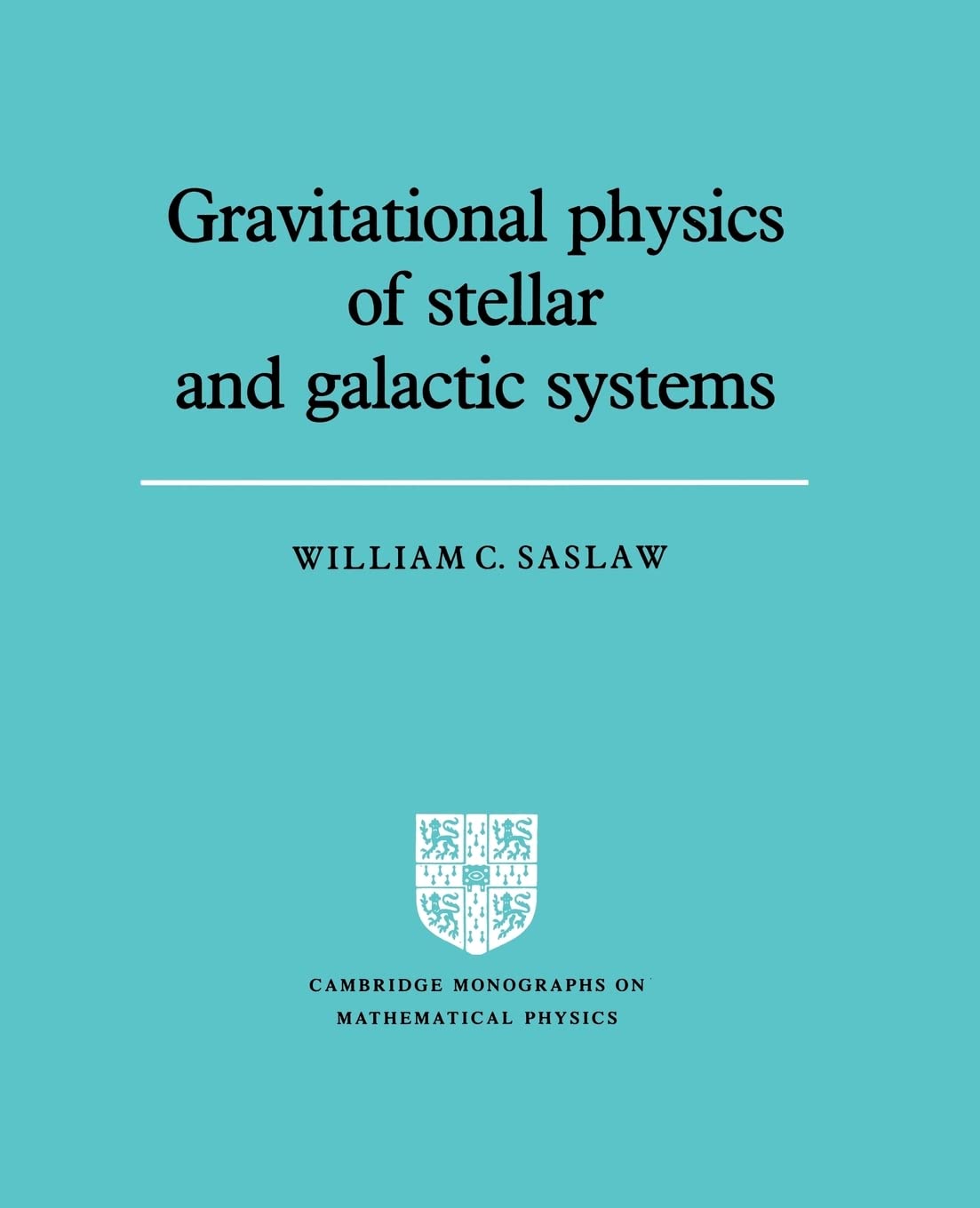
Gravitational Physics of Stellar Systems: A Comprehensive Treatise on Astronomical Dynamics and Galaxy Evolution by Will
Inclusive of all applicable taxes. FREE shipping on all orders.
Available Offers
- 🚚Free Delivery — Free shipping on all orders
- 💵Cash on Delivery — Pay when your order arrives
- ↩️15-Day Easy Returns — Hassle-free return policy
- 🔒Cash on Delivery — Pay safely when your order arrives
Check Delivery
Product Description
Introduction
For students and researchers delving into the intricate dance of celestial bodies, Gravitational Physics of Stellar Systems by William C. Saslaw offers an authoritative and comprehensive guide. Published by Cambridge University Press, this hardcover volume is a cornerstone text for understanding how gravity shapes the cosmos—from small star clusters to the vast architecture of galaxies and the Universe itself. Designed for graduate-level study, it bridges theoretical physics with observational astronomy, making it an indispensable resource for Indian academics and astronomy enthusiasts.
Book Overview
This book is the first comprehensive treatise on gravitational interactions in stellar systems since the early 1960s. It systematically explores the physics that governs the formation, stability, and evolution of astronomical structures across all scales. Saslaw’s approach is self-contained: most results are derived step-by-step, ensuring readers build a solid conceptual foundation. The text emphasizes physical intuition behind the mathematics, making complex ideas accessible. With nearly 300 references and numerous exercises, it serves both as a classroom textbook and a research companion.
Key Highlights
- Comprehensive Scope: Covers everything from small groups of stars to galaxy clusters and the Universe.
- Self-Contained Derivation: Most equations and results are derived from preceding ones, aiding deep understanding.
- Physics-First Approach: Focuses on the physical meaning behind mathematical formalism.
- Extensive Bibliography: Nearly 300 selected references guide further exploration.
- Research-Oriented: Includes exercises and suggestions for original research topics.
Inside the Book
The text is organized to build knowledge progressively. It begins with basic gravitational dynamics of point masses and extends to statistical mechanics of stellar systems, relaxation processes, and tidal interactions. Later chapters tackle galaxy formation, clustering, and large-scale structure. Each chapter weaves together analytical methods, numerical simulations, and observational data. The exercises are designed to test comprehension and inspire independent thinking, making it ideal for Indian universities offering advanced courses in astrophysics.
Key Topics
- Gravitational N-body problems and their applications
- Statistical mechanics of self-gravitating systems
- Dynamical friction, relaxation, and violent relaxation
- Stability of stellar systems and galaxy formation
- Clustering of galaxies and large-scale structure
- Cosmological implications of gravitational interactions
Reader Benefits
Readers will gain a rigorous, physics-based understanding of how gravity organizes matter in the Universe. The book’s self-contained nature reduces dependence on external references, saving time for busy graduate students and researchers. The clear derivations and physical insights help bridge the gap between classroom theory and cutting-edge research. For Indian students preparing for competitive exams or research careers in astronomy, this book provides a solid foundation in gravitational astrophysics.
Learning Outcomes
- Master the mathematical tools for analyzing gravitational systems
- Understand the statistical behavior of stellar clusters and galaxies
- Apply physical principles to interpret observational data
- Develop skills to formulate and solve research problems in astrophysics
- Gain familiarity with classical and modern results in gravitational dynamics
Who Should Read
This book is essential for graduate students in physics and astronomy, especially those specializing in astrophysics, cosmology, or celestial mechanics. It is also valuable for advanced undergraduates with a strong background in classical mechanics and mathematics. Researchers in related fields—such as planetary science or statistical physics—will find the methods transferable. Indian institutions offering MSc or PhD programs in astronomy will benefit from adopting this as a core text.
About the Author
William C. Saslaw is a distinguished astrophysicist known for his pioneering work on gravitational dynamics and galaxy clustering. A professor at the University of Virginia, he has contributed extensively to the statistical mechanics of self-gravitating systems. His research spans from stellar dynamics to cosmology, and his teaching experience informs the clarity and depth of this book.
About the Publisher
Cambridge University Press is one of the world’s oldest and most respected academic publishers, with a strong tradition in science and mathematics. Their titles are known for rigorous peer review and high editorial standards. This hardcover edition reflects the quality and durability expected by serious scholars.
Conclusion
Gravitational Physics of Stellar Systems is a masterful synthesis of theory and application, ideal for anyone seeking a deep understanding of cosmic dynamics. Whether you are a student in an Indian university, a researcher, or a dedicated amateur, this book will elevate your grasp of how gravity sculpts the Universe. Order your copy from Bookshops.in today and add this classic to your library.
Quick Summary
Gravitational Physics of Stellar Systems by William C. Saslaw is a classic graduate-level treatise that systematically explores the gravitational interactions and evolution of astronomical systems across all scales—from small stellar groups to galaxies and clusters. Published by Cambridge University Press, this self-contained volume derives most results from first principles, emphasizing the physical meaning behind mathematical formulations. It includes numerous exercises and research suggestions, making it ideal for students and researchers in astronomy and astrophysics. Readers will gain a deep understanding of stellar dynamics, galaxy formation, gravitational instability, and N-body simulations. This hardcover edition is a durable addition to any academic library. Indian students and professionals will find it invaluable for coursework and research. Order your copy from Bookshops.in, India’s trusted online bookstore for premium academic titles.
Book Highlights
Book Specifications
| ISBN-13 | 9780521349758 |
| ISBN-10 | 0521349753 |
| Publisher | Cambridge University Press (South Africa) |
| Language | English |
| Dimensions | 19.05 x 2.92 x 23.5 cm |
| Weight | 870 g |
| Country | India |
| Category | Reference › Library & Information Science |
| Genre | Non-fiction |
| Original Language | English |
Frequently Asked Questions
What is the main subject of this book?
Who is the author of the book?
Is this book suitable for beginners?
Does the book include exercises?
Which publisher released this book?
What is the ISBN-13?
Is this a hardcover edition?
What language is the book in?
Can Indian students use this book?
Does the book cover galaxy clusters?
Are references provided?
What is the price in INR?
How is this book different from other astrophysics texts?
Readers Also Search For
Customers Also Bought

Related Products
View All![Buy Language in the Context of Use: Discourse and Cognitive Approaches to Language: 37 (Cognitive Linguistics Research [CLR], 37) — BookShops.in](/book-covers/language-in-the-context-of-use-english-andrea-tyler-or-yiyoung-kim-or-mari-takad-img-0.jpg)
Reference
Language in the Context of Use: Discourse and Cognitive Approaches to Language: 37 (Cognitive Linguistics Research [CLR], 37)
Reference
Elements Of Fractional Distillation
Reference
Oxford Handbook of the Septuagint by Law Salvesen – Biblical Studies

Reference
Retellings: The Bible in Literature, Music, Art and Film

Reference
Aviation English as a Global Lingua Franca (Elements in Applied Linguistics)
Reference